


Likes
Comments
Share


Likes
4
Share


@Gorey
Follow
mid next week it will be the harvest, the trichoms are very milky. the smell is excellent. on the video in order: cbg, thc then cbd

Likes
20
Share


@Tracie67
Follow
Pretty quiet week. Seeing some yellowing leaves which is a big indicator of a nitrogen issue but I’m hoping that it’s just because I’m in mid flower and not a bigger problem. Mantis Nutrients walked me through my issues and I have flushed the plant. Will now start giving lower doses of nutrients and will slowly increase the amount. The buds themselves are getting really sticky and stinky. Love watching them grow!
Processing
Likes
16
Share


@osmrducks
Follow
Day 29: The girls are looking great. I upped the nutes yesterday, as I have been giving them barely any at all. Will up them once again on next feeding. Looking like tomorrow. The main branch that I snapped off did not make it. Lesson learned on that one.
Day 30: Removed all other lights and added the HLG 550 V2 RSpec. Did some defoliation on the girls along with another feeding. Will do straight PH'd water next go. The girls are looking strong and healthy. 💪 Just on the small side. Still having to leave the tent wide open to subside temps and humidity.
Day 31: Nothing new to report. Looking very short and stubby and healthy!!
Day 32: Looking like they had some good stretching going on over the 3-day weekend. Will be needing fed tomorrow after work. May water a little less this time, as it is taking 2-3 days for them to dry out.
Day 33: Great stretch and bloom on the girls today! They are looking super healthy and strong! 💪 No smell yet.
Day 34: Girls are looking decent. Noticed some rusty looking splotches on the leaves. I'm thinking possibly Cal-Mag deficiency? Not sure.
Day 35: Not looking too happy today. I let them dry completely and watered with only Cal-Mag. Hoping the patchiness clears up for them!

Likes
5
Share


@Ibanhead
Follow
I didnt pay much attention which plant turned out to be which, so I'm not too sure which plant is depicted on the pictures.
They were all harvested within one week of one another. In total including hash, it was about 1.8 kilo dry weed on the scales:)
They all tasted differently, but they were all very very tasty. Some were really earthy, others were fruity. Absolutely loved this grow.
Likes
4
Share


@eldruida_lamota
Follow
Que hay familia, vamos con la cuarta semana de floración de estas Runtz de Zamnesia y empezamos con riegos intercalados cada 48 horas controlando siempre el Ph, que ahora mismo lo dejamos en 6.5 .
Temperatura y humedad dentro de los parámetros correctos.
Seleccioné de las 5 plantas, 3 , que creo que son los mejores ejemplares que por el momento están creciendo bien y tener tienen un buen color, se ven bien sanas, todo normal hasta ahora, van cogiendo forma y están produciendo una tricomada bastante seria, están increíbles.
Vamos viendo cómo progresan. Hasta aquí todo, buenos humos 💨💨💨.
Likes
9
Share


@Southwest_budders21
Follow
Pink Wafers!
Day 16
Building up a nice root system at the minute and will start topping and Training over the next week or so. Had a bit of stretch but got that under control and will root pot very soon aswell ✌️🏻🇬🇧🏴

Likes
Comments
Share

@DogDoctorOfficial
Follow
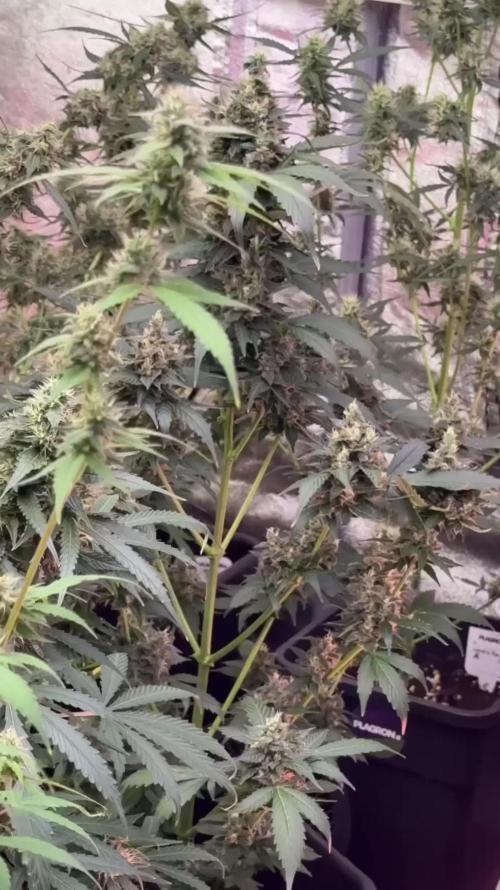
💜 Purple CousKush Auto by Zamnesia | Pheno B | Week 10
🌿 No Demands. No Drama. Just Beautiful Flowering.
Welcome back to another chapter of the 8×8 Adventure! 🌱💚
And once again...
Purple CousKush Pheno B isn't asking for much.
She's not complaining.
She's not creating problems.
She's not demanding special treatment.
She's simply growing.
Flowering.
Building.
And looking absolutely beautiful while doing it.
😂💜
At this stage of the adventure, I think that's exactly what I want from her.
We're reaching that part of the cycle where there isn't necessarily a lot left for the grower to do.
We've built the plants.
We've trained them.
We've managed the canopies.
We've provided the environment.
We've given them the nutrition and the light.
Now?
We mostly provide whatever they ask for and stay out of the way.
And Purple CousKush Pheno B isn't asking for much.
She's perfectly happy continuing at her own rhythm.
So...
let's give this girl her spotlight.
🌱 The 8×8 Adventure — Everybody Has Their Own Rhythm
For anyone discovering this diary for the first time, welcome to the 8×8 Adventure.
Twelve different plants.
Different genetics.
Different phenotypes.
One general cultivation environment.
One lighting philosophy.
One nutrition strategy.
One room.
And yet...
twelve different stories.
That's what makes this project so interesting.
Some girls have been more demanding.
Some have needed more attention.
Some are extremely compact.
Some spread themselves out.
Some move faster.
Some take their time.
And some, like this Purple CousKush Pheno B, basically look at me and say:
"I'm fine. Just keep the drinks coming."
😂💜
Fair enough.
That's exactly what we're doing.
💜 Week 10 — She's Still Doing Her Thing
She's sitting around 96 cm, which puts her firmly into the more moderate-sized category of this run.
She's not a giant.
She's not a dwarf.
She's not trying to take over the tent.
But she's also not cramped into a tiny little package.
Instead, she's developed a really nice spread through the available space.
And that's something I'm appreciating more and more.
She's not particularly compact.
Her branches have room to spread.
Her flowering sites occupy the space naturally.
And the plant has developed a nice relationship between height and lateral structure.
She's using the space she's been given.
Not excessively.
Not wastefully.
Just...
nicely.
And honestly, that's a very satisfying phenotype to work with.
🌿 Beautifully Spread Through Her Space
One of the things that catches my attention this week is how nicely she's occupying the space around her.
She's not simply a vertical column of flowers.
She's spreading outward.
The branches have developed into their own little framework, with flowering sites distributed throughout the structure.
That gives her a completely different appearance from some of the more compact girls in the room.
And that's exactly what I love about comparing phenotypes.
Her sister tells a different story.
Other Purple CousKush plants tell different stories.
This one?
She likes a little more room.
And she's using it beautifully.
There's something elegant about seeing a plant naturally occupy the space available to her without becoming excessively stretched.
She's simply finding her own shape.
And I like her shape.
🌸 The Buds Are Getting Serious
Now let's talk about the flowers.
Because...
damn.
😂💜
The buds are becoming seriously beautiful.
They're gaining density.
They're becoming more defined.
They're carrying more visual weight.
And the overall flowering structure is starting to look increasingly mature.
This is the point where you stop looking at little flowering sites and start seeing proper buds developing throughout the plant.
The structures are filling.
The individual flowers are becoming more substantial.
And the whole plant is increasingly dominated by those beautiful flowering formations.
This is what we've been waiting for.
And she's delivering.
❄️ Very, Very Frosty
And then there is the frost.
She's getting seriously frosty.
The resin is becoming increasingly obvious across the flowers and surrounding sugar leaves.
Get the camera close...
and suddenly everything becomes about texture.
Tiny resin-covered surfaces.
Pistils.
Calyxes.
Sugar leaves.
Layers upon layers of detail.
This is exactly where my love of macro photography and growing overlap.
Because you can stand back and see a beautiful plant.
Then you move closer...
and suddenly you're looking at an entire microscopic landscape.
And Purple CousKush Pheno B is giving me plenty to explore.
The name CousKush might be the first thing you read.
But that frost?
That's what makes you stay and look.
😂❄️💜
🌸 The Hairs Are Changing Beautifully
I'm also really enjoying the way the pistils are developing.
They're no longer just those fresh white hairs we see in early flower.
They're beginning to show more character as the flowers progress.
The colour is changing.
The flowers are maturing.
And that contrast between the developing pistils and the green floral structures is beautiful.
It's another little sign that we're moving forward.
Not finished.
Not ready to write the ending.
But definitely progressing.
And this is the stage where every week becomes increasingly interesting.
Because eventually, those little changes start adding up.
🌿 And Those Leaves...
The foliage continues looking beautiful too.
Nice colour.
Nice structure.
Nice overall appearance.
And there's something particularly satisfying about seeing healthy-looking foliage surrounding flowers that are becoming this dense and frosty.
The leaves are still doing their job.
They're still contributing to the plant.
They're still capturing light.
They're still supporting the flowering process.
And I'm not interested in removing healthy foliage just because we're getting deeper into flower.
At this point, if the plant is comfortable and the canopy is functioning...
leave her alone.
😂
She's got this.
✂️ No More Need for the Scissors
We've already done the canopy work earlier in the flowering cycle.
That work served its purpose.
The plant has room.
The structure is functional.
Air can move through it.
Light can reach the important areas.
And now?
I'm not going back in simply because I feel like I should be doing something.
That's one of the biggest lessons of this stage.
Sometimes the best cultivation technique is:
Don't touch it.
😂
At this point, we're not trying to redesign Purple CousKush.
We're watching her finish.
If she doesn't ask for something...
I'm not going to invent a problem.
💡 The Photons Keep Coming
The Future of Grow Black Series LED continues providing the primary overhead lighting, while Lumiflora contributes additional light beneath the canopy.
And this girl is clearly making use of that environment.
She's built plenty of flowering structure.
She's developing dense buds.
She's producing visible resin.
And she's filling her available space naturally.
That's what I want to see.
The light provides the opportunity.
The environment provides the conditions.
The plant's genetics decide what happens with that opportunity.
And Purple CousKush Pheno B has decided to make some beautiful flowers.
I'm perfectly happy with her decision.
💜🌿✨
🔬 This Is Why Phenotypes Are So Interesting
Looking at this girl beside her sister is particularly fun.
Same genetic line.
Same general room.
Same lighting.
Same environmental philosophy.
Same grower.
But completely different expressions.
One phenotype may be more compact.
Another may spread wider.
One may produce a different flower structure.
Another may develop different proportions.
And that's the entire reason I wanted to document these plants individually.
Because if I simply looked at Purple CousKush as one thing, I'd miss all of this.
There isn't one Purple CousKush story.
There are individual stories.
And this one is telling me:
"I'm going to spread out, build beautiful dense flowers, get very frosty, and otherwise leave you alone."
😂💜
I like that story.
🌸 We're Getting Into the "Watch and Wait" Stage
This is where the entire room is becoming especially interesting.
Most of the girls are moving quickly now.
The flowering structures are established.
The plants have largely finished deciding how they're going to occupy their space.
And the grower starts becoming less of a sculptor...
and more of a caretaker.
We provide what they need.
We monitor.
We observe.
We keep the environment stable.
And we wait.
Because from here, the plant has a lot of the work left to do.
Density.
Resin.
Maturity.
Final flower development.
And eventually...
the finish line.
Purple CousKush Pheno B is heading there beautifully.
💧 Feeding & Irrigation
The current recorded conditions remain:
🌸 Flowering: Week 10
📏 Height: 96 cm
💡 Light schedule: 12/12
🌡️ Day temperature: 29.9°C
🌙 Night temperature: 25°C
💧 Relative humidity: 60%
⚗️ pH: 6.0
⚡ EC/TDS: ~2.0 mS/cm
🌡️ Solution temperature: 25°C
🌱 Substrate temperature: 26°C
🌬️ CO₂: 639 ppm
? Pot size: 15 L
💦 Watering: approximately 1.2 L per plant / 24h
The nutrition and irrigation approach remains consistent.
And honestly?
She's not asking for anything different.
That's important.
There's no reason to change something that's working simply because we're getting closer to the finish.
Consistency remains the name of the game.
🌡️ Stable Environment, Happy Plant
The room continues operating under the same general environmental philosophy.
Stable temperatures.
Stable lighting.
Stable nutrition.
Stable irrigation.
And a plant that appears perfectly comfortable inside those conditions.
That's exactly what I want.
The less drama the plant gives me...
the more I can concentrate on observing what her genetics are actually doing.
And this phenotype is giving us plenty to observe.
📸 This Week's Gallery
The photographs this week really show the progression.
The full-plant shots demonstrate how nicely she's spreading through the available space.
The closer photographs reveal the flower density.
And once you get close enough...
the frost becomes impossible to ignore.
There's something very satisfying about photographing her now.
She's developed enough structure that the plant tells a story from a distance.
But there are enough details in the flowers that you can keep getting closer and still find something interesting.
And that's exactly what I want from these late-flowering photographs.
Not just:
"Here's the plant."
But:
"Here's what the plant has become."
💜 She's Not Asking for Much — And That's a Good Thing
I think I've said this several times about this girl now.
But it keeps being true.
She's not demanding.
She's not troublesome.
She's not dramatic.
She's not constantly asking for intervention.
She's just growing beautifully.
And at this stage?
That's almost the perfect plant.
Because we're reaching the point where there's not much I want to do to her anyway.
I want her to finish.
I want her to build.
I want her to mature.
I want her to show me what those flowers can become.
So if she's happy...
I'm happy.
Simple.
😂💜
🔭 Looking Ahead — How Will She Finish?
And now comes the fun part.
We're getting closer.
Not at the finish line yet.
But close enough that the question becomes increasingly interesting:
How is Purple CousKush Pheno B going to finish?
Will those dense flowers continue swelling?
How much more resin will appear?
How will the pistils continue changing?
How much more maturity will we see in the buds?
And what will this beautiful, nicely spread-out plant ultimately look like when she decides she's done?
I genuinely don't know.
And I'm not going to pretend I do.
That's the fun.
We watch.
We document.
We provide.
And we let the plant write the ending.
❤️ Final Thoughts — She's Shining
Purple CousKush Pheno B is another girl in this run who is making my job wonderfully simple.
She's growing.
She's flowering.
She's spreading nicely through her available space.
She's producing dense flowers.
She's getting very frosty.
The pistils are developing beautiful colour.
The foliage looks great.
And she's not asking me for much at all.
Honestly...
what more could I ask for?
😂💜
She's not the smallest plant in the room.
She's not the tallest.
She's not particularly compact.
She's not trying to be anything she's not.
She's simply using the space she's been given and turning it into flowers.
And I really like that.
This whole 8×8 Adventure keeps reminding me that there isn't one correct way for a plant to express itself.
Some plants compress.
Some spread.
Some stretch.
Some stay short.
Some build giant central flowers.
Some create beautiful clusters throughout the branches.
And Purple CousKush Pheno B?
She's found her own way.
A nice spread.
Beautiful structure.
Dense flowers.
Heavy frost.
Beautiful colour.
And absolutely no drama.
💜🌿❄️
We're at that beautiful point now where I don't feel like I need to do much.
I just need to provide whatever she asks for.
And this girl isn't asking for much.
So we'll keep doing exactly that.
Keep the environment stable.
Keep her supplied.
Keep watching.
Keep photographing.
And let her finish in her own time.
Because she's already given me a beautiful plant.
Now I want to see what she does with the time that's left.
And I have to admit...
I'm very curious.
Let's see how this beautiful Purple CousKush finishes.
She's earned the spotlight.
She's earned the attention.
And she's certainly earned another week of simply being allowed to shine.
💜✨🌿
🙏 Thank You
A huge thank you once again to Zamnesia for these beautiful Purple CousKush genetics and for giving us another fascinating phenotype to follow.
Thank you to Plagron for the nutrition supporting these girls throughout the flowering journey.
Thank you to Future of Grow LED for the Black Series lighting driving the garden.
Thank you to Lumiflora for bringing additional light beneath the canopy and adding another dimension to this experiment.
Thank you to TrolMaster for helping maintain the environment behind the scenes.
And, of course, thank you to everyone following this crazy 8×8 Adventure here on GrowDiaries.
We're getting deeper into the journey now.
The plants are becoming themselves.
The differences between phenotypes are becoming clearer.
And the amount of work required from the grower is slowly changing.
We're no longer building.
We're no longer shaping.
We're mostly watching.
Providing.
Maintaining.
And waiting.
And Purple CousKush Pheno B?
She's making that part very easy.
She's not asking for much.
She's not causing trouble.
She's just growing beautiful, dense, frosty flowers in her own beautiful way.
So let's keep watching.
Let's keep photographing.
Let's keep learning.
And most importantly...
let's see how this girl finishes. 💜❄️🌸
Until next week...
Beautiful structure. Dense flowers. Heavy frost. No demands.
Let's let her shine.
Growers Love & Happy Growing! 🌱💚💜
Likes
2
Share


@Enki_Weed
Follow
I got a Mimosa to save!
It is about 2 months old and is growing in soil and has only been illuminated in 18/6.
It has problems as you can see I will try to get it under control in the next few weeks. Until then there will be a weekly update

Likes
175
Share


@love_2_grow
Follow
Day 36 Flower (Day 78)
Today is the first day of week six of flower and on this glorious day, I went to war against the fungus gnats. By war, I mean watering each girl with 5 million Nematodes in 3 liters of pH 6.5 water. That should hopefully do the trick and get rid of the annoying little shits.
I also experimented a bit more with bud photography and this time I used an LED ring flash. The next step is to shoot during the dark period so I don't get any supplemental light from the grow lights.
That was pretty much it today as it is mostly just coasting along at this point in the grow.
Day 37 Flower (Day 79)
The left girl got pampered with a new light today. Let's see if those extra photons can help her fatten up. She also got a CO2 bag to help her to soak up all those juicy photons.
The right girl on the other hand just got her daily watering. Today with 3 liters at pH 6.6.
Day 38 Flower (Day 80)
All I did today was to give the right girl 3 liters of pH 6.5 water and started brewing some compost tea to feed tomorrow. I used a simple recipe this time with just some worm castings and molasses to increase the microbial activity, as well as a bit of neem meal for some additional nutrition but also to help against pests.
The fungus gnats in the tents are almost gone. The nematodes took care of the gnat larvae and the yellow sticky traps have been catching the adults.
Day 39 Flower (Day 81)
Super chill day. I just gave each girl 3 liters of compost tea at pH 6.2. Done.
Day 40 Flower (Day 82)
I gave 3 liters of pH 6.5 water to the right girl and supported some of her branches as they're getting heavy with buds. Boom!
Day 41 Flower (Day 83)
Today I gave each girl 3 liters of pH 6.5 water. The gnats look to be defeated for now. I can't see any in the tents and the yellow sticky traps are empty.
Day 42 Flower (Day 84)
The last day of the sixth week of flower and all is going great in the tents. The heatwave we were having went away, which kind of sucks on a personal and social level, but it's great for the girls as the tents were swelteringly hot.
The left girl is 103 cm tall and didn't grow anything this week. She has started to fatten up a bit now since I installed a more powerful light, but she is still lagging far behind the right girl.
I'm interested to see if she is only lagging behind in time and will fatten up eventually, or if her ordeal has stunted her flowers, resulting in a bunch of larf. Time will tell. Either way, it will be a learning experience.
The right girl also didn't grow vertically this week (thankfully!). Her 123 cm is tall enough to be dangerously close to the lights.
She is fattening up nicely but still some time to go before she is done. I haven't checked any trichomes yet but should probably start checking next week.
Today was another chill late-flower day, I just gave the left girl 2 liters of pH 6.7 water, and the right got 3 liters at pH 6.5.

Likes
16
Share


@Samsemilla
Follow
Die fünfte Woche startet mit einer (Teil-)Entlaubung, das Blätterdach ist wieder sehr dicht gewachsen.
Die Blätter bekommen wieder ein satteres grün.
Irgendwann innerhalb der nächsten Wochen sollten sie ihr Geschlecht zu erkennen geben, noch sind sie etwas schüchtern.
Ich sehe die ersten Anzeichen, kann es aber noch nicht klar deuten - abwarten und Tee trinken.
Ich habe dem Wassertank meines Autopot Systems einen Luftstein hinzugefügt.
Wird das einen großen Effekt bringen? - keine Ahnung.
Kann es schaden? - ich denke nicht.
So langsam zeigen sich die ersten weiblichen Vorblüten, ich kann aber noch nicht bei allen 13 Pflanzen mit Sicherheit das Geschlecht bestimmen.

Likes
52
Share


@WhiteEdge
Follow
28.04.2024
First harvest in this run! Tropicana Cookies No1 is a winner.) First Tropicana Cookies is harvested on 89 day from seed. Total 55 days off flowering.
Fast flowering indeed as fast in vegetative stage. Cut this girl in branches and hang upside-down in smaller tent for drying
Set RH @ 55% , temperatures not able to control so they will be something around 20-21 in drying tent
Second Tropicana will be chopped within a couple off days
In this cultivation, I used commercial LED lighting for the first time—the HLG Scorpion Diablo 650w, a beasts of light. It helped the plants beneath it develop exceptionally hard heads without heat-induced stress. The light spectrum is excellent, and the plants under it appear much healthier than those under my old light. They also finished faster, if that has any relevance.
After numerous failures and difficulties with the timers I used for pumps and electromagnetic valves, which resulted in interrupted irrigation on several occasions, I believe I’ve resolved those issues.
The TrolMaster programmable devices work perfectly in recycling mode. The ability to adjust times in seconds is precisely what I needed! The TCS1 Tent-X brain, equipped with an excellent sensor for temperature, humidity, and light detection, is remarkably accurate with rapid value measurement response—faster than the AC Infinity 69PRO controller.
My favorite piece of equipment is the AMP3 sensor with pH and EC probes. It performs exceptionally well—precise and accurate. Integrating it into the system is as easy as a breeze. All equipment and sensors can be added fast to the entire system. Additionally, the humidity control I use with the Corroventa K3HP air dehumidifier works like a charm! I am extremely satisfied with TrolMaster equipment and highly recommend it to anyone in need of a precise and reliable system for their grow tent, especially those using hydro or aeroponic cultivation methods.
01.05.2024
Checking TC in drying tent, perfect conditions, i will like more to have cooler temps but ... Six days already drying, think a 4-5 more and trimming. Tomorrow or day after is harvest off second TC and probably one Purple Lemonade...
12.05.2024
First Tropicana Cookies is ready for trimming and curing. Hard and dance buds. Try some small bud, very strong stuff! From first early girl i got 128g net weight
Second Tropicana Cookies is on trimming session within couple of days..
15.05.2024
Second Tropicana Cookies get trimmed. Amazing plant in term of bud density and aromas that it have. Hard and high odor buds. From second girl i got 131g net weight
Total dry bud mass from two plants is 260g, Total power consumption for this two girls is around 180w. Total power used in whole tent is 720w at its maximum peak for 8 plants.
Next week after leaving it in Grow Bags , first smoke review, can wait !
Overall growing Tropicana Cookies was easy grow with lot of fun. This girls are resilient to everything, from bad weather and less than perfect climate conditions. They except all. Growing two plants i can say that they grow very uniformly, finishing at same height and overall same density, size and shape. Almost like from a cutting. That is what i really like ! In future i gonna to grow this lady's at least one more time but with difference, i will grow them as only strain in same tent. Combining them with Purple Lemonade and Wedding Cheesecake was little bit challenging, i feel that either off three cultivars didn't show the best off them.
Main deference was plant height and nutrient requirements. Highly recommended strain for everyone !

Likes
23
Share


@Mr_McNasty408
Follow
Day 43 (1/18/21)
Nutes:
Veg A: 4.6 g/gal
Veg B: 3.1 g/gal
PPM: 1350
Water temp: 63°F
pH: 5.8
Day 44 (1/19/21)
I’m sure my plants have salt buildup, that’s what I’m assuming from leaf symptoms. Starting to flush at lower strength.
Nutes:
Veg A: 3.07 g/gal
Veg B: 2.07 g/gal
PPM: 775
Water temp: 64°F
pH: 5.8
Day 45 (1/20/21)
Checked ppm of runoff and am very embarrassed it took me so long to diagnose🤦♂️ Runoff was 2000ppm
Nutes:
Veg A: 3.07 g/gal
Veg B: 2.07 g/gal
PPM: 775
Water temp: 64°F
pH: 5.8
Day 46 (1/21/21)
Nutes:
Veg A: 3.07 g/gal
Veg B: 2.07 g/gal
PPM: 775
Water temp: 64°F
pH: 5.8
Day 47 (1/22/21)
Nutes:
Veg A: 3.07 g/gal
Veg B: 2.07 g/gal
PPM: 775
Water temp: 64°F
pH: 5.8
Day 48 (1/23/21)
Plants seem to be making a comeback
Nutes:
Veg A: 3.07 g/gal
Veg B: 2.07 g/gal
PPM: 775
Water temp: 64°F
pH: 5.8
Day 49 (1/24/21)
Plants starting to look very good and healthy again 💪
Nutes:
Veg A: 3.07 g/gal
Veg B: 2.07 g/gal
PPM: 775
Water temp: 64°F
pH: 5.8


Likes
30
Share


@TheGourmetWeed
Follow
Hi guys!
Here we are again, closing report for week 12, or 8 of flowering, as you prefer.
This was a great week!
I'm super happy in first place, to be home again, and that gives me much more time to look after the plants, the conditions, and really take great care of the grow.
All the 5 plants had great development in their bud production and amounts. The grow tent looks small for this 5 girls and now they're struggling a little with the space.
About the feedings: I started flushing already. Might be early for many, but I don't see the need for more nutrients when the plants are looking so nice, and I'm also satisfied with it, so now just water until the end.
Curiously, the 2 shortest ones are showing signs og being ready very soon as you can see in the close up shots and video. I might give it another week and will chop them both around december 13/14
The remaining 3 ones... they're still work in progress, growing enormously big for my expectations, and filling up the empty spaces with sweet, fruity and tropical aromas in the room.
Damn it smells nice when you open that grow room.
So yeah, basically now she's just finishing up, drinking water at 6.3 to 6.5PH max, 28 to 38ppm, the temps are good, 18 with lights off, 27 lights on...
The only 'issue' this week it turning the plants a bit because they're bending with the weight. Besides that, all good.
This happy grower is done for this week, let's see what week 13 will bring us.
Thanks for reading, hope you liked the pics also.

Likes
7
Share


@Easygrower
Follow
Hello growers day 83 the buds are in the jar what can I say it’s been a joy growing the Zkittlez a nice little producer didn’t give me no jip through out the grow and my o my she has given some fat dank buds nice and crystaly I also made some bho wax check out the pics it’s 🔥 so so happy with the hole turnout I gave her water from my tap for the first ten days then gave her bio grow/bloom until I see her first pistols then gave them bio grow/bloom/top max/bio heaven up to day 61 then flushed her until day 75 then gave her the chop they had a 20/4 light cycle from the start definitely recommend this strain look after her with a bit of feed and she will look after you I only used the dry trim for the Zkittlez to make the bho and the return was incredible could not believe how much wax I got just from trim until next time be safe and happy growing 👌🏻✌️


Likes
9
Share


@guitarrasrockeras
Follow
Vamos en la semana 12 y esperando con ansias que el 2022 sea bn prospero..!! jejeje


Processing
Likes
18
Share


@Ktims420
Follow
One plant is significantly struggling , brown spots on leaves, it is the tallest and all the spots are towards the top but it is growing a lot slower , no colour change on any of the buds , I have one picture of her. I don’t know what the problem could be all the other girls are fine and have been given the same feeding and watering schedule. However the other girls are very happy from here out it is plain PHed water till I chop. Couldn’t be more excited yet nervous ✌️🏻💚
Likes
11
Share


@cadur
Follow
Whoops, power went off in the shed, plant has been in the dark for 5 days basking in high humidity!
Silly me