




Likes
8
Share


@Sourpatchkiid
Follow
The pot with the white label is the mimosa. The smaller plant is bourbon berry.


Processing
Likes
22
Share


@Silverback_Guerilla
Follow
2/10:
I watered today with about 3/4 gallon each, plus cal-mag, signal, bembe, armor si, a little open sesame, and their final dose of endoboost.
I took photos today, but forgot to snap a shot of the Soooperrunt. She's as tall as the short one now, just not as bushy. I think she'll make a fair amount of bud despite her sloooow start, smaller stature, and smaller pot. The tall one is keeping pace with the biggest plants in the garden.
2/11:
Wife home sick today....postponing construction project to raise the lights....kinda scary....about 10"-12" from the tops now..
2/12:
I woke up to find the tallest of these bitches stretched another few inches and within 9 inches of the lights!!!
I quickly drug everybody out of the closet and undertook the project. In addition to that project, I installed and hooked up my new AC Infinity 6" intake fan. It's pulling in fresh air from the soffit vent on the eave of the attic, and currently feeding the garden with 46f fresh air. I'm able to easily maintain daytime temps in the lower 70f's now. I am able to drive the nighttime temps as low as I want. The only issue is that the outdoor RH varies quite a bit, so I ordered a 30-pint dehumidifier to put in the top of the closet. It will battle with the evaporative cooler while the lights are on to keep it at 45% RH, but after the lights go off, it will lower the RH to 35% unti morning. After another couple of weeks, I'll kill the evap cooler altogether and try to maintain 35% RH 24/7. I'm optimistic that it will be the difference-maker in maintaining lower RH while I'm flushing all the plants during the last couple of weeks. That's usually such a challenge...especially with a bunch of 5 gallon pots.
I also sprayed everybody with boomboom spray to try and mitigate the light burn damage that is likely to ensue.
2/13:
Still stretching... about 12" from the lights again. I will wait to raise the lights until tomorrow when I feed them. I'm seeing calcium deficiency on a few plants, including a #9. Will up the dose tomorrow when I feed.
2/14:
I fed them today with about 3/4 gallon each including grow big, big bloom, tiger bloom, cal-mag, signal, bembe, humic acid, and I switched over from Open Sesame to Beastie Bloomz. Raised the lights another couple of inches. I did some training on them and defo'd a little bit.
2/15:
Installed the new dehumidifier and rigged the continuous drain on it...works great.
2/16:
I rotated the edge plants and removed some old leaves. I added another 22w 3000k 4' bar light under the canopy.
2/17:
I rearranged the garden and defoliated a little bit. That's it for week 8-

Likes
36
Share


@Growgirl1114
Follow
I’m getting so jazzed about this Bruce Banner Auto, upside down grow. Week 8 and she’s getting thicker everyday. I wasn’t sure if she would really amount to a nice grow but it has surpassed my expectations and is turning into a beautiful plant, no real issues to speak of, I do put her under cover every night and pay extra attention to this one but over all what a great experiment #peace ✌️🌱✌️

Likes
38
Share


@Snakeking
Follow
Since i stop spray neem oil and wood vinegar on plants some pests showing up
But i counter them physically
I don’t want to spray anything on the buds
My balcony is my heaven now
I spend all my time with my girls i don’t go for weekends because i have to water them everyday in the 4:30 am! I hope i get my rewards!:))

Likes
28
Share


@TheHighentist
Follow
Second week of flower, time to stretch!
Im very happy with the outcome so far, it is without worry that some tops are in shadow. Enough tops to go around, have to wait until after stretch to lollipop!
The lady all the way in the back, to the left, has either stunned growth or just slower than the other to go into stretch. However i will just play the waiting game, as i see no symptoms for a problem atm.
Last watering was 15/10
👽👉17/10 VPD is set to 1.2, but because of the function of my dehumidifier, it range from 1.1-1.3.
👽👉18/10 Waterday* They are real thirsty
First signs of pistils have shown!
I upped my nutes from EC1.36 to EC1.66
BioHeaven 2ML/L
BioGrow 1ml/L > 1.5
BioBloom 0.5ml/L >1.5
TopMax 0.5ml/L> 1
Calmag 0.3ml/L > 0.4
👽👉19/10
The ladies love it! Stretching and praying hands!
👽👉20/10
Impressed with the stretching. Not much to report, they just feeling the vibe.
👽👉21/10 Changed the lamp hanging system, to gain some more distance from light to canopy.
👽👉22/10 Thirsty ladies, but since i did not have time to water, i gave them 200ml each to survive another 24hours without feed.
👽👉23/10 Waterday*
I upped my nutes from EC1.66 to EC1.77
added 1ML/L Rootjuice to this feed
Bioheaven 2ML/L
BioGrow 1.5 ML/L > 2
BioBloom 1.5ML/L
TopMax 1ML/L
Calmag 0.4ML/L
Rootjuice 1ML/L


Processing
Likes
9
Share


@Kushizlez
Follow
Day 69 (March 6th)
Just gave everyone their last watering. I’m going to harvest and wash everything tomorrow night on day 70. I‘m not going to do that whole 48 hours of darkness thing because I didn’t see a difference last time I did it. In fact, it made my plant under watered before drying which caused it to dry too fast. Slurricane and cheese will be washed with h2o2 and the rest will just be rinsed off in warm RO water and hung up. Before and after washing I’m going to go over each branch with a flashlight and make sure there is no dog hair or debris in or on the buds. I will be drying in my spare bathroom (that no one uses!) from hangers. Aiming to keep it around 60-62F and 50-60 RH. Hoping for that 10-12 day dry. I wanted to do a full plant hang but the tent got pretty dirty and I would feel more comfortable just cutting and rinsing everything off branch by branch. I’m going to try my best to keep the full plant intact. Got my humidifier hooked up and running RO water because with tap water it deposits calcium and lime all over the buds and walls. For air flow I’m just indirectly running a small usb fan. I’m not worried about air flow in the bathroom honestly. It stays nice and breezy down there anyway.
Got the food grade peroxide and RO water to wash up the slurricane and cheese. Everything except for the cheese and garlic#1 is looking more than done. Trichomes all look pretty well done. Some of them have even burst open. Smells are all super ripe and mature too. Can’t wait to smell each individually in jars.
Next week I will recap what went wrong and what I will do differently next time to keep it from happening again.
(Day 70F) Just got everything chopped, washed and hanging. The vast majority of the PM was washed out but I can still see very small amounts. When they dry out I can shake the branches a bit to get the rest off. At very least it’s sterile now. There is no question I lost some potency while washing but the amount is negligible for a much cleaner product.
I could see lots of dirt and other debris float to the surface of the water after being washed. And no those are not trichomes, those sink to the bottom. I could put that nasty water through a bubble bag and wouldn’t get all that much. Although it probably does remove a lot of the actual trichomes heads. I’ll have to check with the microscope.
Everything is rigged up for a nice slow dry. Temp is sitting at 64 and RH is at a nice 60%.

Likes
53
Share


@DogDoctorOfficial
Follow
Hello, my amazing green-thumbed friends! Welcome to the Week 1 flower report for our beloved P.C.R.s. The transition from veg to flower is a magical time, and our plants are already showing signs of their future glory. Let’s dive into the exciting details of this week!
Entering the Flower Stage
Our P.C.R.s have officially entered the flowering stage, and the transformation is already visible. The stretch has begun, and you can see the plants reaching up, preparing to produce those beautiful buds we’re all waiting for. This stage is all about supporting their growth and ensuring they have everything they need to thrive.
NutriSpray Magic
This week, we’ve been diligently spraying Aptus Holland NutriSpray, and the results are phenomenal. NutriSpray is like a spa treatment for our plants, providing essential micronutrients directly to the leaves. It helps with nutrient uptake, reduces stress, and boosts overall plant health. Our P.C.R.s are absolutely loving it, standing tall and proud with their leaves praying to the light.
Nutrient Transition
With the start of the flowering stage, we’ve made some important adjustments to our nutrient regimen. We’ve stopped using StartBooster and replaced it with TopBooster, which promotes flowering and bud formation. Additionally, we’ve introduced P-Boost, a phosphorus booster that enhances root development and flower production.
TopBooster: Encourages larger and more abundant flowers.
P-Boost: Provides essential phosphorus for robust root and flower development.
NutriSpray: Continues to support overall plant health and stress reduction.
Optimal Conditions
Maintaining the perfect environment is crucial as we move into the flowering stage. Our TDS is now at 360, with a pH of 5.9 and a temperature of 21°C for watering. These conditions are optimal for nutrient uptake and overall plant health, ensuring our P.C.R.s have everything they need to produce those beautiful, resinous buds.
Care and Attention
Paying close attention to our plants during this stage is key. Regularly inspecting for any signs of stress or nutrient deficiencies and adjusting care as needed ensures our plants stay happy and healthy. The love and care we put into this process are reflected in the vibrant health of our plants.
In Conclusion
Week 1 of flowering has been all about setting the stage for a bountiful harvest. With the help of Aptus Holland NutriSpray, TopBooster, and P-Boost, along with our careful attention, our P.C.R.s are off to a fantastic start. The excitement is building, and I can’t wait to see how they develop in the coming weeks.
Shout Outs
A huge shout out to @aptusholland, our main sponsor, for their incredible products that keep our plants thriving. Another big thank you to @artgenetix for creating the phenomenal P.C.R. strain. And to the wonderful community at Grow Diaries and all our followers, your support and enthusiasm keep us going. Let's continue to grow together!
Until next time, happy growing, and may your gardens be full with love and green!
Genetics - P.C.R. @Art_Genetix_Team https://artgenetix.world/
Nutricion @aptusholland https://aptus-holland.com/
LED Power @Lumatek and @viparspectra
As always thank you all for stopping by , for the love and for it all, i fell blessed to have you all with me for one more love journey Thank you Thank you Thank you , you guys are great and have been amazing , thank you for everything !
#aptus #aptusplanttech #aptusgang #aptusfamily #aptustrueplantscience #inbalancewithnature #trueplantscience #dogdoctorofficial #growerslove
With true love comes happiness , Always believe in your self and always do things expecting nothing and with an open heart , be a giver and the universe will give back to you in ways you could not even imagine so !
Growers love to you all

Likes
20
Share


@pifflestikkz
Follow
Day 98
Day 63 Flower
30/05/24 Thursday
Finally the time has come!!
The fox tails aren't a issue for me as it's Percy smoke, and to be fair, there decent fox tails 😍😂.
The plant is huge for a auto.
I have wet trimmed,
Removed all excess stem.
Wet bud weight is 587g
Wet trim is 35g
I will update dry weight and smoke report 👌
Thank you to everyone who liked, commented and followed 🙌
Love for the grow 💚
Till next time ✌️

Processing
Likes
141
Share


@Eyeduno
Follow
Flushing the one plant this week and the others next week two week flush then
Likes
10
Share


@extraterrestrial1
Follow
--------------------------------------------------
Day 8
Water: 50ml RO water
Humidifier: 65% (MID-MIST)
Fan Speed: Mid-Low
Light on @ 19:00 (23° celsius @ 76% RH)
Light off @ 13:00 (19.5° celsius @ 54% RH)
-------------------------------------------------
Day 9
Water: N/A
Humidifier: 70% (MID-MIST)
Fan Speed: Mid-Low
Light on @ 19:00 (22.5° celsius @ 74% RH)
Light off @ 13:00 (19° celsius @ ~84% RH)
-------------------------------------------------
Day 10
Water: 50ml RO water
Humidifier: 65% (LOW-MIST)
Fan Speed: Mid
Light on @ 19:00 (22.1° celsius @ ~75% RH)
Light off @ 13:00 (19° celsius @ 70% RH)
-------------------------------------------------
Day 11
Water: N/A
Humidifier: 65% (LOW-MIST)
Fan Speed: Mid
Light on @ 19:00 (23.3° celsius @ ~70% RH)
Light off @ 13:00 (20.7° celsius @ 66% RH)
-------------------------------------------------
Day 12
Water: N/A
Humidifier: 70% (MID-MIST)
Fan Speed: Mid
Light on @ 19:00 (23.4° celsius @ 66% RH)
Light off @ 13:00 (19.9° celsius @ 70% RH)
-------------------------------------------------
Day 13
Water: 150ml RO water
Humidifier: 65% (MID-MIST)
Fan Speed: Mid
Light on @ 19:00 (22.3° celsius @ 72% RH)
Light off @ 13:00 (21.5° celsius @ 67% RH)
-------------------------------------------------
Day 14
Water: N/A
Humidifier: 65% (MID-MIST)
Fan Speed: Mid
Light on @ 19:00 (24.5° celsius @ 63% RH)
Light off @ 13:00 (22° celsius @ 65% RH)
-------------------------------------------------
Likes
57
Share


@AsNoriu
Follow
Day 85 since seed touched soil.
Trim jail !!!
2.40 cm of hanging buds !!!
Happy Growing !!!

Likes
13
Share


@Robeeriegenetics
Follow
Dropped light hours down to 16 . Topped off nutrient solution with 5.0 ph evened out .removed none chosen phenos to be flowered in separate room no longer tracking those we will only follow the chosen mothers clones i cut clones today as well had the lady friend clean floor with bleach and dawn put clones in ez cloner 32 systems
Likes
37
Share


@Terp1
Follow
06.06.23
Tag 44
Pflanze konzentriert sich nun auf die Blüte. Nun heißt es einfach gießen und warten. :)
- Trichome überall auch auf Fächerblättern und sogar dem Stengel. Die Finger kleben sofort beim LST
UND WIE GEIL DIE DAME EINFACH RIECHT
ich kann es kaum beschreiben
- irgendwie bildet die Dame nur Blätter mit 3 Fingern, ganz, ganz wenige mit 5

Likes
4
Share


@GLOrganics
Follow
At this point i was a bit worries because despite trying to match indoor hours to outdoors gradually, and not going below 14, plants started to show signs of flowering. After some conversations i dicided to wait for it to reverse. First time this happened to me. If somebody has a protocol please let me know.


Likes
40
Share


@MrHightimes
Follow
Raised the light a bit the girls that are stretching!
Gave em a decent defoliation, but they really didnt need to much!
The buds are stacking up nice and i think the plants are in their final form!
Likes
Comments
Share
@Raul2021
Follow
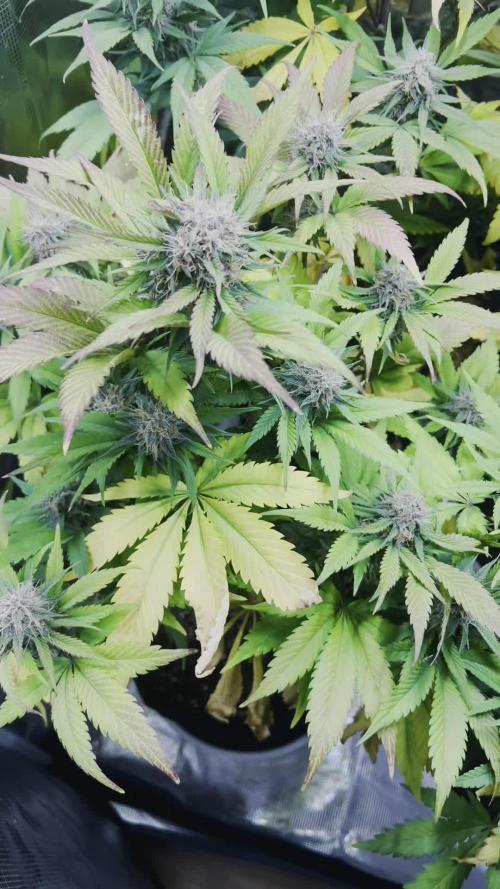
Día 63 de vida de las plantas, crecimiento explosivo de las flores y desarrollo de terpenos de la planta mas avanzada, se ha regado con unos 1,5 litros por planta con un PH de 6,1 y 5,7 y una EC de 0,49 y 1,68. Se han añadido fertilizantes de floración en el riego y potenciadores de flores, siguen cada día desarrollándose, bebiendo mucha agua y con un olor muy potente, en 4 / 5 riegos más se corta toda fertilización y se hace lavado con un nuevo producto adquirido, FLAWLESS FINISH. Muchas hojas se han empezado a caer y a amarillear, la planta parece estar consumiéndose a si misma muy rápido, pero aun es pronto para cortar, se espera entrar en el proceso de maduración en la próxima semana, se aplicará el finalizador OVERDRIVE para un remate final.
Se espera una cosecha en las primeras semanas de Abril.
Estas son las condiciones de esta semana:
Ventilación: nivel 70% oscilación 90 grados modo natural
Extractor: 65% y 25% de standby
Intractor: 25 %
Humidificador: Off
Luz: 100% con altura de 20 cm
Ppfd: 750 umol/m2/s
Periodo: 18-6
Humedad: 45% a 55%
Temperatura: Día 26 C - Noche 22 C
Vpd: 0,91 a 2,47 kpa
Co2: 297 a 885 ppm
Temperatura del sustrato: mínima 19,2 C máxima 23,2 C
Humedad del sustrato: mínima 7,6% máxima 49,8%
Productos y Marcas usadas:
Indoor: MARSHYDRO 80x80x160
Led: MARSHYDRO FC 1500 EVO SAMSUNG
Ventilacion y extracción: MARSHYDRO
Controlador: IHUB PRO MARSHYDRO + Kit Sensores
Medidor PH: Milwaukee PH 600
Medidor EC: Milwaukee C66
Sustrato: COMPOSANA Semilleros / LIGHT MIX BIOBIZZ
Ph: BIOBIZZ UP / DOWN
-Fertilizantes-
BAC: GROW, BLOOM, PK, CALMAG
ADVANCED NUTRIENTS: VODOO JUICE, BUD CANDY, TASTY TERPENES, BIG BUD, OVERDRIVE, BUD IGNITOR, FLAWLESS FINISH

Likes
21
Share


@DeepWaterGrower
Follow
🗓️ WEEK 8 (flo) - HARVEST WEEK (56° FLO)
💧 Midway through this final week of flowering, I performed a complete DWC reservoir change. I replaced the nutrient solution with plain tap water, EC 0.4 - pH 5.8. This flushing solution was maintained for 4 days, right up until the moment of harvest.
🌱 On the 56° day of flowering (day 84 from the dry seed), the plant appeared perfectly ready for harvest. The buds are dense and glistening with resin, nearly all pistils have browned and retracted, and the trichomes show a beautiful mix of milky and enough amber. Immediately after chopping her down, I removed all the large fan leaves and I've decided to dry these too as they are remarkably full of resin.
✅ DRYING PHASE
The entire plant was hung to dry inside the grow box, which was kept completely dark with constant, gentle air circulation for 8 days.
The average VPD during this period was maintained around 1.2 (approximately 20°C and 50% RH). Once this drying period was complete, I trimmed off all the sugar leaves. These resinous sugar leaves will be combined with the already dried fan leaves and larf buds, and I plan to use them to make cannabutter for edibles.
⚖️ DRY WEIGHT
After the 8-day drying period, and once all the remaining small leaves and branches were removed from the buds, I weighed the final product:
The harvest yielded:
- 150 grams of dense buds.
- 5 grams of finger hash collected during handling.
For edibles:
- 30 grams of larf.
- A large amount of fan and sugar leaves.
⚠️ In the next coming days I'll update the harvest week with info about curing stage and a smoke review.