Likes
Comments
Share

@Growbody
Follow
Hallo und herzlich willkommen zu meinem Growbericht Outdoor 2025 mit den Sorten Power Flower Feminized, Royal Medic Feminized und Special Kush #1 Feminized, alle 3 von Royal Queen Seeds. Es ist das erste Mal, das ich Töpfe für den Outdoor grow verwende, bisher waren alle Gorilla grows und direkt in die Erde gepflanzt.
Die URL der Power Flower Feminized: https://www.royalqueenseeds.de/feminisierte-hanfsamen/120-power-flower.html
Die URL der Royal Medic Feminized: https://www.royalqueenseeds.de/cbd-samen/148-royal-medic.html
Die URL der Special Kush #1 Feminized: https://www.royalqueenseeds.de/feminisierte-hanfsamen/138-special-kush-1.html
Die Planung für den Grow ist, die Samen in easyplug Anzuchtwürfeln keimen zu lassen und danach in 0,6L und 2,2L Plastiktöpfen, dann letztlich in die neuen komplett doppellagigen ROOTIES 15 Liter Wide Version Stofftöpfe umzutopfen. Sobald die Witterung es zuläßt, sollen die Pflanzen an die frische Luft.
Es ist schon eine Weile her, das der Grow losging, die Bilder sind jetzt aktuell.
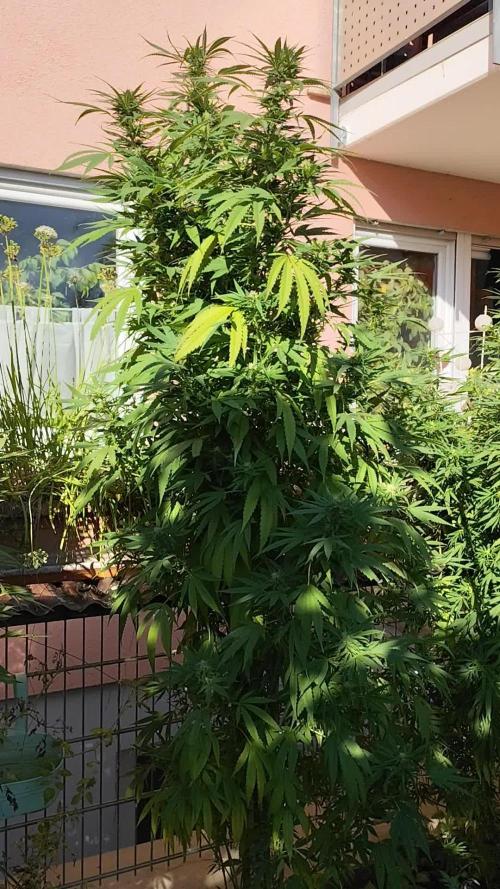
Tag 205: Endlich wieder Sonne, wenn auch mit vielen Wolken. Die letzte Woche hatte nach den 40 L/m² am Wochenende weitere 23 L/m² Regen gebracht. Die drei Ladies haben die ganze Woche unter'm Balkon gestanden, jetzt können sie wieder Sonne tanken. Sie duften sehr fein.
Tag 206: Hab das schöne Wetter genutzt und die drei Großen etwas entlaubt. Es waren jeweils eine große Handvoll Laub, man sieht es aber kaum. Bei der Menge an Laub werd ich das noch ein paarmal machen. Das Große Heupferd darf im Canabis nach Beute jagen.
Tag 207: Die drei Feinen waren heute morgen ziemlich nass, hab nochmal ordentlich entlaubt, das mehr Licht und Luft reinkommt.
Tag 208: Hab mal Fotos der drei Bäume um die Mittagszeit gemacht. Man kann gut sehen, wie nass die Blätter da noch sind. Werde also nicht bis November warten.
Wenn's dir gefallen hat, schau wieder vorbei ✌️😎

Likes
9
Share


@Cultivate
Follow
Spent some time just defoliating the girls last night, tried not to go too far but you get lost😂
Also did some Pruning/Lollipoping to Increase that airflow 💨
Happy so far! Stinking now

Likes
3
Share


@Kazbrownthumb
Follow
I got really busy towards the end and probably made a few mistakes. Probably cut it down a bit early too but she wasnt able to hold herself up anymore and broke some stems. All in all compared to the outcome of my last grow this one plant doubled my outcome so I dont believe I maybe improving on my growing skills.
I have her curing in jars right now. Out of the sample I have tried I really enjoy it. Smells like candy, tastes like candy with a little extra something something at the end. Smooth, burns clean I couldn't be happier.
Likes
32
Share


@LapsekiliTayfur
Follow
Day in and exit fan 15 min off 15 min on Van is full on
Night in and exit fan 30 min off 15 min on Van is off
3. Haftada Topping ve Lst Eğitimleri başladı


Likes
1
Share


@Green_Peace
Follow
The plants are growing at a good rate now and drinking a litre each per day. I feed them by hand and each plant gets 2litres every other day.
Didn't do anything else this week other than install the trellis on the last day.
Love the way these genetics grow and fill out the tent. When I was growing the mother in the pheno hunt I remember remarking how well this plant took to being topped.
These 2 plants are front and right in the timelapse video.
Likes
48
Share


@Focus420
Follow
Den 78 - proplach samonakvétaček
ph 5.8
ec 0.36
Celoročky pohnojeny
ph 6.2 ec 2.1
Den 79 - kontrola proběhla v pořádku
Den 80 - kontrola mikroskopem,trichomy mléčné
Den 81- hnojení ph 6,2 ec 2.1
Proplach - ph 5.8 - ec 0.4
Den 82 - good work
Den 83 - jedeme dále
Den 84 -hnojení ph 6,2 ec 2,1
Proplach ph 5,8 ec 0,36
Den 85.
sklízení vrchů
Blackberry gum auto - 247 g mokrého
Brooklyn Sunrise auto - 154 g mokrého


Likes
15
Share


@BruWeed
Follow
🍀25/04 - Empieza su primer semana en etapa de crecimiento.
🍀Por el momento viene de manera correcta sin ningún inconveniente.
🍀El Ph ya se lo estoy empezando a modificar en 6.3.
🍀Lo que pude notar es que de un día para el otro la plantula creció bastante, se encuentra tupida y bastante grande para los 20 días que tiene de vida.
🍀Los tres fertilizantes que utilice se los agregue directamente en el agua (1L) y la regué.
🍀Tengo pensado dejarla cinco semanas en total en esta etapa, así puede desarrollarse de manera correcta.
🍀En estos dias subiré más imágenes!
Podes seguirme en Insta gram como @bruweed_arg !😶🌫️☘️


Likes
Comments
Share


@Cannajo
Follow
Plant continues to show growth , slow and steady but maybe it will bust with growth one day, but otherwise I noticed to leaves kind of twisting and curling and such not sure why I barely water them to keep from being overwatered because I noticed the soil does retain water a LOT plan to transplant them in coco coir 50/50 mix fox farm cream of the crop but till then they will remain in Fox farm ocean forest( maybe the soil is overloaded with nutes for this strain) 😬(and me amending not making it any better)
Likes
7
Share


@Mullerred1
Follow
Flowering on Lemon Cherry Cookies Auto is growing up and flowering the fastest, Cherry Cola Auto on the left is catching up and spreading out ready for flowering buds. My Smoothie Auto was a week behind but has livened up since adding Charge by Ecothrive to all 3 plants. I had a timer on my light which I switched to the wrong position. So I'd been 24 hours lights on. I switched it back to 20/4. And the rest seems to help growth in the last week.

Likes
86
Share


@Ageddd
Follow
Last week of the plant, she continued yellowing, weird week with huge variations of conditions when the sun hits directly, but generally cold temperatures are here, specially at night, and high humidity, we are having a rainy week, it rained every 2 or 3 hours...
Planned to harvest, the later the better, but having in mind temperatures, humididty and sunlight, it will be when im stimating the best day, and finally it was October 18th. after 2 days plenty of sun, chopped the first of the bad days that were coming, in the morning ..
Feeding:
WATER / TOP CANDY / WATER /
Song of the week : MAD I GOT IT | MAD 1 GOT 1T - Denzel Curry ( Dedicated to @SpinnerGrow as you inspired me sharing fav songs ^^)

Likes
4
Share
@Organic710
Follow
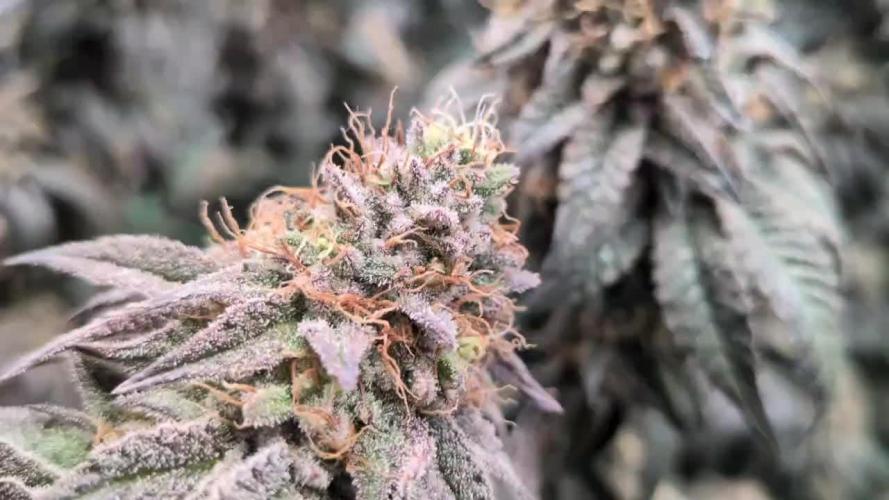
Slowly reducing temps to help preserve terpenes towards the end. Also just water now with 1-2more dose of microbes. Flourish/Trace/Microben and Organic growth regulator all stop 2-3weeks prior now. The mammoth setup is pretty crazy I have the 720w set at 30% and the canopy lights at 50% with corners of the tent still getting 1300ppfd and the middle 1500-1750. I can tell already just within a few weeks of the canopy light and 1week of the 2bar greenhouse light the quality of produce is incredible. I'd be destorying terpenes trying to get this ppfd from my old spiderfarmer lights so it by far was worth it already to me. Also the cost to run the lights is like 2c per hour extra a day for MASSIVE ppdf + spectrum boost and temps below 25c with ease. I cant wait to do a full run using these lights in the new bigger tent 😇
UPDATE 30SEP : I checked all the plants last night and they all seem to be done already. I have heard this can be a 7week strain but im shocked they all are done. Tomorrow will be start of week 8 of flower so today is day 55 and Ill be chopping them this evening. Im hoping they are still nice smoke as ive only added microben for the past few weeks so only microbes and a tiny amount of molasses for them to eat. They have faded pretty well over the past days and lower leaves are falling off themself. 1 plant really isnt upto my standard so its getting donated to make me some cannacaps and not my lungs 😆 Other 4 smell incredible nice and gassy with hints of strawberry/banana and grape and nugs like rocks. New tent isnt here yet so ill clean the 4x2 for a reset before drying in there then once the new tent arrives I can use the 3x3 for drying. My 15yr old Mammoth tent can be binned now I was using that to dry in but its old af and has a good few rips in from me being a impatient idiot back in the day haha 😂

Likes
8
Share


@Maggie_de_Block
Follow
Seems like she's taking longer, think this might be because I used my phone flashlight to check on her during dark in the first weeks flower. Not too bothered by this as it means she might get a little fatter :)
Some slight purple discoloration beginning to show from the cold night temps

Likes
24
Share


@1_Plant_Wonder
Follow
End of week 6, Beginning week 3 of flower for the OG Kush auto🍓🌱
Plant filled up the 60x60 cm tent entirely, and keep on stretching!
And to think i was worried at the beginning that this plant won't get big 🤦🏽😅.
I noticed some leaf curling/burning a bit, and some bleaching of 2 small leafs (not so sure about the bleaching), so i lowered the intensity of the cree cobs led to total 220W.
This happened to me in my last grow (zkittles auto) as well.
I guess the cobs can get too powerful for a small tent like that.
I'll definitely keep an eye on that issue.
Other then that all goes smoothly;)
- I do some light defoliation to the plant every day,
- in the next few days I'll do the big cleaning - lollipoping 🍭 and full defoliation.
P.s - sorry about the bad lighting in this week's photos, I'll fix that next week✌️🏽
Likes
40
Share


@Ukfarmer420
Follow
Hi guys
Been so busy but heres the update on the grow from today, so the stardawg is well into flower, the cheese is doing well although I have snapped the lst cheese twice and taped it back together, the blueberry is doing well and is going to be a beast, potnoodle grow off isn't going to bad, I will get some nitrogen into them as very pale.
There is 3 new additions by the name of big budhas blue cheese that I will veg off the back of the autos for the next scrog run.
Happy growing guys
Likes
5
Share

@BluntTrauma416
Follow
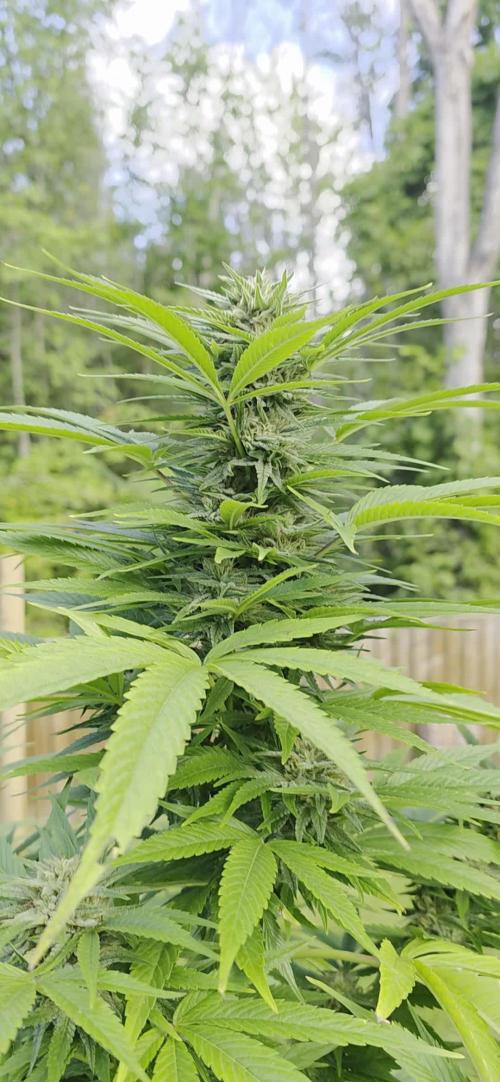
Smelling good.
My largest plant actually has the smallest buds.. but smell great.. look great and i herd it can just be genetics or roots want more room
but smaller buds often increase resin content..
i fed my last feeding
of
gaia green bloom.
I put a thin layer of wormastings and thats it.
I use los cost plant therapy weekly at 10 ml per 900 mill water. Gonna just ride it out until harvest. Gonna pick up a jewlers loop or scope to start checking tricombs next week.

Likes
Comments
Share


@Nofeckingclue79
Follow
This has been a dream to grow the only reason I marked it as neutral and not easy because of it being such a flowery bub.So you just had to keep an eye on the humidity apart from that she stood up to everything even when I was starving her from Calmag 😂🤷
Can't wait to be back with the smoke report

Likes
17
Share


@EXZELENS
Follow
Bud wet weight : 168,1g of trimmed medium to big sized buds
25,4g of tiny tiny buds/larfs = 193.5 grams of trimmed wet buds.
Details on genetics and smoke report above.
This, as my first grow, is way more than I ever expected it to be. I haven´t had that much fun and enthusiasm in a very very long time.
I can´t even explain the feeling it is to harvest your own cannabis, but I know most of you know what I´m talking about haha.
It was really nice to practice LST, even tho it was SO HARD, ´cause I didn´t had barely any space to work since I used a hard pot and did not fill nearly half the size of it and the walls of the pot were really high. It was even difficult to water without dropping water on the lower buds.
I haven´t learnt much about defoliation tho, I feel I need to study a little more about the phases you should or should not do it.
Also, I discovered thrips are a pain in the ass. I had 2 tough weeks dealing with thrips, but in the end it was alright.
I don´t have any humidity control device, which I intend to buy for the next grows.
Growdiaries was really helpful for me, it kept me motivated everyday (not that I wouldn´t have had it anyways), the Grow Questions are REALLY useful and all the community is awesome. Thanks to all people that helped me here on GD during this first grow!
To conclude it: I am really happy and satisfied with how the grow turned out. They look incredible, it almost feels like I can´t believe it still.
Peace.
UPDATES:
07/10 : The buds are now dry and already in curing jars, one of them with a Boveda 58% humidity pack.
The total grams of the dry buds are: 41.4g (medium to big sized buds)
4.1g (tiny buds) = 45.5 grams!
I´m really happy with the results, I thought it would be around 30g so yeah, that´s a really good surprise!
In 2 weeks I´ll be back to update the smoke report.
Thanks so much for reading! Peace.
09/10 : I managed to fit everything in the same container with some space between them, so now every bud is with the Boveda pack.
14/10: It´s been a week and the smell improved, it still smells a little like hay/plant ( even tho it´s not too dry neither too wet ).
21/10: Now it´s been two weeks and even tho the smell isn´t anymore hay, it´s a lot herbal. I really think the aroma can get better, but the taste is already good enough for me. The smoke report has been done and in case I have something to add, I´ll report here.
Thank you so much for reading! Peace.
Likes
38
Share


@Wicked_Stix
Follow
We are at day 21 on this gorilla cookies. I think she would be quite a bit bigger if I didn't break one of the mains on week 2 but she is still chugging along and growing well. I upped the maxigro to .5 tsp per gallon and started them on a little armor si so they can build some strong branches. Still running them on 24 hour light and 24 hour irrigation. They are going to stay under the blurple lights for a few more weeks until I can get them in the big room under the quantum boards. I'm hoping they will flower around 4 weeks but my autos seem to enjoy staying in veg so we will see what happens.
Likes
14
Share


@StoneyMelony
Follow
Week 5 They are really doing great at the moment, by day 35 the DP GB OG is no longer behind and she is growing in a fast paste. I think this are goiong to be big plants. they still have to go in flower so.