


Likes
Comments
Share

@jdean88
Follow
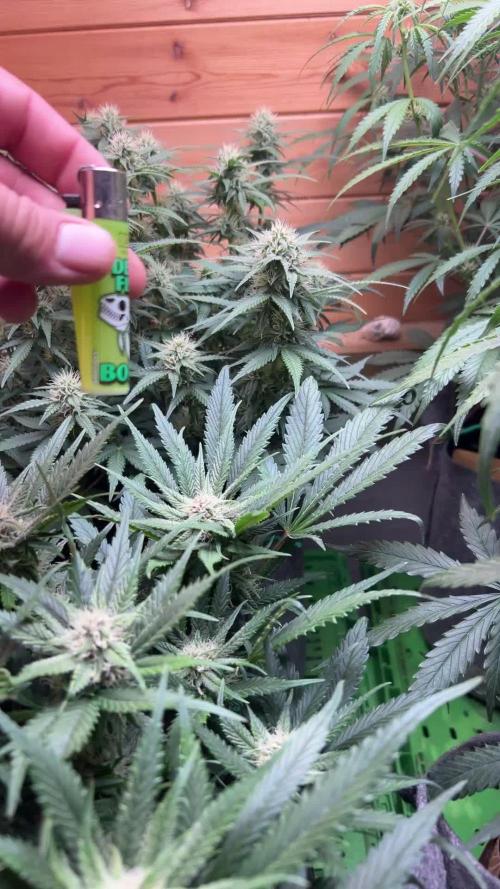
The blue dream and strawberry gorilla smell incredible I think the blue dream will put some nice weight on if she carry’s on this way the strawberry gorilla although a tiny plant she smells incredible like sweets haribo strawberry with a slight gas back note just wooow.the west coast and og are now huge they have stretch a lot but have so many buds sites forming iam expecting a monster yeild from both of this who might I add are feeding light photo periods and still want more incredible to think these are autos top genetics I hope it finish’s aswell as they started flower and iam going to have an amazing Christmas with lots of beau buds

Likes
69
Share


@Qutro
Follow
Hi there,
Here we go with the 4th week of veg.
As soon as they woke up from the stress of the transplant, they were given another dose of training session . We topped them on the first day of the week. Not yet, but two days later we removed 4-4 large fan leaves each and it became clear how much the lower branches of Marshmallow OG didn’t develop in the shade. I already had the feeling that this variety was not genetically stable. These shots looked quite mutant. They seem to adapt more slowly to the hard plant trainings I use most of the time. On this day we also bent the branches with a tent hook to allow better light penetration to the lower parts.👨🏻🌾🌱
They show quite strong indica characteristics at this early stage of the vegetation which is also clearly visible in the shape of the leaves.
It is possible that the planned 6-week veg won’t be enough, as they need much more time to regenerate than most varieties I’ve grown so far. Never mind, maybe even this way the possibility of a harvest before Easter can be maintained.
After the hard training session they got only half dosage of nuts as they lost a lot of foliage. On the last day of the week watered them again with full dosage. 💦
All in all, they seem healthy but not very happy. I'm adjusting to them a bit and hopefully we'll be just fine for next week.
Running the Ts3000 on 65% 42 cm above the canopy which means 450-480 ppfd. 💡🌞
Have a lovely weekend everyone!


Likes
Comments
Share


Likes
16
Share


@Ultraviolet
Follow
Seedling managing 93F 30%RH, around 20 DLI. Vpd is in the 3's. No I don't recommend.
Signum Magnum.
"A great sign appeared in the sky
a woman clothed with the sun
with the moon under her feet
and on her head a crown of twelve stars.
Sing ye to the Lord a new canticle:
because He has done wonderful things.
Glory to the Father, and to the Son, and to the Holy Spirit
As it was in the beginning, and now, and ever shall be, world without end."
The plant nutrient nitrogen exists in forms with both positive and negative charges. Ammonium (NH4+)(immobile in soil)(Cation) has a positive charge, while nitrate (NO3-) (highly mobile in soil)(Anion)has a negative charge. Nitrogen is unique among plant nutrients in that it can exist in both positively charged (ammonium, NH₄⁺) and negatively charged (nitrate, NO₃⁻) forms in the soil. This makes it a special nutrient. In that it is responsible for providing balance for reactionary trade offs when it comes to ph. Because ph itself in the medium will always slowly drift towards acidicity, such is nature. 80% of nitrogen should be nitrate and no more than 20% ammoniacal nitrogen.
Ca, mg, and K are the big 3 cations related to soil composition, pH & base saturation.
When nitrogen is in the form of ammonium, it can compete with calcium, magnesium, and potassium for absorption sites in the plant root. This competition can lead to a reduction in the uptake of these other essential nutrients. Nitrogen, particularly in its nitrate form (NO3-), can increase soil acidity, which can also affect the availability of calcium, magnesium, and potassium. The form of nitrogen applied (ammonium vs. nitrate) can influence its interactions with other nutrients. Ammonium nitrogen can have a more pronounced negative effect on the uptake of calcium, magnesium, and potassium compared to nitrate nitrogen.
Common forms of ammonium nitrogen include ammonium ion (NH4+), urea, and ammonium compounds like ammonium nitrate, ammonium sulfate, and ammonium phosphate.
Common forms of nitrate nitrogen include potassium nitrate (KNO3), sodium nitrate (NaNO3), calcium nitrate (Ca(NO3)2), and ammonium nitrate (NH4NO3).
Phosphorus is an essential plant nutrient, and its availability in the soil is strongly linked to the presence of oxygen. Plants primarily absorb phosphorus as phosphate (PO4), and oxygen is a key component of this molecule. Furthermore, the availability of phosphorus in the soil can be impacted by factors like soil aeration and temperature, which in turn affect the oxygen supply to the roots.
Phosphorus uptake in plants is most critical during the early stages of growth, particularly within the first few weeks of plant development.
Young plants actively growing tissues have a high demand for phosphorus. They may absorb up to 75% of their total phosphorus requirements within the first few weeks of vegetative growth, with up to 51% of uptake happening overnight, primarily in the first few hours or early nightfall.
⑨Anaerobic root respiration, or respiration without oxygen, is detrimental to plants because it's less efficient and produces toxic byproducts, leading to reduced energy production, nutrient uptake issues, and ultimately, root damage and plant stress.
⑨Anaerobic respiration, unlike aerobic respiration, doesn't utilize oxygen as the final electron acceptor in the electron transport chain. This results in a significant drop in the amount of energy (ATP) produced, which is necessary for various plant functions, including growth, nutrient uptake, and maintenance of cellular processes.
⑨In the absence of oxygen, plants produce byproducts like ethanol and lactic acid during anaerobic fermentation. These byproducts can be toxic to the roots and inhibit their function,
⑨When oxygen is depleted in a medium, the pH tends to decrease (become more acidic) due to the production of metabolic byproducts. This is particularly relevant in biological systems where aerobic respiration relies on oxygen as the final electron acceptor.
⑨When oxygen is scarce, plants may switch to anaerobic respiration. This process produces carbon dioxide (CO2) as a byproduct.
⑨CO2 dissolves in water to form carbonic acid (H2CO3). This acid lowers the pH of the medium, making it more acidic.
⑨Anaerobic conditions can impair a plant's ability to regulate its internal pH, leading to a drop in cytoplasmic pH and potentially cellular acidosis.
⑨The change in pH can also affect the availability of certain nutrients to the plant, as pH influences the solubility of micronutrients like iron, manganese, zinc, copper, and boron.
⑨The lack of oxygen in the plant medium leads to a decrease in pH due to the production of carbon dioxide during anaerobic respiration and impaired pH regulation within the plant.
In plant cells, cellular acidosis, a drop in the internal pH of the cytosol, is a significant stress response, particularly during conditions like flooding or hypoxia. This acidification can be triggered by a decrease in oxygen levels, leading to the production of metabolic byproducts like lactic acid and CO2. The plant's ability to tolerate and recover from these conditions depends on its cellular mechanisms to regulate pH and mitigate the effects of acidosis. When plants are subjected to low oxygen environments, such as those experienced during flooding, anaerobic metabolism, which produces lactic acid and ethanol, becomes the primary source of energy. This can lead to a build-up of these acidic metabolites in the cytosol, causing a drop in pH.
OXYGEN
Atomic oxygen (single oxygen atom, O) is the lightest form of oxygen, as it has the lowest mass of the oxygen molecules. Oxygen also exists as a diatomic molecule (O2) and an allotrope called ozone (O3), which have higher masses due to the number of oxygen atoms combined.
Atomic Oxygen (O):
This refers to a single oxygen atom, which is the most fundamental form of oxygen.
Molecular Oxygen (O2):
This is the common form of oxygen we breathe, consisting of two oxygen atoms bonded together.
Ozone (O3):
This is an allotrope of oxygen, meaning it's a different form of the same element, consisting of three oxygen atoms bonded together.
Since atomic oxygen has the fewest oxygen atoms, it naturally has the lowest mass compared to O2 or O3.
Ozone (O3) Lifespan:
Ozone has a relatively long lifespan in the stratosphere, particularly at lower altitudes. For example, at 32 km in the middle latitudes during spring, ozone has a lifetime of about 2 months.
Oxygen (O) Lifespan:
Atomic oxygen, on the other hand, has a much shorter lifespan. At the same altitude, its lifetime is about 4/100ths of a second.
Ozone-Oxygen Cycle:
The ozone-oxygen cycle involves the rapid exchange between atomic oxygen (O) and ozone (O3). UV radiation can split molecular oxygen (O2) into atomic oxygen (O), which then reacts with O2 to form ozone (O3). Ozone can also be photolyzed by UV radiation, creating atomic oxygen again, which can then react with O3 to reform O2.
Dominant Form:
The partitioning of odd oxygen (Ox) between ozone and atomic oxygen favors ozone in the lower stratosphere. This means that a much larger proportion of odd oxygen exists as ozone than as atomic oxygen, especially in the lower stratosphere.
Recombination:
Atomic oxygen has a high energy and reactivity. When it encounters another oxygen atom, they can combine to form O2. This process releases energy, contributing to the heating of the atmosphere.
Ozone Formation:
Atomic oxygen can also react with molecular oxygen (O2) to form ozone (O3). Ozone plays a significant role in absorbing harmful UV radiation.
Other Reactions:
Atomic oxygen can react with various other molecules in the atmosphere, like nitrogen (N2), water (H2O), and carbon dioxide (CO2), forming different compounds.
UV light below 240nm (peak 185nm) creates ozone (O₃) through a process called photolysis, where UV light breaks down dioxygen molecules (O₂) into single atomic oxygen atoms (O). These single oxygen atoms then react with other oxygen molecules to form ozone (O₃). Specifically, UV-C light with wavelengths shorter than 240 nm can cause this photolysis.
UV light with wavelengths between 240-280 nm, (peak 254 nm) breaks down ozone (O₃) into dioxygen molecules (O₂) and atomic oxygen atoms (O). 280nm does not have the energy potential to break apart the stable bond of (O₂) into enough (O) to make (O₃)
At ground level, atomic oxygen (single oxygen atoms) has a very short lifespan. This is because it's highly reactive and quickly combines with other molecules to form stable diatomic oxygen (O2) or other compounds. While the exact timeframe varies depending on the specific circumstances, its lifespan is typically measured in nanoseconds or picoseconds.
Likes
247
Share


@PremiumBudsEU
Follow
Hello growmies
Buds start fatten up and we like it 👆😎
This week the buds have started gaining weight.
I think it's exactly the right time because I still have a few weeks to go.
From this point on I try to keep the PK content at the same level for the next 2 weeks, then I will increase the fertilizer dose a bit and fertilize like this for another 2 weeks until flowering week 8.
What I noticed with my plants up to now is that they are very sensitive to light and that over 1000 ppfd is not possible without an additional co2 supply.
Otherwise I have only good things to say, they smell delicious, they have a very good defense against pests and mold. Sometimes the humidity was over 70 at night.
I am very excited about the result, the effect and the taste 🙂
I will post a video tomorrow
I wish my Growers Family and Sponsors a pleasant weekend without stress and hectic. Stay healthy 🙏🙏🍀

Likes
67
Share


@Basementganja
Follow
Day 77 from seed! Been removing the occasional leaf that's blocking bud-sites, or that's looking at me funny! ;)
She's been getting fed 2.5 gallons dosage of the above listed nutes, every 4 days (when the soil is 90% dry again).
Next week(tomorrow) I will be adding "GH dry Koolbloom" to the nutes at a concentration of 1.25 grams/gallon.
Likes
3
Share

@Growfather1
Follow
Hello everyone.
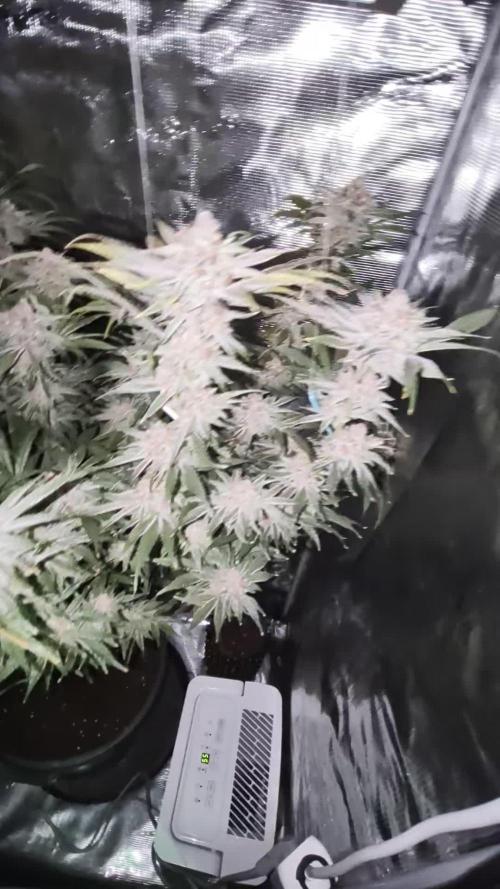
They are looking absolutely majestic in their seventh week of flower and fifth day of flush, putting on a spectacular show with about ninety percent of their pistils turned fiery orange and rich brown.
Temperatures in the tent are sitting perfectly between twenty-one Celsius during the dark period and twenty-eight while the lights are on, while the dehumidifier keeps the humidity locked between fifty and fifty-seven percent.
Since the light shut off right as filming started, a clear video update will be uploaded tonight when they are back on.
Thank you for stopping by, have yourself a nice day.
Best regards,
Growfather.

Likes
12
Share


@Socal6pak
Follow
8 WEEKS. YES, THATS A CATEPILLAR INSIDE THE TOP COLAR. I DIDN'T SPRAY BT THIS ROUND. SO I EXPECTED SOME CATEPILLARS PERHAPS MORE LITTLE ONES. WILL KNOW WHEN I CHOP AND DRY.
ONCE YOU CHOP AND DRY. ALL THE CATEPILLARS WILL START TO FALL OFF THE PLANT. LIKE ESCAPING FROM THE PLANT. DANGLING DOWN W/ SILK. VERY INTERESTING.
LOOKS RIPE TO CHOP. WILL CHOP END OF THIS WEEK. BEFORE CATEPILLARS EAT MORE BUDS.
Likes
6
Share


@ganjaman24
Follow
She grows nice and quick if you Treat her well! I transplanted and made a couple mistakes so she didn’t reach 100% imo but it’s still a nice turn out! Hadn’t she not gotten pollinated I think the yield would’ve been more! Oh well still not a bad turnout will compare her to my other cut of this strain I have finishing up! Check it out, thanks for reading


Likes
1
Share


@Hydroponicfarm7
Follow
Subimos la temperatura de la sala y vaya si se noto, las plantas crecieron más en 2 semanas que en un mes, una pena no haber podido aclimatar antes la sala

Likes
26
Share


@Highgrade_Harvests
Follow
The 3 that are in the 5 gallon pots are the gorilla gas seeds and the one in the litte pot is the blueberry pie f1 fast and another grow off im involved in with seedsman. All of them are off to a great start in seedling starter mix. Just transplanted the gorilla gas seeds into their 5 gallon pots where they will remain for the rest of the grow. Right now I'm just feeding them 6.5.ph water. The coco I'm using is preamended with nutrients to last a couple weeks. Can't wait to watch these girls grow! I'm going to try to get a time lapse video of the grow if I can get my camera working right.
Likes
6
Share


@KambleFrost
Follow
Week 3 flower and they are already stacking nicely!
Buds have a nice purple / blue hue to them already which is awesome!

Likes
5
Share


@Rabidreject
Follow
Si it's been a pretty good week. Getting very impatient at the moment. Trying not to dwell on my plants too much, I just need to leave them to finish maturing.
Iv pretty much started flush now for 2 weeks so that will take me to the end of week 8.
Update - Monday
So my thoughts have been drifting towards the next round.
Iv been writing a list and so far Iv decided I want to explore organics further so will most likely be amending my soil with dry amendments such as different meals.
I also would like to make better use of microbes so I will most likely be using at least recharge. Hopefully mammoth p also but I'll buy that one as I need it further down into the bloom phase.
Something else I also really want to try next cycle is the use of other crops to help with IPM and also help feed the soil.
Two I have decided to use already are basil, which is meant to be great for keeping bugs away and also garlic.
I want to try and use crops that I will also want to eat that's why I decided on garlic.
I'd also really like to try and grow a couple vegetable plants alongside my cannabis but I am a little unsure of which plants will also grow happily with the same light cycle as cannabis. IRS a bit of a strange light cycle for here in England so I'm unsure of what to grow but I'd love it if I could grow some squash, corguettes or aubergine. These are my staples for my diet so these would be incredibly handy.
I am about to move so will have a dedicated small room or large walk in cupboard, depending on how u look at it. I would love to be able to make slightly better use of the space and if I can feed myself even a few times from them as well as them improve my cannabis via post resistance and resin production (they use companion crops in lavender production to raise essential oil production) then it seems silly not to do so.
It will be I interesting to pick out cover crops for my 12/12 larger flowering space, but also for my 18/6 space to grow alongside the autos I plan to grow in there.
Obviously different light cycles will let me do different plants.
I think it will take more initial planning on my part, but I feel once I have it all dialled in after 4 or 5 runs it will be a lot cheaper and much more sense sustaining.
If anyone reads this and knows of any decent potential companion crops I can use please message me.
Like I say garlic and basil so far but have heard beans are a great way to get lots of nitrogen in the soil so they might be a good one for the 18/6 tent.
Also I was thinking and I'm a little unsure of when I'm going to want to harvest so I've decided to leave a week between harvesting each plant.
First one will be pulled this weekend at week 7 of flower then week 8 of flower for the next and the last will be week 9.
That way I can sample over the coming weeks and decide which I prefer for the next cycle.
Update - Tuesday
got my jewelers loupe today but i think im going to buy a usb microscope instead, as its really difficult to hold it steady enough for long enough to be able to tell whats going on with the trichs. i tried to shoot a few pics through it on my phone with limited success.
I think there are about half trichs cloudy atm, maybe slightly less but like i say its hard to tell.
Update - Friday
Ok well yesterday i caved and harvested and hung plant 1 of 3.
Couldn't resist. Now that I have this one to fuxk about with I'm less inclined to want to bring the others down.
Smells unbelievable pinot, fruity and skunky.
Have just used a cardboard box with lines strung through the top to hang from. The plants were so small and had no side branches so I had to tie it to the stem from the lines.
Not a lot on it I dont think but the main cola was pretty chunky.
Interestingly the topped plant had more tops obviously and also has some mad side branching that's at the same level as the main colas and they are all about the same size as the one cola on the non topped plant.
I half expected it to just be double the size of the topped but less of them.
Note to self for future reference:
Always top plants
Use bigger pots


Processing
Likes
6
Share


@samadhi
Follow
It was a great week for this Sour D pheno. She is really starting to fatten up now and is noticeably different after every dark period in terms of the size of her flowers. She is getting tricky to move to the shower where I normally water so she will likely not move again until she is cut. This makes the watering process more tedious but it is a necessary evil to avoid any unwanted mishaps this late in the game. I already caused her to lean a bit from swaying back and forth carrying her across the room during the last fertigation.
The buds still dont have a hugely pronounced smell (like I'd expect from Sour D) or much trichome coverage but I am reassured by the fact that she seems to be a late bloomer and is apparently just starting to take off in terms of flower production. I've only seen a scant number of orange pistils so I think she still has several weeks to go. If she starts to take on that characteristic gassy smell as puts on some frost so I can press her into decent rosin, I'll be more than happy with this run when it's all said and done.
Thanks for following along! Do me a favor and click "Like" if you like what you see here and let me know what you think in the comments. Cheers! 🌱👊

Likes
2
Share


@420DeepGrow
Follow
📆 Semana 8
El cultivo entra en plena fase de engorde, con una absorción eficiente y el coco estable. La planta dirige toda su energía a ganar densidad y peso en las flores.
Los cogollos siguen compactando y la resina aumenta, cubriendo cada vez más la superficie.
El cultivo se mantiene sano, con buen color y aromas más intensos.
Seguimos creciendo fuerte 💪!

Likes
22
Share


@MonsieurDeLaRuche
Follow
F29: really my best grow since I started.. no deficiencies from the beginning to today!
the smells are more and more crazy, the trichomes more and more numerous
I will do a last defoliation in the week and I will not touch again until the end!
the plants that have herm are in front, for a week I haven't seen any bananas I'm happy
smell:
- code red #1: ripe strawberry and cream
- code red #2: fresh tangy strawberry
- Papaya bb #1: rotten exotic fruits, pineapple mango
- papaya bb #2: bubblegum, exotic fruit candies
- B45: citrus and bug on an exotic fruit background
- Cherry gar see ya clone: a puree of exotic fruits, pineapple in particular
- White runtz x Hollywood: lemon, fresh, bergamot
both LA vanilla cake, cream but very little marked yet
in my flowering TCO, I put:
- kelp hydrolysate
- epsom salt
- bat guano
- mealworm guana
- castor bean shell ash
- palm ash
- vermicompost
- blackstrap molasses
- elycitor
-Yeasts Saccharomyces Cerevisiae
Bottom right: Papaya Bang Bang #1
Bottom middle: LA Vanilla cake #2
Bottom left: Papaya bang bang #2
middle right: Code red #2
middle: cherry gar see ya #4 clone
middle left: White runtz x Hollywood
Top right: Code red #1
Top middle: B-45
Top left: LA Vanilla Cake #1


Likes
13
Share

@420DeepGrow
Follow
Gracias al equipo de AnesiaSeeds y XpertNutrients sin ellos esto no sería posible.
💐🍁 Frozen Face Auto
Nueva variedad autofloreciente, tan refrescante como una mañana helada con un toque de cereza y lavanda. Esta variedad es una auténtica obra maestra de la cría, con un linaje dominante 70% Sativa que aporta una vibración edificante y energizante a tu cultivo. Perfecta para los que aprecian la belleza veloz de las semillas autofeminizadas y la mezcla única de dicha aromática.
Con un contenido de THC del 30%, Frozen Face Auto promete una experiencia tan estimulante como una zambullida en un lago fresco, dejándote fresco y vigorizado.
Ofrece rendimientos impresionantes de 550 g/m² en interior y hasta 300 g por planta en exterior. Con un ciclo de 70-75 días.
🚀🌻 Consigue aqui tus semillas:
🍣🍦🌴 Xpert Nutrients es una empresa especializada en la producción y comercialización de fertilizantes líquidos y tierras, que garantizan excelentes cosechas y un crecimiento activo para sus plantas durante todas las fases de cultivo.
Consigue aqui tus Nutrientes:
https://xpertnutrients.com/es/shop/
📆 Semana 11:
Gracias al buen tiempo el engorde de los cogollos está siendo brutal, se han quedado plantas compactas y muy cargadas de resina.
Creo que será la última semana en la que aplique nutrientes.
Likes
3
Share



Likes
30
Share


@Drgreenthumb627
Follow
white runtz seems to be holding its own in the center of the tent, really impressed with how well it has responded in flower after such a difficult veg phase
Likes
182
Share


@Sorsdetacachette
Follow
D92 - rien
D93 - rien
D94 - rien
D95 - rien
D96 - jour de récolte🤩
Beaucoup de travail aujourd’hui 💪
Plus de 13heures pour la manucure du gorille 🤪
Début du séchage pendant une dizaine de jours en essayant de maintenir l’humidité de la pièce à 50% , une température de 21 degrés, le tout dans le noir
Hâte de voir combien cette jolie plante va me donner ……..⚖️🔮