



@420DeepGrow
Follow
📆 Semana 8
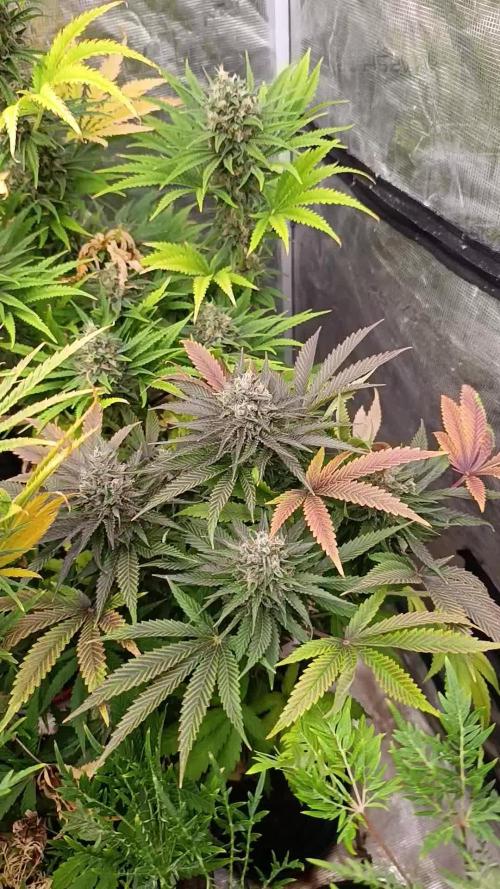
La Ice Cream Haze entra ya en su fase final: cogollos más duros, más resina y los tonos morados ganando terreno en hojas y flores. El aroma se afina, dulce y cremoso, con un punto afrutado que se intensifica al mínimo roce. La planta ya no crece, madura: pistilos oscureciendo y cálices bien hinchados.
Última semana aplicando nutrientes antes del lavado de raíces
¡Seguimos creciendo fuerte 💪!



@Oldwied
Follow
Lady MimosaE was able to get fatter in peace. The humidity is borderline. Fluctuations of 40 -70%. But I will leave it like this, humidification with a fogger and bucket is running.
Otherwise I only watered with water
Light Power: 100%
Day 79
Flower #3








@Ultraviolet
Follow
Permanent Marker weed strain possesses the genetics for high anthocyanin production, which is responsible for its signature deep purple. While the genes are present, the expression of these colors is often enhanced by "thermal stress" (lower temperatures) during the final three weeks of flowering, which triggers the production of these pigments.
👋 Raising the Carbon-to-Nitrogen (C:N) ratio in the growing medium to avoid over-immobilizing nitrogen, on the flip side, being careful not to trigger early autophagy. Moderate, controlled increases in sugar support the energetic demands of flowering and act as a signal trigger, but excess sugar is more likely to inhibit flowering or damage the plant. Balance, like everything else. Visually, when the chloryphyll green gets darker, it is a subtle indicator that the concentration of nitrogen is increasing / more is being stored than is being used. I noticed when you push very high intensity lighting, it slowly fades the green as the plant degrades chloryphyll faster than it can be replenished. When the green of the leaf continually gets darker, it is an indication that the concentration levels of nitrogen are increasing, and I dont want to increase light intensity.
Turn down the nitrogen faucet. C:N ratio dictates the rate at which nitrification occurs, if at all.
The Carbon-to-Nitrogen (C:N) ratio acts as a critical biological "on/off switch" (or regulator) for nitrogen turnover by determining whether microbes
immobilize (consume/tie up) or mineralize (release) nitrogen during the breakdown of organic matter. This ratio regulates microbial activity by defining the balance between available energy (carbon) and building materials (nitrogen). The C:N ratio in a medium acts as a critical regulator of nitrification, effectively functioning as an "on/off" switch for the dominance of either autotrophic nitrifying bacteria or heterotrophic bacteria.
The shade of green in chlorophyll is subtly linked to the enzyme Rubisco through a co-evolutionary, functional relationship designed to optimize photosynthesis. Chlorophyll absorbs blue and red light for energy, reflecting green light, a process that ensures the "light-dependent" reactions provide the correct, controlled amount of energy (ATP and NADPH) needed by Rubisco to perform its "light-independent" carbon fixation. Because Rubisco is a relatively inefficient and slow enzyme—often considered the bottleneck of photosynthesis—chlorophyll and the overall structure of the leaf have evolved to manage energy distribution to prevent overwhelming the Calvin cycle.
While chlorophyll absorbs mainly red and blue light, it is not perfectly efficient, and leaves appear green because some green light is reflected or transmitted. This reflection allows light to penetrate deeper into the leaf, preventing the surface chloroplasts from becoming overloaded and enabling a more efficient distribution of energy to the high volume of Rubisco located throughout the leaf's mesophyll.
The rate of chlorophyll-driven electron transport (light reactions) is matched to the potential rate of carbon fixation (Rubisco activity). If Rubisco were faster, leaves might be darker; however, the "shade of green" represents a balance that prevents chlorophyll from producing more energy than the inefficient Rubisco can process. The green color itself is a byproduct of a photosynthetic system tailored to feed a slow, yet crucial, enzyme (Rubisco) just enough energy to maximize carbon assimilation without inducing excessive oxidative stress or inefficiency.
The shade of green in leaves is directly linked to the concentration of chlorophyll, which is in turn strongly correlated with the amount of
Rubisco (Ribulose-1,5-bisphosphate carboxylase/oxygenase) and, consequently, the rate of carbon fixation. Darker green leaves generally indicate a higher concentration of both chlorophyll and Rubisco, signifying greater capacity for photosynthesis.
Increase output or reduce input. Subtle tells.
While an excess of nitrogen (specifically ammonium) can cause an imbalance, nitrification—the microbial conversion of ammonia to nitrate—is highly sensitive to a variety of environmental, chemical, and physical factors. Because it depends on specific, slow-growing bacteria (Nitrosomonas and Nitrobacter) and archaea, anything that stresses these organisms can disrupt the process.




@HandsomeTerpz
Follow
Black Mamba is absolutely thriving! 🐍🔥
She’s growing beautifully and developing an exceptionally intense aroma 🌿✨ Week 10 is done and things are getting seriously exciting. I can’t wait to see how she finishes up!
Get ready for the official release 🚀
Everything grown with Bio Tabs seriously amazing nutrients for super easy handling and strong, healthy plants 💪🌱
Stay tuned… this one’s going to be special. 😎🔥


@Hix57
Follow
Le 41e jour se déroule paisiblement pour mes précieuses plantes. Je remarque un léger jaunissement des feuilles, probablement dû au début de la floraison, à un éventuel manque d'azote ou à des processus naturels que je découvre au fil du temps.
De plus, des tâches apparaissent sur les feuilles, peut-être en raison d'un déficit en calcium, malgré la dureté élevée de l'eau dans ma région.
Je procède également avec prudence en augmentant progressivement le phosphore et le potassium, dans l'espoir de ne pas répéter les erreurs du passé liées à des excès. Chaque jour, je progresse et je m'enrichis d'expérience.
Merci de me lire et de partager cette aventure avec moi. 🙏🌱
Remarque :
Engrais : légère augmentation du phosphore et potassium et un peu d'azote.
Symptômes : taches sur feuilles comme sur les autres cultures. Peut être calcium.
Plante très petites et trapue probablement a dominance indica.


@MadeInGermany
Follow
Welcome to the Zamnesia Spring Cup 🏆
Day 27 since the time change to 12/12 h .
Hi everyone 🤗.
Every day is a great pleasure as soon as I open the tent and the sweet scent rises in my nose 😍.
The buds continue to develop day after day, and look more and more delicious 😃.
She has stopped growing in height and is fully focused on flower production 👍.
The Monster Bud Mix does exactly what it should 😎.
I am very excited to see how it will develop next week and I hope you enjoy the new update 😃.
Stay healthy 🙏🏻 and let it grow 🌱🙏🏻
You can buy this Strain at :
www.Zamnesia.com
Typ:
Sour Diesel (Zamnesia)
Zamnesia Spring Cup 🏆🏆🏆
Type:
Runtz
☝️🏼
Genetics:
Zkittlez x Gelato
👍
Vega lamp: 2 x Todogrow Led
Quantum Board 100 W
💡
Bloom Lamp : 2 x Todogrow Led
Cxb 3590 COB 3500 K 205 W
💡💡☝️🏼
Soil : Canna Bio
☝️🏼
Nutrients : Monster Bud Mix
☝️🏼🌱
Water: Osmosis water mixed with normal water (24 hours stale that the chlorine evaporates) to 0.2 EC. Add Cal / Mag to 0.4 Ec Ph with Organic Ph - to 6.0 - 6.3
💦💧


@Skinnytalls420
Follow
Day 43- 23/01/22 looking good hopefully they gonna come out better than my last run!!!!


@S2340420
Follow
If ye look at the back right there seems to be a we mutatedeaf growing in the pot beside the actual seed haha


@Canna96
Follow
Very beautiful dense and fruity smelling buds. This strain is definitely not something I recommend for mainlining, as she wants to flower very fast! It took me a couple tries to build a manifold out of her, but the buds are sooo dense and fruity smelling, the pictures really don't do them justice. She is definitely not a huge yielder, as I only got 41.9 zips wet, but I will be satisfied with 8-9 zips in 69 days if the buds taste anything like they smell. She is definitely a big feeder, and absolutely covered in trichomes. I will post a final dry weight and smoke report in a few weeks, thanks for stopping by, enjoy your weekend, and Blaze On!!!


@Nor_Cal_Kannabliss
Follow
Welp, These took a Bit longer than my Cream Cookies and still didn't fill out quite like I thought they would.. But they are still a very beautiful strain and a joy to have grown. They smell stronger and way more lovely than the cream cookies thou just a beautiful aroma
I'd really like to grow these again Indoors where I can control them easier. (Sadly they dried into wispy nothings and we turned them all into bubble hash)
#3 took the hit of some aphids and ended up in a frozen hash pile in our fridge along with two cream cookies from the run. It's frozen weight combined was 203g. *will update with dry*


@Jupiter12
Follow
Popped a seed for SeedSupreme's Chocolope around the beginning of February. Typing this in April, the plant has grown to about 1 meter. Germinated in a paper towel in a bag, but i put the bag in my heated vacuum chamber (without the vacuum running) and set the temp at 89-90 degrees. Popped in like 2 days, named the mother plant Charmaigne, and have since cloned the plant and gotten a good 9-11 babies that I'm currently giving the ol' voir-dire and I'll choose which ones make the cut. Put the lil clones in starter soil while my Ed Rosenthal soil cools off from mixing.
Also, this is about my 4th grow in this space. 1st one i needed to get back into a routine, second one got screwed up with my take on custom dirt, then salvaged. 3rd one, i learned about powdery mildew, and how to NOT get it. This being the 4th, i decided that i really wanted to complicate my life even further with a 13 week flowering cycle plant and no knowledge as to how to get this Chocolope dank af, so any and all critiques, questions, comments concerns and disbeliefs are welcome, as I can use all the help i can get here...


@Hempface86
Follow
Well here we are guys going into our fifth week of flower and she has been putting on weight.. thank you SEEDSMAN for giving me the opportunity to grow this beautiful plant and I really mean that this girl has been amazing from the very beginning I have done absolutely nothing to her other than some small defoliation and she has been a breeze taking any strength of nutrients I throw at her.. I hope and pray everybody is happy and healthy and so are their girls.. this community rocks! Happy growing everyone ✌️😎


@AnnGeneLabs
Follow
Hey Diary! Just wrapped up week 5 of my green project, and we're fully in the blooming stage now! 🌸
Out plant has stretched up beautifully. It seems to be enjoying life just as much as I am.
Here's the weekly rundown:
Automated Watering: This is cool! I've set up an automated watering system that I can control through a Telegram bot. Hello, technology! 🤖💧
Defoliation: Last week, we did some defoliation, trimming off the unnecessary leaves. This helped the plant focus more on flowering. Sometimes less is more, right?
Can't wait to see what the next week brings. Catch you later, GD! 🌿📚


@CannabisKhan
Follow
Plants were watered on day 4 of week 9, as follows:
Lucy: 1 gallon water, pH: 6.27, Height: 22 in.
Herbert: 1.25 gallons water, pH: 5.77, Height: 24.5 in.
***Both fed nutrients - 5 ml/.5 gal BioVega (3% N, 1% Phosphate, 5% Soluble Potash), 7 ml/.5 gal BioBoost (1% Phosphate), and 1 ml/.5 gal BioRhizotonic (0.6% Soluble Potash)
Plants were watered on day 5 of week 9, as follows:
Thin Mint Sr: 1 gallon water, pH: 6.76, Height: 20 in.
Thin Mint Jr: 1 gallon water, pH: 6.50, Height: 19.5 in
Notes: Thin Mint Jr has nutrient burn and so was NOT fed nutrients today. Thin Mint Sr was fed nutrients at 50% strength 2.5 ml/.5 gal BioVega (3% N, 1% Phosphate, 5% Soluble Potash), 4 ml/.5 gal BioBoost (1% Phosphate), and 0.5 ml/.5 gal BioRhizotonic (0.6% Soluble Potash) (both plants still in nutrient distress - in process of recovery but have some new growth that is greener so improvement is being observed; slowly but surely!)
***Plants ideally would have been transitioned to the flowering phase this week, but due to nutrient deficiencies and nutrient burn on Thin Mint Jr., we are holding off on this transition for 1 week to give the plants a chance to recover from stress.



@Hydroaccess
Follow
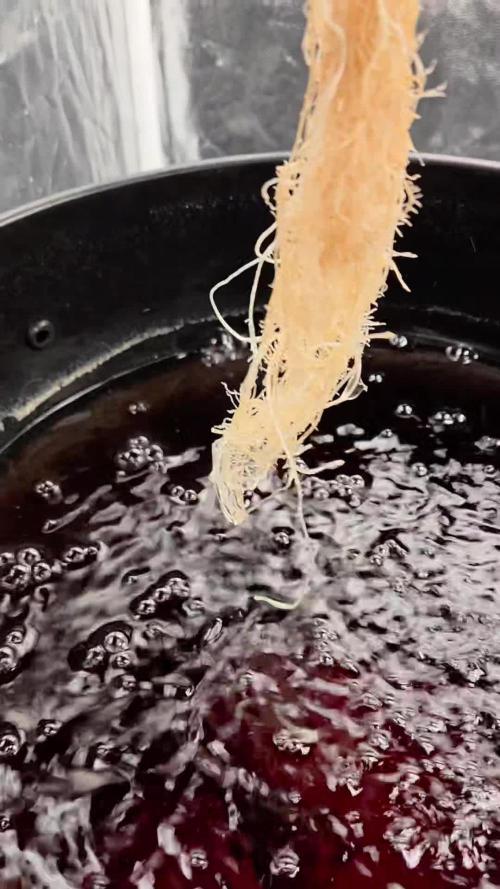
La Jack Herer Auto sigue evolucionando con mucha fuerza. El sistema radicular está explotando, mostrando unas raíces impecables, gruesas y de un blanco que confirma la salud de la planta. El follaje se ve saludable. Los parámetros en el tanque se mantienen estables como un reloj: pH en 5.8 y la EC controlada en 450 ppm. Con la dieta de CalMag, Hesi Crecimiento y Hypro-shield, la asimilación va bien y el crecimiento no se detiene.