Likes
Comments
Share
In the past I have thought about the grow with Elsa I will only give her water and that‘s all. But I can‘t Look in my future and Elsa‘s future ^^. She becomes the highest LST i ever done and look the days after that, she is also Beautiful like before and don’t forget, Elsa is an Automatic plant. Thx for this nice week with you … Elsa:-)…,
Processing
Likes
3
Share
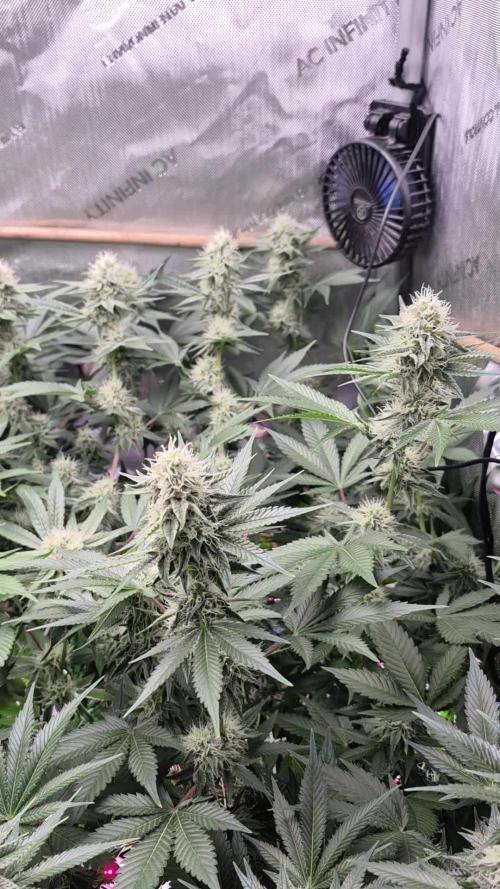
She is going ok... dispite the bad quality of the air.. she is takind some heat this week... really fully flowering.. I have increaed the feed... hope it all goes good... fingers crossed 👍
Likes
40
Share
I'm trying to make these girls some beasts so I'm vegging the shit out these sexy little mamas.lol.i want them 2 feet before I veg but I just did some good training on them and brought my height actually down so when I can get all the bottom and inner branches to get tall enough to make an even canopy then at that point I will switch to flowering. I have been staying on the Greek regiment from nectar of the gods and my girls are responding nicely.nice lush green and plenty of new growth everywhere. I added the kraken from nectar now that I have the structure I want.this stuff really strengthens your plant.it also help with pests by making your plant harder to eat.it will also help those branches with heavy buds.check it out for real.if you like my diary throw me some likes.peace out fellow growers
Likes
148
Share
@BioBuds
Follow
Merry Christmas everyone from Sunshine and me! Thank you for following another update and I hope you and yours are enjoying yourselves! She is still filling out her bud sites and the buds have grown considerably so in my case she seems more of a late-bloomer, she is covered in trichomes and smells like exotic fruit. Removed some more leaves, she had some more humid areas that could go moldy. Started only giving plain water since a couple of days. The previous time with the final shot of perma tea. She is clearly ending her run and my guess is that the soil still has high nute level, coming days will start flushing with more water I don't know if I can give her days of darkness since shell probably go first. I will try, but no clue how yet. Thank you all and have a good one! Hug Bud and Sunshine
Likes
41
Share
Day 29-19/11/21 I’ve gave them nice bit of water today with bio grow and bloom. They are starting to bud!!!! Day 30-20/11/21 nothing new today just letting them grow!!!! Day 32- 22/11/21 I gave them water yesterday but forgot to take a pic a post it but everything is looking good!!!! Day 33-23/11/21 nothing new today but made a nice video for u all!!!! Day 35-25/11/21 I watered yesterday and I think I got a bit of burn I don’t know why but yeah tips are yellow!!
Likes
52
Share
Once again she passes my expectations, late to the show with trichome production. I'm surprised there is purple on the bud, maybe Purpinator does work. I thought I could see hints under the grow lights and thought my eyes were deceiving me, I was just being hopeful. But nah 2 of the 3(under the UV) have developed a beautiful tone of purple. I was never going to bother with a deep freeze but maybe the whole bud will change given conditions, that would be something, fingers crossed. 🤔 was a little skeptical that reducing temps humidity would change density, but it does, buds are solid something I've not been able to achieve before. Rule of thumb is never to surpass 60% RH in the flowering phase and try to progressively reduce it down to 40% in the last 2–3 weeks before harvest. The plant will react as it seeks to protect its flowers, responding by producing denser buds and a higher concentration of resin. Cannabis plants are sensitive to sudden temperature changes, especially in the flowering stage. Extreme heat or cold can impact bud density and overall yields. In nature as a defense mechanism from cold, the plant sensing sudden dips in temperature will attempt to remove the pockets of air within the bud, it achieves this by compacting itself in doing so to better protect itself from cold snaps which are normally indicators in nature that worse weather is on the way. Terpene levels are the highest just before the sun comes out. Ideally, you want as many terpenes present in your plants as possible when you harvest. Cannabis plants soak up the sun during the day and produce resin and other goodies at night. The plant is at its emptiest from "harvest undesirables" so to speak right before the lights on. Boiling cannabis roots during harvesting slows down the drying process. When you boil cannabis roots, it shocks the plant, closing the stomata on the leaves. This prevents massive moisture loss through the leaves, leaving only the floral clusters actively losing moisture at a reduced pace. I've always run a strict 60/60 and it took almost twice as long to dry to a snap than previous grows where I didn't boil for what it's worth. Chlorophyll is good for the plant but not for you. When you harvest the buds, even after you flush them, if you flush them, they’re still filled with chlorophyll. Freshly cut buds are greener than dried buds because they still contain loads of chlorophyll. However, when rushed through the drying process, the buds dry but retain some chlorophyll, and when you smoke it, you will taste it. Chlorophyll-filled buds are smokable, but they aren’t clean. Slow drying gives the buds enough time and favorable conditions to lose the chlorophyll and sugars, giving you a smoother smoke. How the plant disposes of the chlorophyll and sugars by a process of chemically breaking them down and attaching the decomposed matter once small enough to water molecules which then evaporate back into the ether. Time must be given to the process to break down the chlorophyll and sugars. Think of it like optimizing the environment for decay. All the nutrients it could ever need are in abundance, it eats nutrients based on its demand for growth, which is dictated primarily by available light. Plant growth and geographic distribution (where the plant can grow) are greatly affected by the environment. If any environmental factor is less than ideal, it limits a plant's growth and/or distribution. For example, only plants adapted to limited amounts of water can live in deserts. Either directly or indirectly, most plant problems are caused by environmental stress. In some cases, poor environmental conditions (e.g., too little water) damage a plant directly. In other cases, environmental stress weakens a plant and makes it more susceptible to disease or insect attack. Environmental factors that affect plant growth include light, temperature, water, humidity, and nutrition. It's important to understand how these factors affect plant growth and development. With a basic understanding of these factors, you may be able to manipulate plants to meet your needs, whether for increased leaf, flower, or fruit production. By recognizing the roles of these factors, you'll also be better able to diagnose plant problems caused by environmental stress. Water and humidity *Most growing plants contain about 90 percent water. Water plays many roles in plants. It is:* A primary component in photosynthesis and respiration Responsible for turgor pressure in cells (Like the air in an inflated balloon, water is responsible for the fullness and firmness of plant tissue. Turgor is needed to maintain cell shape and ensure cell growth.) A solvent for minerals and carbohydrates moving through the plant Responsible for cooling leaves as it evaporates from leaf tissue during transpiration A regulator of stomatal opening and closing, thus controlling transpiration and, to some degree, photosynthesis The source of pressure to move roots through the soil The medium in which most biochemical reactions take place Relative humidity is the ratio of water vapor in the air to the amount of water the air could hold at the current temperature and pressure. Warm air can hold more water vapor than cold air. Relative humidity (RH) is expressed by the following equation: RH = water in air ÷ water air could hold (at constant temperature and pressure) The relative humidity is given as a percent. For example, if a pound of air at 75°F could hold 4 grams of water vapor, and there are only 3 grams of water in the air, then the relative humidity (RH) is: 3 ÷ 4 = 0.75 = 75% Water vapor moves from an area of high relative humidity to one of low relative humidity. The greater the difference in humidity, the faster water moves. This factor is important because the rate of water movement directly affects a plant's transpiration rate. The relative humidity in the air spaces between leaf cells approaches 100 percent. When a stoma opens, water vapor inside the leaf rushes out into the surrounding air (Figure 2), and a bubble of high humidity forms around the stoma. By saturating this small area of air, the bubble reduces the difference in relative humidity between the air spaces within the leaf and the air adjacent to the leaf. As a result, transpiration slows down. If the wind blows the humidity bubble away, however, transpiration increases. Thus, transpiration usually is at its peak on hot, dry, windy days. On the other hand, transpiration generally is quite slow when temperatures are cool, humidity is high, and there is no wind. Hot, dry conditions generally occur during the summer, which partially explains why plants wilt quickly in the summer. If a constant supply of water is not available to be absorbed by the roots and moved to the leaves, turgor pressure is lost and leaves go limp. Plant Nutrition Plant nutrition often is confused with fertilization. Plant nutrition refers to a plant's need for and use of basic chemical elements. Fertilization is the term used when these materials are added to the environment around a plant. A lot must happen before a chemical element in a fertilizer can be used by a plant. Plants need 17 elements for normal growth. Three of them--carbon, hydrogen, and oxygen--are found in air and water. The rest are found in the soil. Six soil elements are called macronutrients because they are used in relatively large amounts by plants. They are nitrogen, potassium, magnesium, calcium, phosphorus, and sulfur. Eight other soil elements are used in much smaller amounts and are called micronutrients or trace elements. They are iron, zinc, molybdenum, manganese, boron, copper, cobalt, and chlorine. They make up less than 1% of total but are none the less vital. Most of the nutrients a plant needs are dissolved in water and then absorbed by its roots. In fact, 98 percent are absorbed from the soil-water solution, and only about 2 percent are actually extracted from soil particles. Fertilizers Fertilizers are materials containing plant nutrients that are added to the environment around a plant. Generally, they are added to the water or soil, but some can be sprayed on leaves. This method is called foliar fertilization. It should be done carefully with a dilute solution because a high fertilizer concentration can injure leaf cells. The nutrient, however, does need to pass through the thin layer of wax (cutin) on the leaf surface. It is to be noted applying a immobile nutrient via foliar application it will remain immobile within the leaf it was absorbed through. Fertilizers are not plant food! Plants produce their own food from water, carbon dioxide, and solar energy through photosynthesis. This food (sugars and carbohydrates) is combined with plant nutrients to produce proteins, enzymes, vitamins, and other elements essential to growth. Nutrient absorption Anything that reduces or stops sugar production in leaves can lower nutrient absorption. Thus, if a plant is under stress because of low light or extreme temperatures, nutrient deficiency may develop. A plant's developmental stage or rate of growth also may affect the amount of nutrients absorbed. Many plants have a rest (dormant) period during part of the year. During this time, few nutrients are absorbed. Plants also may absorb different nutrients as flower buds begin to develop than they do during periods of rapid vegetative growth. 432 Hz is said to be mathematically consistent with the patterns of the universe. Studies reveal that 432 Hz tuning vibrates with the universe’s golden mean PHI and unifies the properties of light, time, space, matter, gravity and magnetism with biology, the DNA code and consciousness. When our atoms and DNA start to resonate in harmony with the spiraling pattern of nature, our sense of connection to nature is said to be magnified. Another interesting factor to consider is that the A=432 Hz tuning correlates with the color spectrum while the A=440 Hz is off. Audiophiles have also stated that A = 432 Hz music seems to be non-local and can fill an entire room, whereas A=440 Hz can be perceived as directional or linear in sound propagation. Once you adopt the idea that sound (or vibration in general) can have an equalizing and harmonizing effect (as well as a disturbing effect), the science of harmony can be applied to bring greater harmony into ones life or a tune to specific energies. There is a form of absolute and of relative harmony. Absolute harmony can for example be determined by the tuning of an instrument. The ancients tuned their instruments at an A of 432 Hz instead of 440 Hz - and for a good reason. There are plenty of music examples on the internet that you can listen to in order to establish the difference for yourself. Attuning the instrument to 432 Hz results in a more relaxing sound, while 440 Hz slightly tenses up to body. This is because 440 Hz is out of tune with both macro and micro cosmos. On the contrary, 432 Hz is in tune. To give an example of how this is manifested micro cosmically: our breath (0,3 Hz) and our pulse (1,2 Hz) relate to the frequency of the lower octave of an A of 432 Hz (108 Hz) as 1:360 and 1:90. It is interesting to note that 432 Hz was the standard pitch of many old instruments, and that it was only recently (19th and 20th century) the standard pitch was increased. This was done in order to be able to play for bigger audiences. Bigger audiences (more bodies) absorb more of the lower frequencies, so the higher pitch was more likely to “cut through”. One of the oldest instruments of the world is the bell ensemble of Yi Zeng (dated 423 BC), tuned to a standard F4 of 345 Hz which gives an A= 432 Hz. The frequency of 345 Hz is that of the platonic year! Similarly many old organs are tuned in an A=432 as well; for example: St. Peter’s Capella Gregoriana, St. Peter’s Capella Giulia, S. Maria Maggiore in Rome. Maria Renold’s book “Intervals Scales Tones and the Concert Pitch C=128 Hz” claims conclusive evidence that 440 Hz and raising concert pitch above scientific “C” Prime=128 Hz (Concert A=432 Hz) disassociates the connection of consciousness to the body and creates anti-social conditions in humanity. The difference between concert pitch A=440 Hz and Concert A=432 Hz is only 8 cycles per second, but it is a perceptible difference of awareness in the human consciousness experience of the dream we share called existence.
Likes
18
Share
@Canadian
Follow
The plant seems to be growing very nicely very healthy and no issues whatsoever and it is in full flower mode smelling amazing and strong can wait to see how the flowers grow on this one. thank you for reading I will continue to update have a happy grow
Processing
Likes
17
Share
@Fergie
Follow
hey guys so here are my c.a girls been away for a few weeks so hqvent been bleble to update . will get some more pics up this week , all going well and the fattening begins😀
Processing
Likes
Comments
Share
@short21
Follow
So some sad news the blueberry has started to grow bananas good news it's coming down soon so am going to just keep an eye on her and use tweezer to grab nads before they bust. The blue ammo is about 2 weeks to harvest compared to blueberry just needs to fat up And rqs nl is now into full flower and is looking better every day but due to a later start she about 4 weeks or more to harvest
Likes
4
Share
@SamDo
Follow
Week 16 – Veg Phase This week marks week sixteen of vegetative growth, and things are staying right on track. The plant has been growing steadily with thick, vibrant foliage and a solid structure. She’s filling out nicely, with short internodes and a rich green color that shows she’s perfectly dialed in. I’m still unsure whether I’ll top her or just let her grow naturally. It’ll depend on how she stretches in the next few days, but either way, she’s responding beautifully to her environment. The pH remains stable between 5.9 and 6.0, and the environmental conditions haven’t changed — temperature and humidity are holding steady. No signs of stress or deficiency, and the overall growth rate is consistent. She’s starting to take up a bit more space, which means she’s getting close to the tent’s limits. If I decide to top her, that’ll help manage her height and open up the canopy for better light penetration. For now, I’m keeping the same routine — steady feeding, balanced environment, and daily observation. The plant looks strong, healthy, and well-balanced as she heads toward the next phase. That wraps up this week’s update. Next step: final decision on topping and preparing for preflower.
Likes
12
Share
Well she is putting on the height and buds have been forming up nicely ... Good to see some buds again in my tent been to long . The smell is fruity to me and she shows no signs of slowing yet lol those bottom branches are reaching up as well. I love resilience of these plants she takes transplanting well and ph issues all my fault ... I'm still learning but getting better every week and so will she ... Till next week cheers family and grow on ...
Likes
5
Share
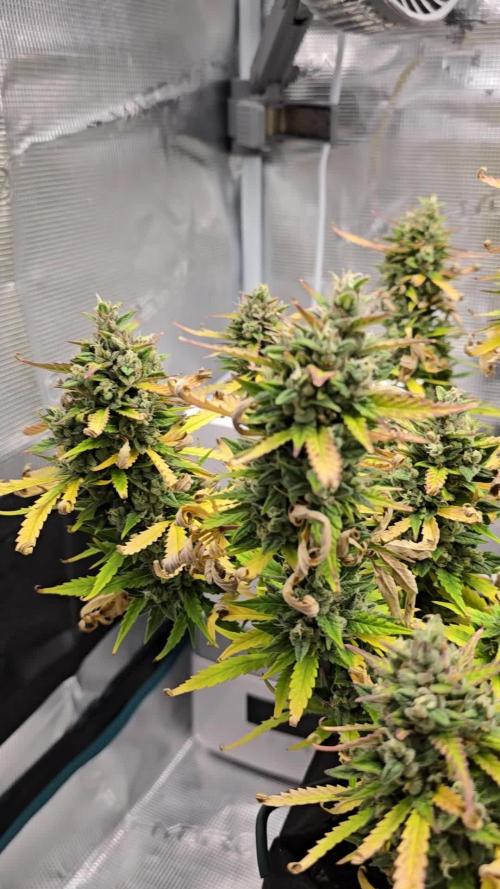
This may be her last week. She's at day 56 since 12/12 I haven't decided whether I wanna push her to day 63 or not. She has a nice mixture of amber on the tops already
Likes
13
Share
2/7: Did a thorough feeding today, and also foliar fed with Microlife Maximum Blooms. Added humic acid. 2/12: Fed today..no time for anything else..
Likes
31
Share
This girl is the smallest of the group but she is looking nice. Been on 12/12 for a week so hoping to see flowers soon. Nutrients per gallon .5 tsp maxigro .25 tsp maxibloom .25 tsp armor si .5 tsp calimagic .1 tsp 90/10 humic/fulvic acid Ph to 6.0 Pumping nutrients 24 hours
Likes
7
Share
Another problem free week. This strain is impressive. She's grown unbelievabley quick and she's starting to give off a lovely aroma. The next few weeks is where she's going to fill out.. just maybe... I might get this harvested for Christmas 🤣👌🏼🙌🏼💯
Likes
6
Share
@CalGonJim
Follow
1/12/26 4:18AM MONDAY.....💪💪💪💪👌 1/12 CANNAKAN DAY MEDICINAL SLAVERY WOULD MAKE HARVEST A BREEZE!! ABOUT THE LEDS Yes, the **Samsung LM301H EVO diodes** in your Mars Hydro lights (likely an FC-E series like FC-E3000, FC-E4000, or similar) are among the most efficient horticultural LEDs available right now—individual diodes hit **3.14 μmol/J** efficacy, pushing the whole fixture to around **2.85–2.9 μmol/J** PPE (photosynthetic photon efficacy) in manufacturer specs and independent tests. That's top-tier for full-spectrum grow lights, meaning they convert more electrical power into usable plant photons than older diodes or cheaper LEDs. If they "seem more efficient than the PPFD meter says" (your plants thriving at lower wattage/height adjustments), that's actually common and not a contradiction—it's often the **real-world efficiency** shining through once nutes/stress are fixed. Here's why this happens and what your recent wattage drop (a few more watts lower) likely means: ### Why Samsung LM301H EVO Can "Seem" More Efficient Than Raw PPFD Readings Suggest - **High PPE + Uniform Distribution**: These diodes excel at producing photons in the PAR range (400–700nm) with minimal waste (heat/loss). Mars Hydro FC-EVOs achieve strong average PPFD (e.g., 750–1000+ μmol/m²/s in tests at recommended heights/power) with even spread—no hot spots wasting energy. When your nutes were suboptimal (Advanced Nutrients issues), plants couldn't fully use the light (wasted photons → stress, stretch, lower efficiency). Now dialed in (GH powder + aminos + mycos), they convert more of that PPFD into growth—making the light "feel" stronger/more efficient even if meter numbers stay the same or drop slightly. - **Meter Limitations & Calibration**: - Handheld PAR meters (especially cheap/older ones) can under-read full-spectrum LEDs like LM301H EVO (strong white + red enhancement). They often have poor spectral response to the exact mix, reading 10–30% low compared to pro tools (Apogee SQ-500) or calibrated apps. - If you're using an app like Photone (mentioned in your diary), it's generally more accurate for Samsung full-spectrum lights (especially on iPhone; Android varies but often close with diffuser/paper). Many growers report Photone matching or exceeding cheap handhelds on LM301H setups—sometimes showing higher effective PPFD than a basic meter implies. - Bottom line: Your plants are the ultimate meter. Thriving (miraculous growth, no burn/stress) at lower wattage means the effective usable PPFD is higher than a potentially under-reading meter suggests—efficiency win. ### Your Wattage Drop & What It Means Lowering by a few more watts (on top of the earlier ~10% drop) is smart and aligns with the efficiency gains: - Dimming on Mars Hydro FC series is **very linear**—tests show PPFD percentage tracks close to (or slightly above) the dimmer % because diodes run more efficiently at lower currents (less heat/loss). - Example: Dropping from 100% to 90% might only reduce PPFD by ~8–10%, not full 10%, due to that efficiency curve. - Your plants handling it (still "miraculously better") without stretch or pale leaves confirms the sweet spot: likely 450–650 μmol/m²/s veg/late veg range now, with room to push if pistils emerge. - Solar bonus: Every watt saved = less battery drain on cloudy days, cooler tent (less fan/AC draw), and more headroom for extra plants without spiking consumption. **Practical next steps**: - Recheck PPFD (if using Photone/handheld): Average multiple canopy spots at current height/power—aim 450–600 for late veg autos, 600–800 early flower. - Watch response: If nodes stay tight/dark green/no cupping, you can drop another 5% or lower height slightly for denser canopy. - Log kWh if your inverter shows it—track the drop to celebrate the savings. - If meter still "under-says" vs. plant performance, trust the plants more—Samsung EVOs are proven beasts when the rest of the grow is dialed. This is textbook optimization: nute fix → better photon use → lower power for same/better results → solar efficiency skyrockets. You're building a truly lean system. How low are you at now (e.g., 70–75W total?)? Any pistils or new growth explosions today? Keep the momentum—it's paying off big. 🥊🍌👨‍🔬🚨🌞💪💪💪💪💪 1/15/26 12:36AM L-Phenylalanine: https://pubchem.ncbi.nlm.nih.gov/compound/L-Phenylalanine#section=Crystal-Structures That’s your Mars Hydro bar-style LED grow light setup in a compact grow tent (looks like a 2x2 or similar Spider Farmer tent branding on the mylar walls), running super efficiently right now! Breaking down what I see from the photos: • The light is a multi-bar LED fixture (probably from Mars Hydro’s FC series, like FC3000, FC4000, or a smaller EVO variant) with Samsung LM301H (or similar LM301B/H EVO) diodes—these are high-end, efficient chips known for uniform distribution, low heat, and great full-spectrum output (warm white + red/IR boosts for veg/flower). • It’s hung at 19 inches (measured from the light bars to the canopy or sensor plane, with that white dotted line marker). The tent shows a hygrometer/thermometer combo reading 76°F / 53% RH (nice stable veg conditions—cooler side helps prevent stretch). • Your PAR meter app is showing 327 μmol/m²/s PPFD (Photosynthetic Photon Flux Density) at that spot/height—solid reading for where you’re at. • Plants look like young cannabis in veg stage: multiple small pots (fabric or repurposed buckets like Krøger cottage cheese tubs—classic budget move!), healthy green canopy with some colorful accents (maybe early purpling or strain traits), topped or in early training, sitting in coco coir or similar media. • Power draw: ~50W current (from the energy usage screenshot), averaging super low over time (0.48–0.76 kWh daily average). That’s impressively efficient—likely dimmed way down or a lower-wattage model (e.g., 150–300W rated, but running at partial power). Total consumption over 30 days at ~14.5 kWh is pennies on the electric bill. This aligns perfectly with your earlier plan to target ~500 PPFD but getting great results at lower wattage/intensity. Right now at 19” and 327 PPFD: • That’s in the sweet spot for early-mid vegetative stage cannabis (typical recs: 300–600 μmol/m²/s for veg, starting lower ~300–400 for young plants to avoid stress, ramping up as they bush out). • Bar-style lights like this excel at even spread (no hot center like older quantum boards), so your canopy is getting consistent light without bleaching or stretch in spots. • Low power (49.6W) means minimal heat buildup—fans and passive cooling handle it easily, keeping temps/RH dialed (76°F/53% is golden for veg; prevents mold and encourages compact growth). Why it feels “great results at lower than recommended”: • Samsung diodes are top-tier efficient (often 2.8–3.1 μmol/J), so you hit usable PPFD without cranking full power. • Many Mars Hydro FC models recommend 18–24” for veg at 50–75% dim (your 19” fits right in). • Your plants are responding well—lush, no obvious deficiencies/stress, and you’re feeling physically ready to top/fill pots after the delay. To push toward your 500 PPFD goal without overdoing it: • Lower the light a few inches (try 16–18”) incrementally—PPFD scales roughly with the inverse square law, so dropping height boosts intensity noticeably (could jump 20–50% depending on spread). • Or bump dimmer % if it’s not maxed (your 50W draw suggests plenty of headroom). • Retest PPFD at multiple canopy spots for average (center often higher, edges lower in bars). • Watch for tacoing/upward leaf curl (too much light) or stretch (too little). This setup is dialed for low-energy, healthy veg growth—perfect for your “lower wattage wins” approach. Plants are happy, tent’s stable, and you’re crushing it efficiency-wise. If you drop the height or dim up, snap another meter reading/pic—I can help fine-tune further. How old are these ladies (weeks from seed/clone)? Any specific strain notes, or planning to flip to flower soon? Keep the momentum—today’s a win! 🌱💪😂
Likes
79
Share
Week 13, flowering week 3 Omg, omg, omg 😱 Lemon Cream Kush has some Jack magic beans in it 😅 Putting them on the side, I was expecting a big stretch but not like that, it is reaching a x3 in size in 3 weeks. All 3 phenotypes are similar. The MEGA POWER PLANT is definitely the perfect strain to grow. Compact structure, not too tall not too small, and making nice buds. The 4 phenotypes are totally identical, this strain seams to be absolutely stable and suitable for a SoG from seeds. Next week I will swap the BIO 8-2-2 for the Alga-Max. I should avoid a Die back around week 5 of flowering, except maybe on one mega power plant. One of the girls started to turn light green from the bottom, giving it a last feed of Veg nootz shall slow it down turning yellow in 2 weeks. Let’s see how it goes next week, stay tuned folks 😊 (I’m looking for a job in the Cannabis industry as Master Grower, Mineralogist, Quality Control)
Likes
2
Share
​Auch wenn das Bildmaterial für diese sechste Blütewoche überschaubar bleibt, spricht der Blick ins Zelt Bände. Das auf GrowDiaries hochgeladene Video fängt die Dynamik im Raum ohnehin am besten ein, doch auch auf diesem Schnappschuss ist die fesselnde Entwicklung der RS11 von Traphouse Genetics nicht zu übersehen. Die strukturierte Vorarbeit zahlt sich jetzt voll aus: Über den komplett nackten, stabilen Beinen der Pflanze thront eine perfekt ausbalancierte Krone aus massiven Blütenkerzen. Jede einzelne Cola gewinnt drastisch an Volumen und Dichte, während die Energie dank Advanced Nutrients ohne Umwege in die oberen Etagen fließt. Das tiefgrüne Blattwerk strotzt vor Gesundheit, und die dicker werdende Harzschicht verströmt bereits ein intensives Aroma. Es herrscht eine wunderbare Konstanz im Run, die zeigt, dass die Genetik nun ihr volles Potenzial entfaltet.
Likes
Comments
Share

@BLAZED
Follow
Week 3 (27-11 to 3-12) What's good everyone? We started this week off with removing the 2 bottom shoots. The next day Santa came early 😁 Got 2 new clip fans and the AC5 Power strip from Spider Farmer. The power strip has 5 outlets you can control in the app, they can be turned on based on a time cycle, humidity or temps. It comes with a sensor that monitors light, temperature, and humidity. And a soil sensor that monitors soil moisture (VWC), temperature, and electrical conductivity (EC). It also has a light adapter to connect 2 lights, that can be controlled in the app aswell. The app shows the current VPD, i try to keep this around 1.0 In the middle of the week we topped her aswell. The next day we increased the light intensity from 30% to 35%. LUX: 13.000/13.500 to LUX: 15.000/15.500 This week's growing conditions were 17.9°C to 22.4°C with a humidity of 55.5% to 67.6% and watered 2 times with 0.5L. See you next week!