


Likes
34
Share


@Southwest_budders21
Follow
Day 14 for these kre8 Genetics CandyMan regular seeds but I'm feeling confident I've got at least 2 girls growing 🤞🏻 been on mild feed of monkey Nutrients every couple days and seem to be enjoying it 😏 gave them just water today. The pots will be topped up with soil in the next day or so then I can take the pins out and start topping & training them 😍
Update: I've now just topped them on Day 19
Processing
Likes
49
Share


@The_Projexx
Follow
Shes growing well , I will be dialing the nutrients back on her as well I dont think I have to but its to keep it nice and even throughout the grow until she reaches flower . I can really say I have complaints about her for the past week shes been growing and doing her thing :) Shes getting ready to push up a new node so thats always exciting !
I'd like to thank everyone for the continued support as well as a special thank you to all my followers that come in daily and weekly to check out the updates you guys rock !!
-Happy Growing!


Likes
12
Share


@Zoe_Spacecake
Follow
He hecho varias podas para controlar el crecimiento de las plantas. Sirve también para hacer las ramas un poco más fuertes, porque es una variedad que tiene tendencia a crecer alta, fina, con ramas débiles.
Likes
4
Share


@Ultraviolet
Follow
RAW GROW is a tested blend of all 12 RAW Soluble plant nutrients, essential elements and supplements. This blend has been proven to be an optimal all-in-one base “Grow” horticultural fertilizer. RAW GROW is used through out the entire vegetative stage. Derived from: Plant protein hydrolysate, mono potassium phosphate, potassium sulfate, cane molasses, sodium borate, copper sulfate, iron DTPA, magnesium sulfate, manganese sulfate, zinc sulfate and azomite. Also contains non-plant food ingredients: Humic acids derived from leonardite and peat, kelp (ascophyllum nodosum), silicon dioxide derived from diatomite and yucca extract.
When you overlap a copper wire to attract ions, it is called ion exchange. Copper wire is often used as a material for ion exchange because it has a high affinity for positively charged ions, such as copper, zinc, and nickel. When copper wire is overlapped or wound into a coil, it creates a surface area that attracts ions and allows them to bind to the wire or gather within the space. This process is used in various applications, such as electroplating, water treatment, chemical separation processes and cultivation.
Electrolysis is a chemical process that involves passing an electric current through a liquid or solution containing ions. This process causes the ions to migrate towards the electrodes, where they undergo a chemical reaction.
In the context of plant growth, electrolysis is used to increase the availability of your nutrient-rich solution that can be used to feed plants.
Electrolysis and nutrient rich reservoirs work well together since your cannabis nutrients are salt based. The process involves passing an electric current through a solution of water and plant nutrients, which causes the water molecules to break down into their constituent parts, hydrogen, and oxygen.
The hydrogen ions (H+) then combine with the nutrients in the solution to form a nutrient-rich substance that can be absorbed by the plant roots easier. This will only work in a nutrient rich solution as it requires the salt-based nutrients to engage.
This process, known as hydrolysis, provides the plant with a continuous supply of nutrients and oxygen, which can help to increase plant growth and improve yields. By providing the plant with a more efficient method of absorbing nutrients, electrolysis can help to increase the uptake of essential elements such as nitrogen, phosphorus, and potassium. Additionally, electrolysis can help to maintain the pH balance of the growing medium, which is essential for optimal plant growth. One of the key advantages of using electrolysis to increase plant growth is that it allows for greater control over the growing system. This is exactly why this is generally a technique reserved for advanced hydroponics growers. By adjusting the voltage and current levels, cultivators can custom control the nutrient concentration and pH level of the solution, ensuring that the plant receives the optimal amount of nutrients sitting perfectly on potential hydrogen spectrum.
Carotenoids absorb light in the blue-green range of the visible spectrum, complementing chlorophyll's absorption in the red range.
Carotenoids protect photosynthetic machinery from excess light. They deactivate singlet oxygen, which is a harmful oxidant formed during photosynthesis.
Carotenoids quench triplet chlorophyll, which can be harmful to photosynthesis.
Carotenoids scavenge reactive oxygen species (ROS), which can damage cell membranes and proteins.
Carotenoid derivatives signal plant development and responses to environmental cues.
Carotenoids provide precursors for the biosynthesis of phytohormones like abscisic acid (ABA) and strigolactones (SLs).
Carotenoids are pigments that give fruits and vegetables their orange, red, and yellow colors. They also act as free radical scavengers to protect plants during photosynthesis.
Beta-carotene is the most common provitamin A carotenoid. It's found in orange and yellow fruits and vegetables like carrots, sweet potatoes, and mangos. Other carotenoids include lycopene, lutein, and zeaxanthin. These carotenoids have antioxidant and photoprotective properties. In plants, Vitamin A is found as carotenoids, which are pigments that give plants their color. Vitamin A is a fat-soluble vitamin.
Vitamin B plays a vital role in plant growth and development. It acts as a coenzyme in many metabolic reactions, which are the basis for plant growth and maintenance.
Vitamin B helps plants metabolize nutrients, which are essential for growth and development.
Vitamin B helps plants respond to biotic and abiotic stress.
Vitamin B can help plants grow new roots, which can reduce transplant shock.
Vitamin B can help plants grow shoots, especially slow-growing plants.
Vitamin B1 Also known as thiamine diphosphate, vitamin B1 is a key component of metabolic pathways like glycolysis and the tricarboxylic acid cycle.
Vitamin B3 Also known as nicotinamide or niacin, vitamin B3 is a biostimulant that can improve plant growth and yield.
Vitamin B6 Vitamin B6 acts as an antioxidant and cofactor, and is involved in plant stress responses.
Vitamin C, also known as ascorbic acid, is a vital nutrient for plants that helps with growth and protects them from excess light.
Vitamin C acts as a redox buffer, which is important for regulating photosynthesis.
Vitamin C helps enzymes that regulate photosynthesis, hormone production, and regenerating antioxidants.
Vitamin C is a coenzyme in the xanthophyll cycle, which converts excess energy into heat. This process helps plants protect themselves from too much light.
seedlings to young plants can feed on 200-400 PPM, Teenage plants that have a maturing root zone can feed on 350-550 PPM and adults will feed 600-1000 PPM. The more you feed plants and watch them grow you'll get a feel for how much to give them. Less is more when trying to grasp this. High level of CEC in organic soil so I'm watering 5-gallon

Likes
65
Share


@bypado_farm
Follow
Day 49:
Watered the plants 0.5L with nuts
678 ppm, 1446 us/cm, PH 6.4
Day 51:
Did some defoliation
Day 52:
Watered the plants 0.5L with nuts
781 ppm, 1665 us/cm, PH 6.4
Day 54:
Watered the plants 0.5L with nuts
712 ppm, 1560 us/cm, PH 6.4


Likes
6
Share

@Northern_Ent
Follow
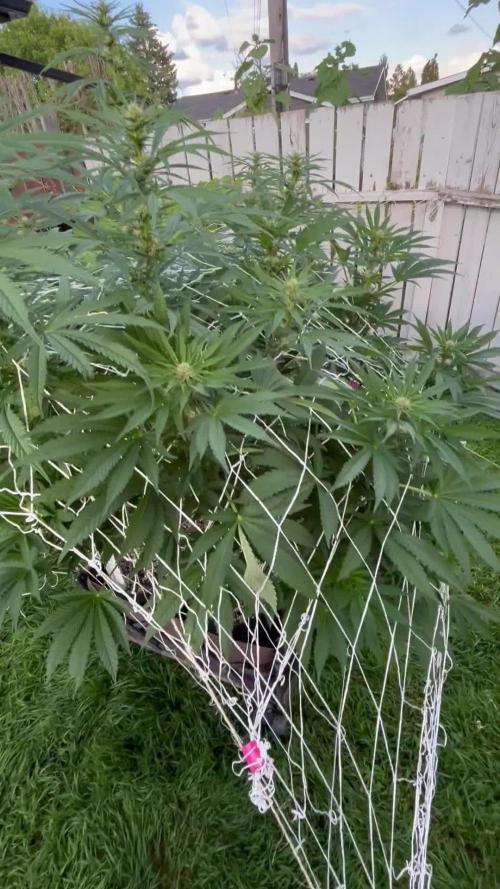
Aug 8: she had a late start and lost a couple of colas to hail a few weeks ago.
Aug 9: defoliated lower limbs.Layered another scrog net on the top and clipped to to the twine.
Aug 10: adding Green Sensation to the rotation and removing molasses. Molasses are great for growing but it needs to be stopped 4-6 weeks before harvest so you don’t have to smoke sugar along with your weed. ‘Molasses are for growing, not for smoking.’
Aug 13: mostly overcast and a bit of rain again today but some good sun.

Likes
7
Share


@cwgrows
Follow
They weren't kidding about the preflower growth, they are absolutely exploding!


Likes
4
Share


@NuttyYeti
Follow
Coming along nicely. I have to water it twice a day but that's to be expected with such a tiny pot. Should get a nice stick of bud out of it.

Likes
2
Share


@Fayah_Burn
Follow
Think this is gonna be my new FB favorite, smelling strong looking stronger 💪, hope that gorilla punches hard..
Ill tell you guy's more in the final report after everything is dry n cured..
Unfortunately i have not taken any post harvest pictures eather 😞 you can imagine all that lack of information resumes down to just one thing, lack of time.. sorry for that!

Processing
Likes
47
Share


@rhodes68
Follow
10/21 Day 23
Well may be seeing some improvement on Brandy and Maggie from the drench and mag foliar spray. Will spray again tomorrow.
Layla is just lovely and holding off another day on watering, temps have lowered and humidity is up so drying is slow.
Just dont get it but I have decided to go full Coco coir from here on, something aint right
10/22 Fed Layla
Big Bloom 3tsp - Fish Mix 1tsp - CalMag 1tsp - Recharge 0.5tsp - Fish Sh!t 0.5tsp / Gal at 6.5 ph for 0.5 gal
Brandy and Maggie seem to be improving, had to train and gave another foliar spraying nothing else done.
10/24 Update
New Pics - note new growth
Plants beginning to drink more and Maggie showing most improvement. Afraid Brandy will stunt but sure that was going to happen a week ago.
Leaf structure is improving greatly.
Prob will feed in a day or two and another foliar spray at the same time
10/26 Day 28 Finally fed all three girls - nothing much has changed appearance wise and pics tomorrow on new week.
Including initial dose of bloom nuets as hairs are showing strong - no foliar spray until Sunday.
Feeding:
Cal-Mag 5ml - Big bloom 15ml - Fish Mix 5ml - Bio-Bloom 5ml - Fish Sh!t 5ml / gal @6.45 ph for 1 gal (Layla) 0.75 gal (Maggie) 0.5 gal (Brandy) as they are drinking at different rates unfortunately. Final PH is taken after all nuets added, makes a difference.
NOTE:
Since this veg cycle is ending and the plants will be moving to the Flowering tent and this tent will be doing drying duty for the LSD-25 for a few days, time we were getting the Growit Coco coir ready for the Green Crack grow in a week or so. Hydrated the first brick (2 cuft hyd) and am single buffering the coco with 30 ml of cal-mag in four gallons of water for 24 hours.
This will also serve as a safety wash just in case the factory lies :)
Its supposed to be pretty good coco, little if any peat or croutons I can see.
Will do second brick when this one finished and I can store
Looking at using a different system this time around. Hope yall follow along
Went ahead and posted the daily pics of the problem children just for giggles.
Likes
6
Share


@Ross4Twenty
Follow
I think they are ready. I’ve just given her one last watering. Will wait for the soil to dry out now over the next two days and then put her in complete darkness for 32 hours then I will be trimming her down.
Thanks a lot guys for the people who have kept on top of this diary. Peace

Likes
5
Share


@HempZ
Follow
plants with 49 days - 15/09
everything going fine, took out some branches and will have a taste of whats coming in a few days.
gdp is looking the best, big buds full of resin. sweet grape smell.
mother 1 is probably gonna be my mother, full of crystals with a refreshing lemonade smell.
two more weeks to go for most of these plants, some will take longer.


Likes
Comments
Share


@ChewiesGrow420
Follow
If memory is correct I got just over a 40g dry weight. I wish I was more careful doing some LST on her. Snapped her main cola like an idiot!

Processing
Likes
47
Share


@KilgoreTrout
Follow
Going great. Just topped, transplanting by Saturday into final 5 gallon smart pots. 1/4 nutes. Probably fire up the MH after transplant.

Likes
15
Share


@Drgreenthumb627
Follow
by far the strongest and most vigorous of all my ladies. she is showing signs of flower more quickly than all the others
