


Likes
Comments
Share


@Chubbs
Follow
Weekly update on these lovely ladies. This week has been fun to watch the flowers form and swell. They definitely are starting to smell, as soon as you open the tent it hits you like a ton of bricks. I'll be doing my final dedoliation this week taking off some of the bigger fan leafs allowing more light to the lower flower sites. All in all Happy Growing

Likes
5
Share


@undermink
Follow
Both Princess Bubblegum I and Princess Bubblegum II look great. Both are growing their buds and keep on doing this. Thanks to the LST at the beginning the head bud and the buds surrounding it are euqal size and height. Seems to have worked as I wanted it to - yay 😍


Likes
6
Share


@lOlympusl
Follow
I added a second light yesterday. I’m not sure if it’s overkill and if it’ll work well with the other one. They are both VIVOSUN 300w LEDs, the one I already had has a veg and bloom switch, but the new one doesn’t. But hey it was cheap on Black Friday for $63. But having the new one in there quickly increased the heat in there from 75 to 85. I’m waiting for an oscillating fan to throw in there also which will help. Any advice on the light situation? More light spectrum the better?
Update: did my first LsT on all three girls on 12/1. Within 3 hours all the leaves were facing the lights again I was impressed




Processing
Likes
9
Share


@ClosetAndOutsideGrow
Follow
Haven't uploaded in a month, but back at it!
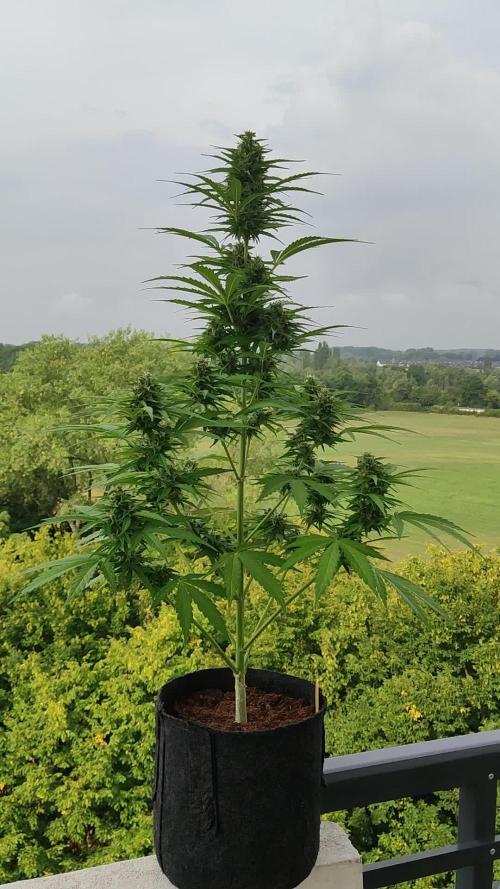
Plant has been doing great. An animal almost cracked the main stem right through but with some tape and patience she recovered quite well. Recently discovered that i should water her even more (first plant) so now i'll give her a good 2-3 liters every 2-3 days. She's standing outside 24/7. I've also ordered General Hydrophonics nutrients yesterday since i had the opportunity. I've topped her once about 2 weeks ago and I'm thinking of topping the 2 main stems again soon.
Wondering when she'll go into flower though
See you next week!

Likes
10
Share


@OnlyBuds
Follow
Week 6 – Fat Lemon Energy 🍋🔥
Week 6 is here and the Lamin-O-Gs are doing their thing – stacking, swelling, and smelling like straight-up citrus bombs.
Buds are thickening up, pistils are firing everywhere, and the canopy looks like it’s ready for takeoff. 🚀
💧 Feed for the week (15L):
• 20ml Topmax
• 70ml Bloom
• 50ml molasses
• 30ml EM (Effective Microorganisms)
• 30ml CalMag
The nitrogen fade is on point – older leaves are gently fading, feeding the flowers, while the tops stay lush and green. No drama, just bloom power.
These girls are soaking up every watt of light without a single complaint.
Full throttle. Lemon OG jungle vibes. 🌴
Next week? Expect even more frost and bulk – these ladies are just getting started.
Stay tuned, amigos. Only buds, no stress. 💚

Likes
42
Share


@Grey_Wolf
Follow
Barneys Farm pineapple Chunk 7 weeks of Flowering Completed
8th March 2020
I found some Bud rot in a bud early this past week and immediately removed it. This had me very concerned so after I washed my hands I inspected all of the
remaining buds and couldn't find anymore which was both a blessing and a Warning to be extra vigilant from Now on. Luckily the Constant high humidity caused from the overcast conditions has finally abated and this weeks forecast is for Mostly sunny and Dry days. The Big fan that can be seen in the above images runs 24/7 now to
create a constant medium strength Breeze that physically moves the branches and hpefully inhibits any further Rot fom occuring.
Barneys Farm suggests a possible 56 day harvest for this strain but in the two times I have previously grown it . The phenotypes required 70+ days to get 20% amber trichomes.
To be perfectly honest I doubt i'll be able to let this one run for that long because of the potential loss of bud thru rotting. I'm only at day 49 now so I guess I will be
counting myself lucky if I can get it to around the 60 day mark ?
Been needing to feed and water quite often as its drinking up everything I throw at it.
Other than that not a lot else to report other than those big colas are very heavy already and dense which is my main concern but happy to see them so fat too 😎
Thanks once again to you all for reading my Update , Please leave a like if you liked the update and I'll see ya's next week 👍


Likes
8
Share


@LokalGrenz
Follow
Week5
March 1st day 30
I transplanted one( the one with no broken branch) inti the 7gal today watered and did some LST I really hope it adapts to its new home I’ve never transplanted before I used extreme garden MYCOS hope it works also moved the light up a bit and plan on going 100% once I transplant the other one
March 2nd transplanted the other one (broken branch one) my shop didn’t have 3.0😔😔😔😔😔😔😔 so i used DNC Great Lakes water only soil hopefully this works and I mixed some 3.0 I had left from the other pot cross fingers for nice transition to its new home
March 5 been three days since transplant can’t really tell if they adapted to there new homes yet some sings of stretching since transplant I’ve never transplanted before and I’m not sure if they need water or not so imma chill let them go for couple more days then I’ll water scared to over water them right now since I transplanted them don’t want to over stress them other one in 3.0 seems little droopy to me compared to the one in Great Lakes but Great Lakes soil seems bit dry sooooo idk I’m going keep an eye on them

Likes
4
Share


@Kassus_Kush
Follow
Polly has been eating like a queen. A very thirsty plant. This is her last week before I start flushing. This was a very fun grow!

Processing
Likes
43
Share


@Master_weeda
Follow
Bonjour à tous les padawans et maîtres jedis
Jour98 grosse defoliation et léger arrosage
Jour101 arrosage avec 2, 5 litres d'eau ph6.3
Processing
Likes
15
Share


@DeepRootGrows
Follow
This is one happy plant, she takes any of the training I give her, she’s eating twice a week now, around a gallon a day, just eating to be a real beauty, so so excited to see her at harvest.

Likes
6
Share


@nonick123
Follow
Bienvenidos al diario de Gorilla Zkittlez Auto por FastBuds
Día -4 (02/05): Se coloca la semilla en tubo de ensayo con 15 ml de agua (EC 0,5) + 3 gotas agua oxigenada (H2O2) en un lugar oscuro a 25 ºC durante 48 horas
Día -2 (04/05): Se prepara una maceta (11L) con 8,8 Litros (80%) de sustrato PRO-MIX HP BACILLUS+MYCORRHIZAE + 2,2 Litros de Insect Frass (20%) + 110 gramos de Earth Vibes Super Soil (10 g/L substrato)
Se mezcla con el agua del 1er riego (EC 0,4) la parte proporcional de la probeta de microorganismos y se riega muy lentamente hasta percolación profunda
Se hace un agujero de 1 cm de profundidad, se coloca la semilla al azar en el agujero, se tapa con un poco de sustrato y se humedece ligeramente con agua en spray
Se coloca parte superior botella en la zona de germinación para mantener humedad relativa alta
Se introduce en el armario con la lampara ENCENDIDA para mantener la temperatura 20-21 ºC en las horas nocturnas
Día -1 (05/05): Se intuye que la semilla empieza a romper el top del sustrato! NO LA TOQUES! 😡🤣
💦Nutrients by Lurpe Solutions - www.lurpenaturalsolutions.com
🌱Substrate PRO-MIX HP BACILLUS + MYCORRHIZAE - www.pthorticulture.com/en/products/pro-mix-hp-biostimulant-plus-mycorrhizae
Likes
8
Share


@Anon73
Follow
Pave was ready, took the tops and let the rest swell, also took down the tops from pink pillow.Gush mintz were getting to the point of over ripe, took all the heavy tops. Some rot was found.
Took down the tops from the original blueberry, they were rock solid and just to the apex of maturity, the flowers were pristine save a few holes from moth larvae- also left the lower branches to fill out.
Many hours of trimming already and I have not made a dent in the garden. Sugar cane and gorilla glue have produced massive colas and I plan on taking the mature tops next week.
I had some trouble with the centurion tabletop trimmer but it was just due to massive amounts of sticky resin on the brush roller and blade.
This is the stickiest and healthiest crop yet, perhaps it is due to the elecroculture antennas I made and installed this year (see week 2.)
Bugs did not want any part of the garden this year except for the moth larvae and spiders (which were beneficial.)

Likes
28
Share


@Ferenc
Follow
Day 86, 5th of December 2020:
Similar to my Runtz Gum the same breeder brillinat! Healthy, strong and amazing! Big like! All good nothing much to say!
The lamp is now on 11 hours and off 13 hours. Every week 15 minutes was taken off and after 4 weeks here we go. Strated 12/12 and now 13/11 wanted try to imitate the nature as the light days are getting shorter.
Fertilization has changed no more epsom salt from this week and I will stop giving nitrogen as well from next week.
Likes
55
Share


@Ultraviolet
Follow
What's in the soil? What's not in the soil would be an easier question to answer. 16-18 DLI @ the minute. +++ as she grows.
Probably not recommended, but to get to where it needs to be, I need to start now.
Vegetative @1400ppm 0.8–1.2 kPa 80–86°F (26.7–30°C) 65–75%, LST Day 10, Fim'd Day 11
CEC (Cation Exchange Capacity):
This is a measure of a soil's ability to hold and exchange positively charged nutrients, like calcium, magnesium, and potassium. Soils with high CEC (more clay and organic matter) have more negative charges that attract and hold these essential nutrients, preventing them from leaching away.
Biochar is highly efficient at increasing cation exchange capacity (CEC) compared to many other amendments. Biochar's high CEC potential stems from its negatively charged functional groups, and studies show it can increase CEC by over 90%. Amendments like compost also increase CEC but are often more prone to rapid biodegradation, which can make biochar's effect more long-lasting. biochar acts as a long-lasting Cation Exchange Capacity (CEC) enhancer because its porous, carbon-rich structure provides sites for nutrients to bind to, effectively improving nutrient retention in soil without relying on the short-term benefits of fresh organic matter like compost or manure. Biochar's stability means these benefits last much longer than those from traditional organic amendments, making it a sustainable way to improve soil fertility, water retention, and structure over time. Needs to be charged first, similar to Coco, or it will immobilize cations, but at a much higher ratio.
a high cation exchange capacity (CEC) results in a high buffer protection, meaning the soil can better resist changes in pH and nutrient availability. This is because a high CEC soil has more negatively charged sites to hold onto essential positively charged nutrients, like calcium and magnesium, and to buffer against acid ions, such as hydrogen.
EC (Electrical Conductivity):
This measures the amount of soluble salts in the soil. High EC levels indicate a high concentration of dissolved salts and can be a sign of potential salinity issues that can harm plants.
The stored cations associated with a medium's cation exchange capacity (CEC) do not directly contribute to a real-time electrical conductivity (EC) reading. A real-time EC measurement reflects only the concentration of free, dissolved salt ions in the water solution within the medium.
98% of a plants nutrients comes directly from the water solution.
2% come directly from soil particles.
CEC is a mediums storage capacity for cations. These stored cations do not contribute to a mediums EC directly.
Electrical Conductivity (EC) does not measure salt ions adsorbed (stored) onto a Cation Exchange Capacity (CEC) site, as EC measures the conductivity of ions in solution within a soil or water sample, not those held on soil particles.
A medium releases stored cations to water by ion exchange, where a new, more desirable ion from the water solution temporarily displaces the stored cation from the medium's surface, a process also seen in plants absorbing nutrients via mass flow. For example, in water softeners, sodium ions are released from resin beads to bond with the medium's surface, displacing calcium and magnesium ions which then enter the water. This same principle applies when plants take up nutrients from the soil solution: the cations are released from the soil particles into the water in response to a concentration equilibrium, and then moved to the root surface via mass flow.
An example of ion exchange within the context of Cation Exchange Capacity (CEC) is a soil particle with a negative charge attracting and holding positively charged nutrient ions, like potassium (K+) or calcium (Ca2+), and then exchanging them for other positive ions present in the soil solution. For instance, a negatively charged clay particle in soil can hold a K+ ion and later release it to a plant's roots when a different cation, such as calcium (Ca2+), is abundant and replaces the potassium. This process of holding and swapping positively charged ions is fundamental to soil fertility, as it provides plants with essential nutrients.
Negative charges on soil particles: Soil particles, particularly clay and organic matter, have negatively charged surfaces due to their chemical structure.
Attraction of cations: These negative charges attract and hold positively charged ions, or cations, such as:
Potassium (K+)
Calcium (Ca2+)
Magnesium (Mg2+)
Sodium (Na+)
Ammonium (NH4+)
Plant roots excrete hydrogen ions (H+) through the action of proton pumps embedded in the root cell membranes, which use ATP (energy) to actively transport H+ ions from inside the root cell into the surrounding soil. This process lowers the pH of the soil, which helps to make certain mineral nutrients, such as iron, more available for uptake by the plant.
Mechanism of H+ Excretion
Proton Pumps: Root cells contain specialized proteins called proton pumps (H+-ATPases) in their cell membranes.
Active Transport: These proton pumps use energy from ATP to actively move H+ ions from the cytoplasm of the root cell into the soil, against their concentration gradient.
Role in pH Regulation: This active excretion of H+ is a major way plants regulate their internal cytoplasmic pH.
Nutrient Availability: The resulting decrease in soil pH makes certain essential mineral nutrients, like iron, more soluble and available for the root cells to absorb.
Ion Exchange: The H+ ions also displace positively charged mineral cations from the soil particles, making them available for uptake.
Iron Uptake: In response to iron deficiency stress, plants enhance H+ excretion and reductant release to lower the pH and convert Fe3+ to the more available form Fe2+. The altered pH can influence the activity and composition of beneficial microbes in the soil. The H+ gradient created by the proton pumps can also be used for other vital cell functions, such as ATP synthesis and the transport of other solutes. The hydrogen ions (H+) excreted during photosynthesis come from the splitting of water molecules. This splitting, called photolysis, occurs in Photosystem II to replace the electrons used in the light-dependent reactions. The released hydrogen ions are then pumped into the thylakoid lumen, creating a proton gradient that drives ATP synthesis.
Plants release hydrogen ions (H+) from their roots into the soil, a process that occurs in conjunction with nutrient uptake and photosynthesis. These H+ ions compete with mineral cations for the negatively charged sites on soil particles, a phenomenon known as cation exchange. By displacing beneficial mineral cations, the excreted H+ ions make these nutrients available for the plant to absorb, which can also lower the soil pH and indirectly affect its Cation Exchange Capacity (CEC) by altering the pool of exchangeable cations in the soil solution.
Plants use proton (H+) exudation, driven by the H+-ATPase enzyme, to release H+ ions into the soil, creating a more acidic rhizosphere, which enhances nutrient availability and influences nutrient cycling processes. This acidification mobilizes insoluble nutrients like iron (Fe) by breaking them down, while also facilitating the activity of beneficial microbes involved in the nutrient cycle. Therefore, H+ exudation is a critical plant strategy for nutrient acquisition and management, allowing plants to improve their access to essential elements from the soil.
A lack of water splitting during photosynthesis can affect iron uptake because the resulting energy imbalance disrupts the plant's ability to produce ATP and NADPH, which are crucial for overall photosynthetic energy conversion and can trigger a deficiency in iron homeostasis pathways. While photosynthesis uses hydrogen ions produced from water splitting for the Calvin cycle, not to create a hydrogen gas deficiency, the overall process is sensitive to nutrient availability, and iron is essential for chloroplast function.
In photosynthesis, water is split to provide electrons to replace those lost in Photosystem II, which is triggered by light absorption. These electrons then travel along a transport chain to generate ATP (energy currency) and NADPH (reducing power). Carbon Fixation: The generated ATP and NADPH are then used to convert carbon dioxide into carbohydrates in the Calvin cycle. Impaired water splitting (via water in or out) breaks the chain reaction of photosynthesis. This leads to an imbalance in ATP and NADPH levels, which disrupts the Calvin cycle and overall energy production in the plant. Plants require a sufficient supply of essential mineral elements like iron for photosynthesis. Iron is vital for chlorophyll formation and plays a crucial role in electron transport within the chloroplasts. The complex relationship between nutrient status and photosynthesis is evident when iron deficiency can be reverted by depleting other micronutrients like manganese. This highlights how nutrient homeostasis influences photosynthetic function. A lack of adequate energy and reducing power from photosynthesis, which is directly linked to water splitting, can trigger complex adaptive responses in the plant's iron uptake and distribution systems.
Plants possess receptors called transceptors that can directly detect specific nutrient concentrations in the soil or within the plant's tissues. These receptors trigger signaling pathways, sometimes involving calcium influx or changes in protein complex activity, that then influence nutrient uptake by the roots. Plants use this information to make long-term adjustments, such as Increasing root biomass to explore more soil for nutrients. Modifying metabolic pathways to make better use of available resources. Adjusting the rate of nutrient transport into the roots. That's why I keep a high EC. Abundance resonates Abundance.
Likes
2
Share


@C_More_Budz
Follow
Things are goin on as they should the girls are getting more bushy than tall which is what I wanted but everything is on cruise control. Only watering when soil is dry and I’m about to start giving them silica on a routine basis in low doses just for added nutrient uptake. Enjoy the pics and video and I will upload to YouTube once I’m done editing video. Any suggestions are greatly appreciated thanks and happy growings

Likes
3
Share


@Shmoopy_me
Follow
Getting close to the finish and it’s very pungent smelling it’s hard to pin a nose on her! Still filling out and getting dense towards the end!
