Likes
Comments
Share
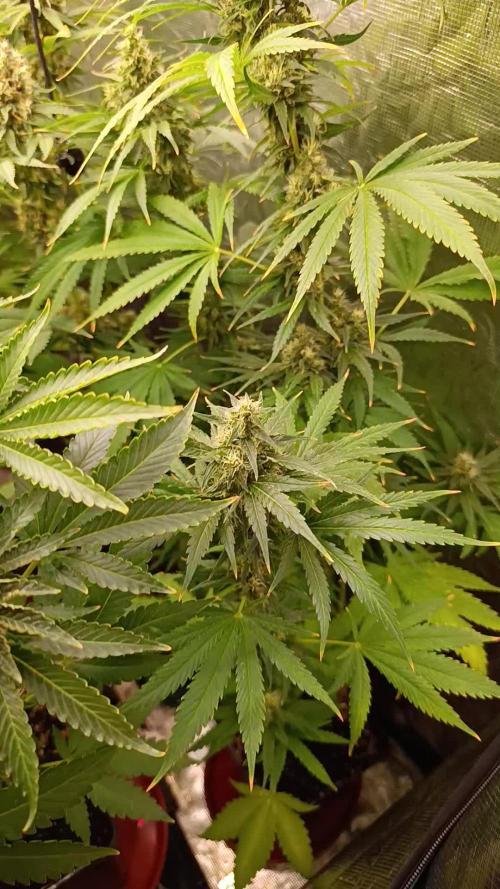
📆 Semana 7 El engorde continúa con fuerza y los cogollos siguen aumentando de volumen gracias al apilado constante de cálices. La producción de resina se intensifica, cubriendo cada vez más las flores, mientras los aromas ganan intensidad. Las variedades de floración rápida muestran una gran densidad y las de dominancia sativa continúan desarrollando flores más largas y voluminosas. El consumo de agua y nutrientes sigue siendo elevado, por lo que mantener un riego constante, una nutrición equilibrada y un ambiente estable será clave para completar el engorde de forma uniforme. ⚡ EC: 1.8–1.9 💧 pH: 6.2–6.5 🌡️ Agua: 21 °C 🌫️ Humedad: 50–55 % 💡 Intensidad: 1000–1050 PPFD 🔥 Nota de cultivo: Mantener la estabilidad del cultivo permitirá maximizar el engorde, la producción de resina y la expresión de terpenos. ¡Seguimos creciendo fuerte! 💪
Likes
57
Share
@Igrowneil
Follow
The overall cycle had to deal with alot of heat issues and lighting so what they did product is certainly top quality flowers just short on there stretch period so will run again to make a certain opinion but as of now no hermis and all seeds flowered apart from one tiny plant 10 girls all to harvest shows stable genicitic traits from these girls also , height , bud structure colour shape smell all seem to be closer to a match of each other
Likes
7
Share
Mixed nutrients today. Last night I added 2 ml of oxy science h202 to 18L of Kamloops City water filtered through our homes water filter, no idea what it does exactly lol. I put an air stone over night and let the water bubble off any chlorine and the rest of the h202, I use microbial mass so I just wanted to sanitize the water but not kill my soil. Mixed in bases first into 21.7 C ph 8.1 Water in the morning. Important not to mix concentrated solutions, I used syringes that I rinsed well between products. I find that with this product you just follow the instructions and it’s pretty awesome results.
Likes
2
Share
We become aware at such times of man's wonderful ability to bring seemingly unrelated elements into harmonic balance, and receive a glimpse into a world where everything exists in conscious sympathetic attunement to everything else. When we listen to a piece of music that seems to strike a beautiful chord somewhere inside us, or view a painting that simply glows with harmonic awareness well executed, we probably do not spare much time to contemplate the wonderfully intricate combination of vibrations that our sensors make it possible for us to perceive. We tend to appreciate the relationship between the parts of something by an awareness of the harmony or dissonance of the whole. This ability enables us to say "what a beautiful house!" instead of "analysis has proven that this collection of building materials exhibits certain elements of harmonic proportion." While this ability to instinctively appreciate the beauty of true harmony has an important role to play in evolution, a more analytical understanding of the laws involved can be most useful. This is especially so if we wish to create works of art where each part exists in true harmony, not only with the other part of that particular whole, but with the universe within which the creator and the created exist. Everything vibrates. From the most dense matter to the most subtle cosmic rays, everything which our senses allow our thoughts to become aware of, can be specified in terms of wavelength or frequency of vibration. These two terms define the same thing, but from different points of view. The following are the approximate wavelengths of various energy carriers: Cosmic rays 0.000,000,001 mm Gamma rays 0.000,000,1 mm X rays 0.000,500 mm Ultraviolet rays 0.003 mm Visible light 0.006 mm Infrared 0.01 mm Sound waves 1 meter Radio waves 300 meters Violet light 400 nm to 450 nm Blue light 450 nm to 500 nm Green light 500 nm to 570 nm Yellow light 570 nm to 590 nm Orange light 590 nm to 610 nm Red light 610 to 700 nm 1 nanometer (nm) = 0.000,000,1 cm = 1/10,000,000 cm If a guitar string is plucked and we hear a sound, it is not too difficult for the human mind to associate this sound with the vibration of the guitar string. With color it is quite different. It is difficult for us to conceive that the color of a substance is not an inherent property of the substance itself, but an indication picked up by our senses of that substance's ability to absorb or reflect the light which happens to be shining on it at that moment. Neither the matter nor the light is colored. What happens is that the brain learns to differentiate between the frequencies reflected or transmitted by the substance the eyes are focused on. The same thing happens with sound. When we say "Oh! Listen, they're playing my favorite song," what we really mean is: "My brain has stored within it a particular pattern of frequencies. I have compared the new information being received with this stored pattern and have deduced the answer that the two patterns are similar within certain specified tolerances." The 'pleasure' involved could have something to do with our running the pre-recorded pattern at the same time, in 'sympathy' with the new pattern as it is received. The word sympathy describes very well our ability to appreciate color and sound. It also describes the reason behind certain elements of harmony. For instance, if a substance vibrating at 100 cycles per second (tone 1) is in the proximity of another substance vibrating at 200 cycles per second (tone 2), we could perceive, if we had the right equipment, a certain sympathetic relationship between the two. We will see from this that there is a uniform doubling of the first tone seen in the second. At various points along the waves, the two are the same in amplitude. At other points, they are at opposite poles to each other. This doubled frequency has more points of similarity to the original than any other frequency except the original itself. If the equipment we had available for measuring these two frequencies was a soundboard amplifier and a pair of ears, then we would hear what would sound to us like one tone. If we had the opportunity to hear one at a time, we would hear that although they sound the same, one is higher in pitch than the other. This characteristic of 'the same but different in pitch', musicians have called the octave. Any two tones produced where one has exactly doubled the frequency of the other is called an octave. Speaking in ratios, an octave would appear then as the ratio 2:1 or 1:2, depending on whether we are talking of an octave up or down. A single note produced by almost any instrument will contain more than one wavelength or frequency. It will have a dominant frequency, the wavelength of which we would call the note's 'fundamental' or 1st harmonic. It will also have a varying number of upper harmonics, gradually fading in intensity into infinity or silence. Natural harmonics always have the same pattern of intervals between them. The interval between the 1st and 2nd harmonic is a perfect octave; between the 2nd and 3rd a perfect fifth; between the 3rd and 4th a perfect 4th; and so on, the intervals becoming smaller and smaller until they lose any relationship with the western 12 tone scale as it exists at the moment. Just as an octave has certain elements of sympathy with its fundamental, so some intervals have been noted to be more perfectly in sympathy with the fundamental than others. The ratio of the 'perfect 5th' or interval of 7 semitones, as it occurs in the harmonic series, is 3:2 or 2:3, while that of the 'perfect fourth" is 4:3 or 3:4. All the tones in the western 12 tone scale can be expressed in terms of the ratio between the upper tone and its fundamental. This would seem to be an ideal way of generating a scale from any given fundamental and several attempts have been made to do this, the Pythagorean system being probably the most well known. Although when working with a single tone instrument playing on its own, the Pythagorean formula works wonderfully well, if we had several instruments tuned this way together and asked them to play almost any western music, we would find that at times they sounded quite out of tune to each other. The lack of flexibility of the various scale systems based on the harmonic series has led to what is known as the 'tempered' scale. This uses as its primary unit of interval the ratio of the octave or 2:1. It then proceeds to divide the interval between any fundamental and its upper octave into 12 smaller intervals by applying the ratio: two to the one-twelfth power, to one (21/12:1). This equals 1.059463094, so by multiplying any frequency by this number, we will obtain the tempered semitone next up from our fundamental. We will also find that any tone twelve semitones up from any other tone, in a scale generated in this way, will have exactly double the frequency. If we took the note middle C on a piano and halved the wavelength, we would have the note C one octave above. If we halved this, we would have the C above, and so on. However, within about 6 octaves, we would find that although a 'sound' was being produced, no human ear could perceive it. If we kept on going, halving and producing upper octaves of our fundamental C, we would proceed through the infrared band, into the visible light spectrum. If we happened to be outside during the day, we would, for one octave only, see the note C with our eyes. The next octave above would already be in the ultraviolet band, and outside the eye's sensitivity range. If we can think of color as being an indication of a substance's vibratory rate or wavelength, we may begin to see a relationship that could exist between the color and sound spectrums. The logical extension of what has so far been said is that there exists a scale in the color spectrum that corresponds exactly to the scale in the sound spectrum, each color tone being an octave of the equivalent note in the sound range. This is not the end of the story but only the beginning. If we can for the moment accept that any wavelength in one band has upper and lower octave stretching out to infinity, then the next question is 'fine, but what shall we use as our fundamental? A particular color? A particular sound frequency?' The musicians among us will probably say 'A 440'. This means that the note A should vibrate at 440 Hertz, or 440 times per second. They would tell us that this is standard pitch has been adopted by most orchestras around the world; pianos are tuned to it, instruments are constructed to formulas based on it, and so to them it would probably seem the most appropriate place to begin. Some of these musicians may know of the battle that is still raging with regards to this being the standard, but few would know why A = 440 Hz was chosen except that it worked when it was set to be a suitable compromise between the many different pitches in use at the time. 432 Hz is said to be mathematically consistent with the patterns of the universe. Studies reveal that 432 Hz tuning vibrates with the universe’s golden mean PHI and unifies the properties of light, time, space, matter, gravity, and magnetism with biology, the DNA code, and consciousness. When our atoms and DNA start to resonate in harmony with the spiraling pattern of nature, our sense of connection to nature is said to be magnified. Another interesting factor to consider is that the A=432 Hz tuning correlates with the color spectrum, while the A=440 Hz is off. Audiophiles have also stated that A = 432 Hz music seems to be non-local and can fill an entire room, whereas A=440 Hz can be perceived as directional or linear in sound propagation. Once you adopt the idea that sound (or vibration in general) can have an equalizing and harmonizing effect (as well as a disturbing effect), the science of harmony can be applied to bring greater harmony into one's life or tune to specific energies. There is a form of absolute and relative harmony. Absolute harmony can, for example, be determined by the tuning of an instrument. The ancients tuned their instruments at an A of 432 Hz instead of 440 Hz - and for a good reason. There are plenty of music examples on the internet that you can listen to in order to establish the difference for yourself. Attuning the instrument to 432 Hz results in a more relaxing sound, while 440 Hz slightly tenses up the body. This is because 440 Hz is out of tune with both macro and micro cosmos. On the contrary, 432 Hz is in tune. To give an example of how this is manifested microcosmically: our breath (0,3 Hz) and our pulse (1,2 Hz) relate to the frequency of the lower octave of an A of 432 Hz (108 Hz) as 1:360 and 1:90. It is interesting to note that 432 Hz was the standard pitch of many old instruments and that it was only recently (19th and 20th century) the standard pitch was increased. This was done in order to be able to play for bigger audiences. Bigger audiences (more bodies) absorb more of the lower frequencies, so the higher pitch was more likely to “cut through”. One of the oldest instruments of the world is the bell ensemble of Yi Zeng (dated 423 BC), tuned to a standard F4 of 345 Hz, which gives an A= 432 Hz. The frequency of 345 Hz is that of the platonic year! Similarly, many old organs are tuned in A=432 as well; for example, St. Peter’s Capella Gregoriana, St. Peter’s Capella Giulia, S. Maria Maggiore in Rome. Maria Renold’s book “Intervals Scales Tones and the Concert Pitch C=128 Hz” claims conclusive evidence that 440 Hz and raising concert pitch above scientific “C” Prime=128 Hz (Concert A=432 Hz) disassociates the connection of consciousness to the body and creates anti-social conditions in humanity. The difference between concert pitch A=440 Hz and Concert A=432 Hz is only 8 cycles per second, but it is a perceptible difference of awareness in the human consciousness experience of the dream we share called existence.
Likes
60
Share
This was an overall amazing strain to grow i had little to no problems with this plant. The ease of growing it was great because as being a newby to growing weed for personel use that was super helpfull. I liked how the smell was strong from day one and just how she grew so fast . i would recommend this strain to anyone because it smells great piney , citrus, earthy sticky . Dinafem did a great job of making my life super easy when it came to growing it . As long as i can get a priper cure on this bud it will be amazing smoke for sure.. I hope anyone who sees the journal enjoys it and ill be doing more in the future i love this forum and the other amazing growers out there ..it says 8 weeks its been hard maintaining entries at first and timely so she is over 8 weeks flowering when i chopped it..smoked some of the plant that was chopped up alittle while before this girl tastes very good and the stickiness of the buds is very impressive i would like to enjoy this plant and grow her again some time ...
Likes
5
Share
@Random80
Follow
Took off most of the damaged leaf's and tried saving her.
Likes
21
Share
Well another week is going and I'm having a little trouble, some of the girls seemed to have a nutrient lock because of a wrong pH watering I did on them, after that (thanks to advice from you guys that answer my grow question, thanks a lot!!) I mixed another reservoir this time with right pH and water them with a few liters till the run out came out in a more decent number... now they seem to be doing better, I finally got the nutrients I was waiting on so hopefully they'll be even better next week... thanks to anyone reading this and happy grow to everybody!!
Likes
120
Share
~_~_~_~_~_~_~_~_~_~_~_~_~_~_~_~_~_~_~_~_~_~_~_~_~_~_~_~_~_~_~_~_~_~_~_~_~_~_~_~_~_~_~_~_~_~_~_~_~_~_~_~_~_~_~_~_~_~_~_~_~_~_~_~_~_~_~_~_~_~_~_~_~_~_~_~_~_~_~_~_~_~_~_ 02/19/22 Week 9 bitches!!! These buds look fantastic!!..we're about week 2 of their fade and water only from here on out..The GG#4 is shining thru the Peyote Gorilla big time, everything is absolutely coated..we're not overly patient and the extra 2-3weeks on these long flowering strains feels like an eternity but these will be worth waiting for...there's only 2 strains in that tent (ignoring the single White OG) but the pheno variety makes it appear that we have at least 3 distinct strains..for example 1 WIFI smells putrid, heavy diesel tones while the WIFI right next to it (with completely different structure) smells amazing, like Lemmon Pledge lol..the Gorilla smell is fairly consistent across the strain..we plan to check all plants under the glass at the end of this week because I suspect they'll finish at separate times.. we'll update again midweek..thanks for dropping by and happy harvests everyone!! ❤️💡🌱😽💨 ~_~_~_~_~_~_~_~_~_~_~_~_~_~_~_~_~_~_~_~_~_~_~_~_~_~_~_~_~_~_~_~_~_~_~_~_~_~_~_~_~_~_~_~_~_~_~_~_~_~_~_~_~_~_~_~_~_~_~_~_~_~_~_~_~_~_~_~_~_~_~_~_~_~_~_~_~_~_~_~_~_~_~_
Likes
3
Share
Still not given any food at 35 days since popping. She's growing well and I've put her in a 4ltr pot. I've pinched the top out to slow down the vertical growth.
Likes
13
Share
@ladyjane
Follow
7/26 - Just gave them light watering today with RO water & CalMag 7/27 - Liquid feeding time. All is well in veg! 7/29 - Just a light watering today and a foliar spray of Ancient Amber.
Likes
1
Share
aktuell in der letzten phase 4 wochen fermentieren
Likes
44
Share
👉The time finally arrived for the harvest, mostly cloudy trichomes with scant few amber, very few white pistols, and the leaves had either faded or were fading. The run-off pH would quickly plummet and the run-off EC would spike. This may be an indicator that the plant is ready but that only would be conjecture on my part. The overall look of the plant to me said it was ready. The aroma was super strong citrusy and intoxicating. THe leaves were fading and there were virtually no white pistols. 👉I harvested bottom to top. I hung each cola on alphabetized clothes pins with gardening wire attached for hanging on the rack. The buds are dense and shaped like pine cones. I trimmed it semi-tight, but left some of the smaller frosty sugar leaves. The buds and sugar leaves are very frosty but it wasn’t as scissor freezing as the Gorrila Glue I grew last year. I measured the post trim wet weight on a self-calibrating digital scale. I checked the accuracy of the scale with a set of scale calibration weights and it was accurate at all weight ranges. I logged each colas trimmed wet weight and hung on the rack. I have a 42” tower fan. For first 12 hours I ran it at its medium setting, then reduced to lowest speed. I rotated the side facing the fan after 24hrs. Then after another 24 hrs I placed them in paper sacks with to top open. I left the buds on the clothes pin hanger and clipped the bag to that. After another 24 hours I closed the tops. Another 24 hrs and I test weighed a couple of colas. I monitored for another couple of days until the weights averaged 20-25% reduced from the initial wet weight. I then cataloged the weight of each cola and placed each into its own jar, most got one of those small cheap hygrometers. These hygrometers have been calibration tested and I know the drift of each. My target humidity is 62%. I would open the jars for brief periods of time during the next couple of days until the humidity stabilized at 62%. Once stable I placed 62% humidity packs in the jars. I took out most of the hygrometers for the next plants cure, but leave some of them with the best buds. The Queen cola was 20g when placed in the jar. That is about 24% remaining weight from trim. 24% is a little on the high side of the humidity target range. The jar the Queen cola is in, is a wide mouth counter jar and I will be toking that bud primarily and it will dry out the fastest. I have compensated the weight I entered on the dry weight spec to reflect about 20g more of humidity loss and another 30 for the stems that are left on the bigger buds. The final weight of the buds going into the jars was 254g (not including the larf at 23gdry). 200g of plump sticky pine cones for the final weight is pretty nice for a 1 gallon pot. 👉I wrote this review at 3 weeks before the 6 week cure mark. In my short experience of being weed rich, its been interesting to take note of how the flower continues to ‘cure’ as time goes on. I have found that 6 weeks isn’t a given for when its ‘cured’. I have observed that as weed ages it changes. I have not noticed much difference with 2-3 week old buds at 62% humidity when compared to 6 weeks from jarring. But I do notice significant difference around 6 months of age. The flavor is enhanced and the buzz is stronger. It maintains this level then 8-12 months it has leveled off and all strains are becoming more ‘couch lock’ inducing. My observations are not scientific by any means. This is just my 8th plant in the 2 years that cannabis became legal for home grow in my area. But I still have each of the plants and rotate which one I consume. 👉I loved growing this plant, and hopefully gained more knowledge. It fox-tailed a bit at the end. I think my frequent fertigation techniques contributed to most of the issues I had. I think I was a little too conservative with nutrient mix and irrigation volume and frequency. I used only 10% expanded clay pebbles in the coco mix as opposed to the standard 30%. This was slightly problematic at first before the roots filled the pot. Fertigation events would cause erosion and caution had to be taken around the seedling. I placed a layer of hyrdoton pebbles across the surface and the issue was solved. Once the pot was filled with roots it took 10+ minutes to give the plant 2L of solution. The pot was packed hard with roots. This may have been a contributing factor to some of the possible nutrient issues I had. I dont think the nutrient issues I saw had much impact on the final outcome. To get 200g from a 1 gallon pot is wonderful.
Likes
5
Share
@simps
Follow
Transplanted into 2 gallon plastic pots I used fox farm soil ocean forest growing a little slow but I’m sure growth will pick up after she settles into the new pot I’m going to put them out in about 16 days going to be transplanting into 30 to 50 gallon pots next see how big I can get them before flower should be fun to see it play out lol
Likes
12
Share
This was an easy grow, and had some amazing results. This is some of my best homegrown to date ❤️ the ladies were easy to manage, no PM, pests or disease. The root balls were enormous, wasn’t much soil to recover. They got heavy in the end from the weight but managed to stay upright for the most part. They were big stretchers , prepare for that, scrog was a good way to go but some of the eager beavers got away from me, which ended in some massive colas. Overall easy to grow, no surprises and you won’t regret the results! 10/10 ❤️👊🤤
Likes
15
Share
@Rebola
Follow
Big bud strain is the one with smalest buds, but thats my fault, not an easy life for her, many problems with ph result in slow growth.. New growth is now more green, but i think its to late for the recovery so i dont expect to much from her 💔 The others have a few brow spots and yellow leaves but overall they look good 🙏 Watering 3L + nutes every 2 days. Day 45 Buds are getting more fat now 😍 But they have a bit nute burn, a little more on #2, i will reduce the nutes.. Big Bud is still very fragile, with signs of heat stress.. 🙁 Smell is very sweet in the tent 😋
Likes
5
Share
Begging to streaky in flower very bushy plant and the leaves are very close together got to be careful during defoliation letting her stretch to get a better defoliation
Likes
47
Share
Très heureux avec cette sour Diesel ⛽️ la fin approche!
Likes
73
Share
@Natrona
Follow
White Widow X Crystal Meth - SeedSupreme Outside Grow 2026 7/5-11 W10 F6 Thunderstorms, flash floods, heat and humidity have been the environment this week so I haven’t watered. I took off a few yello leaves. She has the entire canopy since I moved Wedding Cake inside. Some pistils are turning brown while she throws out more pistils and the trichomes are just starting to form. So far, no pests (using mesh bag) and no mold issues though I will have to keep a close eye on WWxCM’s thick buds. WWxCM is 32 inches tall. Next week the weather looks the same. Hot and humid. That’s all for this week. Remember to check out SeedSupreme current sales. Use my code Natrona20 for a discount on seeds. https://www.seedsupreme.com/?a_aid=Natrona July is a big sale month so check it out: • Jul 8–10: 710 THCa Flash | 25% off All THCa Flower & Concentrates (3-day window) • Jul 15–21: Mix Pack Madness | 30% off All Mix Packs + BOGO All Autos • Jul 22–28: Strain Spotlight | 50% off 1 featured strain (limited stock, first come first served) Stay green, growers love 💚🌿 💫Natrona💫
Likes
30
Share
@Gusarone
Follow
Start of week 8. Looks good. No big issues to report so that's good. Dropping feed to 350ppm. Using dry koolbloom for ripening and I plan to start flushing mid week. The gelato is having a hard time standing up. I've tied up branches everywhere. I took clones from plants that were in 3 weeks of flower for those 2 plants. (Monstercropping). It does work where there are way more stems and budsites. The downside is most stems are weak and cannot support alot of weight. It was a good experiment though. Thanks to the community for all the likes and support. Looking to harvest most plants in the next 2 weeks. Tricomes are filling up and beginning to turn cloudy on at least half the plants. Good day all, and happy growing!!!