


Likes
Comments
Share


@MrGreen92
Follow
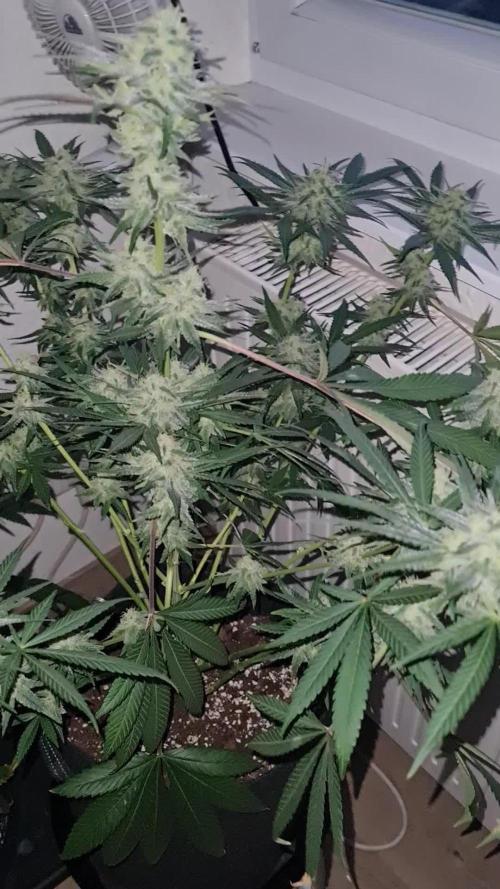
They've been having a bit of trouble with calcium deficiency due to me overwatering them and not giving them CalMag every feed but have learnt my lesson for next time and will be getting the bare minimum nutrients from a recommended supplier.
Been feeding them half nutrients one feed and pHd water with CalMag the other, and that's taking a day break between watering.
Think they've only got this week left now then I'll start flushing with water I think, the one in the corner may need another week or 2 but at least it'll have loads of space to finish up when they're out of there 🙂
Was gonna start flushing this week but they just look so poorly so gonna have 1 more week with nutes every day cause I think they're thirsty bitches which has slowed them down possibly, full nutes, no nutes doesn't seem to be doing me any favours so I'll start flush the 2 that I think are ready next week and the last one a week after 😊😓
Have ordered a microscope to check the trichomes, no idea what to look for but I'm sure I'll see something.. feeding them everyday again as it's been another hot week should've just stuck with a daily feed probably. Will upload some trichome pics soon hopefully 😊

Processing
Likes
42
Share


@Dunk_Junk
Follow
This bush is a beast.
Take a look at her stem. Monster.
So many leaves!! 😲
On she goes!

Likes
22
Share


@Ultraviolet
Follow
In 1995, scientists placed human DNA inside a sealed, air tight tube with photons. Without the DNA, the photons arranged themselves in a random scattered pattern, but when the DNA was inserted, the photons formed an alignment.
Are there metaphysical, multidimensional aspects to our DNA? Have we just begun to understand what DNA is and what it represents?
Vladimir Poponin is a well known Russian scientist who in 1995, with his colleagues, including biophysicist Peter Gariaev, conducted a very interesting experiment during their time at the Russian Academy of Sciences. In their paper (P.P. Gariaev and V.P. Poponin. Vacuum DNA phantom effect in vitro and its possible rational explanation. Nanobiology 1995 (in press)), Poponin states, in the introduction of the report, that, “We believe this discovery has tremendous significance for the explanation and deeper understanding of the mechanisms underlying subtle energy phenomena including many of the observed alternative healing phenomena.”
Why did he feel this way? We will get to that.
Poponin and Gariaev tested the behaviour of DNA on photons, little tiny bits of matter, in the “quantum” that our world is made up of. They put photons into a tube specially designed to simulate a vacuum, just like the vacuum of space. With no air inside, they inserted the photons as they wanted to see what they did and how they behaved. The photons were distributed in a way that was completely unordered and random, scattered all over the container. This of course was what the team of researchers expected.
Next, samples of human DNA were placed inside the tube with the photons, and what happened next is what’s truly mysterious. The photons reacted to the DNA, and changed their pattern and formed a specific alignment. In the presence of living material, the human DNA, the photons organized! This signified that the DNA was clearly having a direct influence over the photons. It’s one of many examples hypothesizing that something within us has a direct affect on the physical material matter outside of us. This experiment was repeated and confirmed, and it was further observed that human DNA has a direct affect on the quantum ‘stuff’ that our world is made up of. Fascinating to say the least.
The Next Big Surprise
The next big surprise was observed when the researchers removed the DNA from the container. The scientists assumed that the photons would simply return to their original scattered state, but this didn’t happen. Instead, the photons remained ordered as if the DNA were still in the tube. Poponin described the light as behaving “surprisingly and counter-intuitively.”
The researchers hypothesized and were “forced to accept the working hypothesis that some new field structure is being excited.” Is there something being left behind? Something in non-physical form? This experiment tells us that DNA is communicating with the ‘stuff’ our world is made of, and that there is some sort of invisible field that exists. Perhaps DNA represents a place of storage and communications to the past? To the future? To others in the universe who have left their mark, so to speak. Who knows.
Quantum Physics and Consciousness
Nobel laureate of the twentieth century Richard Feynman once said, with regards to quantum mechanics, “we choose to examine a phenomenon which is impossible, absolutely impossible, to explain in any classical way, and which has in it the heart of quantum mechanics. In reality, it contains the only mystery.”
Another great quote that comes to mind anytime the world of science dives deep into the mysterious world of quantum physics:
There seems to be a deep concern that the whole field will be tarnished by studying a phenomenon that is tainted by its association with superstition, spiritualism and magic. Protecting against this possibility sometimes seems more important than encouraging scientific exploration or protecting academic freedom. But this may be changing.” – Cassandra Vieten, PhD and President/CEO at the Institute of Noetic Sciences.
The reason why the association with superstition, spiritualism and magic mentioned in the quote above exists when it comes to examining certain phenomenon is simply because the observed phenomenon is unexplainable. But it’s important to remember, just because something is unexplainable does not mean that it’s not real, it simply means we don’t fully understand it yet. Academia has a long history of rejecting phenomenon, that’s clearly real, yet simply unexplainable.
Quantum physics clearly has a strong connection to consciousness and metaphysical phenomenon. Max Planck, a physicist who originated quantum theory, regarded consciousness as “fundamental,” and matter as “derivative from consciousness.” He said that “we cannot get behind consciousness. Everything that we talk about, everything that we regard as existing, postulates consciousness.”
This has been demonstrated quite clearly by multiple experiments, like the quantum double slit experiment.
A paper published in the peer-reviewed journal Physics Essays by Dean Radin, PhD, explains how this experiment has been used multiple times to explore the role of consciousness in shaping the nature of physical reality.
In this experiment, a double-slit optical system was used to test the possible role of consciousness in the collapse of the quantum wave-function. Photons were shot through two slits, in multiple different ways. The study found that factors associated with consciousness “significantly” correlated in predicted ways with perturbations in the double slit interference pattern. In this experiment, tiny bits of matter (photons, electrons, or any atomic-sized object) are shot towards a screen that has two slits in it. On the other side of the screen, a high-tech video camera records where each photon lands. When scientists close one slit, the camera will show us an expected pattern, as seen in the video below. But when both slits are opened, an “interference pattern” emerges — they begin to act like waves.
You can refer to the actual study to find out more about that if you want to see a visual demonstration of the quantum double slit experiment. The point is, consciousness changes the behaviour of the particles.
“Observation not only disturbs what has to be measured, they produce it. We compel the electron to assume a definite position. We ourselves produce the results of the measurement.”
The study cited above points out that “factors associated with consciousness, such as meditation experience, electrocortical markers of focused attention, and psychological factors including openness and absorption, significantly correlated in predicted ways with perturbations in the double-slit interference pattern. The results appear to be consistent with a consciousness-related interpretation of the quantum measurement problem.”
The Takeaway
DNA is fascinating, and it’s probably the least understood part of our biology. There are definitely interesting metaphysical non-material aspects to our DNA, and changes to our DNA can come as a result of our thoughts, feelings, and emotions alone. HeartMath researchers have shown that physical aspects of DNA strands could be influenced by human intention. The article, Modulation of DNA Conformation by Heart-Focused Intention – McCraty, Atkinson, Tomasino, 2003 – describes experiments that achieved such results.

Likes
7
Share


Likes
66
Share


@Earthling37
Follow
58 Days have passed in flower.
Cheese left, Gorilla Girl right.
The "Just water no pH" experiment has failed me around week 5 of flower.
I have not done anything to keep the soil biology alive so thats probably the issue.
Its all good though, it was fun while it lasted and definitely worth a try.
I have let the soil dry as much as possible and then i watered in a tablespoon molasses per gallon water.
pH'd to 6.6.
I just need atleast 3-7 more days of flower and hopefuly the buds will mature a little more.
I took a snip of the bottom leafs to check for trichomes maturity, those are the weakest of trichomes on the plants.
---1st time growing with FLO - Florian Living Organics.---
They claim that there is no need to pH when watering and that their living fertilizer is the only thing that i will need throughout the whole grow so i only need to mix with soil and just water with plain water.
If this stuff works then it can simplify my future grows ALOT!
Happy growing. 😎

Likes
36
Share


@TaterheadJohnson
Follow
7/19: Started new nutrients today. Filled gallon jug with new nutes. Poured half of new nute mix in half gallon jug. Poured the entire half gallon jug into reservoir.
7/20: Bumped light intensity to 50%
7/21: Filled reservoir to the 2nd line today. Added a total of 1 gallon to res to get it to that line. Poured the rest of the mixed nutes for this week (half gallon) and then another half gallon of just plain water.
7/24: Bumped light intensity to 55%
7/25: Sadness today 😞.. While in the process of doing more LST today I accidentally snapped the main stem. I Panicked! Moved plant back in opposite direction to counteract the split. Will be monitoring very closely! 🙏🏾
***** For this Grow******
“Day Air Temperature” will be the max temp of tent for the week.
“Substrate Temperature” will be the average temp of tent for the week.
“Night Air Temperature” will be the lowest temp of the tent for the week.

Likes
41
Share


@Reyden
Follow
Oracle Octane ha incominciato ad ingiallire le foglie più velocemente anche a causa del sciacquone freddo penso, ma ha preso ugualmente dei bei colori e un ottimo profumo…spero che continui a riempire di resina questi boccioli da tutte le parti e ancora penso che una settimana manca tutta! Oggi ho tolto qualche foglia 🍂 perché è veramente cespugliosa questa ragazza! Cercando di fare luce un po’ ovunque

Likes
38
Share


@Nickeluring
Follow
The beautiful mutant is turning out to be a very special one. The buds are the stickiest in the tent, and she is full of them! I can't wait to try these lovely fruits. She's dealing very well with the heat we have.
Likes
Comments
Share


@Cannibalgardens
Follow
Dam I am in love with this plant she took to bending and training so well, then the change in environment from indoors to outdoors should have been rough but it wasn't at all.. she is a trooper and looking to be a producer as well ..


Likes
6
Share


@ChitownCannaChica
Follow
I can’t say enough! Terpy piney gas, frosty, yield, beautiful bud structure! Just a perfect plant all around. 🏻💚
Likes
25
Share


@eldruida_lamota
Follow
Venga tercera semana crecimiento de estas Casey’s rollex O.G. de Dutchfem, La verdad que se ve muy marcado el porte indicó que tiene, un color espectacular , que ganas de ver cómo florecen, a llegado el otoño y lo notamos en la temperatura siendo led.
.
La humedad anda entre 55% la temperatura está entre 22/23 grados , y como siempre el ph , ya que es de lo más importante,está en 5,8/6,0.
.
AgroBeta:
0,8 ml x L Growth black line , vía radicular.
0,2 ml x L Tucán , vía radicular.
0,15 ml x L Flash Root , vía radicular.
0,05 ml x L Gold Joker, vía radicular.
.
Hasta aquí todo gente, espero que os este gustando , un saludo y buenos humazos 💨💨💨.

Likes
100
Share


@AsNoriu
Follow
Day 64. Heavy feed day, first 5 will get 1600 blast with EC going high as 3.0 ;))))))
If no burned leaves - Ill have huge buds, otherwise I will have 5 smallest girls on harvest day ....
Fingers crossed ;))))
That's my last blast, I think I over calculated amount of Epsom salt... Should be in 1200 range, but it's my last BioBizz bottles and I can't remake new blend.
Looking at them now - it looks like I haven't touch a leaf from them a week or so ago ... Insane ! I want buds !!! Will have to strip again, but I will do it in late flower, not now ...
Day 65. They survived and loved it !!!
Video shows and proves it !
Happy Growing !


Processing
Likes
3
Share


@Green_Dream
Follow
It has been a good week. The SQ is fattening and getting covered in ice! She is also loosing most of the lower leaves.
Now after two weeks of stretch it seems like she stopped ascending.
I can't wait to see how this coming week will go!
Btw, she got this weird stuff on one of the leaves stems, and only on that one. Does anyone know what that is?

Likes
12
Share

@GERGrowDesigns
Follow
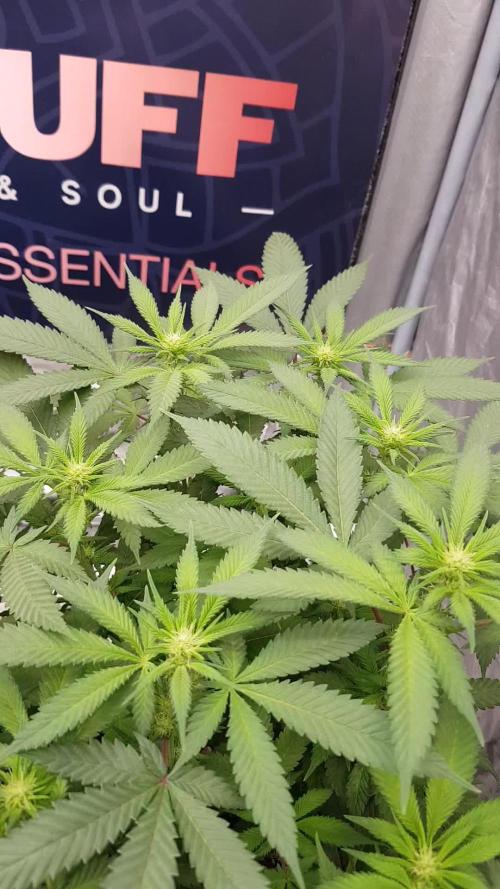
Welcome to Flower Week 2 of Kannabia Apple Fritter BioBoost Edition
Need a Fail-Safe Germination and Express Flowering?Kannabia Makes It Easy with BioBoost, Sproutly and Its Fast Genetics . More informations to find at The Kannabia Blog on GrowDiaries.
Check out Kannabia Seeds with my link [https://www.kannabia.com/de?ref=61966] and grab the germination device or the strains I used . Trust me – it’s worth it for sure !
Get another 20% Discount at all products using the code [GGD] at the checkout.
For this Project , I’ve chosen the Feminized Photo Strain Apple Fritter BioBoost :
Here’s what I’m working with:
• 🌱 Tent: 120x60x80
• 🧑🌾 Breeder Company: Kannabia Seeds
• 💧 Humidity Range: 60
• ⏳ Flowering Time: 63 Days
• Strain Info: 24%THC
• 🌡️ Temperature: 26
• 🍵 Pot Size: 20
• Nutrient Brand: Hy-Pro
• ⚡ Lights : 600W x 2
A huge thank you to Kannabia Seeds for allowing me to try my Best with this amazing collection from Photo Strains they managed to Sponsore . Big thanks for supporting the grower community worldwide! Your genetics and passion speak for themselves!
Let’s grow together – and don’t forget to stop by again to see the latest updates!
Happy growing!
Stay lifted and stay curious!
Peace & Buds!
Likes
5
Share


@123Grow
Follow
I have done 5 feedings for flower. So really I am in week 5 of flower. I am coming back from a small potassium deficiency. I upped the Langbeinite. This was due to using Dr Earth flower girl and not using additional potassium. Dr Earth Flower Girl is slightly low is potassium if you are using a 1:3:2 ratio at 1000 ppm’s.
Todays Feeding m: 2 gallons distilled water. 150 mls of pre-diluted Langbeinite. This got the water to 350 ppm’s. Added 1/2 cup of Fish Bone Meal. Ppm’s reached 925. I added 4 TBSPs Big Bloom to the mix. The ending solution was 1012 ppm’s and water temp 68 degrees.
Also in the mix: Kidney Beans SST, Photosynthesis Plus, Fulvic/Humic Acid, LABS, Seaweed/Kelp
We have two more feedings of Full Bloom Nutrients and then I and switching to 0:3:3 for weeks 8 and 9. The final week I flush with recharge and a little extra molasses.
Likes
22
Share

@Organic473
Follow
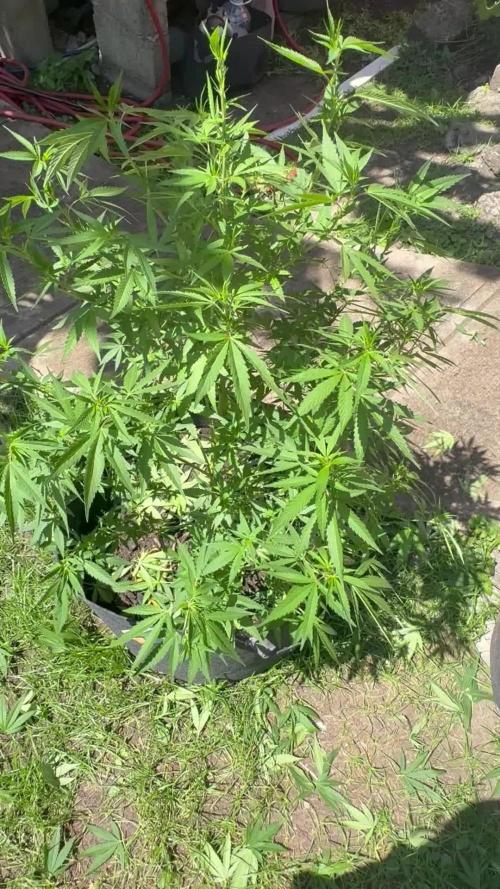
Defoliated the first girl that started flowering… The other one would stay until January 2027 hopefully she makes it out this wild humidity ride with the El Niño.
Likes
31
Share


@Hempface86
Follow
Well here we are day 78 and she looks like she's got probably three or four weeks left.. I will say this she's starting to give off a smell that smells exactly like real blueberries.. I never thought I would say that but it literally smells like blueberries unbelievable I can't wait for this harvest to come.. I don't know if it's because I'm doing such a small pot grow but she's showing lots of deficiencies of everything I try flushing thinking possibly a nutrient lockout but then again I always feed to run off.. so what I'm going to do is just feed her for the next week week and a half and then just give her water for a couple weeks I feel like she's going to flush very quickly due to the small amount of medium.. hope everyone's having a great day and their plans are thriving .. Happy growing ✌️😎.
Day 82 and today I gave her 3 gallons of water to give her a real good flush as I see about 5 to 10% Amber.. I might give her one more 3 gallon flush and a couple days and then chopper after she dries.. hope everyone's doing great and their girls are doing great as well happy growing ✌️
Likes
11
Share

@Oyziphar
Follow
😅
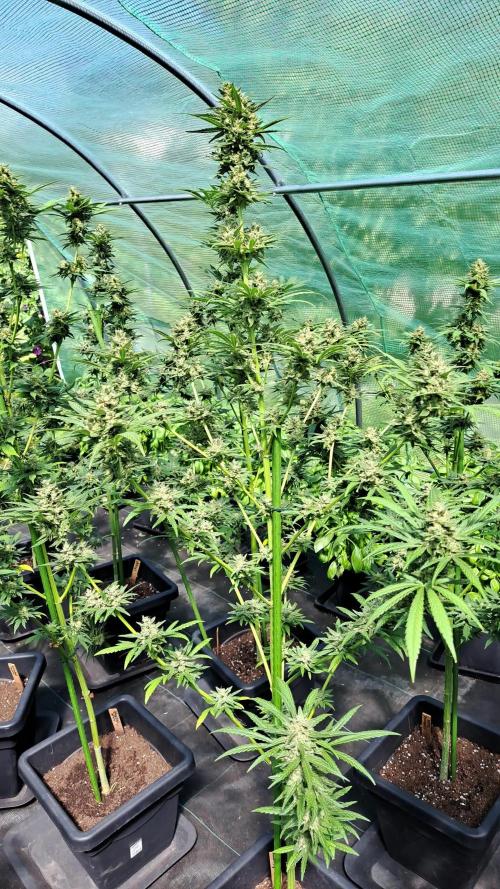
Another Hot Week 🌶️🌶️🌶️
High temperatures 🌡️🌡️🌡️and lots of sun 🌞🌞🌞 and no rain 🌧️
➡️ The buds are ripe and ready to harvest 🌰 Their scent is strong 👃👃👃
➡️ Just a little water at the beginning of the day 💧💧💧
📍 Plant #1 (154cm) is the biggest plant and definitely the best yielder. A bit leafy in the buds
📍 Plant #2 (140cm) a slightly smaller plant. The modest sister of Plant #1. Less leafy in the buds
📍 Plant #3 (139cm) also a slightly smaller plant, but a different phenotype as Plant #1 and #2. Many trichomes and therefore a white appearance
Open plant, almost no leafs in the buds. Maybe more flavorful than numbers 1 and 2, or a higher-head sativa effect. We will know soon 😃
Eighth week of Light Deprivation
👉👉👉👉Every morning at 9:00 am I move the plants to the greenhouse.
👉👉👉👉Every evening at 9:00 pm I move the plants (together with some other strains) inside the growroom (which I don't use in the summer)

Likes
34
Share


@TommyBVRSA75
Follow
Así que dejaros de esta vez, un video muy interesante sobre el resultado de la temporada de invierno y el desarrollo de las dos cepas de Ripper - Washing Machine e Brain Cake.
13 minutos narrados en inglés para que veáis las horas finales de los grows. El domingo (lunes máximo) serán cortadas y puestas en secado para empezar la segunda fase del ciclo - secado y cura.
Así que espero vuestros comentarios importantísimos y que podáis dar vuestras opiniones indispensables para que vuestros conocimientos también puedan servir para que en el futuro las cosas se hagan mejor y siempre es posible evoluir y hacer mejor.
420 siempre y que el Dios Jah nos guarde de todos los peligros.
Un feliz 2024 para todos....
