





@Luke_Lee
Follow
—————————————————————
WEEK 4 / DAY 22-28
Mars Hydro FC-E3000
Floragard Professional GrowMix
11L Plant bag made of fleece
Light: 55cm / 50%;
Schedule: 24/0;
PPFD: 592 umol/m2/s
20° C - 75 RH
300ml per Plant every 2-3days
PH 6,5-7
1ml BioGrow; 0ml TopMax ; 0ml BioBloom
1ml CalMag
#1 Royal Critical Automatic
#2 Royal Critical Automatic
Fan, extractor and pump ON 24/0.
—————————————————————
-10.02.2025
The third vegetation week begins, the ladies look really good.
The lamp has been set to 55cm and is running at 50%.
The lowest leaves with the rust-colored spots have been removed.
-13.02.2025
The GrowBox was cleaned and disinfected once.
The lowest/oldest leaves were cut off. As the soil had settled after a few weeks, the pots were filled with fresh soil.
-16.02.2025
Today is the last day of the third week of vegetation.
The plants look good, so far everything is quite unproblematic.
Total Time: 701:00h
Total Energy: 107.07kWh


@birdmountain
Follow
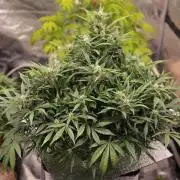
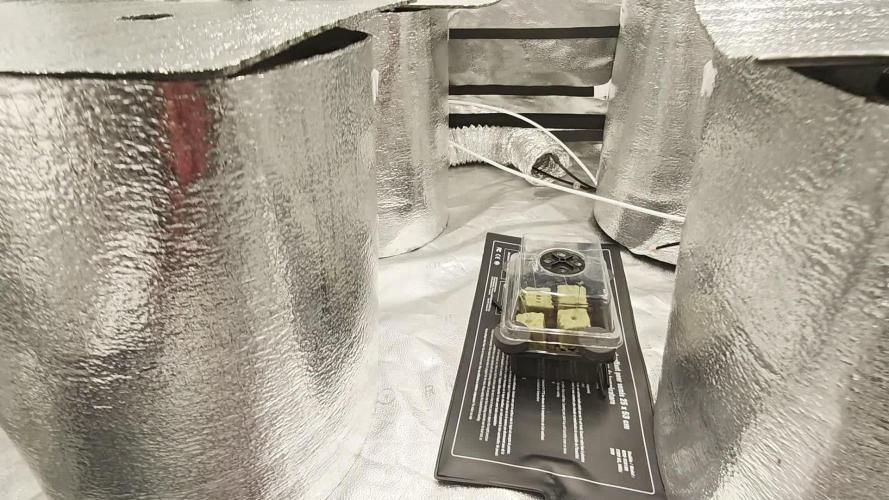
Die Bilder sind früh am Morgen aufgenommen worden, deshalb das viele Gegenlicht. Bei dieser Hitze ist es besser die Outdoor Tätigkeiten morgens zu erledigen.
Was für eine Woche; Temperaturrekorde wurden gebrochen, in meiner Region noch über 40° C. Es musste vielfach gewässert 💦werden, die Fruit Bomb Punch ließ auch ab und zu ihre Blätter hängen, jedoch gab es glücklicherweise keine Trockenschäden wie an der Blueberry die Woche zuvor.
18 cm Zuwachs trotz der Hitze und ein gleichmäßiges buschiges Wachstum ist recht passabel. Allerdings werden nun die Abstände zwischen den Pflanzen geringer, ich werde sie etwas auseinanderrücken müssen.
Kein Fraß
Kein Trockenschaden
Kein Windbruch
Keine Unterdüngung (evntl. etwas zuviel)
Eigentlich langweilig...
aber das Ziel ist eine gesunde Outdoor Pflanze mit gutem Ertrag.
Vielen Dank für euren Besuch!


@nijuana
Follow
OK NOW I HAVE A GOOD START 😅🙏
I restarted because the first attempt was chaotic with the broken spider farmer g12 and the very poor cotton substrate , second one I does a mistake with the temperature it was too cold ❄️ , now the third one attempt , everything is good


@GoosengrowerUK
Follow
Hey Growmies, hope everyone is keeping well a nose around the garden all looking good for the moment the stardawg is looking deficient as hell because of all the rain recently I'll be mixing some nutrients for her tomorrow but everything else is loving life hope everyone is staying happy healthy and as high as humanly possible 💚🇬🇧💪


@Easygroow
Follow
Soooo....
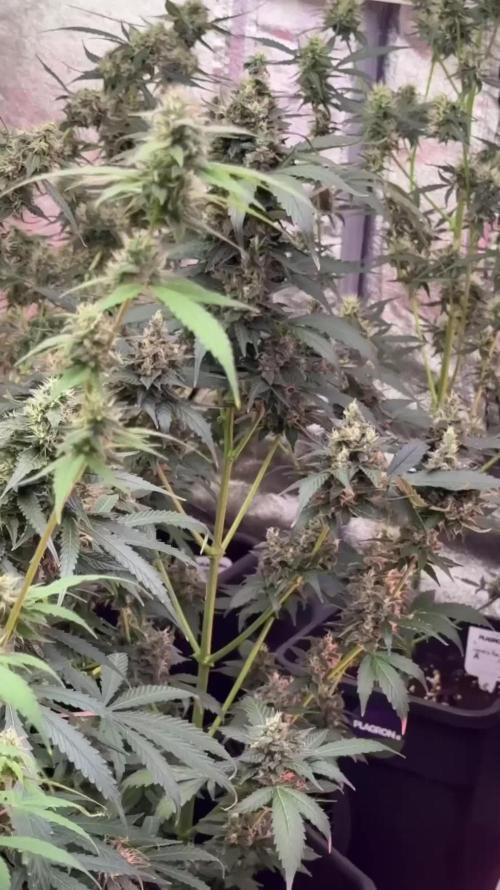
Looks like flowering stretch is over.
Buds are forming nicely so far , and they look frosty already😍

@DogDoctorOfficial
Follow
💚 Amnesia Haze Auto by Zamnesia – Pheno B
Week 10 | The Little Pot Is Trying to Steal the Spotlight 😂🌱👑
Welcome back to another chapter of the 8×8 Adventure! 🌱💚
Well...
She's doing it again.
😂
Every week I look at this girl and think:
"Okay, surely this is where the little pot finally becomes the limiting factor."
And every week she looks back at me like:
"You were saying?" 😂
Amnesia Haze Auto Pheno B continues to impress me.
In a very positive way.
And at the same time...
she continues giving me work.
A lot of work.
😂💚
I'm standing there with a big smile on my face, looking at this beautiful, tall, flower-loaded plant sitting in only 11 litres, wondering how the hell she continues doing this.
She's growing beautifully.
Her structure is beautiful.
The bud formation is amazing.
The frost is coming along beautifully.
She's becoming heavier.
And somehow...
she's still standing.
Well...
mostly because we're helping her stand. 😂
🌱 The Little Pot Is Still Fighting the Big Plant
I know I'm repeating myself.
I've said it before.
I'll probably say it again.
But...
I'm not doing small pots again anytime soon. 😂
And let me be very clear:
I'm not saying I'll never do it again.
I don't say "never" about anything.
Life has a funny habit of proving us wrong. 😂
Maybe somewhere down the road I'll decide:
"Hey, remember that ridiculous 11-litre experiment? Let's do it again!"
But for the foreseeable future?
Nope.
I'm very happy with what this experiment has taught me.
And one of the biggest lessons is simply this:
When the plant keeps growing and keeps demanding water, a small container can turn into a lot of work.
The plant isn't complaining.
I'm the one doing the complaining.
😂
And I'm doing it while smiling.
Because look at her.
How could I complain too much?
💚 She's Growing Like She Has Something to Prove
Pheno B isn't behaving like a little plant.
That's still the funniest part.
She's sitting there in that relatively small root volume, yet she's tall, beautifully structured and carrying a serious amount of flowering development.
She isn't shrinking herself to fit the container.
She's growing.
She's building.
She's flowering.
She's putting on weight.
And she's basically telling us:
"I'll decide how big I'm going to be."
😂🌱
And apparently...
she decided 135 cm was a reasonable answer.
🌸 The Buds Are Becoming the Main Event
This week, the flowers are really starting to steal my attention.
The formation is looking beautiful.
The individual flowers are becoming more substantial.
The structure is becoming easier to see.
And the plant is starting to look increasingly like what we've been waiting for all these weeks.
We're moving beyond simply seeing flowering sites.
We're watching those sites develop into proper, substantial flowers.
And this girl has them everywhere.
High.
Low.
Inside.
Outside.
All across that beautiful structure.
She may have started this adventure with the smallest pot...
but she certainly isn't trying to produce the smallest harvest of flowers. 😂
❄️ And the Frost...
Oh...
the frost.
😍❄️
This is another part of Pheno B that continues to make me stop and look twice.
The resin development is becoming increasingly visible.
The flowers are getting that beautiful crystalline appearance.
The sugar leaves are joining the party.
And the closer I look...
the more I find.
It's one of those things that photographs can sometimes struggle to communicate properly.
You look at the plant from across the room and think:
"Beautiful."
Then you get the camera closer.
And suddenly:
"Ohhhhhh..."
😂📸❄️
There is so much detail happening inside these flowers.
And Pheno B is making sure we have plenty to photograph.
👑 She's Trying to Steal the Spotlight
And I think this girl has developed another objective.
She's trying to steal the spotlight from her sisters.
😂👑
The 8×8 Adventure has plenty of characters.
We've got different structures.
Different sizes.
Different expressions.
Different personalities.
And Pheno B seems to have decided:
"Okay, enough about them. Look at me."
And honestly?
It's getting difficult not to.
She's tall.
She's beautiful.
She's flowering beautifully.
She's getting frosty.
She's becoming heavy.
And she's doing all of that while sitting in the smallest container in the room.
That's a pretty good way to get attention.
😂💚
? The 11-Litre Challenge Continues
But here's where the experiment becomes interesting again.
The little pot isn't stopping her.
It is, however, making my life more complicated. 😂
There's simply less substrate volume holding this increasingly substantial plant.
As the flowers gain weight, that becomes more noticeable.
The plant has built the structure.
The plant has built the flowers.
Now we have to help support what she's created.
And that's where the yo-yos, supports and general attention come into play.
We're not trying to turn her into something else.
We're simply helping her remain standing.
Because she has already done the hard part.
She's built herself into this beautiful plant.
Now we're basically standing beside her saying:
"Don't worry, girl. We've got you." 💚
😂 The Watering Department Would Like a Word
If Pheno B had a human job, I think she'd be the person who creates paperwork for everyone else.
😂
The plant keeps demanding water.
The container is small.
The plant is not.
And that combination means I have to pay considerably more attention than I would prefer.
That's probably the biggest downside of this particular experiment.
Not the plant.
Not the flowers.
Not the growth.
Not the quality.
The workload.
And that's exactly why I keep laughing when I say I'm not rushing back into small soil containers.
The plant is doing an amazing job.
She's just making me work for the privilege of watching her do it. 😂
Fair enough.
🌿 Still Beautifully Healthy
And despite all the jokes about the pot...
the plant itself is looking fantastic.
Beautiful green foliage.
Strong structure.
Excellent flowering development.
Increasing resin production.
And a really interesting overall balance.
She's not showing me a reason to complain about what she's producing.
Quite the opposite.
She's giving me plenty to admire.
That's why this is such a funny situation.
If she were struggling, I'd be frustrated.
But she's not.
She's thriving.
So every time I complain about the watering and the small container, I'm doing it with a massive smile on my face.
😂💚
Because the plant is basically answering every complaint with another beautiful flower.
💡 Same Room. Completely Different Story.
And once again, Pheno B reminds me why I love this project.
She's sharing the same overall room with her sisters.
Same general environmental philosophy.
Same lighting ecosystem.
Same flowering strategy.
Same overall nutrition approach.
Yet she has created her own story.
She's the smaller-container experiment.
She's the 135 cm surprise.
She's the plant that refuses to behave like her pot should dictate.
And she's becoming increasingly impressive as flowering progresses.
This is exactly what I wanted from the 8×8 Adventure.
Not twelve identical plants.
Twelve individual stories.
And Pheno B is definitely writing hers in capital letters. 😂
📸 The Camera Keeps Finding More
This girl is becoming a fantastic photographic subject.
The wider photographs show her overall structure.
The closer photographs reveal the individual flowers.
And the macro perspective?
That's where the frost really starts becoming ridiculous.
❄️🌸
You can see the pistils.
The developing calyxes.
The resin-covered surfaces.
The textures.
The little details that disappear completely when you're simply looking at the whole plant.
And I think that's one of the most beautiful parts of documenting this project.
We're not just watching plants grow.
We're watching an entire microscopic world develop.
And Pheno B is giving the camera plenty to discover.
🌱 The Plant Is Bigger Than the Pot
At this point, I think we can officially say that.
😂
135 cm plant.
11-litre pot.
Beautiful flowers.
Increasing weight.
Increasing frost.
Constant demand for attention.
The mathematics of this girl simply don't make sense to me anymore.
😂
But maybe that's exactly the lesson.
A container is one part of the growing environment.
The plant itself is another.
And genetics can produce some seriously unexpected combinations.
Pheno B is certainly one of them.
🌸 Flowering Is Getting Serious
We're now at Week 10, and the flowers are looking increasingly mature in their structure.
They're getting bigger.
They're getting denser.
They're becoming more defined.
And the resin development is becoming increasingly obvious.
There's still more time ahead, of course.
I'm not calling the finish line yet.
But when I look back at the earlier photographs and compare them with what I'm seeing now...
the difference is huge.
This girl has come a long way.
And she's still moving.
That's the exciting part.
💚 Nothing to Complain About
So...
what do I actually have to complain about this week?
The pot.
😂
That's about it.
The plant?
Beautiful.
The structure?
Beautiful.
The flowers?
Amazing.
The frost?
Amazing.
The colour?
Beautiful.
The development?
Exactly what I want to see.
The weight?
Well...
that's becoming a little problem.
But it's a good problem.
The watering?
Let's not talk about that. 😂
So once again, I'm standing there laughing.
Because the experiment is giving me exactly what experiments are supposed to give us:
information.
And sometimes that information comes with a watering can in your hand twice a day.
😂💚
👑 She's Coming for the Crown
I said it last week.
She's trying to steal the spotlight.
This week?
I'm becoming a little concerned that she might actually succeed. 😂👑
She's not necessarily the biggest plant.
She's not sitting in the biggest container.
But she's making a very strong argument with what she's producing.
The flowers are beautiful.
The structure is beautiful.
The frost is developing beautifully.
And her overall presence is getting harder to ignore.
She's basically standing there saying:
"Remember me."
Don't worry, girl.
We haven't forgotten.
💚👑
🔮 Looking Ahead
There's still plenty of road ahead.
And that's what makes this so enjoyable.
We're going to keep watching the flowers develop.
We're going to keep watching the resin.
We're going to keep watching the weight.
We're going to keep helping her support that weight.
And yes...
we're going to keep dealing with that tiny pot.
😂?
I'm not going to pretend I know exactly where she'll finish.
That's part of the fun.
The plant will tell us.
We'll watch.
We'll document.
We'll photograph.
And we'll see what Pheno B decides to become.
So far...
she's becoming something I really like.
💚 The Little Pot That Keeps Winning
Pheno B started this experiment with a disadvantage.
Or at least...
that's what I thought.
😂
Eleven litres.
A relatively small root volume.
And yet here she is.
135 cm.
Beautifully structured.
Flower-loaded.
Frosty.
Heavy.
And increasingly impressive.
She didn't let the pot define her.
She simply grew.
And now the pot is the thing struggling to keep up with the plant.
😂🌱
That's probably my favourite part of her story.
The plant never got the memo that she was supposed to stay small.
👑 Let Her Steal the Spotlight
So this week, I'm giving Pheno B the stage.
Go ahead, girl.
Take the spotlight.
You've earned it.
💚
Show them the flowers.
Show them the frost.
Show them the structure.
Show them what an 11-litre pot apparently can produce when the plant decides not to cooperate with our expectations. 😂
You're small where it doesn't matter.
You're big where it counts.
And you're becoming one hell of a beautiful plant.
🌱💚👑
The little pot may be giving me work...
but the girl inside it is giving me nothing to complain about.
And that's a pretty fantastic trade.
🌡️ The Environment
The current recorded conditions are:
🌸 Flower Week: 10
📏 Height: 135 cm
💡 Light schedule: 12/12
🌡️ Day temperature: 29.9°C
🌙 Night temperature: 25°C
💧 Relative humidity: 60%
⚗️ pH: 6.0
⚡ EC: approximately 2.0 mS/cm
💦 Solution temperature: 25°C
🌱 Substrate temperature: 26°C
🌬️ CO₂: 639 ppm
? Pot size: 11 L
💧 Watering: approximately 1.3 L/plant/24h
The environment remains consistent, while Pheno B continues showing us her own interpretation of it.
🙏 Thank You
Another week.
Another chapter.
Another reminder that the plants don't always follow the plan we imagined for them.
A huge thank you to GrowDiaries for giving us the platform to document, share, learn and compare these different expressions.
Thank you to Zamnesia for the genetics behind this fascinating Amnesia Haze Auto phenotype.
Thank you to Plagron for supporting the nutrition throughout this adventure.
Thank you to Future of Grow LED for the lighting powering the room.
Thank you to TrolMaster for helping maintain the environment behind the scenes.
And thank you to LumiFlora for adding another dimension to the lighting experiment throughout the canopy.
And, of course, thank you to everyone following the 8×8 Adventure.
Every comment.
Every question.
Every observation.
Every person stopping by to see what these girls are doing.
It makes this whole experiment even more enjoyable.
And Pheno B?
She's still here.
Still standing.
Still growing.
Still flowering.
Still getting frostier.
Still getting heavier.
And still making me work for every litre of water I give her. 😂
But honestly...
I'm looking at her with a huge smile.
Because she's beautiful.
She's impressive.
And she's definitely trying to steal the spotlight from her sisters.
And you know what, girl?
This week...
you can have it. 👑💚🌸❄️
The little pot that refused to stay little.
The plant that refused to stay small.
The girl that refuses to stop impressing me.
Let's keep watching.
Let's keep documenting.
And let's see just how much more this little giant has left to show us.
Growers Love, my friends, and happy growing! 🌱💚👑


@Grnhead
Follow
Final week before harvest. Been flushing for 2 days by the beginning of this week. Each flush takes the ppm level down slightly but not yet to pure water in the reservoir. Orange hairs are popping up more rapidly and I noticed a few amber trichomes at the beginning of the week. Trying for a slightly early harvest for the effect.


@Ultraviolet
Follow
Lacewings seemed to have mostly killed themselves by flying into hot light fixtures. I may have left the UV on which was smart of me :) Done very little to combat if anything but make a sea of carcasses, on the bright side its good nutrition for the soil.
Made a concoction of ethanol 70%, equal parts water, and cayenne pepper with a couple of squirts of dish soap.
Took around an hour of good scrubbing the entire canopy.
Worked a lot more effectively and way cheaper.
Scorched earth right now, but it seems to have wiped them out almost entirely very pleased.
Attempted a "Fudge I Missed" for the topping. So just time to wait and see how it goes.
Question?
If I attached a plant to two separate pots but it was connected by rootzone, one has a pH of 7.5 ish the other has 4.5. Would the Intelligence of the plant able to dictate each pot separately to uptake the nutrients best suited to pH or would it still try to draw nitrogen from a pot with a pH where nitrogen struggles to uptake?
Food for stoner thought experiments!
Another was on my mind.
What happens when a plant gets too much light?
Well, it burns and curls up leaves.
That's the heat radiation, let's remove excess heat, now what?
I've always read it's just bad, or not good, but when I look for an explanation on a deeper level it's just bad and you shouldn't do it.
So I did.
How much can a cannabis plant absorb, 40 moles in a day, ok I'll give it 60 moles. 80 nothing bad ever happened.
The answer, finally. Oh great........more questions........
Reactive oxygen species (ROS) are molecules capable of independent existence, containing at least one oxygen atom and one or more unpaired electrons.
"Sunlight is the essential source of energy for most photosynthetic organisms, yet sunlight in excess of the organism’s photosynthetic capacity can generate reactive oxygen species (ROS) that lead to cellular damage. To avoid damage, plants respond to high light (HL) by activating photophysical pathways that safely convert excess energy to heat, which is known as nonphotochemical quenching (NPQ) (Rochaix, 2014). While NPQ allows for healthy growth, it also limits the overall photosynthetic efficiency under many conditions. If NPQ were optimized for biomass, yields would improve dramatically, potentially by up to 30% (Kromdijk et al., 2016; Zhu et al., 2010). However, critical information to guide optimization is still lacking, including the molecular origin of NPQ and the mechanism of regulation."
What I found most interesting was research pointing out that pH is linked to this defense mechanism. The organism can better facilitate "quenching" when oversaturated with light in a low pH. Now I Know during photosynthesis plants naturally produce exudates (chemicals that are secreted through their roots). Do they have the ability to alter pH themselves using these excretions? Or is that done by the beneficial bacteria?
If I can prevent reactive oxygen species from causing damage by "too much light".
The extra water needed to keep this level of burn cooled though, I must learn to crawl before I can run.
Reactive oxygen species (ROS) are key signaling molecules that enable cells to rapidly respond to different stimuli. In plants, ROS plays a crucial role in abiotic and biotic stress sensing, integration of different environmental signals, and activation of stress-response networks, thus contributing to the establishment of defense mechanisms and plant resilience. Recent advances in the study of ROS signaling in plants include the identification of ROS receptors and key regulatory hubs that connect ROS signaling with other important stress-response signal transduction pathways and hormones, as well as new roles for ROS in organelle-to-organelle and cell-to-cell signaling. Our understanding of how ROS are regulated in cells by balancing production, scavenging, and transport has also increased. In this Review, we discuss these promising developments and how they might be used to increase plant resilience to environmental stress.
Temperature stress is one of the major abiotic stresses that adversely affect agricultural productivity worldwide. Temperatures beyond a plant's physiological optimum can trigger significant physiological and biochemical perturbations, reducing plant growth and tolerance to stress. Improving a plant's tolerance to these temperature fluctuations requires a deep understanding of its responses to environmental change. To adapt to temperature fluctuations, plants tailor their acclimatory signal transduction events, specifically, cellular redox state, that are governed by plant hormones, reactive oxygen species (ROS) regulatory systems, and other molecular components. The role of ROS in plants as important signaling molecules during stress acclimation has recently been established. Here, hormone-triggered ROS produced by NADPH oxidases, feedback regulation, and integrated signaling events during temperature stress activate stress-response pathways and induce acclimation or defense mechanisms. At the other extreme, excess ROS accumulation, following temperature-induced oxidative stress, can have negative consequences on plant growth and stress acclimation. The excessive ROS is regulated by the ROS scavenging system, which subsequently promotes plant tolerance. All these signaling events, including crosstalk between hormones and ROS, modify the plant's transcriptomic, metabolomic, and biochemical states and promote plant acclimation, tolerance, and survival. Here, we provide a comprehensive review of the ROS, hormones, and their joint role in shaping a plant's responses to high and low temperatures, and we conclude by outlining hormone/ROS-regulated plant-responsive strategies for developing stress-tolerant crops to combat temperature changes.
Onward upward for now.
Next!
Adenosine triphosphate
(ATP) is an energy-carrying molecule known as "the energy currency of life" or "the fuel of life," because it's the universal energy source for all living cells.1
Every living organism consists of cells that rely on ATP for their energy needs. ATP is made by converting the food we eat into energy. It's an essential building block for all life forms. Without ATP, cells wouldn't have the fuel or power to perform functions necessary to stay alive, and they would eventually die. All forms of life rely on ATP to do the things they must do to survive.2
ATP is made of a nitrogen base (adenine) and a sugar molecule (ribose), which create adenosine, plus three phosphate molecules. If adenosine only has one phosphate molecule, it’s called adenosine monophosphate (AMP). If it has two phosphates, it’s called adenosine diphosphate (ADP).
Although adenosine is a fundamental part of ATP, when it comes to providing energy to a cell and fueling cellular processes, the phosphate molecules are what really matter. The most energy-loaded composition for adenosine is ATP, which has three phosphates.3
ATP was first discovered in the 1920s. In 1929, Karl Lohmann—a German chemist studying muscle contractions—isolated what we now call adenosine triphosphate in a laboratory. At the time, Lohmann called ATP by a different name. It wasn't until a decade later, in 1939, that Nobel Prize–-winner Fritz Lipmann established that ATP is the universal carrier of energy in all living cells and coined the term "energy-rich phosphate bonds."45
Lipmann focused on phosphate bonds as the key to ATP being the universal energy source for all living cells, because adenosine triphosphate releases energy when one of its three phosphate bonds breaks off to form ADP. ATP is a high-energy molecule with three phosphate bonds; ADP is low-energy with only two phosphate bonds.
The Twos and Threes of ATP and ADP
Adenosine triphosphate (ATP) becomes adenosine diphosphate (ADP) when one of its three phosphate molecules breaks free and releases energy (“tri” means “three,” while “di” means “two”). Conversely, ADP becomes ATP when a phosphate molecule is added. As part of an ongoing energy cycle, ADP is constantly recycled back into ATP.3
Much like a rechargeable battery with a fluctuating state of charge, ATP represents a fully charged battery, and ADP represents a "low-power mode." Every time a fully charged ATP molecule loses a phosphate bond, it becomes ADP; energy is released via the process of ATP becoming ADP.
On the flip side, when a phosphate bond is added, ADP becomes ATP. When ADP becomes ATP, what was previously a low-charged energy adenosine molecule (ADP) becomes fully charged ATP. This energy-creation and energy-depletion cycle happens time and time again, much like your smartphone battery can be recharged countless times during its lifespan.
The human body uses molecules held in the fats, proteins, and carbohydrates we eat or drink as sources of energy to make ATP. This happens through a process called hydrolysis
.
After food is digested, it's synthesized into glucose, which is a form of sugar. Glucose is the main source of fuel that our cells' mitochondria
use to convert caloric energy from food into ATP, which is an energy form that can be used by cells.
ATP is made via a process called cellular respiration that occurs in the mitochondria of a cell. Mitochondria are tiny subunits within a cell that specialize in extracting energy from the foods we eat and converting it into ATP.
Mitochondria can convert glucose into ATP via two different types of cellular respiration:
Aerobic (with oxygen)
Anaerobic (without oxygen)
Aerobic cellular respiration transforms glucose into ATP in a three-step process, as follows:
Step 1: Glycolysis
Step 2: The Krebs cycle (also called the citric acid cycle)
Step 3: Electron transport chain
During glycolysis, glucose (i.e., sugar) from food sources is broken down into pyruvate
molecules. This is followed by the Krebs cycle, which is an aerobic process that uses oxygen to finish breaking down sugar and harnesses energy into electron carriers that fuel the synthesis of ATP. Lastly, the electron transport chain (ETC) pumps positively charged protons that drive ATP production throughout the mitochondria’s inner membrane.2
ATP can also be produced without oxygen (i.e., anaerobic), which is something plants, algae, and some bacteria do by converting the energy held in sunlight into energy that can be used by a cell via photosynthesis.
Anaerobic exercise means that your body is working out "without oxygen." Anaerobic glycolysis occurs in human cells when there isn't enough oxygen available during an anaerobic workout. If no oxygen is present during cellular respiration, pyruvate can't enter the Krebs cycle and is oxidized into lactic acid. In the absence of oxygen, lactic acid fermentation makes ATP anaerobically.
The burning sensation you feel in your muscles when you're huffing and puffing during anaerobic high-intensity interval training (HIIT) that maxes out your aerobic capacity or during a strenuous weight-lifting workout is lactic acid, which is used to make ATP via anaerobic glycolysis.
During aerobic exercise, mitochondria have enough oxygen to make ATP aerobically. However, when you're out of breath and your cells don’t have enough oxygen to perform cellular respiration aerobically, the process can still happen anaerobically, but it creates a temporary burning sensation in your skeletal muscles.
Why ATP Is So Important?
ATP is essential for life and makes it possible for us to do the things we do. Without ATP, cells wouldn't be able to use the energy held in food to fuel cellular processes, and an organism couldn't stay alive.
As a real-world example, when a car runs out of gas and is parked on the side of the road, the only thing that will make the car drivable again is putting some gasoline back in the tank. For all living cells, ATP is like the gas in a car's fuel tank. Without ATP, cells wouldn't have a source of usable energy, and the organism would die.
Eating a well-balanced diet and staying hydrated should give your body all the resources it needs to produce plenty of ATP. Although some athletes may slightly improve their performance by taking supplements or ergonomic aids designed to increase ATP production, it's debatable that oral adenosine triphosphate supplementation actually increases energy.
An average cell in the human body uses about 10 million ATP molecules per second and can recycle all of its ATP in less than a minute. Over 24 hours, the human body turns over its weight in ATP.
You can last weeks without food.
You can last days without water.
You can last minutes without oxygen.
You can last 16 seconds at most without ATP.
Food amounts to one-third of ATP production within the human body.



@wolfvb
Follow
✂️ Harvest Day is Here! + BIG NEWS & Giveaway! 🚀🐺
GrowFam, we finally made it to the finish line! 🌱?
After weeks of TLC, it's time to chop this broccoli head. I am incredibly proud of how this run turned out. The buds are looking frosty, dense, incredibly terpy, and I couldn't have asked for a smoother ride this time around.
But as we all know, the hardest part of any grow is what comes next: the dry and cure.
Usually, my setup involves hanging a drying rack near the tent, or drying right inside the tent if it happens to be empty. But for this harvest, things are going to be a little different… and a lot cooler. 😎
I am super hyped to announce that I have officially been selected as a #DryRocketTester! My test unit literally just arrived, perfectly timed for this harvest. I’m going to be drying this entire run in the DryRocket and taking you all along for the ride. Expect a full review and step-by-step updates on how it handles the terps!
Now, for the BEST part: 🎁 GIVEAWAY TIME!
Recently, I won 3rd place in the DryRocket Photo Contest, and they hooked me up with a 50€ voucher for their shop. Since I already have my hands on the tester unit, I am giving this 50€ voucher directly to YOU guys!
👉 Head over to my Instagram @wolfvb.growdiaries to enter the giveaway and snag that 50€ voucher!
🔥 BONUS: If you don't want to wait for the giveaway and want to upgrade your drying game right now, the awesome team at DryRocket hooked our community up. You can use my personal code wolfvb30 at checkout to get 30€ OFF your own DryRocket! (Code is valid until May 31st!)
Mission completed ✅
Woke up to the BEST kind of text... THE HARVEST IS DRY! Yesterday morning started off right. My @DryRocket app pinged me with the ultimate notification the dry cycle was officially complete! You already know what happened next... straight into TRIM JAIL! I put in a solid 4-hour shift from 9 AM to 1 PM, getting my hands sticky and dialing in these nugs.
I got to say, the DryRocket absolutely crushed it. The structure is perfect, the trichomes are completely intact, and the terps are incredibly loud. Just look at the frost on these beauties!And of course, the best part of trim jail is the reward. Check out that kief pile!
You know I had to celebrate the end of this run by rolling up an infused joint smeared with the good stuff to officially test the fruits of the labor. GIVEAWAY REMINDER! Don't forget, my giveaway for the DryRocket voucher is STILL LIVE, but it ends on the 15th of this month! If you haven't entered yet, check out my pinned reel to get your name in the drawing so you can upgrade your drying setup.
BONUS: If you want to skip the line and take the guesswork out of your drying process right now, you can use my code wolfvb30 at checkout to get 30% OFF your own Dry Rocket! (Code is valid until May 31st!) Link in bio!
Drop a ✂️ in the comments if you know the struggle of trim jail! What's the longest trimming session you've ever done? Letu2019s hear it!
Thank you all for following along on this diary. I'll be updating the dry weights and final smoke report soon. Let me know what you think of the harvest in the comments, and don't forget to check out the giveaway on IG!
Smoke Report:.
The buds are not to my taste for me they tested like haze, the Rosen in the other way is very tasty 🤤 😋 I would say a bit frouty (or maybe like a sweet flower ) and maybe a bit of bine and spicy I really like it, I think that's how I will use this one more Rosen less joints 😂
Keep growing, Pack! 🐺🌿💨





@Naujas
Follow
77 days, for some reason, the girl is growing without me :( the vacation was unexpectedly long, I only managed to get these photos, I'll be back to see them next week on Tuesday, I think it might be harvest day :).


@AestheticGenetix
Follow
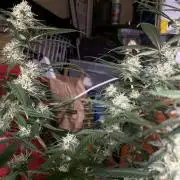
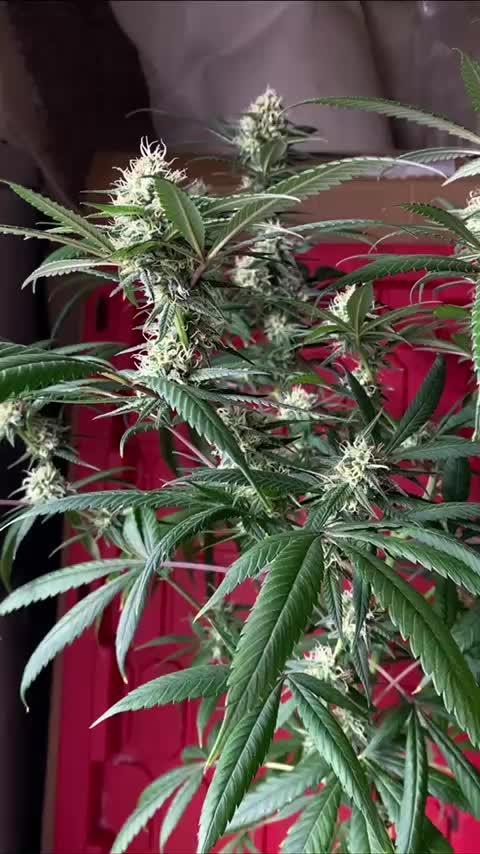
Starting to chunk up. Giving Candy like sweet tarts or something or smarties


@Easygrower
Follow
Hello growers day 58 in the garden I gave her a bit of a leaf defo today still not purple some leafs have purple tips but that’s about it she has got some nice looking buds forming so we will see happy growing


@Rap_a_cap
Follow
Who says weed doesn't grow much above 30°C? This beast do it.
Another good week for PK, despite 4 days of storms. I have decided not to top her. Starting LTS. Smell will be a problem later. Healty and strong plant!


@n1mbu5
Follow
OK guys I was away for a week so this week we are at the end of week 4 veg instead of the beginning of the week.
There was a boom growth period and the taller Punch 2 has bent herself to avoid getting burnt as she is 30cm tall, the other Punch 1 is 20cm tall and seems fine.
I have just given them a watering with calmag and just a drop of PK ratio 13-14.
I have also ramped up the lamp to 100% and put it at 55cm from the top of the plants.
I'm hoping they will soon switch to flower guys fingers crossed. 🎄
shorts_status_processing


@Book_of_Thoth
Follow
I've been away for a week, leaving my tent in the care of a friend. Coming back I was surprised to see how much bud growth has occurred, as you can see colas are really starting to stack up, and trichromes are already appearing.
Pineapple Express is growing as amazingly as ehs always seems to, and this time around there's certainly a lot more of her to be seen. At only three weeks into flowering, there seems to be a lot of potential for the weeks to come. I spent 2 hours trimming leaves today, mainly in spots where they were rubbing against other colas, and there's a good amount of space for each branch so far. Really excited to see what develops. Stay tuned!


@HeavyHead
Follow
Great strain. Will post more pictures as it cures and update the smoke report :)
Going to aim for a 30 day cure and I’ll post how it looks


@Salokin
Follow
Week went again very uneventful, she is not very hungry anymore and had to constantly refill the reservoir with water to keep the ec in check. Trichomes are all cloudy and start to turn amber. She has developed that amazing purple hue and is sticky to the max, so definitely showing her glue heritable ;) I will continue to feed her until Wednesday this week and then start the flushing and darkness. Harvest will be next week end.
