


Likes
Comments
Share


@marihoochi
Follow
Today October 25th is the First day of Week 6 In Flower.
Received the Refractometer and got right to pressing. First I tried a mortar and pestle to extract the sap -- this worked ok but took a lot of time and force. Then I tried 2 spoons held together and squeezed with vice grips (didn't work for me). 2 Pieces of MDF board squeezed together with vice grips didn't work either. I guess I'm not strong enough.
Tried a blender, a hand blender...neither of these worked!
Then the vice, it was faster and took less force to extract the sap. Works great!
Took leaves from top to bottom of each individual plant. (16 plants) Rolled a few leaves up, put in a numbered piece of parchment and pressed.....voila...sap😃 Refractometer was already calibrated and ready to go.
Placed sap on meter, held up to light and there it is! My first BRIX reading😮 using $28 Refractometer.
Going to change base nutrients to a "hard water" formula. So impressed with Harley Smith that I've ordered some NPK RAW products. Like the idea of micro dosing. I sent Harley an email and he replied the same day! Not a canned response either. So cool. Thanks Harley! AND he took a look at GrowDiaries and this grow✊😃 What a kind gentleman. 😇
Hope I didn't go overboard but I watered again today with amino acids and cal mend to try to fix this Calcium def. Will Brix leaves tomorrow and see if this makes a difference. The brix line yesterday was very clear and very easy to read indicating a calcium def. Maybe locked out from too much phosphorous or hard water?
Watered Oct 29 & 30 Temp 20 PH 6.4 EC 1.9
Runoff EC 1.9 to 2.3 after at least 2-3 Gallons of water put thru each pot. Some pots Runoff were way off the charts😵EC 3.6! . Put water thru until EC hit 2.3 on 2 pots others were EC 1.9 to 2.1. Put 56 Gallons or 220L thru plants over a 2 day period until I reached a better EC.

Likes
10
Share


@berlinbeginner
Follow
Blueberry Muffin, day 28 (week 4). They're still green and not dead yet, so that's a success. :)

Likes
2
Share


@High_Grade_Dadli
Follow
#1 first week in and she putting on some lovely blossoms....tied down a few of her branches (LST) and she is jus spreading her wings
#2 diet seemed to be a off so increase potassium looks like it balanced out..jus watching it to see....also lock off extended hours of light so she can start to get ready to go into flowering
Likes
20
Share

@cangrowz
Follow
Grow Diary – Wochenupdate 🌱
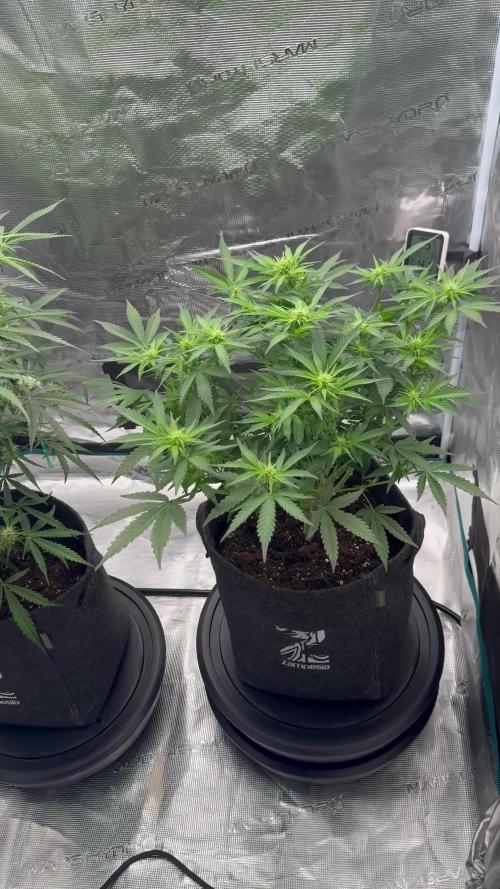
Diese Woche verlief insgesamt ziemlich entspannt. Großartig eingreifen musste ich nicht, nur bei der kleineren Pflanze, die nicht getoppt wurde, habe ich nochmal etwas nachgeschnitten – vor allem ein paar Blätter, da doch wieder einiges nachgewachsen ist.
Aktuell sehen beide Pflanzen sehr gesund aus und machen einen stabilen Eindruck. Man merkt jetzt schon deutlich den Unterschied zwischen getoppt und nicht getoppt, was sich auch im Aufbau und der Struktur zeigt.
Für den nächsten Run ist der Plan klar: Beide Pflanzen werden wieder getoppt und zusätzlich mit Scrog gearbeitet. Der Vergleich zu den vorherigen Grows zeigt einfach, dass sich der Mehraufwand definitiv lohnt.
Bin gespannt, was die nächsten Wochen noch bringen.
Happy Growing Growmies

Likes
2
Share

@DogDoctorOfficial
Follow
👑 Godfather OG – Pheno A
Week 6 | Wearing the Crown with Confidence
Welcome back to another chapter of the 8×8 Adventure!
There are always a few plants in every grow that naturally draw your attention.
Not because they're demanding it...
But because they quietly command it.
Godfather OG Pheno A continues to be one of those plants.
Now standing at approximately 90 cm, she's become one of the tallest ladies in the room, carrying herself with a strong, elegant structure while moving confidently deeper into early flower.
Every week she seems to add another layer to her personality.
And this week, she revealed one of my favourite characteristics yet.
🌱 Growing Her Own Story
For anyone joining this diary for the first time, welcome!
This entire project is being grown using the 12/12 From Seed technique.
Rather than providing a long vegetative period before flowering, every seedling receives twelve hours of light and twelve hours of darkness from the very beginning of life.
Instead of deciding when flowering begins...
...I allow each phenotype to decide for herself.
Some race into bloom.
Others take their time building structure before committing their energy to reproduction.
Watching those different strategies unfold inside the very same environment continues to be one of the most rewarding parts of this project.
Nature always has her own plans.
👑 A Crown Begins to Form
Flowering is now becoming impossible to miss.
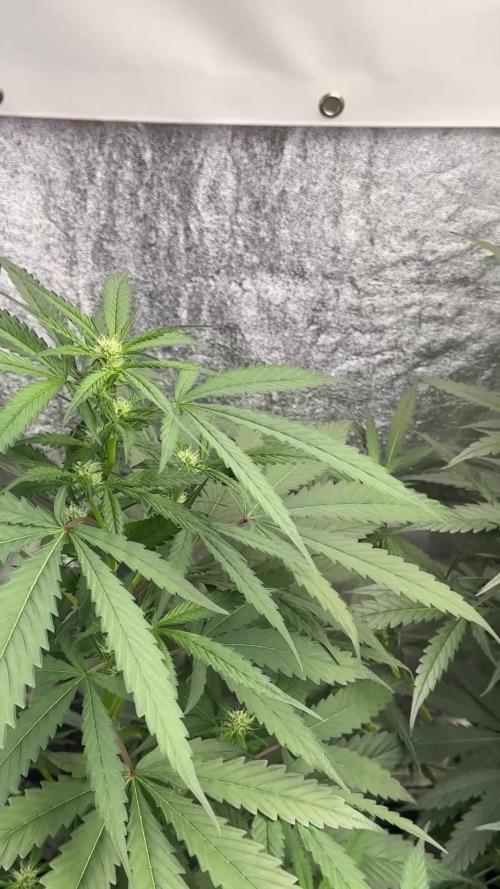
The main apex is beginning to stack fresh white pistils while the secondary branches are quickly following behind.
Every growing tip is slowly transforming from vegetative growth into future flowers.
Although these buds are still small, you can already start to imagine the shape they'll eventually become.
This is one of my favourite stages of every grow.
Each morning brings noticeable progress.
Each day the plant looks just a little different than she did the day before.
The excitement only continues to build.
🍃 Nine Fingers of Beauty
One feature immediately caught my attention this week.
Those incredible nine-fingered fan leaves.
Large.
Wide.
Deep green.
Absolutely beautiful.
It's a question growers often ask:
Do nine-fingered leaves mean indica or sativa?
The honest answer is...
Not necessarily.
Leaf shape and leaflet count are influenced by both genetics and environmental conditions. While broad nine-fingered leaves are often associated with vigorous indica-leaning plants because of their wider leaflets, sativas and hybrids can produce nine, eleven, or even thirteen-fingered leaves as well when they're thriving.
Rather than acting as a reliable indicator of lineage, high leaflet counts are often simply a sign that the plant is healthy, mature, and growing vigorously.
In many ways, they're like a badge of confidence.
When a plant has everything she needs—healthy roots, stable nutrition, proper lighting, and a balanced environment—she has the energy to produce these large solar panels that capture tremendous amounts of light.
And that's exactly what these leaves are.
Tiny power stations.
Every one of them working around the clock to fuel the flowers that are only just beginning.
🌿 Strong Structure, Gentle Guidance
Standing around 90 cm, Godfather OG Pheno A has continued stretching while maintaining excellent branch spacing throughout the canopy.
The weeks of gentle Low Stress Training are paying off beautifully.
Rather than forcing the plant into an unnatural shape, the goal has simply been to open the canopy and allow every future flower site its opportunity to receive direct light.
Only small adjustments continue to be made.
A little leaf tucking here.
A gentle repositioning there.
Sometimes the smallest interventions produce the biggest rewards later in flower.
🍽️ Feeding for the Next Chapter
As flowering continues establishing itself, the nutrition program remains focused on supporting both the final stretch and the beginning of flower production.
This week's feeding included:
• Terra Bloom – 1.9 ml/L
• Green Sensation – 1 ml/L
• Sugar Royal – 1 ml/L
• Power Buds – 1 ml/L
• pH adjustments using Lemon Kick and pH Plus when required
Everything continues to be delivered through the AutoPot system, allowing the AquaValve to provide nutrient solution only when the plant has actually consumed what was previously available.
One of my favourite aspects of AutoPots is their simplicity.
The plant decides when she drinks.
I simply make sure the reservoir gives her everything she needs.
🌡️ Environmental Conditions
Consistency continues to be one of the strongest foundations of this grow.
This week's averages included:
• Day temperature: 29°C
• Night temperature: 25°C
• Relative humidity: 60%
• Nutrient solution: 22°C
• Root zone: 21°C
• CO₂ concentration: 639 ppm
Humidity has now been reduced slightly compared to previous weeks as flowering becomes more established, helping prepare the environment for healthy flower development while maintaining vigorous growth during the final stretch.
Healthy gardens aren't built through dramatic changes.
They're built through hundreds of small, consistent decisions.
📸 This Week's Gallery
This week's photographs tell the story perfectly.
The close-up shots capture clusters of fresh white pistils appearing across the tops of nearly every branch.
The side profile highlights her impressive vertical growth and elegant branch spacing.
And perhaps my favourite photograph of the week...
...that enormous nine-fingered fan leaf.
Sometimes one leaf says everything you need to know about a plant's health.
It almost looks too perfect to be real.
🔮 Looking Ahead
During the coming week I expect the vertical stretch to begin slowing as more energy shifts toward flower production.
The small pistil clusters should begin merging into recognizable bud sites while resin production quietly prepares to make its first appearance.
Training will remain minimal, allowing the plant's natural architecture to continue doing most of the work.
Something tells me this lady is only just getting started.
And if her early performance is any indication...
She's planning to live up to her name.
💚 Thank You
Thank you so much for following another chapter of this 8×8 Adventure.
Every week these plants remind me that growing isn't about controlling nature.
It's about creating the conditions that allow nature to express itself.
Watching each phenotype reveal its own character has been one of the greatest joys of this entire project, and I'm incredibly grateful to everyone sharing the journey alongside me.
A special thank you to:
💚 GrowDiaries for providing a platform where growers around the world can document their progress, learn from one another, and inspire the next generation of home growers.
Zamnesia for the outstanding genetics making this phenotype hunt possible.
🌱 Plagron for supplying the nutrients supporting every stage of this grow.
💡 Future of Grow LED for delivering the light that powers every leaf, every branch, and every flower.
🌿 TrolMaster for helping maintain a stable environment twenty-four hours a day.
And finally...
Thank you to everyone who follows these diaries, leaves a comment, asks a question, shares advice, or simply stops by to see how the garden is evolving.
Every update becomes a little more meaningful because it's shared with this amazing community.
I'll see you all next week as Godfather OG Pheno A continues growing into the queen she's already beginning to look like.
Until then...
Growers Love and happy growing, everyone! 🌱👑💚
Likes
12
Share


@cookingwithninja
Follow
best cannabis I ever grew and smoked. Others agree. This is a cup winner I would win with no competition. 3 months harvested, 90% consumed. Will run more genetics and future cross, backcross. Feels like energy drinks, positive, 100% youre high and lit, extreme ripped. Smell is slight citrus, this is very sweet tasting and smelling because of my methods of growing. Oozing sticky like an industrial adhesive. Daytime smoke, ripped no couchlock. For heavy daily smoker this is above your level of comprehension, good luck finishing 0.5g session. 10/10 all categories.
4 months after harvest video macro, this is what 40% looks like


Likes
132
Share


@Crashoverite
Follow
Hi all👨🌾👋
Welcome to my another week update
Hope everyone keeping well 🧑🌾
Week 5
Mar 1 - Mar 7
What a joyful grow. Both girls are almost like twins. Super healthy and strong. Girls are in pre-flower and going head to head in development. Not expecting them to grow super tall but time will show. Considering to let them grow freely and not installing scrog net. This idea may change in coming days. 2 waterings of 2.5 l on Mar 2+ foliar feeding and second in Mar 7. May take another week before first runoff experience. Continously leaves tucking. Girls are responding perfectly to feeding like also to my LST. I am very happy and excited of what's to come 😁🧑🌾
Wishing you all a wonderful rest of the week✨🍀
Much appreciate all your likes, follows and comments. 🙏💚❤️💜
Peace and love brothers and sisters 👨🌾✌️💚
Stay tuned for new week update soon
Links
https://2fast4buds.com/seeds/TROPICANA-COOKIES-AUTO
https://www.biobizz.com/
https://fishheadfarms.com/

Likes
15
Share


@38PLAN
Follow
Abbiamo tagliato a metà 3 piante,farò il raccolto scaglionato,le lascerò ancora per un pò cercando di evitare le cime popcorn,l'odore é fortissimo e la quantità incredibile,fino ad ora la miglior pianta mai fatta,e da tagliare rimane ancora molto....BUON ANNO!!
Likes
12
Share


@GREENPHOENIX6262
Follow
Fastbuds - Mimosa (2x) 08/27
Coming into week 4 Veg, User error stunted them lightly but things seem back on track.
Exhale 365 C02 bag introduced last week to setup for early flower.
No signs of concern or any deficiencies.
Early flowering has begun
*Mid-Week Update* *08/30*
Both plants have recovered nicely, and placed under trellis net.
Introduced NPK Phosphate
Purged Pure Blend Pro Grow
*End of week recap*
Flowering has begun
Stopped veg nute feed
Introduced Raw NPK Phosphorus and Potassium
Likes
6
Share


@GermGrowFox
Follow
Danke liebe Politik dass ich mein Hobby ausleben darf❤️❤️
Ich bin wirklich zutiefst dankbar und erleichtert.
Likes
4
Share


Likes
51
Share

@pandrticka
Follow
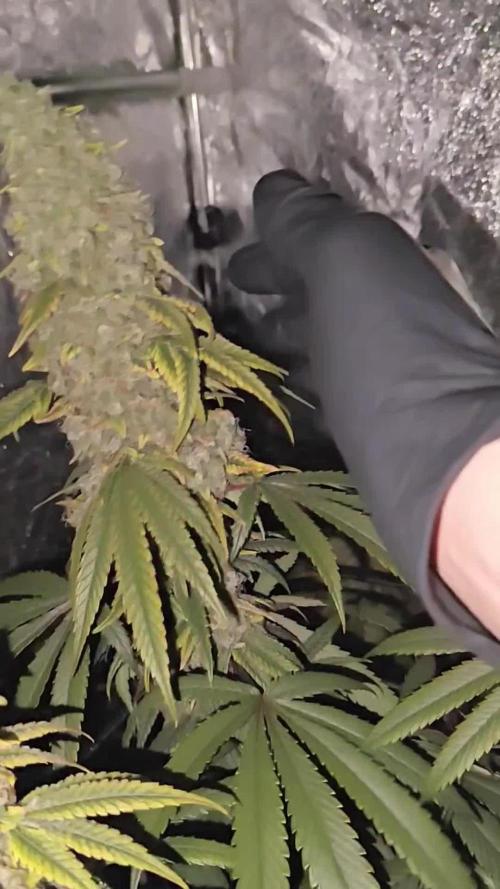
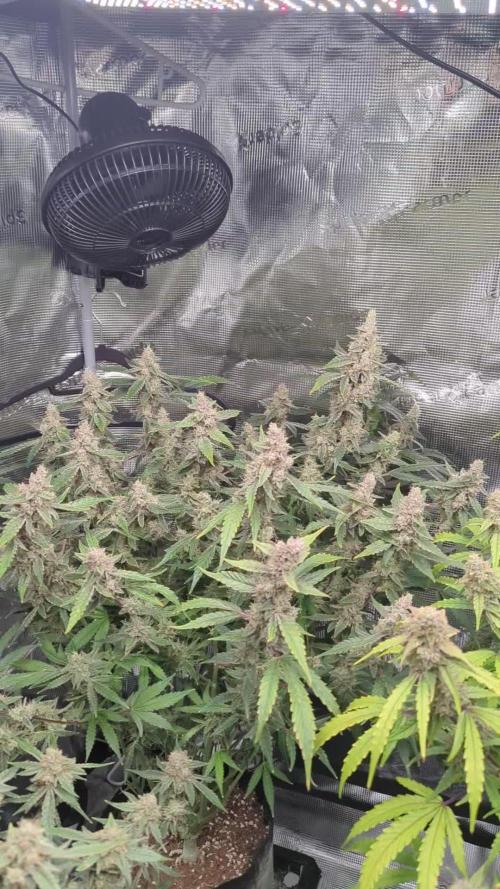
Let's go to the finale. The eighth and final week of flowering. The flowers are hard as a rock. The trichomes are milky and sometimes an amber hue appears.


Likes
72
Share


@BodyByVio
Follow
After a lot of research I realized that my plant needs more food. I increased the PPM to 700PPM and plant seems to love it.
Also I started spraying with Neem Oil and Copper Fungicide since I noticed some rust on the leaves.
Also this week I added Roots Accelerator.

Likes
23
Share


@dataTwiiix
Follow
07/10: 5e semaines de floraison :D on approche de la fin. Arrosage tôt très tôt ce matin. 961ppm que du lourd ;) peut être encore un engraissâge avant la fin de la semaine mais je pense plutôt à commencer le "flushing". Je vais y réfléchir en fumant un bon petit pétard. ...
07/11: je réfléchis toujours :D #56
07/12: la patience est une vertue!
07/13: on approche de la fin de la 9èmes semaine :D #58
07/14: #59 on approche de la fin de la 5ème de flo. Ce soir ou demain matinous je commence le "flushing" et suivra la récolte quand je verrais des trichromes ambrée ce qui n'est pas encore le cas :).
07/15: premier rinçage. #60
07/16: début de sénescence (jaunissement des feuilles) qui était attendu signe qun la récolte est proche! #61
Demain début de la 6ème et dernière semaine.
Likes
9
Share


@I_Identify_As_A_Dan
Follow
Week 10 for Black Lebanon by SSSC
She's looking a lot nicer after she's adjusted to the training the previous week. Unfortunately its been way too hot😥 She did end up getting a little leaf burn here & there but not much. Its a little hard figuring out when these 250L pots need to be watered/how much water they actually need😅 I gave her 7L of water yesterday afternoon but the temps are staying in the low 40's this upcoming week so ill be giving her more water this evening too. She's really turning into a big monster😂 Really enjoying this plant.

Likes
100
Share


@SensimillaP
Follow
The journey for this lady is over! She is huge and gorgeous, the buds seem rocks just by touching them!

Likes
65
Share


@Dendegrow
Follow
Week 2 of the flowering phase flew by 🌱💨. Unfortunately, I may have overdone it with potassium or kept the water level too high – the classic signs of clawing leaves were evident. Thankfully, they seem to be recovering now and are back under control 💪🍃.
My IR night experiment is showing clear results 🌌: The plants exposed to infrared radiation at night stretched significantly more. This might be especially beneficial for this indica-dominant strain as it leads to better canopy distribution, improved airflow, and reduced risks of mold and disease. Plus, the light distribution is much more efficient now, which I’m excited to see pay off.
On the downside, my Orange Sherbert turned hermaphroditic 😔. It’s hard to pinpoint the cause – overfertilization seems unlikely since I’m using only organic nutrients. I suspect it might be linked to an E-field experiment I’ve been running. To confirm this theory, I’ll conduct a new grow with a similar strain next year to see if the electric field negatively impacts cannabis development.
Stay tuned for updates! Drop a like and follow along for more grow insights 🌿✨. See you next week!
Woche 2 der Blütephase ist wie im Flug vergangen 🌱💨. Leider habe ich wohl etwas zu viel Kalium gegeben oder den Wasserstand zu hoch gehalten – die typischen Anzeichen von Adlerkrallen waren sichtbar. Zum Glück scheinen sich diese jetzt zurückzubilden und sind wieder unter Kontrolle 💪🍃.
Mein IR-Nachtexperiment zeigt bereits deutliche Ergebnisse 🌌: Die Pflanzen, die nachts mit Infrarotstrahlung bestrahlt wurden, haben deutlich stärker gestretcht. Das ist besonders bei dieser indica-dominanten Sorte wahrscheinlich von Vorteil, da es zu einer besseren Verteilung des Blätterdachs führt. Dadurch verbessert sich die Luftzirkulation, das Risiko von Schimmel und Krankheiten wird minimiert, und die Lichtverteilung wird effizienter. Ich bin gespannt, wie sich das weiter auswirkt!
Leider hat meine Orange Sherbert gezwittert 😔. Woran das genau liegt, kann ich schwer sagen. Eine Überdüngung halte ich für unwahrscheinlich, da ich nur biologischen Dünger verwendet habe. Ich vermute, dass mein E-Feld-Experiment eine Rolle spielt. Um das zu bestätigen, werde ich nächstes Jahr einen neuen Durchlauf mit einer ähnlichen Sorte machen und prüfen, ob das elektrische Feld tatsächlich eine ungünstige Rückentwicklung der Pflanze verursacht.
Bleibt dran, lasst ein Like da und folgt mir für weitere Updates 🌿✨. Bis nächste Woche!
