


Processing
Likes
Comments
Share


@YAKDADDYDWC
Follow
Nice colas popping up showing to see the hard work pays off

Likes
12
Share


@DrShotzUK
Follow
Week 10 / 11
Starting the flush smells absolutely amazing
Big thanks to 420 fast buds for the seeds.
DRSHOTZUK💚💚🍀🍀

Likes
42
Share


@DrLaggis
Follow
Day 64 - Beginning of the Final Flowering Week 🌱
Hello, my grow friends! We’re entering the last flowering week, and it looks like I’ll be harvesting the plant around Friday, which will be roughly Day 68.
💭 Harvest Decision:
It’s a tough decision because while the buds are still growing, the trichomes in the middle and lower parts of the plant are already about 80% milky and 10% amber. I’ll keep an eye on things and plan to check the trichomes again on Day 65, two days before harvest, to make a final decision.
🌿 Trichome Considerations:
I have a feeling that even after cutting the plant and hanging it upside down to dry, some nutrients might still move into the buds, potentially causing them to swell a bit more. This is something I’m curious to see.
💧 Humidity, Water, and Temperature:
As I mentioned in my last update, I flushed the plant yesterday, just before the start of the final week, with 4 liters of water. This should help flush out any remaining nutrients, and I likely won’t need to water again before harvest since the pots are thoroughly soaked.
The humidity and temperature are holding steady between 52-58% and 20-24°C, which I find ideal. I’ve got my exhaust system and fan running continuously to ensure no mold develops.
📸 Final Updates:
I’ll check in again with an update just before harvest to let you know how things are looking. Remember, I’m posting new pictures and videos of my plant every day.
🌱 Day 70 - Last Day Before Harvest 🌱
Hey Grow-Friends! 😄
Today marks the final day before harvest, and I couldn’t be more excited! As planned, I’ve kept the plant in darkness for the last 48 hours and haven’t watered it for 6 days. My goal is to let it sit in the dark until this evening, when the time finally comes to chop it down. 🌿✂️
Drying Decisions 🌬️
After much research and considering several factors—especially the high humidity in my tent—I’ve decided to go with wet trimming instead of dry trimming. I know dry trimming is often recommended for better bud quality and taste, but my main concern is avoiding mold at all costs. So, to play it safe, I’ll wet trim the buds, get them into the right size, and then place them in a drying net for about 7 days.
Timing Concerns ⏳
I’m still figuring out the best timing for transferring the buds into curing jars. Since I’m wet trimming, I won’t be able to rely on the classic “stem snap test” to check dryness. But we’ll figure that out as we go along!
Final Reflections 🌟
It’s been an amazing journey, and although I could push the grow a little further, I believe this is the perfect time to harvest. Given my upcoming personal plans, it feels right to finish up now.
I can’t wait to report back with the harvest update soon! 🌿 Stay tuned, and as always, thanks for following along!
Likes
Comments
Share

@Philipp420
Follow
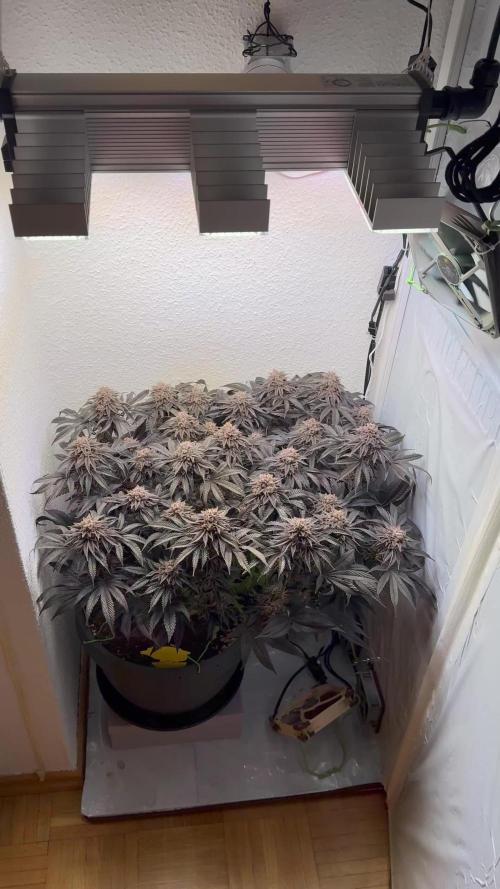
Herstellerangaben: Ernte an BT 56-63
Ernte hier: BT 71
Lampe Leistungsverlauf in % (von 190W) über den Grow und dazugehörige PPFD Werte:
BW1-3: 40-60%, langsamer Anstieg von ca 400 auf 650 PPFD
BW 4: 60%, ca 650 PPFD
BW 5: 65% ca 700 PPFD
BW 6-8: 75%, ca 800 PPFD
BW 9: 70%, ca 750 PPFD
BW 10: 60%, ca 600 PPFD
Trichome:
Ernte bei circa 80% Milchig, 10% Klar und 10% Bernstein


Likes
2
Share


@nickeri
Follow
18.7.2k24 New start maximal flowering with Plagron Green Sensation. Cutting large leaves for maximum air flow..🚁 🌿🌸🌹

Likes
74
Share


@Mr_Maes
Follow
This week we should really see these colas blow up and start stacking really strong. The mixer of 7 hours of sun and 17 hours under my LEDs has really helped my girls grow strong. Nothing compares to good old Mother Nature.


Likes
10
Share


@Losweed
Follow
2 plants have undergone too much stress due to excess fertilizers, but thanks to the help of expert friends maybe I can fix it !!! we hope well!!
Likes
4
Share


@adam_pawloski87
Follow
At a total of 79 days this Sangria is a beautiful one! A cross between The GOGO and Ogreberry she is super delightful, Dense resiny heavy covers trichome buds , with the smell of Gassy rotten fruit funk on the nose! She a stanky one ! Other then that she was a pretty easy grow , y’all don’t sleep on it an better get your hands on it , at @Twenty20Mendocino they got you covered

Likes
12
Share


@PolezGardn
Follow
week six flower everything looks great so far :D
buds are filling out & terps going crazy!!
GorillaGlue 1: smells woody and fresh
GorillaGlue 2: smells more woody and less fresh like a tree
I water them with 1.5l every 48h
the light I use was set to 100% and it hangs 80cm away from the tops

Likes
13
Share


@CalGonJim
Follow
11/6 Monday. She’s very very dry today. I’m gonna do 96 ounces of water she’ll take all that and I’m gonna do the medium feeding schedule and I’m gonna go with the bloom tastic I’m gonna do two mils per gallon.
11/7 after the water last night she did really good, but because I did not top her at the fourth node, I usually do. I just tied the branches back with those plastic clips I need to defoliate there’s way too much underneath I’ve never had this kind of growth before so I have to go and trim out some of the non-functioning branches and some of the bigger leaves to get some airflow and light to the bottom.
She’s really great I’m super surprised last time I had bad Soil and this time I have some bugs but I’ve sprayed for them and she’s responding well I also gave that bloom hardener sooner than I should’ve but she’s doing good
LST went good 👍 8 hours later she’s responding. Well leaves are starting to reach up again because I lowered the light to 92 W whenever they start pushing down it seems like there’s too much light which also means it’s cooler so it’s just great. I’m glad I got the Mars Hydro lights. They’ve made a huge difference being able to put the driver outside the tent without having to buy any extras. I’ll probably get a fourth one of those eventually.
11/8 Wednesday super early morning I dried some of the little branches. I took off overnight and I’m smoking them right now. I can’t believe it. She is so strong. Her leaves are really starting to wake up. Lowering the light made a huge difference. the light was just too powerful. I keep forgetting that so I turned it down to about 92 W and she’s really waking up today. It’s incredible and I’m a little bit dizzy. It’s a little stronger than I thought. This is one of my best ones. I really like this. 👍👍👍
11/8 PM I turned the light up 5 W. It made a pretty good difference and I raised it up about 2 inches to get a little more light spread. I did another unexpected watering today.
She was completely dry so I did a full gallon. I mean 96 ounces with half gallon measured out nutrients, I had some weird issues with my water. I hope it doesn’t affect the plants.
I boiled my water and I look at the top of it and lots of small particles floating on the top of the water & the bottom of the pan has something brown burned onto it. Very weird.
11/9 👍👍👍🤩
11/10 I did another watering using 96 ounces this morning. She is growing like nothing I’ve ever seen before. Last time I topped her between the third and fourth node to keep her small and I did it way too soon.
I was experimenting so her main stem was really thin and this time is one of the thickest ones I’ve had, so she clearly does not like being topped and now she’s growing into a beautiful monster it’s just great is probably one of my best grows
11/11 her buds really seemed to swell overnight after the defoliation and the feeding. Lowering the lights wattage as helped I’m just going to leave her alone today, but wow.🤩
She had a really good day. I did a little extra tying down of some branches. I didn’t takeoff early any leaves just one or two let her heal a lot from trimming yesterday she doing great probably my best grow ever and the first time that I’ve just used tying the branches down instead of topping much better result for this plant.
11/12 Sunday end of the week. She has been phenomenal this week and her buds are really starting to swell. Now I have to spray for bugs. I think that the soil bugs are eating at the roots whenever I spray at the bottom of the bag I immediately could results so there’s something in the soil I’m competing with, but she is the best girl I’ve ever had. You can get up to nine free seats if you buy the right thing on seedsman and so I stocked up on these critical pluses now I know how big they get. I’m gonna keep growing these and they smell so good .
Likes
10
Share


@MrIssa3x3
Follow
Happy I made it to harvest as I know that’s a lot of first growers issue. She’s sticky, funky, and chunky. Nothing bad to say. I definitely learned some things that I’lol be implementing next grow. Probably do another run of Autos from Mephisto as I have a few. But my goal is to get into the Photos, preferably the kushiest of the kushy lol. If anybody has any suggestions of some fire Gas, point me in the direction. More updates to come, so for the next week or so, just monitoring. Stay high growmies!

Likes
27
Share


@RDWCGrowing
Follow
3/25/2023
Week 6- Day 1 of Veg (Day 52 overall)
Added my first between changes SILICA Top offs. Was worried that when you add it to pre mixed Nutes that it can make the whole thing turn into a gummy looking substance. I was ready to drain the system and start it over for the week if needed, but no issues adding it to the tank. the Silica going into the Res didn't gummy the system up, it did drop my PH by quit a bit causing me to have to bring it back in balance.
36 Gallons in the Tank
Silica
Add .5mil/Gal = 18Mil
I topped some that needed to be topped, I defoliated some that needs to be defoliated. Since I have moved into Week 6 I have increased the light intensity up to just over 500 maxing it out for Veg Cycle. Next increase will be Week 1 of Flower.
3/26/2023
Week 6- Day 2 of Veg (Day 53 overall)
All conditions looked great. Other than me not putting one of the humidifiers back right which means it didn't work last night so Humidity was lower than I like. But got the Humidifier back on it's stand correctly and it is now pumping away. With that I decided to give the plants a day off from any stresses, no topping, no FIMing, no Defoliation for today. Just some good old soaking up the light rays and the ability to get all the Nutes they would like..
3/27/2023
Week 6- Day 3 of Veg (Day 54 overall)
Looking kind of Bushy today, so I defoliated some, and topped some.
3/28/2023
Week 6- Day 4 of Veg (Day 55 overall)
PH was a little lower than I like 5.74 so I added a few Mil of PH UP and brought it back up to 5.94.
Not much else at this stage, just I topped a little and I defoliated a little.
3/29/2023
Week 6- Day 5 of Veg (Day 56 overall)
Topped a little, Defoliated a little Watched them grow!!
3/30/2023
Week 6- Day 6 of Veg (Day 57 Overall)
Main action today was breaking down my old tent and setting up a new tent and getting my second RDWC system setup and ready for clones. I Topped a little, I Defoliated some and started taking a good look at what I would like to take for clones in the coming days. I have a few bottom branches that look every promising for my clone material on each.
3/31/2023
Week 6- Day 7 of Veg (Day 58 overall)
#3 is at 16" Tall
#2 is at 13" Tall

Likes
19
Share


@LucasHendrik
Follow
She is going to be amazing when full sized. I had my quarrels with the lady but it's been rewarding waiting with patients. That is like we should do with all lady's. ;)


Likes
23
Share


@dataTwiiix
Follow
06/12: c'est le moment de commencer à compter les semaines de floraison.
Arrosage ce matin qui a été suivi par une drôle de réaction de la part de la plante je n'arose que très peu depuis le début vus que c'est une automatique et aujourd'hui après deux jours de canicule et 3 jours depuis le dernier arrosage. Enfin voilà ce matin j'arrose et les feuilles deviennent tombante je me dit ok: attendons quelques heures voir ce qui se passe et je l'a retrouve dans une forme holympique.
Mise quotidienne du LST.
06/13: arrosage 1L *engraisser
06/14: vague de chaleur. ... je sent que je vais vite devoir arroser de nouveau la chaleur et les ventilateurs et pot en geotextiles égale substrat qui sèche vite!
06/16: arrosage 1.2L (engraisser)
06/17: température extérieure 33*C température dans la box 30*C malgré cette vague de chaleur la wcc réagi plutôt bien on dirait qu'elle aime la chaleur et le vent plus que les vario. Que j'ai grow jusqu'à présent.
06/18: la temperature retombe sous les 30°C ouf temp. dans la +/-26° arrosage 1.5(AN ph Perfect grow pour corriger un manque d'azote + bud candy) (j33)
Likes
55
Share


@budsfromthesix
Follow
Good start off to week 4. I did a 50 litre flush for pheno #1 and she bounced back real good. She is super happy and growth is really starting to pick up. A little more small in the tent now so I’m happy.
I’ve also added bamboo sticks for both plants since I’m not using scrog so no trellis net to stop the plants from falling over once they start to pack on weight. Excited to see how the next couple are gonna go. Hopefully no more issues :)


Likes
16
Share


@Gulliver
Follow
Эти девушки очень много сахара произвели за неделю и плотность бетоном очень увеличиваеться!
Прекрасный рост.
