


Likes
Comments
Share


@1Right_Angle
Follow
Feb 11th
Week 8 is off to a good start.
- lite-cycle; 11.5 hrs on, 12.5 hrs off
- reducing rapidstart / CaliMag
- increasing molasses
- Reducing Volume of water > 14L next feed. Only 4 feeds till flush if all goes well.
Feb 13th
- USB scope shows that there is still a lot of development to come. Trichomes still showing clear in many areas.
- 3 areas were checked & it’s 50/50 with clear / cloudy trichomes. Week 8 of Flower from a proposed 11-13
-no food tonight, soil still damp
15th
- Lite cycle down to 11 hrs on, 13 off
Feb 16th
- reduced UVB time by an hour. Using 5 in total ( 2x 2.5 hrs )
- down to 3 feeds; before flush. Trichomes will be checked 1st
- raised light a bit ~ 19” from closest Bud
- planning Flush
-targeting 40% RH
18th
- finishing week 8 of Flower with a proactive move on shortening the lite-cycle again; 10 On - 14 Off.
Goal is to promote Resin production, Bud-filling and hopefully bring the show to a tidy finish, on-time.
- Took a few pictures last nite, posting later today
- Calyxes really seem to be swelling and filling in

Likes
12
Share


@Kakui
Follow
Por lejos este ha sido mi mejor cultivo hasta ahora, han sido los cogollos más grandes, densos y llenos de tricomas que he cultivado, comparado con el cultivo anterior en el que usé el mismo tipo de planta, está vez fue muy superior. Los motivos de la mejora pueden ser varios, incluidos más luz, ya que en el cultivo anterior solo tuve 480w, ahora fueron 720w, también usé tutores y palitos de madera para crear una estructura firme en algunas plantas, y fueron estás mismas las que tuvieron los cogollos más grandes, así que lo usaré en todas las plantas del siguiente cultivo. Además el tiempo de cultivo se redujo de 4 meses a 3 meses y medio, aprox. Ahora solo queda esperar unas 2 semanas para el secado y ver cuánto fue la cosecha total en gramos secos, la anterior fue de 635 gramos secos, está yo creo que por lo menos rondará los 700 gramos secos, incluso puede que me sorprenda y sea mucho más.

Likes
262
Share


@Ju_Bps
Follow
For this grow I've used,
For the growth
1 sf1000
2 fan 15w
1 extractor 150mm 350m3/h
1 carbon filter 150mm
1 Hydro Shoot 60x60x140
1 timer
1 thermostat
Heating system for the winter month
To start pot 2l, after 8l
18 Hours On, 6 hours off light
For the soil I've used plagron light mix and rqs pellets.
For the blooming
2 sf1000
2 fan 15w
Extractor + Filter 150mm
1 Lite 60 box
2 timers
4 RQS Fabric Pot 15l
12/12
Plagron batmix + RQS Pellet
After harvest,
I'll not use my usual carton dry, last time I've got mold on few big buds, si this time I've put the stuff in a room with 15w fan (see video),
Thanks for all my friends!
And again thanks to RQS and @James

Likes
3
Share


@Ieiogrow94
Follow
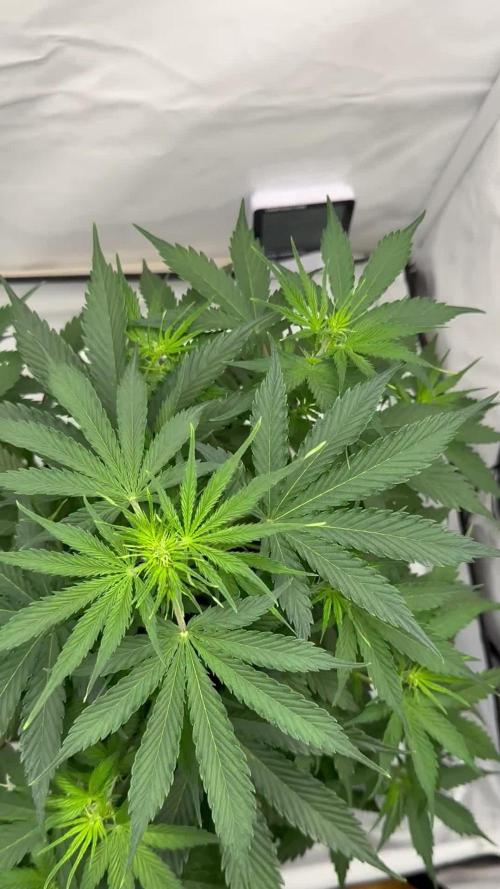
Eccoci di nuovo qui!!!
Super eccitato per questa nuova collab con Kannabia Seed Company, team davvero al top, che mi ha dato l’opportunità di testare questa nuova genetica e di condividere i progressi con tutti voi!!!
Come sempre partiamo nei bicchieri per poi travasare.. Questa volta verrà svolto tutto sotto la Lumatek Zeus 465 ProC, mi aspetto molto da questo ciclo!!
WOOOOOW!!
Grazie a tutti per il supporto ❤️🍀🔥



Likes
15
Share


@Happy_Rakosnicek
Follow
I got new lighting from VIPARSPECTRA and type XS1000 and I added another dose of nutrients according to the table, but I only used 0.5l of water.

Processing
Likes
6
Share


@Ashbash
Follow
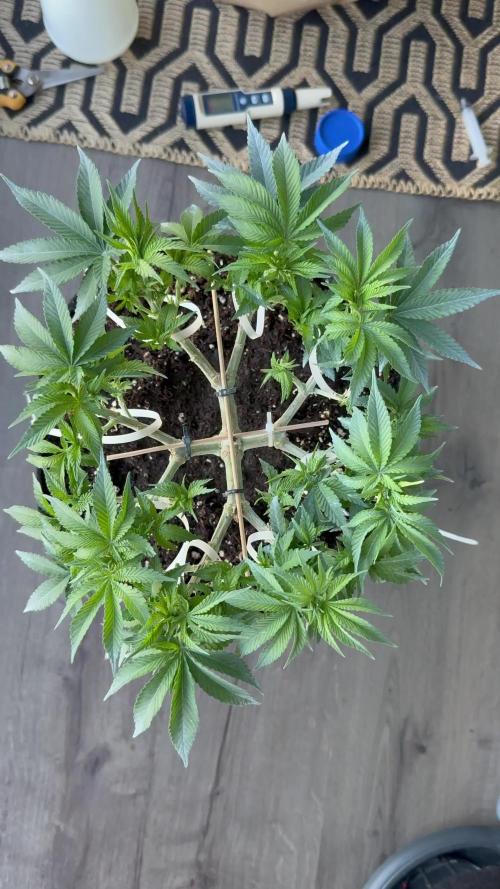
Not giving them Any nutrients now until chop which should be in a few days. Seeing lots of amber on the Royal Gorilla, not so much on the Green Gelato, but still present in small amounts.
2 days until 10 weeks total flowering.
Letting the plants fall and rest on the side of the tent isnt ideal, but its the only way i could have saved them from the heat.
Check out my stardawg diary for what heat can really do to a plant....gonna upload another week soon and there is HUGE damage to the plant that didnt auto.
These smell lovely anyway, cant wait to try them!



Likes
22
Share


@Smith420
Follow
It doesn’t look so good. Can someone tell me if i under-watered or over watered? They look sad?

Likes
8
Share

@HashishOculus
Follow
Week 12 - Flower Week 7
12. of Feb. Day 78 - Flower Day 43
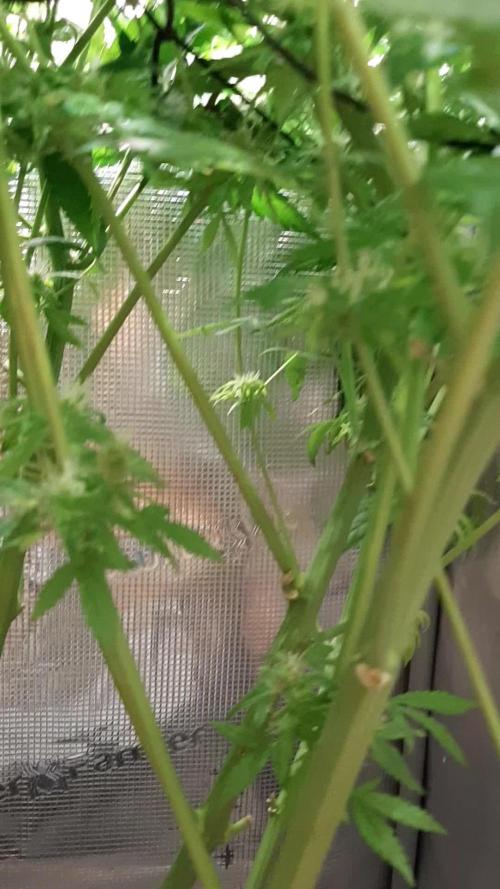
Reservoir steady in the mid-1.6 EC range. pH behaving normally after corrections. Drinking roughly around a liter per 24h. The tops are mostly orange. Very few white pistils up top. That’s what’s dominating my attention. It feels early for them to look this mature. I start questioning whether the late-January catastrophe pushed her into finishing prematurely. Trichomes look mostly clear on closer inspection - not milky like I first thought. That’s important.
13. of Feb Day 79 - Flower Day 44
Pre top-off EC dips slightly - small sign of uptake. pH stable in the mid-5s after correction. Still fixated on the topmost crowns. They look static. I compare pictures from a week earlier and struggle to see obvious swelling. That’s frustrating.
14th of Feb Day 80 - Flower Day 45
Numbers stable again. EC mid-1.6s, pH mid-5.8s after top-off. Drinking steady but not aggressive. I consider whether development has stalled. Buds look healthy, not deteriorating - but not exploding either.
15th of Feb Day 81 - Flower Day 46
The mental tension is still there. Considered drastic action (flush), but decided against it after reviewing the data. Numbers weren’t extreme. Plant wasn’t collapsing. Chose stability instead of panic. EC held in the mid-1.6 range. pH stable. Drinking continued. EC trends stable. pH predictable. Roots healthy. No worsening damage.
16th of Feb Day 82 - Flower Day 47
00:15 pre top-off:
pH 5.5
EC 1484
She drank just over a liter. After top-off:
pH ~5.8
EC mid-1.6
This is the first real shift in perspective. I notice that underneath the canopy, popcorn buds and mid-level sites still have completely white pistils. That’s a crucial observation. If she were truly finishing early, those would not be fresh and white. This doesn’t look like shutdown. It looks uneven maturity between canopy layers.
17th of Feb Day 83 - Flower Day 48
00:10 pre top-off:
pH 5.73
EC 1564
After circulation:
pH 5.75
EC 1620
EC meter seems to show too low values at first.
Drinking 1L again.
This is the day I actually see bulking happening. Not on the very tip of the highest tops - but right below them. The secondary crowns are stacking visibly. Calyxes swelling. Structure thickening. I realize I’ve been staring at the most stressed tissue (the very tops affected by the earlier light/EC incident) instead of looking at the plant as a whole.
18th of Feb Day 84 - Flower Day 49
Pre top-off:
pH 5.92
EC ~1.6-1.7 (meter slightly inconsistent but trend stable)
After top-off:
pH 5.87
EC 1620
She drinks over a liter again. The brown pistils on the very top now feel less like “premature finish” and more like scars from the January event. Lower pistils remain white. Calyxes are not collapsing. Bud density is slowly improving.
This week ends in a different place than it began.
Not explosive. Not perfect. But alive, feeding, stacking - and very much still in flower.
Next week should hopefully be all about stability and bulking.

Likes
13
Share


@BigTuk420
Follow
It was week 13 2 days ago iv just not had much spare time but here is a small video that will make you feel drunk. things are going as good as i can get for now they all just had a quick water. untill next time take it easy peeps... Ps does anyone know who has a good dawg not the nast horrible types that tast mouldy lol thanks


Likes
8
Share


@WeedNinja
Follow
They're making a good improvement this week.
Got 2 tall ones and 2 short ones I guess because of the overcrowded place , what you guys think?
But the smallest one on the back got a beautiful top 🤤 .

Likes
2
Share


@Green_Peace
Follow
Putting on weight fast now in peak flower. Love the structure of the plant and really regretting not taking a cutting. Oh well, ce la vie. Will stop adding PK in the next few days before cutting back on nutrients next week then flushing for the last 2 weeks. This plant is at the back of the timelapse.
Likes
105
Share


@Green_Friends_Inc
Follow
Commencing Week 10 - 2nd week of flowering - Day 64 from germination - Day 14 of 12/12 on December 26th
All is awesome! 😁
Although all plants have hairs right now, 818#1&2, BH2, & GZ2 (especially 818s) seem to start throwing hairs just a few days before the rest.
RD is stretching out rather nicely and is working in sync to make a nice level and full canopy.
Have noticed the pH of the nutrient solution now swings very low with every plant, especially the bigger ones, within 24 hrs going from 5.8 down to 3.8-4.3. I pH back up accordingly every day.
Lastly I decided to go with "bonsai" training instead of topping.
(This is in order to keep plants growing at a steady pace - non-stunting - while taking away the apical shape that is natural for some strains.).
I "bonsai'd" The following: GZ1&2&3, AND 818#1.
Simply put I coiled bonsai wire around the main cola and bent below the next lowest node /tier (see photos)
The other s: RD, BH 1&2, and 818#2 have a natural level/close to level shape.
D.65/15
Started tucking leaves and light stress training. So far I have taken only 3-4 leaves off per plant. And other than coiled the Apex cola they are been untouched.
Also to balance out the pH drop, I have been pHing to the 6.0-6.2 range. Seems to steady the solution better so I will continue.
Lastly I have put both the fans and the oxygen pumps on a 15m on 15 m off interval throughout the 24 hr day. I thought it might be risky however the plants seem not to mind, rather maybe even like this better.
D.69/19
Yesterday I added a tiny bit of bloom food high in phosphate to help with the flowering since it's picking up now, as well as some extra Cal Mag and the plants seem happier because of it. And I have still been putting the pH a little higher, in the 6.1 range, rather than a 5.8 since it seems to be dipping low every time I check rather than going up.
Also I put these pumps back on 24 hrs per day because after two days of being on for 12 hours her day they seemed not as happy as they were prior. Lesson learned with that one no harm done so that's a good thing.
The raspberry diesel is really taking up the space wonderfully in between the four plants in the corners and is becoming almost + shaped really filling in the canopy just like the description online says don't vegfor long because the flower phase stretch is something to behold.
818 headband number one has a really beautiful medium sized stature not too short but not tall and lanky either and tons of Bud sites and is looking the most bud-filled already whether that means it will have the most yield or be done the fastest, or both we'll have to wait and see.,
All three of the Gorilla Zkittles seem to have slightly different phenotype variation one a little bit more sativa than the other two that are more hybrid looking. All 3 have very different root masses compared to the rest of the plants and are pretty big but one in particular is absolutely huge. (Comparisons will be posted in next week's update.)
the Boss hogs also seem to have very different phenotype expressions as of now one is staying much more short and having a very level canopy naturally and no hairs, while the other is close to a level canopy but still has a little bit of that main cola dominant feature as well as a lot more hairs.
Thank you watching hope your enjoying, the best is yet to come !!😁😁


Likes
Comments
Share


Likes
Comments
Share


Likes
7
Share


@XoticGROW666
Follow
( RUNTZ X F1DURB X GUSHERS )🍬🌈🍨🍧
PURP KICKIN INN END #WEEK4
CANT WAIT TILL THE BUDS SWELL UPP!!
SUPA INTENSE CANDY TERPS THIS ROUND
NOT BIG BUDS BUT SUPA HIGH IN BRIXX LEVEL WITH ALL THE ORGANIC CARBON INPUTS!! PPM 900/1200 1.2 max
(Face Off OG x Watermelon Zkittlez) X (Runtz x F1 Durb x Gushers) 🍉🍬🌈🍧🍨🍦
LIL PRUPLE TINT WIT MOUTH WATERING SUGARY TERPS KICK INN END #WEEK4 BY WEEK 7/8 SHE WILL BE PURPLE PURPLE WIT SUPER INTENSE CANDY MOUTH WATERING TERPS CANT WAIT TILL SEE THEM BUDS SWELL UPP!! PHENO A/B
NOT BIG BUDS BUT SUPA HIGH IN BRIXX LEVEL WITH ALL THE ORGANIC CARBON INPUTS!! PPM 900/1200 1.2 max

Likes
15
Share

@Stoney_Stark
Follow
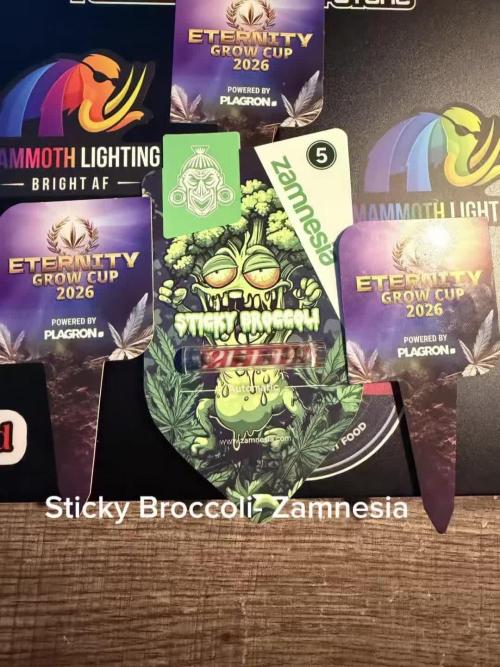
Sticky Broccoli Auto – Harvest Update
Strain: Sticky Broccoli Auto
Breeder: Zamnesia Seeds
Grower: Little Lilly Farms
Overall Outcome
This run didn’t hit the mark. The genetics felt unstable and inconsistent across all four plants—each one expressed very differently in structure, growth, and final bud development.
Bud quality leaned airy and loose, lacking density, but was heavily coated in resin and trichomes. Visually appealing frost, but the overall structure didn’t back it up.
Terpene profile was underwhelming—nothing loud or complex. Mostly a sweet gas aroma, but lacking depth and punch.
⸻
Harvest & Final Week Timeline
4/1
Fed one plant ½ gallon of previous nutrient mix. Very minimal runoff.
4/2
* 1 gallon of premade feed (from 3/31) used
* Small runoff achieved
* Other 2 plants received straight RO water (not pH’d)
* No noticeable change in color or fade on water-only plants
4/3
¼ gallon of premade feed mix applied
4/4 – Harvest Begins
* Cut down 2 plants
* Fit both into the Cannatrol for drying
* Buds extremely resinous and sticky
* Heavy trichome coverage across both plants
* Switched remaining plants to straight RO water moving forward
Final Feed Mix (per gallon):
* 0.5 ml Silicium Bloom
* 2 ml MagCal
* 4 ml Green Sensation
* 2 ml Cocos A
* 8 ml Cocos B
* 4 ml Pure Zym
4/6
* Purple coloration showing on sugar leaf edges
* ¾ gallon RO water (not pH’d)
* ~5% runoff
4/7
* ¾ gallon RO water
* Minimal runoff
4/8
* 1 gallon RO water
* ~15% runoff
4/9
* ¾ gallon RO water
* ~20% runoff
4/10
* 1 gallon RO water
* ~15% runoff
⸻
Drying & Cure
All 4 plants have been harvested, dried, and are currently being trimmed. Final weight will be recorded once trimming is complete.
⸻
Final Thoughts
* Pros:
* Extremely resinous buds
* Heavy trichome production
* Good visual frost
* Cons:
* Airy, low-density buds
* Weak terpene expression
* Highly inconsistent phenotypes across all plants
Overall, this run felt like a genetic gamble that didn’t fully pay off. While the resin production was impressive, the lack of density and terp complexity made this one fall short of expectations.

Likes
15
Share


@OrganikTek
Follow
Sorry brothers to be so lait this week... had some problems with may Home Assistant raaspberry. Lost a day and half of photos.
Weather is Getting better
Black Cream Is in senescense. Buds are fattening and getting some color. Shes so Beautiful now.
The other are starting to a lot of pistilis out. Flowering in early stage. didnt train them so much let them grow more vertically.
Chears BrotherHood
Likes
7
Share

@Terp_Turkey
Follow
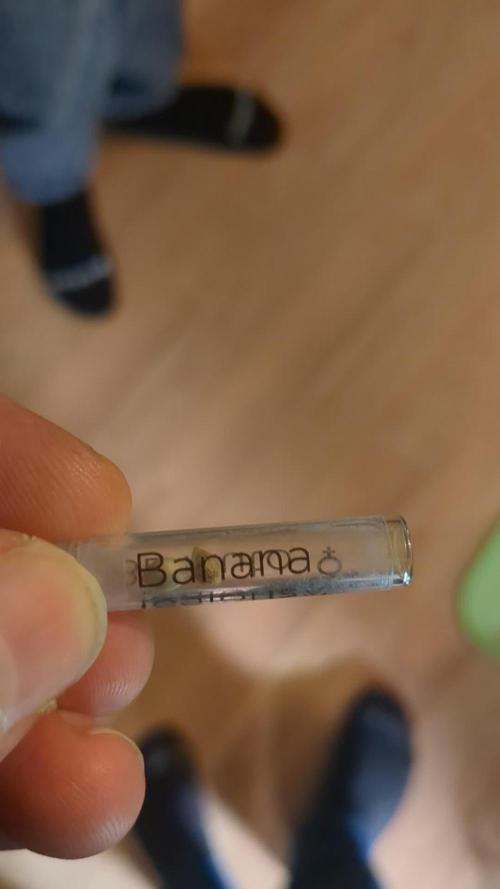
Should be about 80 days from when the seed comes up. This is my first time running Ethos gear and I'm pretty excited. Can't wait to see the quick results. The other plants I have it seems like I've been growing them for an eternity because it's been so cold in my basement. Hopefully I can give this gal a better start.