


Likes
Comments
Share


@rhodes68
Follow
Four plants in all eventually
1/31 First of the Bond harvests, Pussy Galore first of the FFT-7s, two more follow.
Pussy Dry weight 312 grams
3/5 Holly 665 grams wet into dry - dry 98 grams
Two more F7s to go
3/25
Pussy-1 clone yields 1107 grams wet in dry --- dry yield 181 grams
One FFT-7 Remains Pussy-2 buds look a bit larger
3/28 Pussy-2 wet weight 1295 grams in dry. 242 grams dry. This concludes the FFT-7 harvests


Likes
11
Share


@Just_Jazz
Follow
Two weeks after the germination of the seeds, the plants look great. Next week, they will be moved to larger 19-liter pots. Next, we'll perform topping (fimming) and low-stress training (LST).

Likes
28
Share


@GodZilla_Owner
Follow
We are at the beginning of the 9th week of flowering. The trichomes are slowly beginning to change color.
I'm now going on vacation for 9 days, I couldn't have planned it any shittier. But anyway, I've decided to keep them growing and then probably harvest them straight after my vacation.
Processing
Likes
13
Share


@GhettoGrowShow
Follow
The plant on the right has stretched and has taken over. It is about 3 times the size of the plant on the left.
I have not used any added nutrients yet for this grow beside The Osmocote plus that I mixed directly into the soil when I planted the seeds. SO far their doesn’t seem seem to be any deficiencies but at some point during flowering I plan on giving them some miricle grow bloom booster if they seem to get hungry.
Likes
39
Share


@flako
Follow
day 21 : irrigation
Plant still looking heathy, but only 11cm , i'm no idea if this is normal to outdoor because is my first time growing outside, but i have no problem with that :D .
ill buy neem oil to avoid pests 👆
Day 24 she grow up to 15 cm ( 4 cm in 4 days) and spray her with Anasac products (Chilean pesticides used in agriculture) she's growing stronger, 😤 im really happy.
she will preflowering soon


Likes
11
Share

@HerrnBubatz88
Follow
17.11:
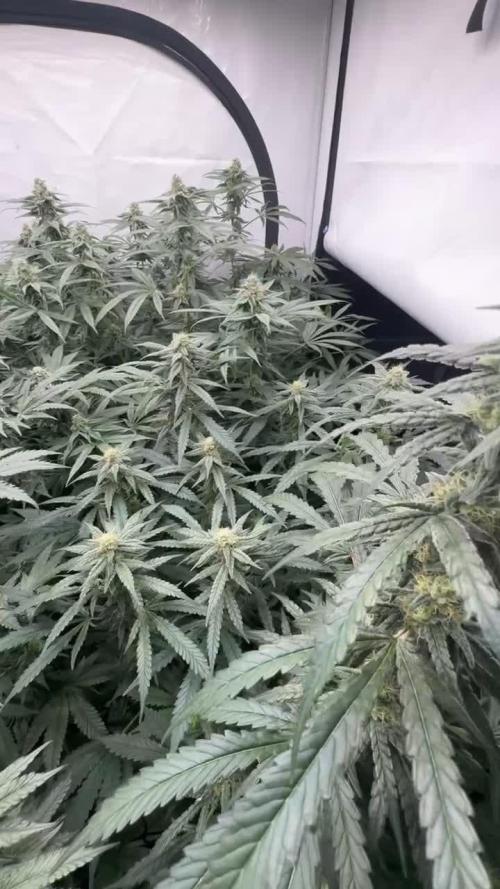
Sup Guys, starting Off Week 5 beautifully - Great smell and Stack. Got you a Look around again. If you Insist of Any Pictures just ask. Adjusting the Nutes a Little as the CO2 will run out in 2-3 Days. Hopefully they keep stacking good as I dont wanna Hang another CO2 Bag. Stay Tuned!
Any questions or Tipps? Feel Free to Comment.
21.11: Night temps dropping with the first negative Degrees.. You Can definitely see a difference between Lob #1 and #2 forming, #2 leaning more to the Zangria side #1 more to the Blue Lobster. All buds are still stacking nicely. ChemD still a little behind but as I said that’s due to genetics as from the breeders info she’ll need a week more than the others, maybe she will catch up we will see.
Current setup as I got asked:
BBC x WC (Topped)
2x Blue Lobster x Zangria (#2 topped)
ChemDogg x Papaya
4x15L Autopot
480W Spiderfarmer SE5000
2x 15w Fan / one canopy one Cooling the LED
1x 50w 360 Rotation Fan
2x Trellis net
Dehumidifier 380 w from comfee
4“ Incline Fan spiderfarmer
50/50 RO + Tapwater mix starting EC 0,25
Athena Ag on Coco


Likes
30
Share


@ktkoi
Follow
Day 60: Using LST and FIM Lemon's canopy looks great all the sites exposed to light. Orange is getting taller.. so we'll see how it'll end up. The yellowing leaves might actually be light burn they're pretty close to the light, but the sugar leaves are a bit more protected. I might go back to 20:4 in terms of light schedule or lower the shelf. Smell wise even Lemon's non sugar leaves have a very lovely scent. I'll get back to the scent profile another day.


Likes
2
Share

@ao_grows1978
Follow
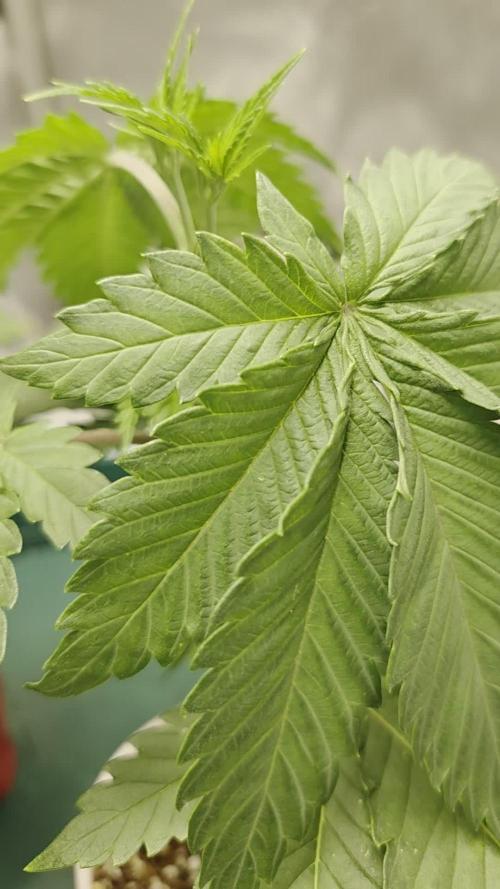
Another week down and the girls are doing great. The new tops are developing nicely. The leaves and stems are starting to smell, and they've gotten their top dressing of 5g of Grow Dots. That should carry them through to the end of flower.

Likes
253
Share

@Hologram
Follow
Yes!
harvest time!
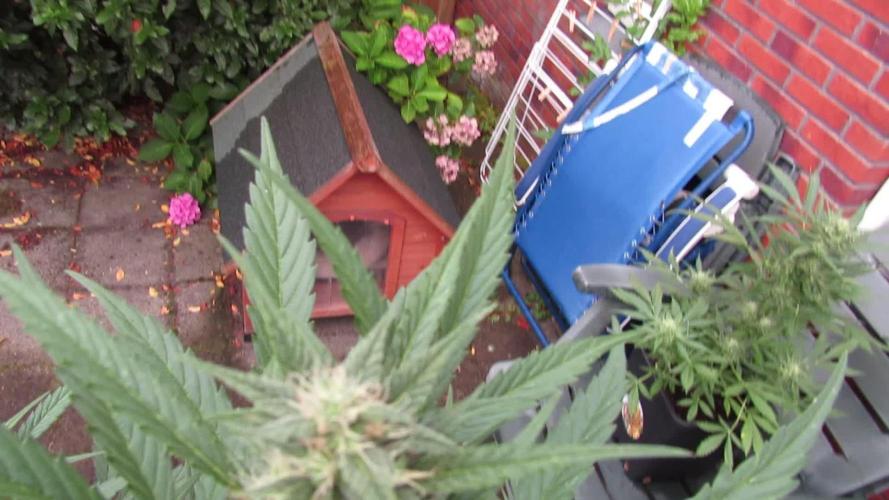
Buds r very solid, smelling very sweet and have lovely colours of pink in it.. but dang! so sticky!!
She was in a 5L pot but she grew hard, like the beast she is 😎👍
Sticky was on tour a lot
She started out on my window sill with only 13H of daylight and NO sunshine! But the winter was long, and i just could not wait any longer! 👊
..then she went in my little greenhouse in my garden//and when she got bigger, she got an upgrade to the big safehouse (also in garden)
and now and then she could stay on my gardentable to catch few rays..
She has battled a lot of bad (storms!) and cold weather and with that came a lot of bugs and pests..(big safe house is open at the sides.. its more a cover to protect them from rain and wind)
But she still kept on growing like she did not care..
Only the last week of her grow she got some nice weather
and i think she was very happy i let her enjoy that before chop!👏
yes i can write a lot about this grow, but i can also just say:
WOW!
my whole garden smelled very sweet thanks to her
but im sure my neighbours are happy she is gone..😆
And don't forget:
FOR ALL MY GROWBROS IS A DISCOUNTCODE: ZAMMIGD2023
YOU GET 20% OFF @ZAMNESIA!
😎
happy growing for all✊


Likes
16
Share


@MadeInGermany
Follow
Info:
Unfortunately, I had to find out that my account is used for fake pages in social media.
I am only active here on growdiaries.
I am not on facebook instagram twitter etc All accounts except this one are fake.
Have fun with the update.
Flowering day 33
since time change
to 12/12 h.
Hey everyone 😃.
Another wonderful week goes by :-).
The lady is developing very well.
The flowers begin to develop properly and already smell very nice 🙂.
The day before yesterday was the last time 1 g of GHSC Powder Feeding per L substrate was added :-).
That should last to the end now.
Of course, she continues to receive GHSC enhancers 👍 every 14 days.
The tent was cleaned every day just like the humidifier was refilled every day.
I am very curious how it will develop in the coming week and until then I wish you a lot of fun with the new update.
Stay healthy 🙏🏻 and let it grow 🍀🙏🏻
You can buy this Strain at
https://www.barneysfarm.com/blue-cheese-34
Type:
Blue Cheese
☝️🏼
Genetics:
Blueberry
X
Original Cheese
👍
Vega lamp:
2 x Todogrow Led
Quantum Board 100 W
💡
Bloom Lamp :
2 x Todogrow Led
Cxb 3590 COB 3500 K 205W
💡💡☝️🏼
Soil :
Canna Coco Professional +
☝️🏼
Fertilizer:
Green House Powder Feeding
☝️🏼🌱
Water:
Osmosis water mixed with normal water (24 hours stale that the chlorine evaporates) to 0.2 EC. Add Cal / Mag to 0.4 Ec Ph with Organic Ph - to 5.5 - 5.8


Processing
Likes
18
Share


@CanadianFillmore
Follow
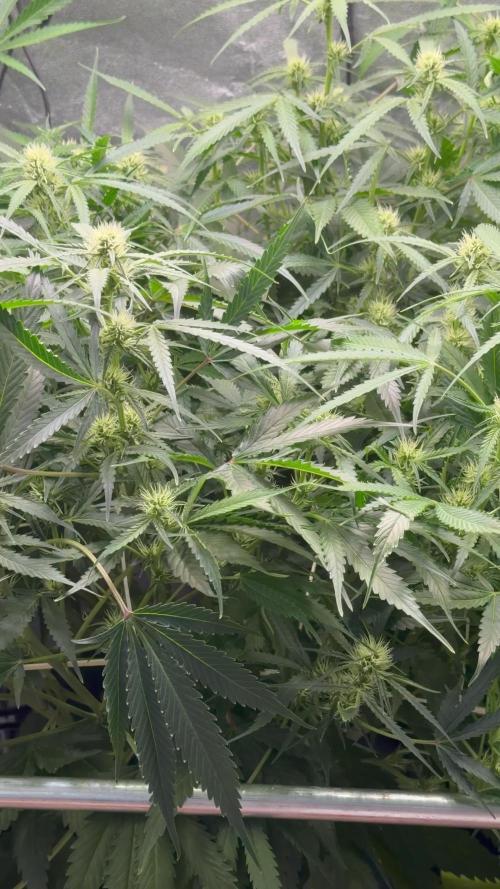
Week 4 begins for Divine storm 1&2, 4 weeks to go!
Both ladies are looking good, DS1 is a bit more thirsty then her sister DS2, I'll keep a close eye on her this week and will feed her extra if necessary.
Thanks for stopping by 👽🌳💚

Likes
24
Share

@TrickzGrowz
Follow
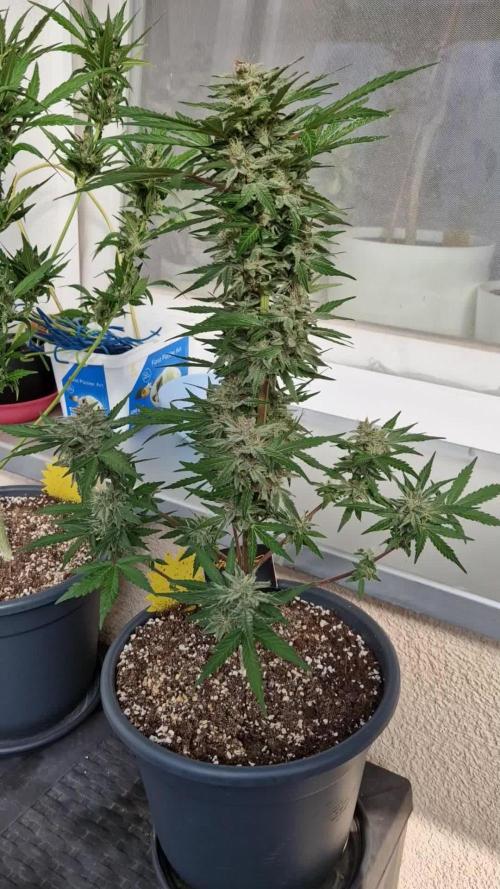
Servus Moin!
Die Chemical Candy macht sich bis jetzt immernoch am besten. Die Buds sehen richtig nach etwas aus! Bin sehr zufrieden mit ihr! Mal schauen wie dick die Buds noch werden.
Likes
11
Share


@Hellishjam
Follow
Working on day 47, 17 days into flower and one of these GSC what really taken off she's stacking up well. Dealing with some cal mag problem in these as well, did a flush with 4 gals per pot and will amend the soil on the on the next watering after we get a nice dry. Will be using bloom and oystershell flour. One of these ladies had some lst done to her as she was just way to close to the light. Did some defoliation with all the girls in the tent to try and open things up a bit, I know autos but things were pretty crazy and a lot of bud hidden. The intake filter for the hood works very well the glass inside is very clean after 28 days, just gave the outside a quick wipe and good as new. Ive got the temps back down a bit and holding strong at 25, when I checked the tent it was running around 28, highest being 30 at one point not sure how long that went on for but it's all fixed up now. Its a working progress learning indoor growing 2 weeks at a time but hey it is what it is and were having fun. hope you enjoyed.

Likes
207
Share


@nonick123
Follow
Bienvenidos a la semana #9 😀 😬 🙏
Día 59 (16/07)
Descubro unas pequeñas arañas rojas
Aplico jabón potásico 5ml/l + aceite neem 2 ml/l
Riego 5 litros con H2O reposada + Melaza 1 ml/l + Té Hummus 30 ml/l - pH = 6.5 EC = 0.81
Día 60 (17/07)
El neem se ha cargado las arañas rojas 😬
Sigue crece que te crece 😀
Voy a tener un bonito monstruo en floración 😬
Día 61 (18/07)
¡A su ritmo de no parar! 😀
Día 62 (19/07)
Las fuc*ng arañas rojas van dando por saco. Las elimino manualmente
He perdido al alien entre tanta rama 😂
Día 63 (20/07)
Riego 4 litros con H2O reposada + Melaza 1 ml/l + Té Hummus 30 ml/l + Guanato 10 ml/l - pH = 6.5 EC = 1.01
Esparzo 100 gramos de Hummus de lombriz en la capa superior del sustrato antes de regar
Día 64 (21/07)
Las ramas principales son espectaculares. Y todas las que han crecido de las ramas superiores con el supercropping también.
¡Es impresionante como crece! 😀
Día 65 (22/07)
No sé si repetir el supercropping
El crecimiento es bestial!
Esta semana no he podido estar muy encima (como habitualmente) porque he estado enfermo del 19 al 21 de julio, pero he sacado algo de fuerzas para regarlas y echarles un vistazo...
Día 66 (23/07)
Ella ha mostrado el sexo!
Voy a tener un problema con la altura 😂


