The Grow Awards 2026 🏆
Likes
Comments
Share
@Afterglow
Follow
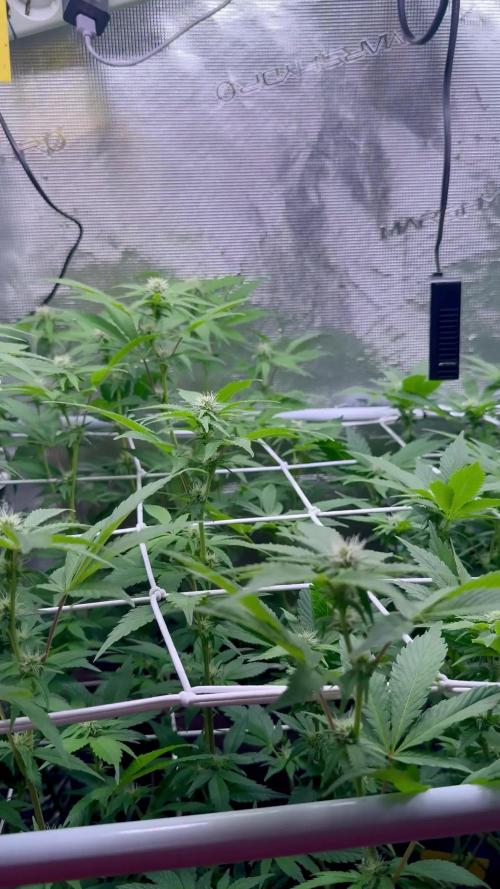
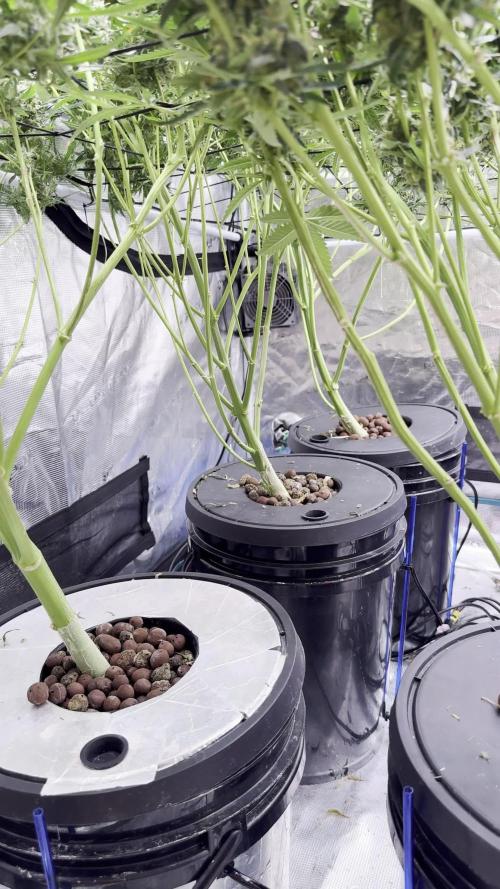
Вначале недели пришлось 8 основных колл согнуть вбок, чтобы они не убежали сильно вверх. Это привело к тому, что этажи ниже вырвались вперед и теперь у меня получился какой-то огромный забор из колл. По сути у меня получился SoG без использования сетки, а только лишь с помощью подвязок. Мало того, растишка стала наращивать зеленую массу и заняла все свободное пространство бокса. Если честно, я сам в небольшом ахуе. Я знал что у меня будет супер-скоростной гров, но чтобы еще и такой массивный - даже не представлял. Мало того, шишки начали расти прямо из листьев. 😂 Мы абсолютно здоровы. Специально сфотографировал кончик старого листика. Ни единого намека на дефицит или профицит веществ. Увеличил дозу до 850 PPM, в дренаже такой же. Перешел на чистое Bloom питание с добавкой Bud Ignitor. Вообще я прям очень рад этим удобрениями. Растет на нах прям отлично, за PH не смотрю. Одни из причин - лень пойти купить батарейки. С другой стороны TDS показывает постоянный PPM, поэтому уверен, что PH нормальный. Ну и сами листья об этом говорят. Как станет теплее на улице, вытащю бокс на балкон, потому что чувствую, что с таким большим урожаем не справится ни один фильтр, хотя у меня их два. Недавно отключился свет и буквально за пару часов вся квартира наполнилась ароматом. Вот такие вот дела... Спасибо что заглянули!
Likes
17
Share
Blütetag 9 🌺 500m l Osmosewasser bei PH 6,3 mit Calmag, Bio-Heaven, Fish-Mix, Bio-Grow, Top-Max und Bio-Bloom. Blütetag 10 🌺 500m l Osmosewasser bei PH 6,3 mit Calmag, Bio-Heaven, Fish-Mix, Bio-Grow, Top-Max und Bio-Bloom. Blütetag 11 🌺 - Nährstoffmangel Bedingt durch das Gießen mit Osmosewasser zeigt sich ein möglicher Eisenmangel an den neuen Blättern. Daher 500m l Osmosewasser bei PH 6,3 mit 1ml ALG A MIC als auch die Blätter leicht besprüht. Die nächsten Tage wird sich zeigen, ob es den Bedarf des Mangels deckt. Blütetag 12 🌺 500m l Osmosewasser bei PH 6,1 mit 0,4ml Calmag und 0,7ml F06 Eisen (mineralischer Dünger) Blütetag 14 🌺 1,5 l Osmosewasser bei PH 6,1 mit 0,8ml Calmag und 0,7ml F06 Eisen (mineralischer Dünger) Sunlight Evo 3-60 60% 60cm Abstand (ca. 600 PPFD) 23-25 Grad Celsius bei 50-55% Luftfeuchtigkeit. VPD 0,8 - 1,0 kPa
Likes
48
Share
@M0S3S
Follow
D108: After the stress we experienced, we managed to recover with a yield of 60-70%. We will start monitoring trichomes in the 8th week. Continuing with two waterings, one with fertilizer and one with calcium, we proceed.
Likes
31
Share
Questa gorilla cookie cresce ben forte..spero arrivi al termine senza nessun intoppo.... Siamo arrivati alla fine della3 settimana. Tt procedere alla grande
Likes
24
Share
@nonick123
Follow
Día 37 (08/07) Ajustes de LST en todas las plantas! 🚀 Día 38 (09/07) Ajustes de LST en todas las plantas. Las ramas inferiores están creciendo como un cohete! 🚀😍 Riego con 250 ml H2O pH 6,5 Día 39 (10/07) Las plantas se muestran sedientas! Creo que el cepellón está lleno de raíces y piden el trasplante! El crecimiento no se ha visto afectado de momento Riego con 500 ml H20 pH 6,5 Día 40 (11/07) Paso a regar con 500 ml / día, ya que hace mucho calor (30 ºC) y efectivamente las plantas ya han copado la maceta de raíces OnionOG y KS1: Las ramas de nodo inferior se han quedado enanas tras el entrenamiento, de modo que las elimino y aplico canela en polvo en los cortes Riego con 500 ml H20 pH 6,5 Día 41 (12/07) Riego con 500 ml H20 pH 6,5 Clones! Mi experimento vuelve a demostrar que NO necesitas complejos productos de clonación ni sistemas para obtener clones! Hace 15 días puse 2 clones con el tallo sumergido en miel durante 5 minutos en una maceta de 400 ml con PRO-MIX HP BACILLUS + MYCORRHIZAE He mantenido la humedad alta con una cúpula de humedad casera hecha con una botella de agua PET de 5 litros cortada por la mitad y pulverizando a diario. Han estado los 15 días en mi terraza con luz indirecta, y temperaturas que rondan los 30 - 32ºC durante las horas centrales del día Hoy los he trasplantado a una maceta de 1 litro porque ya habían formado raíces y empezaban a formar nuevas hojas! 🐥🐥🚀🐥🐥 Día 42 (13/07) Riego con 500 ml H20 pH 6,5 Día 43 (14/07) Trasplante a maceta definitiva de 21 litros de ROOTPLUS Pot de GSKOREA GLOBAL! Estas macetas son una maravilla! Proceso de trasplante: Se prepara con 17,85 Litros (85%) de sustrato PRO-MIX HP BACILLUS+MYCORRHIZAE + 1,05 Litros de Humus de Lombriz (5%) + 2,01 Litros de Insect Frass (10%) + 210 gramos de Earth Vibes Super Soil (10 g/L substrato) Se llena la maceta de sustrato con las manos (limpias) y rompiendo los trozos más gruesos, para que el sustrato esté aireado y esponjoso, sin presionar Se coloca una maceta vacía de 6,5L para que quede la forma perfecta de la maceta donde están actualmente Se espolvorea la parte proporcional de la probeta de microorganismos sobre el agujero de trasplante Se saca la planta de su maceta actual (bonitas raíces 😍) y se coloca en la maceta final Se riega muy lentamente hasta percolación profunda con H2O EC 0,5 pH 6,5 Una vez asentada, complemento con un riego de 500 ml con 25 ml/L de Humus de Lombriz Liquido Se coloca mulch (acolchado) de paja para evitar traspiración excesiva y cuidar a los microorganismos del suelo A ver como reacciona al trasplante! Aplicación foliar Kelp hidrolizado de Lurpe Solutions a 0.25 ml/l Realizo ajustes de LST aprovechando el trasplante a la nueva maceta. De momento tienen una canopia muy bien formada! 💦Nutrients by Lurpe Solutions - www.lurpenaturalsolutions.com 🌱Substrate PRO-MIX HP BACILLUS + MYCORRHIZAE - www.pthorticulture.com/en/products/pro-mix-hp-biostimulant-plus-mycorrhizae
Likes
124
Share
Day 1 drying: Really nice strain! Easy to grow, medium dosage of nutrients. Smells amazing, I’m really curious how they will end up after the drying. Let’s see in some days. Drying day 7: finished and damn the terps are amazing! Smells and taste amazing. It reminds me of amnesia but in a mix with mimosa. Super special. I do really recommend trying this one out. But I would recommend using living soil over coco!
Likes
2
Share
Start of week 2. Everything seems to be ok. The bottom left and right seem to have taken the lead. I switched the two biggest plants into the center. And raised the pots off the ground to help with airflow and temps. Plants are doing good. Two centers are taking the lead. Using RO water. Currently watering when top two inches are dry.
Likes
14
Share
Week 18 Gorilla Glue #4 (Original Sensible Seeds) 6 week of blooming This week I needed to change the arrangement of the pots ... Gorilla Glue #4 is with a full.... looks like an expensive perfume how wonderful :) Your heavy flower branches if unsupported will fall.... The plant was turned where it got less light ... I halved the nutrients... Week 6 Amnesia Amnesia 1 (Seedstockers) More LST continues to stretch 2 week of blooming Amnesia 2 (Seedstockers) Without LST continues to grow slowly with no sign of bloom Gorilla Cookies Auto (Fast Buds) 10 days It has already suffered a touch on the stem with the heating mat but has managed to recover, I hope. Godzilla Cookies (Herbies) 1 Day
Likes
2
Share
Very high quality strain. No joke, I'm glad I have discovered such a fruity and sweet sativa strain. This m8 by gea seeds is a pleasure to smell, I'm so sad about growing her in that little 11l pot, hope next year I can make a very big bush full of fruity big colas 👨‍🌾🤤🍭🍓🍓🍏🍉🍉🍊 Loving the fragrance. Very recomended guys. Peace ✌️💚❤️💛
Likes
8
Share
@Aleks555
Follow
The fourth week of growth has begun, and our FBA 2502 from 42Fast Buds is thriving. After the transplant into a 10-liter pot, the plant has adapted well and continues to develop strong and healthy. Despite being an autoflower, we're experimenting with a 12/12 light cycle, and so far, the results look promising. The temperature remains stable, reaching up to 30°C during the day, with an average of 27°C–28°C. Humidity is maintained between 60% and 65%, providing optimal conditions for growth. The plant has grown noticeably, now standing between 20 and 25 cm, with well-developed foliage. We've started applying low-stress training (LST) to shape its structure, encouraging better light penetration and maximizing potential yields. Additionally, we continue to feed our beauty with Xpert Nutrients, and the results are already visible—strong, vibrant growth and lush green leaves. Everything is on track, and we’re excited to see how our experiment unfolds in the coming weeks!
Likes
27
Share
Day 36 Flowering: Hi growmies Here we are at the halfway point in the flowering cycle. They will be in full PK swing now and be craving those elements to power more pistils and bud energy. I am giving them their last full Pk warrior 9/18 dosage this feed alongside a 3/4strength Megacrop feed. following feeds will be at half pk 9/18 till last 2 weeks. I am also still using calmag to compensate for the l.e.d and coco leeching that often happens with these combinations. In general they are both very healthy and feeding with no issues I now need to up the watering frequency as they do drink way more now. Mimosa lemon is looking long and lanky still but her potential to fill out over the coming 5 weeks is easy to vision. With her stems all set in place and her projection of where she will join nodes in the coming weeks , I think I need to think about supporting them maybe?. She doesn't have a lot of leaf among the stalky colas and looks very like a long flowering sativa does. Hwr smell is now very clear when touched and even close to the plant, you can smell the limonene from her namesake. A stinky lady is imminent i think. filter at the ready. With around 12 mains all going for Merristem status , she could be a contender for best auto yielder this run. Glueberry is certainly living up to her name if I dare to touch her!!. She is beginning to smell so nicely sweet with a hint of diesel too. I think i did stunt her growth early on with the foolish underwatering error. She recovered really well and does have a lot of buds within her canopy hidden. I will make sure I keep her well aired to avoid any mould issues .
Likes
6
Share
Day 71-1/10/22 gonna flush these babies one more time!!!!
Likes
47
Share
All content on this diary is for inspirational and educational purposes only. The ideas shared are not a substitute for professional advice. This diary/account is not officially affiliated with Alan Watts or his estate. All materials are used under the principles of fair use. I honor the legacy of Alan Watts by sharing his wisdom respectfully and with the intention of inspiring awareness and self-understanding. 2nd net is up. Early bud formations are promising. holding up to the extremes pretty well, some leaves taking minor damage, but overall, she is holding up, gave her 1 night at 50F see how she would react, stressful. Not advised as it messes with her metabolism, but I want to see if it triggers any anthocyanin response. Love to see her purp up but no signs yet. Remember, For every molecule of glucose produced during photosynthesis, a plant needs to split six molecules of water. This process provides the hydrogen needed for synthesizing glucose and other organic compounds, while oxygen is released as a byproduct. Homework. If Rubisco activity is impaired and it cannot properly function or regenerate its substrate, the plant's leaves are likely to turn a pale green or lime green, a condition known as chlorosis. Essentially, Rubisco activity is highly regulated and susceptible to various environmental and metabolic factors that can cause it to become inhibited, leading to an apparent failure in RuBP regeneration due to a lack of consumption. Rubisco regeneration is intrinsically linked to nitrogen supply because Rubisco is a major sink for nitrogen in plants, typically accounting for 15% to over 25% of total leaf nitrogen. The regeneration phase itself consumes nitrogen through the synthesis of the Rubisco enzyme and associated proteins (like Rubisco activase), and overall nitrogen status heavily influences the efficiency of RuBP regeneration. RuBisCO is a very large enzyme that constitutes a significant proportion (up to 50%) of leaf soluble protein and requires large investments in nitrogen. Insufficient nitrogen supply limits the plant's ability to produce adequate amounts of RuBisCO, thereby limiting the overall capacity for photosynthesis and carbon fixation. Maintaining the optimal, slightly alkaline pH is crucial for the proper function and regeneration of Rubisco. Deviations in either direction (too high or too low) disrupt the enzyme's structure, activation state, and interaction with its substrates, leading to decreased activity and impaired RuBP regeneration. (Lime/yellowing) Structural Component: Nitrogen is an essential building block for all proteins, and the sheer abundance of the Rubisco protein makes it the single largest storage of nitrogen in the leaf. Synthesis and Activity: Adequate nitrogen supply is crucial for the synthesis and maintenance of sufficient Rubisco enzyme and Rubisco activase (Rca), the regulatory protein responsible for maintaining Rubisco's active state. Nitrogen deficiency leads to a decrease in the content and activity of both Rubisco and Rca, which in turn limits the maximum carboxylation rate, Vmax, and the rate of RuBP regeneration Jmax, thus reducing overall photosynthetic capacity. Nitrogen Storage and Remobilization: Rubisco can act as a temporary nitrogen storage protein, which is degraded to remobilize nitrogen to other growing parts of the plant, especially under conditions of nitrogen deficiency or senescence. Nitrogen Use Efficiency (NUE): The allocation of nitrogen to Rubisco is a key determinant of a plant's photosynthetic nitrogen use efficiency (PNUE). In high-nitrogen conditions, plants may accumulate a surplus of Rubisco, which may not be fully activated, leading to a lower PNUE. Optimizing the amount and activity of Rubisco relative to nitrogen availability is a target for improving crop NUE. Photorespiration and Nitrogen Metabolism: Nitrogen metabolism is also linked to the photorespiration pathway (which competes with carboxylation at the Rubisco active site), particularly in the reassimilation of ammonia released during the process. To increase RuBisCO regeneration, which refers to the process of forming the CO2 acceptor molecule Ribulose-1,5-bisphosphate (RuBP) during photosynthesis, the primary methods involve optimizing the levels and activity of Rubisco activase (Rca) and enhancing the performance of other Calvin-Benson-Bassham (CBB) cycle enzymes. Biochemical and Environmental Approaches: Optimize Rubisco Activase (Rca) activity: Rca is a crucial chaperone protein that removes inhibitory sugar phosphates, such as CA1P (2-carboxy-D-arabinitol 1-phosphate), from the Rubisco active site, thus maintaining its catalytic competence. •Ensure optimal light conditions: Rca is light-activated via the chloroplast's redox status. Adequate light intensity ensures Rca can effectively maintain Rubisco in its active, carbamylated state. •Maintain optimal temperature: Rca is highly temperature-sensitive and can become unstable at moderately high temperatures (e.g., above 35°C/95F° in many C3 plants), which decreases its ability to activate Rubisco. Maintaining temperatures within the optimal range for a specific plant species is important. •Optimize Mg2+ concentration: Mg2+ is a key cofactor for both Rubisco carbamylation and Rca activity. In the light, Mg2+ concentration in the chloroplast stroma increases, promoting activation. •Manage ATP/ADP ratio: Rca activity depends on ATP hydrolysis and is inhibited by ADP. Conditions that maintain a high ATP/ADP ratio in the chloroplast stroma favor Rca activity. Enhance Calvin-Benson-Bassham (CBB) cycle enzyme activity: The overall rate of RuBP regeneration can be limited by other enzymes in the cycle. •Increase SBPase activity: Sedoheptulose-1,7-bisphosphatase (SBPase) is a key regulatory enzyme in the regeneration pathway, and increasing its activity can enhance RuBP regeneration and overall photosynthesis. •Optimize other enzymes: Overexpression of other CBB cycle enzymes such as fructose-1,6-bisphosphate aldolase (FBA) and triose phosphate isomerase (TPI) can also help to balance the metabolic flux and improve RuBP regeneration capacity. Magnesium ions, Mg2+, are specifically required for Rubisco activation because the cation plays a critical structural and chemical role in forming the active site: A specific lysine residue in the active site must be carbamylated by a CO2 molecule to activate the enzyme. The resulting negatively charged carbamyl group then facilitates the binding of the positively charged Mg2+ion. While other divalent metal ions like Mn2+ can bind to Rubisco, they alter the enzyme's substrate specificity and lead to dramatically lower activity or a higher rate of the non-productive oxygenation reaction compared to Mg2+, making them biologically unfavorable in the context of efficient carbon fixation. The concentration of Mg2+ in the chloroplast stroma naturally increases in the light due to ion potential balancing during ATP synthesis, providing a physiological mechanism to ensure the enzyme is activated when photosynthesis is possible. At the center of the porphyrin ring, nestled within its nitrogen atoms, is a Magnesium ion (Mg2+). This magnesium ion is crucial for the function of chlorophyll, and without it, the pigment cannot effectively capture and transfer light energy. Mg acts as a cofactor: Mg2+ binds to Rubisco after an activator CO2 molecule, forming a catalytically competent complex (Enzyme-CO2-Mg2+). High light + CO2) increases demand: Under high light (60 DLI is a very high intensity, potentially saturating) and high CO2, the plant's capacity for photosynthesis is high, and thus the demand for activated Rubisco and the necessary Mg2+ cofactor increases. Mg deficiency becomes limiting: If Mg2+ is deficient under these conditions, the higher levels of Rubisco and Rubisco activase produced cannot be fully activated, leading to lower photosynthetic rates and potential photo-oxidative damage. Optimal range: Studies show that adequate Mg2+ application can enhance Rubisco activation and stabilize net photosynthetic rates under stress conditions, but the required concentration is specific to the experimental setup. Monitoring is key: The most effective approach in a controlled environment is to monitor the plant's physiological responses e.g., leaf Mg2+ concentration, photosynthetic rate, Rubisco activation state, and adjust the nutrient solution/fertilizer to maintain adequate levels, rather than supplementing a fixed "extra" amount. In practice, this means ensuring that Mg2+ is not a limiting factor in the plant's standard nutrient solution when pushing the limits with high light and CO2. Applying Mg2+ through foliar spray is beneficial to Rubisco regeneration, particularly in alleviating the negative effects of magnesium (Mg) deficiency and high-temperature stress (HTS). While Mg can be leached from soil, within the plant it is considered a mobile nutrient, particularly in the phloem. Foliar-applied Mg is quickly absorbed by the leaves and can be translocate to other plant parts, including new growth and sink organs. Foliar application of: NATURES VERY OWN MgSO4 @ 15.0g L-1 in a spray bottle. For those high-intensity workouts when 1 meal a day is just not enough! Foliar sprays are often recommended as a rapid rescue measure for existing deficiencies or as a supplement during critical growth stages, when demand for Mg is high. Application in the early morning or late evening can improve absorption and prevent leaf burn. The plant was getting a little limey yellow in the centre. Shortly thereafter, she was back in business, green mostly regenerated. The starting point [of creativity] is curiosity: pondering why the default exists in the first place. We’re driven to question defaults when we experience vuja de, the opposite of déjà vu. Déjà vu occurs when we encounter something new, but it feels as if we’ve seen it before. Vuja de is the reverse—we face something familiar, but we see it with a fresh perspective that enables us to gain new insights into old problems. Confidence is evidence... nothing more. You are confident because you have driven 10,000 times, you are confident because you have spoken 10,000 times. People think confidence is a feeling, but it's not. If you want more confidence, then you need to create evidence, take more shots, collect more data, build more experiences, take more risks; fail, confidence doesn't come first; it is the reward you get for doing the work. no one else wants to do.
Likes
27
Share
@Fresco
Follow
Well... everything is going well, I think. The bushes almost doubled from the transfer to flowering. The bush with main lining has grown by 1 meter ... The buds began to smell strongly of caramel (?), But the smell does not leave the tent. Plus they've become very sticky .. I also don't understand why the bush with lst has thicker cones and stigmas than the main lane, but shorter. There seems to be more crystals on the lst. The cones on the clones never cease to please .. I did not expect to see any result from them at all, because 3 clones are in a very small amount of land and nevertheless grow
Likes
148
Share
@BioBuds
Follow
Well, she keeps disappointing me a bit. If you see her development compared to the two other strains, she is miles behind. Not stretching that much, and flowering stays behind. Im checking for male signs every day as I suspect she might go on me. All conditions are the same. This is a 9 euro seed. 4 of them didn't germinate. 50 bucks down the shitter. The plant right next to her comes from a one dollar seed, xtrakush at weedseeds.site. That's why I plead for the growers to share their lucky shots and give the small-time breeders a break. Also a plea for an expiry date on the products, for the price vs cost of production, we can expect that service. that way renowned breeders also protect their name when third parties sell old seeds to growers that leave bad reviews. Maybe she surprises me yet, but we are long way from the silverback we wanted. Thanks for checking in, see you next week!! Bud
Likes
16
Share
"it is going lightly, I have applied a spray of cal-mag leaf, it really is not possible to compare time with soil so, avoiding high watering so as not to leave the soil moist for a long time to wait for nature to do its part, fed with water this week , this soil contains organic mixtures and has a time of use maybe in the future I can think of introducing some more legal organics of strong nutritional weight ....
Likes
33
Share
***** Week 7 December 30/20 to Jan 5/21 - Days 43 to 49 from germination ***** Week 6 went well overall and she got her colour back for the most part the last week. She is pretty green now and is looking good for the next week. In fact, watch the ppm going in now and keep it below 1,000ppm so we don't have issues flushing her soon. She only has about two weeks of feed left and then we will be down to water only........likely stop in the high 50's, maybe day 60.......we should be okay though......the last feed day just seems to come so quickly with autos😀 I love autos as they allow you to add variety to your smoke because they finished quickly........10 or 11 weeks idea typically. You really have to keep on your game though for the first 4 weeks........keep them happy everyday otherwise you lose veg growth😞 This girl has had some early issues with getting enough nitrogen and I am seeing some of those effects now, later on in growth, and her main stem is not as thick as I think it should be for big thick buds but she has grown well and showing some beautiful legs on her😁 She is week 3 of flower and for an auto flower and this is the week I typically hit them hard with nutrients and ensure they have lots of light intensity. Since she has been doing very well the last days this means I will keep a closer eye on her ppm, I don't think that I should break 1,000ppm with her......or not by very much as we hit her with the last bloom additives..........she is looking a nice green at the start of the week. I think that I will keep with adding Rezin from Green Planet Nutrients to help with trichome production and Terpinator for the terpene production. Keep up the CalMag this week as well and then start tapering off, same for silica. She is feeding hard at the start of the week and she is being watered twice a day now........she is finishing the 2L to 2.5L that stays in her media within 24 hours now. Therefore, have to watch ppm with that much liquid going into her😲 Her colours are popping on her obviously and she is certainly living up to her name. The main stems are bright green but I am noticing some purple on some, so ensuring I keep the CalMag right now. Her fan leaf stems are quite purple as well. There is obviously going to be some genetics at play with the colour but there is still signs of some stress there. Will continue to remove some lower bud sites from her this week but will keep the fan leaves where possible. She has some long branches and because the node spacing is so large she appears to be lacking some leaves for photosynthesis so I don't want to remove any that she continues to need......just take the bud sites so she can focus on the upper buds. Trying to minimize stress this will happen over a few days and keep an eye on how she reacts to their removal. She is looking fabulous Fast Buds and growing with a crazy amount of vigor and shooting out some long branches!!! Impressive so far😍👍 Little more detail........ Dec 30/20, Day 43 - she is looking taller again this morning😀 - Pulled her out quickly to test the weight of the pot and she needs watering again today. - The leaf colour is quite green now when you pull her out and look at them under natural light.......back off ppm next two watering's and keep CalMag, Terpinator, and microbes for now only. - 11:00am she had 2L watering with Magnifical @ 1ml, Enzymes Komplete and Microbial Mass @ 2ml = 175ppm and 5.7pH Dec 31/20, Day 44 - pots are really light this morning. - 2.5L feeding with Terpinator @ 3ml, MagNifiCal and Rezin @ 2ml Natures Candy @ 1ml = 600ppm and 5.9pH - pulled her out and trimmed off a fair bit of lower branching. Did it now before she gets too far into flower. - she has some long branches and those lower sites are getting a lot less light intensity. Trimmed off some lower bud sites and left some of the fan leaves. - It was actually fairly aggressive stripping so will keep an eye on her and see how she reacts......should have added some kelp and vitamin B to the feed but didn't😶 Jan 1/21, Day 45 - watering in the morning. - 2.5L watering with CalMag, VeloKelp and Vitathrive @ 1.5ml = 400ppm and 6.0pH (Had to add Terpinator for 1ml/L to bring down the pH......missed it so added something, too much pH up was added.) - They have been given a lot of ppm this week so backing off a bit and just giving some basics as using RO water. - She has some huge potential to yield but with her only in a 3 gal pot.......I feel like I shot myself in the foot and she should have certainly had a 5gal pot!!!! - Toxicity signs popping up......water only for at least next three days!!!!!! Jan 2/21, Day 46 - pots are dry and time for moisture again. - plain water only!!!!! She is showing signs of some excess from pushing them harder this week. - backing off and let her use some of the nutes she already has in her. - 2.5L water with Enzymes @ 1ml = 15ppm and 5.7pH - droopy in the morning........see how they look in a couple of hours. - closed the door to the room last night and temps in the tent were 97 degrees this morning.......they will bounce back but it definitely impacted them last night. - temps shot up closer to 98 range, pots were dry so no moisture for them, they were already starting to battle toxicity, and then a light on a timer kicked that shouldn't and the girls were under too much light for 12 hours!!!! Yesterday, they looked worse and worse and as the day progressed. - Temps dropped in the tent to 72 degrees, humidity dropped to 52%, lights turned down to just one 135W in the 3 x 3.........just let them play out the day like that. Jan 3/21, Day 47 - well F!!!!!!! What happened the night of Jan1/Jan2 was not good. F.....F.....F.... - pots still had a little weight to them this morning. Not normal for the last week......they should have been almost bone dry this morning! - Have two of the lights on dim today. Temps at 77 degrees and humidity at 57%.......trying to keep them cool and dark. - watered each girl with 2L plain water only. PPM was 15 and pH was 5.4..........lowered the pH a bit. - So F.......not much you can do damn it. Lots of plain water for next couple of days and keep them darker....... Jan 4/20, Day 48 - So getting over it and stop being pissed off, the girls were put in to dark spots and rotated the pots to reduce the light and stop the hurt😀 - Cooled them off 68 degrees for yesterday and the evening. Humidity was dropped to 50% and give some plain water. - She is pulling out of it. She has lost at least 12 leaves to the stress and the toxicities took over those leaves and dried them out. - All you can do is accept it now and work on keeping the rest of her happy and out of harms way and she is coming. - looking better today in the sense that the leaf tip curl is backing off and they are straightening out. - It is the very top of 3 colas that the most impacted......those that were closest to the lights. - water day to help keep them getting some moisture and keep them not looking for moisture. - 2L plain water with VeloKelp and Rezin @ 1ml = 85ppm and 5.7pH - they have not had a base nutrient feed this week.......just Terpinator, CalMag, Kelp, Microbes, Enzyems, and Rezin........unfortunate but have lost three days now to this light/heat issue....F...!
Likes
37
Share
@Stork
Follow
Time for drying. Btw drying them like this was a bad idea buds are pressed from one side may be conceded to move them, well I still prefer hanging drying 🤪
Likes
4
Share
Mar 31st Week 16 Mar 30th changed nutrients First 2 days will be straight Dense Bud Compactor @ 900-1000 ppm I use 1 gram / litre On April 1st I will add all other nutrients to the existing solution and check ppm level is not to strong April 1st Changed nutrients from straight Dense Bud Compactor to a full nutrient mix I used 8 litres of fresh water + 6 litres of the Dense Bud solution to make a mixer that is @ 1100 ppm