


@Grassland
Follow
Day 1 of week 8 , about 3 weeks left until harvest. The buds have a higher percentage of amber pistils. The buds are getting a bit wider and their hairdo is a bit less spiked. Some minor issues with low humidity in the seedling stage. Once past the seedling stage this was a very easy grow. After my daily reservoir change I noticed after moving a few buds that yes i'm smelling licorice . It smells exactly like licorice sticks . I also get pine and some other spice, maybe cloves. My carbon filter still keeps the smell under control but opening the tent gives you a good slap. Buds look close to being ready . I will do a trichome check Sunday and a video. OK I took a few trichome pictures today at 8 complete weeks (Saturday ). This is my first photo period grow so I want to go close to the 10 week Cropking suggested flowering time.


@Prototype0181
Follow
The purple punch x dos-si-dos are keepers for sure, they got such amazing tropical smell:)
Only downside is that i have 1 pheno that is a bit ahead of her sisters:(
The Diesel dipped coockies packed some size last week:) And the nuggs damn they are so dense it Just doesn't make sense;)
The glookies are still stacking💪 quite a good yielding strain im asuming. Nice Lemon smell on these


@CrazyHorse
Follow
Hello my friends 😇
I'm very sorry for missing updates, I'm very busy man in last weeks so I have very limited time for myself thats why I get silent for a while 😑
Good think is all of my girls doing great or even better 😅
I didn't add any new pictures for few days, different between that days is amazing, what do you think ??
Have a good night 😴 You Lovely Girls Growers 😇 💪 🙏


@valiotoro
Follow
Hello everyone week 1 of flower has passed for this Skywalker haze auto 💥
Mars hydro SP-6500 75%
have a great day and wish you all happy growing 😎👨🌾🏻


@DabbertGlobberfield
Follow
For the Herbies contest - https://growdiaries.com/diaries/157348-grow-journal-by-dabbertglobberfield#gallery=6777378 - Grandmommy Purple is guilty multiple noise violations for being too loud and for stanky funk.
Harvest - 169 days / 66 days in flower
Well, we did it. I made it to the end. All I can think is...WOW that was A LOT of work. But I think I had very good results for a first time grower. I
For harvest, we took Plant B and D and prepared them for immediate freezing. Altogether, I ended up with 1212g wet on plant B and 1089g wet on plant D. I ended up freezing 1816g of this. There was some from each of these plants that was set aside from freezing because, for whatever reason, I thought they were not worthy of washing because of how progressed the leaf damage was from the root rot battle. So that was cut up and dried as nuggets instead of hanging like the rest. Sawtooth and Plant C were both harvested and hung in the tent to dry for 12-13 days. I think I overdried by 1-2 days because when I jarred them they struggled to raise up to 55%. So I am using rh% packs.
After drying Sawtooth and plant C, I ended up at 459.8g for dried flower and 170.8g in dried trim. So just over 1lbs between the 2 plants and 4.15lbs wet between the other 2 plants that was washed for hash.
So... are you for real with the effort involved with washing bud for bubble hash? I don't think I would do this in the warmth. I only pursued doing bubble hash cause it's cold right now and I figured that would really help. Even in the 30s(fahrenheit) stuff would stick. It's hilarious how sticky of a process this is. I hope you have a bunch of gloves, water, and ice to burn through. I went through over 60 gallons of distilled water and 80lbs of ice to wash the 4 lbs. I am envious of people in videos using a hose to collect, clean, and refill. Also, doing this as a 1 person show is the definition of insanity.
I broke the washings up into 3 parts. The first part was was the tester wash. I broke off 420g of plant D's 848gs available. I used 7 bags to see where I would end up. I used 220, 160, 120, 90, 73, 45, 25. What I determined was that if I was hunting a specific micron with a lot of material this would help find what you can get. But for the next washing I reduced the amount of bags to 4; 220, 160, 45, 25. The time, with the 4 bags, I washed with 809g. I had a much more favorable experience and return this second time but I had green fast and probably used too much ice. The 3rd wash was the remaining 631g and I found an extra 137g I added of sugar leaves and trim, brining the 3rd wash to 768g. I used 5 bags this time; 220, 160, 73, 45, 25.
By the 3rd wash I have become an expert in collection but also never want to do it again. lol.
2 of the 3 washes have dried and I have 43.4g of bubble and 2.8g of dry sift. 37.4g of that bubble is able to be pressed into rosin. I will probably press that dry sift as well. The other stuff is 25u or 160u that I will experiment with or cook with. The other stuff is drying so I can't add it all in.
I pressed a bunch of trim and some flower. The trim presses nice and the dab is decent. I am working out a good temp for the flower. But the problem with all these tests to find the sweet spot is that I have all these testers to go through but want to keep pressing and trying that! I think I will need to work on a better storage solution.
I can't wait for the fresh frozen bubble hash rosin pressing... I have over 20gs of bubble to put in one bag. I am really looking forward to this. But I will need to work up to that pressing since I have never pressed hash/kief/bubble before in my rosin press. So this should be really fun.
I will 100% post an update of the hash pressing once I do that and also after the 3rd wash session is done drying.
In closing, saying I learned a lot from this grow would be an understatement. I fully expect to start it back up in a few weeks after some R&R then some R&D. There's some things I will need to work on before I start again, such as: having a single external reservoir that feeds multiple plants, hard to clog and easy to use ebb and flow system, miscellaneous final run stuff like space for drying. So thanks everyone for hanging out and perusing the photos and or reading all my huge rambling updates and thanks to those for the help along the way.


@SalocinSpecial
Follow
***Note that I started to count the days when I placed the seeds between paper towels. The seeds were planted 3 days later and sprouted from the ground 2 days after being planted.
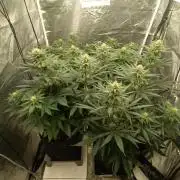
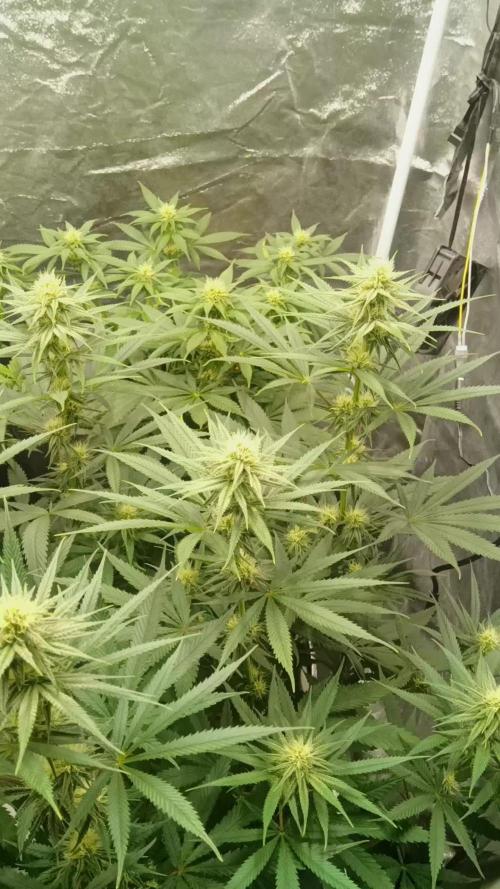
D80 (13/05/2021): I'm looking at the trichomes every other days. Glue Gelato is starting to show amber on top buds. No amber for Banana Kush and Gelato. This time I will chop them all at the same time so the one I will rely on is the Glue Gelato. As soon as she is ready, I will harvest them all. Banana Kush and Gelato would probably need more, but in term of logistic, I need to harvest all my plants at the same time.
D83 (16/05/2021): Not ready yet. I'm checking trichomes closely! 😬
- Light: the lights are at 100% and at 12 inch form the plants.
- Temperature: during the day: 24-25C ; during the night: 20C.
- Humidity: the humidity is maintain around 46-48% all the time.
- Air circulation: There is an oscillating fan on the ground, one fixed fan pointing on top of the canopy and one fixed fan to help cool the lights.
- Water: I gave water every other day or when the ground feel dry or the pots feels light.
- ***IPM: I never mention it but I'm using nematodes pouch as an integrated pest management. I had trouble with pest in my first grow and I learned from it. That's the only thing I do for pest and of course watching closely and regularly at my plants 😊


@HazeLiebhaber
Follow
📝 Blüte Tag 28
🚿 Seit heute gebe ich Phosphor und Boost zum Wasser dazu. Sonst alles wie in der Vorwoche.
🌡️ Temperatur 26-27°C
⛈️ RLF 55%


@bigsmoke42069
Follow
Week 5 of flower 9/6/24
After neglecting to check runoff EC, the reading was 3 and PH 4.7, it's crazy that the plant did not show any signs of damage besides one branch.
After flushing the growing medium with RO water + FloraKleen + H2O2 (PH 6.5), the runoff PH was still to high.
The problem persisted after watering with 50% dilution nutrient solution and still getting low PH readings and high EC.
The solution was to put something underneath the fabric pot, to create a gap for the runoff water to drain freely from the bottom part.
Before, the fabric pot was sitting on the plate and the runoff was draining from 2 little holes in the middle to the drain compartment.
Right after creating the gap and watering, all the readings were corrected.
Fortunately, all salt build up got washed away, and the plant showed no more problems. :)
On day 26 days of flower, the nutrient schedule was changed to fit the fifth week of flower.
Note to self: check PH and EC every 3 waterings.


@Silverback_Guerilla
Follow
1/24 - 1/28:
Fed on 1/28. The SO's and MW's have entered the harvest window. and both the Platonium and Velvet Sugah Bref are right behind them, so it was the last feeding for everybody except maybe the GG4.


@Zer0xKira
Follow
Having a battle with my soil ph which is at 7.3 (down from7.8) I have been watering with water in the 4.5- 5 ph range since the soil ph is so high. I am also having nitrogen issues . I stopped feeding a last week. I added a bit of top soil to the plant which might have added more nutrients making it worse. I am going to do s flush and see If things improve.


@GrowerGaz
Follow
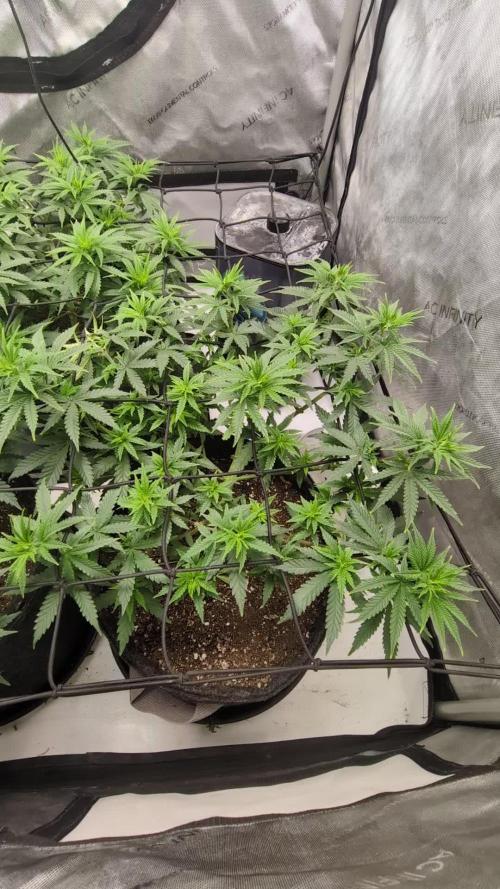
Still defoliating and lollipop , forgot how easy it can be with a good mineral nutrients.



@CannaWolf420
Follow
Another good week for the ladies with good growth. They are strong and vibrant with many tops starting to take form. With some of the taller branches I used HST by rolling the stem untill it bends basically in half, giving the lower branches plenty of time to grow up. Once they have reached past the scrog net I begin to LST by tucking branches under also making way for new growth. One more week with minimal training and mostly defoliation of bigger fan leafs before I'll flip to flower


@Staffedition
Follow
Привет друзья.
Наше знакомства продолжается с новым сортом автоцветущих растений от Smail_Seeds сорт TROPICANNA POISONZKITTLEZ XL AUTO F1 reg.
Сегодня растению 36 дня.
Растение очень хорошо развивается, ни каких сбоев в генетике не наблюдается.
Сорт выводим сами.
Смотри мой профиль, у нас всегда есть что то интересное.
Не забудь поставить лайк❤️, если понравилась как прошла неделя
И читайте наш TELEGRAM: https://t.me/smail_seeds
#Smail_Seeds 😀


@CanadianFillmore
Follow
Let the flushing begin! Super pumped to finally be at the end of this first grow of this strain. 4 liters water for the flush. The last week she put on a little bit of size, but probably more density in the buds as well as terpenes and smell was gained.


@Ultraviolet
Follow
0.23v tuned to 7.83Hz Plants exposed to the Schumann resonance often show greater resistance to stress factors such as drought, diseases, and pests. It is possible that these natural electromagnetic waves strengthen plants' immune systems and increase their ability to resist disease.
Pretty neat, in the afternoon when the tent hovers around 84F the plants are 🙏, can visually see in time around 10 minutes after I opened the tent the temp had dropped to 76 pressure was lost, she is still chilling but she doesn't quite have that perk anymore.
*Salinity3.5% - 100ml H2O=100g The concentration of salt in a solution 3.5%= 3.5g in 100ml.
Growing well. Not going to top or do any training, I'll let the plant do its own thing, she is constructing foundations now for what she senses ahead. Smart girl. ✨️ Let her, do her thing, let me do mine.
The voltage that is needed for electrolysis to occur is called the decomposition potential. The word "lysis" means to separate or break, so in terms, electrolysis would mean "breakdown via electricity. Green hydrogen is hydrogen produced by the electrolysis of water, using renewable electricity. The production of green hydrogen causes significantly lower greenhouse gas emissions than the production of grey hydrogen, which is derived from fossil fuels without carbon capture.
Electrolysis of pure water requires excess energy in the form of overpotential to overcome various activation barriers. Without the excess energy, electrolysis occurs slowly or not at all. This is in part due to the limited self-ionization of water. Pure water has an electrical conductivity of about one hundred thousandths that of seawater. Efficiency is increased through the addition of an electrolyte (such as a salt, acid or base).
Photoelectrolysis of water, also known as photoelectrochemical water splitting, occurs in a photoelectrochemical cell when light is used as the energy source for the electrolysis of water, producing dihydrogen . Photoelectrolysis is sometimes known colloquially as the hydrogen holy grail for its potential to yield a viable alternative to petroleum as a source of energy. The PEC cell primarily consists of three components: the photoelectrode the electrolyte and a counter electrode. The semiconductor crucial to this process, absorbs sunlight, initiating electron excitation and subsequent water molecule splitting into hydrogen and oxygen.
Water electrolysis requires a minimum potential difference of 1.23 volts, although at that voltage external heat is also required. Typically 1.5 volts is required.
Biochar, a by-product of biomass pyrolysis, is typically characterized by high carbon content, aromaticity, porosity, cation exchange capacity, stability, and reactivity. The coupling of biochar oxidation reaction (BOR) with water electrolysis constitutes biochar-assisted water electrolysis (BAWE) for hydrogen production, which has been demonstrated to reduce the electricity consumption of conventional water electrolysis from 1.23v to 0.21v.
Biochar particles added to the electrolyte form a two-phase solution, in which the biochar oxidation reaction (BOR) has a lower potential (0.21 V vs. RHE) than OER (1.23 V vs. RHE), reducing the energy consumption for hydrogen production via biochar-assisted water electrolysis (BAWE).
BAWE produces H2 under 1 V while eliminating O2 formation: key word "eliminating". Air with a normal oxygen concentration of around 21% is not considered explosive on its own; however, if a flammable gas or vapor is present, increasing the oxygen percentage above 23.5% can significantly increase the risk of ignition and explosion due to the enriched oxygen environment.
The addition of ion mediators (Fe3+/Fe2+) significantly increases BOR kinetics.
Air:
Nitrogen -- N2 -- 78.084%
Carbon Dioxide -- CO2 -- 0.04%
Hydrogen in homosphere H -- 0.00005%
Hydrogen "GAS" H2 in homosphere - 0%
"Nitrogen, oxygen, and argon are the three main components of Earth's atmosphere. Water concentration varies but averages around 0.25% of the atmosphere by mass. Carbon dioxide and all of the other elements and compounds are trace gases. Trace gases include the greenhouse gases carbon dioxide, methane, nitrous oxide, and ozone. Except for argon, other noble gases are trace elements (these include neon, helium, krypton, and xenon). Industrial pollutants include chlorine and its compounds, fluorine and its compounds, elemental mercury vapor, sulfur dioxide, and hydrogen sulfide. Other components of Earth's atmosphere include spores, pollen, volcanic ash, and salt from sea spray."
Although the CRC table does not list water vapor (H2O), air can contain as much as 5% water vapor, more commonly ranging from 1-3%. The 1-5% range places water vapor as the third most common gas (which alters the other percentages accordingly). Water content varies according to air temperature. Dry air is denser than humid air. However, sometimes humid air contains actual water droplets, which can make it more dense than humid air that only contains water vapor.
The homosphere(where you live) is the portion of the atmosphere with a fairly uniform composition due to atmospheric turbulence. In contrast, the heterosphere is the part of the atmosphere where chemical composition varies mainly according to altitude. The lower portion of the heterosphere contains oxygen and nitrogen, but these heavier elements do not occur higher up. The upper heterosphere consists almost entirely of hydrogen, cool.
78%nitrogen as N2, a far too stable bond to be used by organisms.
20%oxygen
0.04%co2
0.00005% hydrogen
When lightning strikes, it tears apart the bond in airborne nitrogen molecules. Those free nitrogen atoms N2 nitrites then have the chance to combine with oxygen molecules to form a compound called nitrates N3. Once formed, the nitrates are carried down to the ground becoming usable by organisms. Will it react with the oxygen in the air spontaneously, the answer is no. The mixture is chemically stable indefinitely. A mixture with air near the release point can be ignited, but if this does not happen then when its concentration gets below 4% it will be unable to carry a flame. Taking a small detour into chemistry here, a key concept to understanding the health impact of nitrogen-based compounds is knowing the difference between nitrates and nitrites.
What Are Nitrates and Nitrites?
A nitrite (NO2) is a nitrogen atom bonded to only two nitrogen atoms. Very strong bond
A nitrate (NO3) is a nitrogen atom bonded to three oxygen atoms. Weaker bond The optimal pH for nitrate (NO3-) depends on the process and the type of bacteria involved.
Nitrification
The optimal pH for nitrification is between 7.5 and 8.6
Nitrification is the process of oxidizing ammonia to nitrate and nitrite
Nitrosomonas has an optimal pH between 7.0 and 8.0
Nitrobacter has an optimal pH between 7.5 and 8.0
Nitrification ceases at pH


@pzwags420
Follow
I started the GSC seeds from HSC by soaking in a glass of water overnight then planted in coco coir under a humidity dome in my veg tent. I will plant them in flower box in a couple weeks when they can handle the feed that my BB clone is on right now. On day 5 my 2 other Gsc seeds rotted perhaps too wet but I have one good remaining for this run. I started White widow seeds and will run 2 phenos. Gsc is looking good so far.
