


Likes
Comments
Share


@AshBrand
Follow
9/29/21 - We are marking today the first day of veg. That Mars Hydro TSW 2000 is doing a great job at 50% power. The plants all look great today!
9/30/21 - They look good. We are giving them water with no nutrients for this week so they will transplant nicely.
10/1/21 - They look great! I’ve been misting them in the morning. Soil is still wet from the transplant watering. We are waiting on fans and a scrog net.
10/2/21 - They are looking very good today. We mist them daily, sometimes twice a day.
10/3/21 - All plants look great! We stopped misting them for now. They look over watered a tad. We know it’s early but we started LST on a couple of the taller ones.
10/4/21 - Looking good! Just cruising along at 50% power, watering when dry. I know they won’t be low maintenance in a couple weeks when they are bushes.
10/5/21 - They look great! The ladies in the back are doing some LST still since they are much taller. It’s safe to say the roots are expanding and the plants overall are growing.

Likes
9
Share


@NanoLeaf
Follow
End of Week 8 (First week of flower)
Increased the CO2 to 1200ppm and the ladies love it, already started stretching within the first 3 days of flower which shows that CO2 definitely boosts the grow cycle of cannabis.
The main top-sites are popping up everywhere and everything looks evenly spread out. I defoliated again because the fan leaves are growing so fast and blocking bud sites. I also did one last lower canopy maintenance and removed small and stalky bud sites and stems below the trellis net to make sure I get maximum energy distribution to the main colas.
I also added some GHF BioEnhancer to make sure the soil-microbes are happy and that the plants reach their maximum potential.
Pest Report: EXTERMINATED!
Thrips VS Ladybugs VS Neem Oil...
I decided to fight fire with fire - I purchased Swirski-Mites from Koppert (They are beneficial insects that feed on the eggs and larvae of thrips and other unwanted pests). As for the adult thrips - I got very lucky and found about 10 Ladybugs in my garden and decided to introduce them into my grow room as they will feed on adult thrips and any other unwanted pests.
Then to be extra sure I know that neem oil hinders the life cycle of pests like thrips causing them to stop colonising in my grow room. So I sprayed the ladies every day during the dark period to make sure there are no pests that I or the Ladybugs have missed.
Mission accomplished. No more wilting and definitely no more thrips.

Likes
41
Share


@WolverineGreens
Follow
Got a little behind on the defol. but everything runnin smoothly besides that. I lost a fight wit a greenhouse and he bruised my ribs. Been gettn around a little slow. Then on top of that broke my phone again ya kno, because im retarded. That makes life difficult sumtimes.
Just given em a gal of water and a recharge, coconut/aloe water mix rotated every 3 or 4 days and trying to stay out of the way. I had an issue wit the blumats so just turned it off about a week ago. Ill get around to fixen it eventually....50/50 on if thatll b during this run.
Member berry grew weird but turned into a monster, purple punch is standing out and so is the wedding cake and gorilla blue. And obviously the D is lookin lovely as always. Im down to 13 because i cut a gsc. It was a long shot from the start and didnt want to risk a hermie.
Cant wait to finish this run so that i can make a plan for outside. Form sum kinda ranking. How many of which plant goes where and all that.
I kno...I Kno I take shitty pics🤷
Processing
Likes
11
Share


@Dunk_Junk
Follow
She's done. Her trichomes are going milky. I want to harvest her earlier rather than later to get the 'high' trippy effect as opposed to the couchlock when there are amber trichomes present.

Likes
22
Share


@elevensixty6
Follow
This is my third attempt at my first successful grow, my two initial tries failed from not being aware of needing to add CalMag to RO water and was using Coco... Either way, germination began April 2nd using the paper towel method and bottled spring water, tap roots were long enough to be planted by the 4th. Planted the Blueberry into a solo cup with just Happy Frog, and the Wedding Cake Auto into a 5 gallon fabric pot with mostly Ocean Forest but a solo cup sized amount of Happy Frog were I planted the seed just to get it started without nute burning the seedling. After planting the seeds into the soil I watered each with about 20 mL daily of RO water with around 200ppm's of CalMag and they're doing great.


Likes
Comments
Share

@Lvnsource
Follow
Feed log;
D:30 - 4.0L + 4.0L - [pH 6.8] Si[0.5ml] ,Vega[5ml], Flores[6ml],Ca[0.3g/L/]Mg[0.1g/L] INPUT; [1.1 EC] OUTPUT; 3.6L pH 6.0 [1.74 EC] previous irrigation: D:23
———————————————————————————
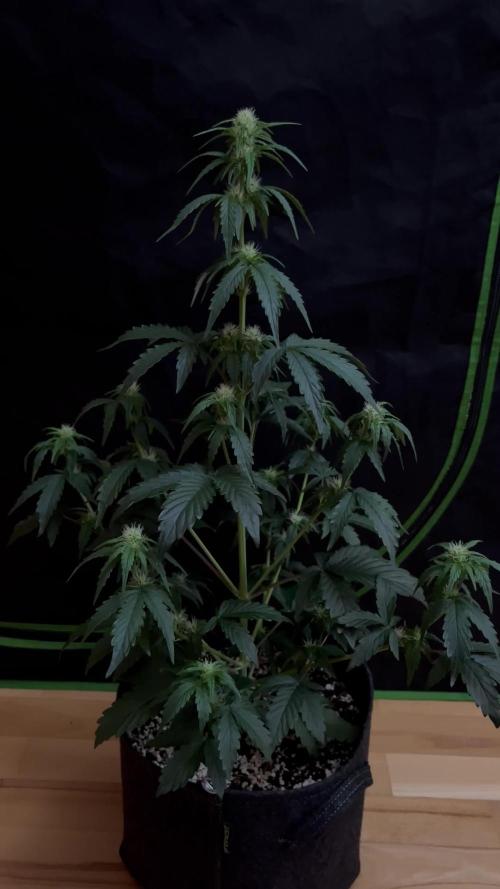
This phenotype decided it wanted to be stout as she entered flower early ; the plant is currently still putting on height and has grown 12cm since day 27! 🌱
I’m still keeping the PAR levels around 550-580 ppfd to squeeze out a few more cm of height 🌞
Likes
3
Share


@NoProbation4Weed
Follow
This week the beautiful lady was set into final 20L Pot.
Just a small defoliation of the biggfest leaves.
Bending down the stemps with a scrog net.
Light hitting with around 550 - 650 PPFD.
Likes
6
Share


@macrocefalo
Follow
With great joy I will start my second season growing cannabis. I hope to learn from some small mistakes from the first season where I was surprised by my performance as a first-time sailor cultivating the BlueDream strain. This season I left the 4 seeds of GorillaGlue 36hrs in a pot of water to break the dormancy. After that I used the napkin technique for more 42 hrs. So I put each one in a 5-gallon airpot, as they are automatic and go to harvest in the same pot. After 24hrs in the vase the first 2 little leaves came out. I made a homemade dome with a 2-gallon water bottle, cutting it into strips and lining it with plastic with some holes to keep the humidity high during this initial phase. We entered the first week of cultivation and unfortunately due to an oversight I got confused in the fertilizer table and clearly the dreaded overfert happened. I did a watering only with water to try to remove the excess fertilizer let's hope it works.


Likes
9
Share


@russrahl
Follow
60 days into flowering now, pulled 2 of these girls 7 days ago because 1 had a few bananas on it and the other was stressed to much from light and not really giving any quality bud and it was stretched out taking up lots of space. The 2 left have been flushing a little over a week now and are very close to harvest. I will prob harvest them sometime this week. Everything is going good so far anyway for these 2 and we will hopefully get some nice dense buds, we will see. Cheers💨
Day-62 update
Found my microscope! Got some picks up of the tricombs up now, and as I suspected they are not quite ready yet. There are a few amber but I’m still seeing clear ones, but there mostly all cloudy now so I’m thinking another week or so will probably do it. That will give me a good 2 week flush as well. I got some pics and a video up as well just before my lights came on so there better then under the HPS anyway. Lol cheers💨

Likes
21
Share


@Excalibur
Follow
02 October 2018 -
Day 99
3rd day of flush and we see her begin to grow nicely.
Day 100 -
Happy lady as she gets densier and begins to really smell.
Day 101 -
She is maturing lovely.
Day 102 -
Orange pistols curl. She is on her way.
Day 103 -
Mature and ready. has thickened up significantly.
Day 104 -
Water topped up and pH balanced 5.4
Day 105 -
Trimmed after the video.
Likes
16
Share


@osmrducks
Follow
Day 15: Plants looking healthy as can be! I didn't make a rack for the lights but I got em in. Looks jankie, but I think its gonna work. 🙏
Day 16: Trying to work out kinks in my grow. Since I put the other 2 lights in, I'm now battling the heat and humidity. Switch the fans around. Got the cold air coming in down low. Will feed them in the morning.
Day 17: The girls were showing signs of being thirsty this morning for sure! They received their first drain to waste watering. They will be getting some additional nutes on the next feeding (AN B-52, AN Sensizyme, AN CalMag Extra).
Day 18: Looking amazing today! I tried my hand at a little LST. Wish the girls luck.!! 🙏 Tomorrow is the official 2 week mark from breaking ground. So, not sure. I've got the humidity finally dialed in at around 50-55% and the temp around 78°. Also gave them another drink as they were already dry about 1.5" down??
Day 19: This is the official 2 week mark. I think I stressed the girls pretty good yesterday, but they look to be recovered today. Should start seeing good growth in the day to follow. Will just be tucking a leaf here and there for a bit. I will being doing a straight water feed next with Great White.
Day 20: Nothing new to report other than found 2 leaves that had some yellow mottling. I added Sensizyme, Recharge, and Great White to this feeding. Did not do drain to waste. Just watered the outside perimeter. PPM was 260 at 5.8 ph.
Day 21: NO MORE NUTES for these girls! Tips on a couple of em are turning yellow!!! Stupid me. Over watering and giving too many nutes.

Likes
57
Share


@nonick123
Follow
Día 20 (13/05) Todas las plantas muestran las preflores!
Auto Northern Dragon Fuel by @supersativaseedclub_official no parece estar muy contenta con los nutrientes disponibles
Tiene algún problema que se me escapa, o es mucho más demandante que sus compañeras de ciclo que se muestran un crecimiento muy sano
Vamos a ver después del riego de ayer con nutrientes liquidos como se comporta!
Día 21 (14/05) Auto Northern Dragon Fuel presenta clorosis intervenal y peor estado general...
Baño de sol de 2 horas!
Día 22 (15/05 El gran @Thecannalife420 me diagnostica deficiencia de Mg
Aplico foliarmente Sales de Epson
Día 23 (16/05) Las plantas han reaccionado muy bien a las sales de Epson!
Riego 750 ml H2O + Regulator 0,15 ml/l + CaMg-Boost 0,25 ml/l + Startbooster 0,25 ml/l - pH 6.2
Día 24 (17/05) Las plantas salen al exterior! 😍 Les aplico heno como mulch (acolchado)
Día 25 (18/05) Riego 250 ml solo agua todas las plantas
Día 26 (19/05) Riego 250 ml H2O + Regulator 0,15 ml/l + CaMg-Boost 0,25 ml/l + Startbooster 0,25 ml/l + TopBooster 0,2 ml/l- pH 6.2
💦Nutrients by Aptus Holland - www.aptus-holland.com
🌱Substrate PRO-MIX HP BACILLUS + MYCORRHIZAE - www.pthorticulture.com/en/products/pro-mix-hp-biostimulant-plus-mycorrhizae

Likes
5
Share

@PapaTerps
Follow
Black Lobster - Cipher Genetics
Week 6 Bloom
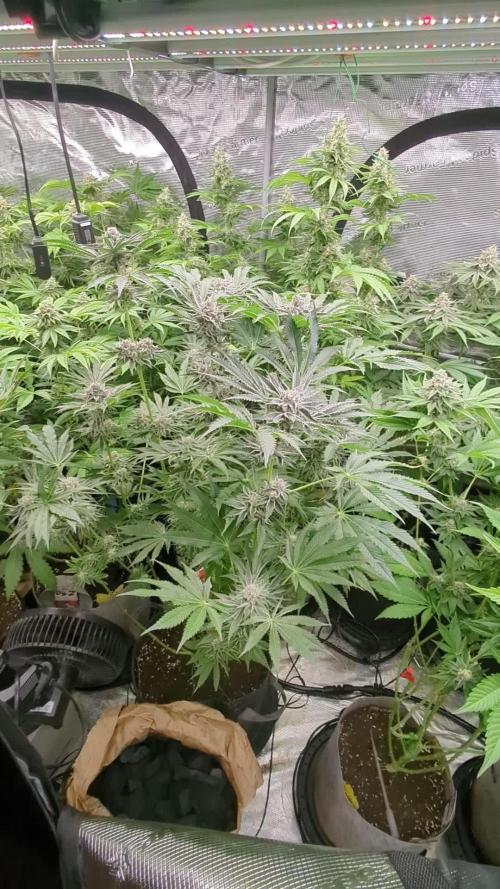
🌸 The changes in her bulking are becoming less noticeable as the days go on, so this means her bulk phase is coming to an end. She has developed medium sized flower that is completely covered in trichomes, she's incredibly sticky and her gassy blueberry scent lingers on you for a good few minutes after you brush up on her! Her pistils are turning amber and her colouring is becoming more deep green with dark purple tips, the sugar coating of trichomes (she is 100% bred for hash/rosin) makes it look like something from outer space! She's really beautiful! 😍 Temperatures have started to drop now, which is perfect timing for these girls as they all have about 3-4 weeks of scheduled bloom left.
✂️ I've removed her lowest most side stems that were too far behind the canopy, they will only cause problems and use up energy that could go upward. Other than that, she is in great health 👍🏻
💧 Watered every three days with 5L of RO water, nutrients were mixed individually, in order and then finally pH'd to 6.3. I've altered her nutrients to meet her needs for late phase of bloom.
💡 PPFD: ~900
♒ VPD: 1.46kPa
🌱 Days from seed: 102
🌸 Days in Bloom: 41

Likes
3
Share


@Mn_Smokes
Follow
Good amount of growing this week. For a first time I think I’m doing good so far this week.

Likes
2
Share

@Ninjabuds
Follow
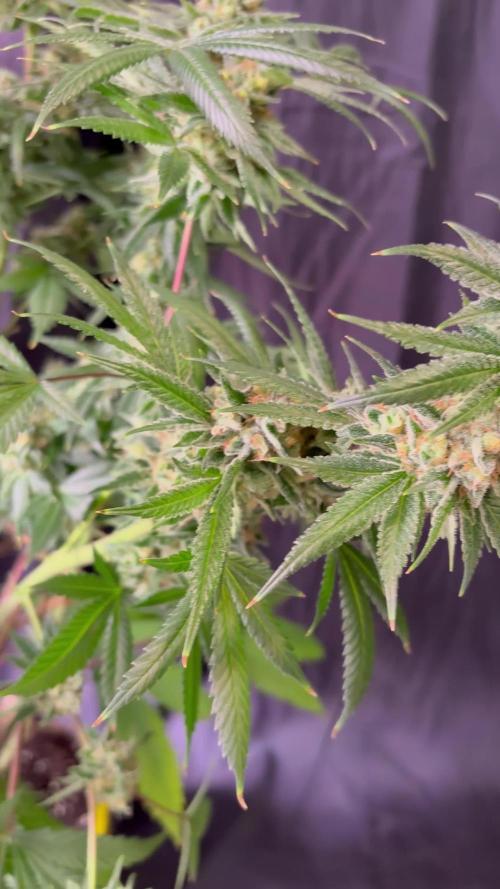
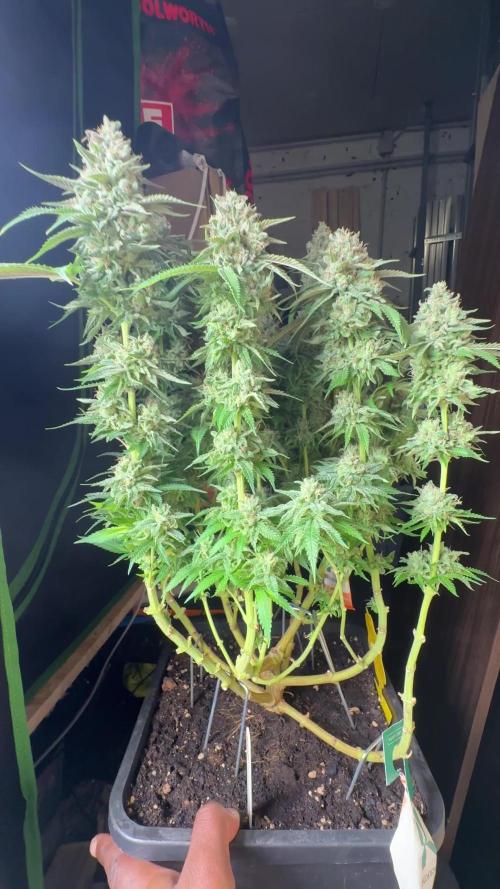
The Gorilla Runtz harvest was phenomenal. The buds are incredibly dense and pungent, packing a serious punch. Its compact size meant nearly the entire plant was covered in frosty buds, making for an impressive yield.

Likes
2
Share


@TowersD
Follow
The plants are in the 2nd week of flower and the pistols are staring to show it. That confirms that all of the plants are female.

Likes
4
Share


@Exoticfarm99
Follow
El viernes 21 regamos foliarmente con Delta 9 preparándolas para floracion


Likes
294
Share


@StarLorr
Follow
Welcome to my Ðivine ØĠ Ķush diary.
In this diary:
Seeds: sponsored by Ðivine Șeeds
Media: Promix HP
Nutrients: Advanced Nutrients, Diablo Nutrients, Gaia Green Power Bloom.
Light and Weather: Şun☀️and Mother Earth.🌎
___________________________
Feeding:
Wed 14Aug: 8L water not pH'd
Thu 15Aug: 10L water not pH'd
Fri 16Aug: 9L water not pH'd
Sat 17Aug: 10L water not pH'd
Sun 18Aug: 6L water not pH'd
Mon 19Aug: 2L water not pH'd
___________________________
*please note that most watering are from top now since topping with Gaia Green Power Bloom*
______________________________
Ķush Ķush got more defoliation treatment who required the stepladder last Friday Aug16th😅😂🤣mostly fan leaves and tiny branches.
_______________________________
Top dressing her with Gaia Green Power Bloom was a Sage move she seems to like it, haven't fed her with liquid nutrients this past week, was kinda concerned about over feeding her😬but will do later on this week.
______________________________
Thanks for stopping by, likes and comments are appreciated!👊🏻😎
Keep on growin!
Keep on tokin!!!
😙💨💨💨💨💨


