


HidropQuadgrow - S.A.D F1 - Sweet Afgani



FLO
Phytoled Blurple 130 watts Light Emitting Diodes/150W
Phytoled Blurple 130 watts


Coco Coir
Custom

Perlite
Custom

Expanded Clay
Custom

Indoor
Room Type
HST
weeks 10, 13
FIMing
weeks 13
Defoliation
weeks 5-6, 8, 10, 13
ScrOG
weeks 6, 8, 10, 13
LST
weeks 8, 10
11 liters
Pot Size
Start at Harvest
G
Germination3y ago

Nutrients 1

FastRoot1 Dry Powder Rooting Hormone
1.302 mll
TommyBVRSA75 July 10, 2023 - Beginning germination of four seeds - Fast strain (F1) - Sweet Afghani Delicious (S.A.D.) from Sweet Seeds.
Important heat conditions with room temperature at 27ºC (dark environment) and 43% RH.
Initial germination on wet paper towel to which germination and root growth hormone was added.
In three days, depending on the seed sprouting, they will be transferred to coco jiffy where they will develop over a week, initial roots.
Next week, based on the recorded growth, coco/perlite and expanded clay pots will be prepared, and the 20-liter tank in the gravity Autopot system will be filled, directing the irrigation solution to the board where the four pots with Smart Mat (special absorption fabric pads) will remain, keeping the chosen substrate with the necessary amount of solution for the correct irrigation of the system.
The chosen strain has been the Afghani F1 due to the natural conditions of this type of cannabis family. Afghan strains (in general, the Hindu Kush families) are optimal for the conditions we will have throughout the summer in southern Iberian Peninsula (with days and indoor lighting influence around 30ºC and relative humidity below 40%).
In other words, the option that could be based on the many seeds and numerous types I have, in seeds that could ultimately transform into beautiful specimens, like the current American strains or those leaning towards purple, blue, or red colorations, we will leave for autumn and winter. This is important because it's crucial for less experienced grower brothers to keep in mind that strains that display the natural colorants from the carotenoid line (which provide the exotic colors we see in many plants that today’s banks present as "headliners" in their variety and with complex terpenes)... in general, hot summers with low relative humidity are significant "enemies" for "colorful" strains to express their exotic colors.
The Afghan "hazes," almost 100% indica, in their modest appearance of very simple plants with very modest sizes, with crowns of buds and very simple and lightly loaded leaves, stand out greatly for their nature as classic "hashish weed" with their resin-loaded buds and short, tightly packed leaves. In other words, as I tell friends who enjoy this growing world, the greatest beauty of the "Afghans" lies in that wonderful smoke that gets you "high" to incredible limits, and that the "Afghans," more than photos to showcase extremely beautiful plants, have beauty in the simplest and classic aspects of the Indica genre of Cannabis. In their "skinny" appearance with thin branches but crossed halfway up with buds that leave your fingers sticky with resin and your head "stuck" from some of the most precious "highs" that cannabis smoke can give you.
For all these reasons, the Fast Afghani from Sweet Seeds is the lady to follow, and surely, she will bring us good results.
Always under the watch of God Jah, with wisdom, with protection against the bad spirits and ill intentions of all those who make misunderstanding, malice, and prejudice against those of us who cultivate this plant, not to make a living from it nor to succumb to the madness of profit and the ignominy of illegality because it seems easier than earning a living.
Thus, I will continue to share ideas and thoughts in the diary entries that I love to make and share with all of you.
Green greets...
4 likes
3 comments
Share
Used method
Paper Towel
Germination Method
1
Week 1. Vegetation3y ago


2 cm
Height
18 hrs
Light Schedule
29 °C
Day Air Temp
5.9
pH
615 PPM
TDS
63 %
Air Humidity
30 °C
Solution Temp
26 °C
Substrate Temp
24 °C
Night Air Temp
11 liters
Pot Size
2 liters
Watering Volume
30 cm
Lamp Distance
Nutrients 3

CANNA Coco A
1.9 mll

CANNA Coco B
1.9 mll

CANNA RHIZOTONIC
4 mll
TommyBVRSA75 Week 1... #SweetSeeds perfect ...3+1 pack Afghani Fast and 4 perfect germinations with no problems.
As I mentioned in the germination week, the fast Afghanis, due to the simple strains they have in their genetics, thrive in the climates of the Hindu Kush... so whether in summer heat or winter cold, and if you have over 50% humidity, you'll end up with top-notch plants and phenotypes where the resin drips from your fingers...
Another season... very excited about hydroponics and to see the evolution of these wonderful plants and a seed bank that deserves all the praise.
God Jah with all the brothers... Green greets
2 likes
1 comment
Share
2
Week 2. Vegetation3y ago


8 cm
Height
18 hrs
Light Schedule
30 °C
Day Air Temp
5.9
pH
615 PPM
TDS
40 %
Air Humidity
30 °C
Solution Temp
26 °C
Substrate Temp
24 °C
Night Air Temp
11 liters
Pot Size
2 liters
Watering Volume
30 cm
Lamp Distance
Nutrients 3
CANNA Coco A
1.9 mll
CANNA Coco B
1.9 mll
CANNA RHIZOTONIC
4 mll
TommyBVRSA75 Week (-1) Vegetative - the soil mix and the watering method of the Quadgrow system, almost perfect for what we’ve had so far this season.
It’s very significant that despite the indoor heat in summer, the strain with its Afghan lineage is starting to show tremendous health in what can be seen externally. The almost uniform growth is fueled by the distribution of nutrients and water, and despite some difficulty in germinating (the four seeds took about 96 hours to germinate and their transition from Jiffy to the coco/perlite and arlite substrate happened without any shock for the four Afghan ladies). The calculations for next week will need to be assessed regarding 13/15L in the tank (and the 15 liters will have an evaluation of elements for one week and not two as will happen. It’s not dramatic since the composition of the watering compound is just different, in the contribution of Canna Zym, because the root base (with the preparation I attribute to the soil with the addition of mycorrhizae and a bit more trichoderma (more than the natural ones that the coco XL trichoderma base from Ugro already has).
Passive hydroponics is very good for heat conditions like the ones we are facing. Moreover, I fear that a "living" soil at these temperatures, even with Trichoderma and mycorrhizae, would struggle greatly, and giving water by hand wouldn’t have a better appearance than what the "4 incredible" present (once again, outstanding for #sweetseeds for the incredible genetic work they develop for us).
I’m in love with growing in coco and passive hydroponics, especially because the quality that the germinated plants present is wonderful. Not a single leaf curled inward; not a yellow tip; and very clear signs of the vitality that the roots of the "fast" Afghans show.
For all these reasons, this incredible proposal for the summer season, following a strain perfectly adapted to heat and low humidity.
Then the notion that even with a 20-liter tank, the rest comes a lot from the way the Smart Mat functions and that they are soaked 24x24/7x7...from that interesting "pumping" of what the substrate continuously does, sucking the water from the solution and allowing only the root to grow just in the wet area where the Smart Mat contacts the coco/perlite/arlite and as you can undoubtedly see in the photos, is the tremendous vitality in a plant that is suffering from very particular stress conditions due to the temperatures that the south of the Iberian Peninsula has in summer.
I hope that the second week of vegetative growth will be very revealing of the potential that the coco substrate and passive hydroponics have as a very balanced and effective growing medium.
I hope you keep commenting and that you can share your knowledge, unbeatable advice.
For the vigor of the roots in vegetative, in coco and passive hydroponics, it’s very easy to understand the savings that could mean being able to change the light cycle from 18/6 to 12/12 in a maximum of 4 complete weeks. For now, only with the dimming, we’ve increased the wattage from dimming to 50 to 60% (2 X 2 Ts1000 - 60%) and in this way we go from a well-distributed lighting of 150 watts between two panels to now 180 watts for the entire coverage area (90 watts per panel) at 30 CMS from the plant's focal point.
Due to the almost perfect distribution of lights and the quality of the substrate, watering solution, and optimal amount that passive hydroponics has with the distribution of water.
In short, I’m happy...very happy and hoping that this diary ends as it’s starting,...touching perfection.
So far...100 points!
God Jah in command and may a halo of light and good things cover us every day.
2 likes
comments
Share
Grow Questions

TommyBVRSA75started grow question 3y ago
Impressive show of vitality growing using both combined (Passive APU Hydroponics Quadgrow system) + custom Coco mix soil on 11L pot (4x) - soil "Coco powder+fibres (75%) + Perlite (20%) + Expanded Clay (5%l). 15 liters of solution - a week


Open
Roots. Other
Feeding. Automatic systems
likes
Answer

gottagrowsometimeanswered grow question 3y ago
That's really nice man. Hope it turns out well for you. Can you do me a favor the guy who asked the Q above yours. Can you message him about growing with res in coco. He could use your help.
Good luck
likes
Complain
3
Week 3. Vegetation3y ago


14 cm
Height
18 hrs
Light Schedule
31 °C
Day Air Temp
5.8
pH
Weak
Smell
625 PPM
TDS
42 %
Air Humidity
28 °C
Solution Temp
29 °C
Substrate Temp
27 °C
Night Air Temp
11 liters
Pot Size
2 liters
Watering Volume
30 cm
Lamp Distance
Nutrients 5
Spicy Poker - General Nutrition solution
3.5 mll
CANNA Coco A
1.9 mll
CANNA Coco B
1.9 mll
TommyBVRSA75 ** Week Edition - 14 liters of water have been added to the system with the amounts specified based on the number of liters considered. Canna Zym has already started to be introduced into the system, and the consideration for the water at 14 liters has been made so that on 17/08, flowering nutrition begins and the light cycle changes to 12/12. The next two weeks will correspond to a total of 5 weeks of vegetative growth, and based on the growth rates, we will likely see the final height dimension of the cultivar in two weeks. (I calculate the height of the grow by doubling the grow dimension when the light cycle changes. So if a vegetative plant is 30 CMS when the change to 12/12 occurs, it will represent that at the end of flowering, the final height will always be slightly more than double. That is, if in two weeks the grow is around 30/35 cm, at the end of flowering we will have a maximum grow of about 70 cm.
The grows continue to show wonderful development, and the fast Afghan strain from Sweet Seeds has proven to be a fantastic choice for the high temperature and low humidity conditions we are experiencing.
Week 1 1/2 - I almost cut something about three days into this current week of vegetative development, and if you look at the previous diary entry, it may seem incredible how much the growth of the Fast Afghanis from Sweet Seeds has skyrocketed. A success across the board... phenotypic lines facing the Hindu Kush gene family. Plants that react wonderfully to heat, and I had already mentioned that with a consistent temperature that is over 30ºC with the lights on and even in the dark, around 26-27ºC, where the RH is always between a maximum of 50% and a minimum below 40%, and just because of their "past" from the northern mountains of the Afghanistan/Pakistan border, it's very clear that the genetics are ready for heat... or also for cold, in other strains like Mazar-i-Shariff.
So today, the diary entry with video (in English) and a new set of photos makes things clear. The seedlings were transferred from jiffy to the current substrate around July 20, and today, July 29 - eight days later, they are very revealing of the virtues of associating one of the simplest forms of hydroponics (passive or APU, meaning gravity action) which allows without deficiency or excess that irrigation through Smart Mat (a special type of fabric that takes the solution of water and nutrients from a 10-liter tray/pot and retains another 10 liters of solution in a tank that will pour into the tray by gravity according to the absorption speed of the plant's root system (meaning with gravity, a total of 20 liters circulates in the system and based on the preparation of these 20 liters, which are the basis for calculating pH and EC that the different moments of the cultivar will need).
The most surprising thing comes from the following analysis: the amount of water needed and the amount used, nutrient savings, and a much more effective calculation in controlling issues that when compared, for example, when we do irrigation by pouring 1.5 L with nutrients and watering it every day, leads from an early stage of development to providing more water and nutrients than necessary, which in the end tends to be too much. Thus, the cultivars will get used to a philosophy of "excess," and with that in mind, the final flushes often have to be very aggressive to break the nutrient crystals that form due to excess salts in the system.
I had already had contact with cultivars in coco, but cultivation in this medium when exposed to conditions where rational use of water and nutrients in the system is made, is proving to be almost spectacular, the way day by day, the growth of the plants is a "mirror" of the balance of rationing water and nutrients.
For example, comparing the previous entry to this one and seeing the structure of the stem and leaves, their insertion, and the short internodal spaces, is very revealing of the main virtue of coco and gravity hydroponic crops. Some friends with more experience had told me that growth in the vegetative stage is simply explosive, and what we are taught in just four or five days of vegetative growth will set the quality bar very high this season.
According to experts, this explosive growth in the vegetative stage occurs because of the proportional way the root system next to the Smart Mat becomes the only wet area of the growing medium.
If you compare it with some other diaries I present here where I cultivated in soil, it becomes very clear that only around the fifth to sixth week does a qualitative and quantitative stretch of the cultivars occur. Generally, if we think about normal irrigation in soil, especially in summer, the first thing would be that the pots for soil would be larger than the hydroponic standards of 11 liters. 11 liters in hydroponic pots correspond to 23 liters in regular soil. Then, with temperatures in the range we are experiencing, it would correspond to irrigations of 2 liters of water daily with nutrients, and with the temperature and the necessary water addition, for soil, at this time, the temperature stress and especially the water stress (due to the amount of water provided) would take a toll on growth. Unlike other seasons (of soil and daily watering), we do not have, first of all, areas of soil in the pot that become overloaded with water when there is still no root matter. One of the signs that grows in soil and direct watering present in summer is usually the leaves curling downwards and that the primary set of leaves would have already turned yellow.
Then, one of the most notorious salts in blocking other salts due to its excess in the system is nitrogen. What direct watering in summer creates is that when saturating areas of soil that still do not have roots, nitrogen tends to get fixed in salts in those areas, and later, while there may often be a very high amount of nitrogen, due to that excess, there will be negative influence on other salts and especially micronutrients, which will not integrate into the cultivar in the best way when they are most needed.
Many people do not usually reflect on how root nutrition is done through the soil and if there are reducing factors in the integration of salts when they become most necessary; for example, they may not know that excess nitrogen can prevent phosphorus or magnesium or elements like boron, iron, manganese, or zinc from integrating into the cultivar when they are most needed. Generally, beginners do not understand that an "overfert" of nitrogen, which tends to occur more commonly than imagined (that idea that they are doing the correct nutrition when, for example, the beginner glances at their "little plant" and sees it a very strong and lush green). Generally, the vast majority of over-fertilization occurs with the addition of water. A beginner will not be very concerned with the pH of their water and thus will also give little importance to the EC, and I leave you with this idea: "it is not the same to prepare daily nutrient solutions based on preparing 1.5 liters of solution (based on a regular water bottle) than, for example, preparing a 6 or 7-liter bottle and using that bottle for successive daily waterings. Even with measurements, it is very different than in the gravity hydroponic system I have in use, as I prepare 20 liters of solution that I will put in a tank, from this tank, through a hose with an APU system - gravity lock - it will fill the tray/tank with about 10 liters, and in these 10 liters, the Smart Mat strips will be submerged, which when filled to the top, conduct the irrigation only in the area where the root systems of the plant are already formed. So in the system, just the necessary water and nutrients will enter for what the roots absorb... while when you do direct watering on soil, it is normal for there to be a much larger area where the medium is saturated with water and nutrients.
I explained that for what can be controlled in pH and EC, there are very significant differences between preparing 1.5 liters of solution for one day; a 6/7-liter bottle for watering over 5 or more days, or preparing for my hydroponic system with 20 liters of solution that will be used only by the root structure that absorbs them gradually.
To those in summer, facing the dilemma of watering, even seeing indoors that the soil dries quickly due to high temperature and low humidity, and that with this, in a pot for soil with 23 liters, you might end up watering at least twice a day with a total of 3/4 liters of water, where part of that water with the solution of salts will be poured into the soil, but in areas of the soil where there are no roots... almost certainly, what we are seeing with these waterings is that we will surely have leaves of a very beautiful green and without realizing that the leaves will become thick and curled downwards, and because of the "pretty" green, not understanding that over-fertilization is already in full swing, and that later in flowering, due to the excessive presence of nitrogen, for example, what will happen in flowering is that when we need plenty of phosphorus and magnesium for flowering functions, fattening, and evolution of terpenes and resins, even for "rippening," what usually happens makes nutrient manufacturers happy, who fill their lines with even 25 products intended in part "to correct the formulation inaccuracies with which we develop our initial products and to tell our less experienced customers that we need to put in more than the account, so that later we need other products in excess to balance out real chemical bombs - whether biological or mineral.
So, without prolonging the reasoning further, and based on the evidence and more on the empirical nature of the matter, what I see at least for the summer period and with the combination of the following factors: FACTOR 1: F1 Fast seed with Hindu Kush genetics for both father and mother, which holds plants that are by definition, perfectly resistant to conditions of high heat and low humidity + FACTOR 2: passive gravity hydroponic system, four 11-liter pots responsible for an optimal watering method in which the water with the solution integrates water from Smart Mat fabric and from there to the root system that develops in contact with the Smart Mat with the growing medium + FACTOR 3: growing medium made of: Coco peat/powder with natural trichoderma - Ugro Basic block 70 liters (75%) - Fine Perlite (20%) + Expanded Clay Balls Europebbles Plagron (5%). To the areas where the germinated seeds in jiffy peat are placed, mycorrhizae Kraken - Glomus iranicus sob. + Tricofor 50 (Trichoderma harzanium) are added as a protective reinforcement medium + FACTOR 4 - CANNA Coco nutrition line.
The four factors are the foundation and axis of what is best in my opinion, in the Quadgrow system. As simple hydroponics, I believe it is very good for summer conditions, as it allows for very regular watering. There may be doubts with winter conditions, but in winter, it may be necessary to counteract the amount of prepared solution and instead of 20 liters for an average of 12/14 days, it may be more interesting to prepare tanks of no more than 12 liters that can be extended for a maximum of 11 days.
As an example, this enormous dimension of the comment and some analyses on the technical issues of growing in hydroponics remain. While all the technical aspects are important, let's put our faith in the good God Jah, so that everything can happen in peace, so that the grows can be done without setbacks, and so that the looks and gossip of neighbors never bring problems, and that always, because the most beautiful plant in the universe is not to generate a greater profit than to give friends enjoyment of good movies, good music, good company, and in that, the greatest virtue of cannabis as an element of human development makes its human brother.
Green greets and I invite you to enjoy the video and the photos...
5 likes
comments
Share
4
Week 4. Vegetation3y ago


18 cm
Height
18 hrs
Light Schedule
33 °C
Day Air Temp
5.8
pH
Weak
Smell
620 PPM
TDS
43 %
Air Humidity
28 °C
Solution Temp
29 °C
Substrate Temp
27 °C
Night Air Temp
11 liters
Pot Size
1.4 liters
Watering Volume
30 cm
Lamp Distance
Nutrients 5
Spicy Poker - General Nutrition solution
4 mll
CANNA Coco A
2.2 mll
CANNA Coco B
2.2 mll
TommyBVRSA75 Day 20 Vegetative - incredible and impressive growth regarding perfect watering and nutrition signals. #Sweet_Seeds note 1000!!!
As you can see, grows #1 and #2 are a bit more developed than #3 and #4, and that's justified by the dimmer connection I had chosen until four days ago; it wasn't up to par, and somehow, the power of the grows located on the right side of the cabinet wasn't receiving the same power as the grows on the left, which were connected directly. Therefore, the power output from the dimmer associated with the ballast supplying #1 and #2 has been changed to the dimmer associated with ballast #3 and #4, and the growth has leveled out. It's not a problem, but we need to keep in mind not only for this grow but for the future how the grows develop.
On the bright side, the fantastic Indica fan leaves and perfect secondary vegetative development make it clear that the grows are receiving the necessary light power. #Sweet_Seeds incredible!!!
To my fellow growers who enjoy looking at grow characteristics, the photos are revealing of what passive hydroponics and growing in coco can yield at their best. It's very clear that we have crops with perfect watering and that the aeration of the coco allows for impressive root growth.
As you can see, we are dealing with extremely high temperatures and low humidity, but all factors are combining in the best way. As I've said more than once, the Afghan strain in its genetic line "feels at home" with the necessary adaptability for heat and low humidity to be optimal for its development, and then what passive hydroponics allows, meaning the perfect hydration of the grow structure. I've thought in recent days that if I were currently growing in soil and doing empirical watering at this very moment, I would surely have the system saturated with water (more than in the areas where the roots grow; others without roots would be overflowing with water - the natural tendency with such temperatures would be to water heavily, and the soil, unlike coco with its aeration, would tend to fill up with water from the start. With this, I would almost certainly not have the high-quality growth that my cultivars present, and from the beginning, the imbalances would be noticeable, making it very complex to balance the system in the future.
With the growth we have, I will give just a couple more weeks of vegetative growth before starting the transition to the 12/12 light cycle, thus forcing the start of flowering.
God Jah is in charge of the grow, and I put a lot in His hands since the "ladies," like us, are facing many degrees of temperature and relentless low humidity. With this, we must trust what we know from our past experience, but God Jah also has to come through so that everything can turn out well, and so far, I am very happy with what I see (and what I show you here in photos).
Green greets and the best of summers to everyone (and especially for our grows).
5 likes
3 comments
Share
5
Week 5. Vegetation3y ago


33 cm
Height
12 hrs
Light Schedule
33 °C
Day Air Temp
5.9
pH
Normal
Smell
745 PPM
TDS
48 %
Air Humidity
29 °C
Solution Temp
30 °C
Substrate Temp
29 °C
Night Air Temp
11 liters
Pot Size
1.8 liters
Watering Volume
30 cm
Lamp Distance
Nutrients 5
Spicy Poker - General Nutrition solution
4 mll
CANNA Coco A
2.75 mll
CANNA Coco B
2.75 mll
TommyBVRSA75 Day 31 - Light cycle change started today - 10/08.
The change in the light cycle has been largely determined by the cruel temperature conditions that the grow has been facing over the last six days.
As I informed you in the last diary entry, a 14-liter solution was prepared still scheduled for root consolidation and the end of the vegetative stage, but the extremely high temperatures - we’ve had two days where during the light period in the grow cabinet we reached the "chilly" 37ºC and the effect of temperatures along this line translates into nutrient blockages, and the cultivars showed noticeable burnt tips, which in my opinion was a clear example that potassium, despite the amount provided in the solution, was not being integrated.
The 14-day nutrient solution was "drunk" by the system in just 6 days, and as such, I have decided to force flowering.
With the 35 centimeters that each grow has on average at this moment and taking into account that until vegetative growth is blocked, I expect to have plants reaching up to 70 centimeters maximum, which will allow for better space management in the cabinet and, to a large extent, manage the extremely high temperatures and low humidity.
It is clear that my indoor conditions are very close to what outdoor conditions would be (despite the fact that in the last three to four days, the maximum temperatures in the south of the Iberian Peninsula have been over 44º).
Despite the incredibly high temperatures, I continue to note that the "Afghan Fast from #Sweet_Seeds is behaving heroically, and only a very strong genetic variety with incredibly adaptable genes allows the "ladies" to withstand the tough "beatings" that the temperatures and humidity are giving them. With what they are going through, they have fully earned the nickname "heroic," and I hope they can ultimately give us something in line with the quality that #Sweet_Seeds knows and works on in the evolution of what they develop.
Let’s see in the next 15 days what the evolution will be - temperatures, humidity, closure of vegetative growth, start of flowering (with the dimensions that the grows will reach).
The Indica phenotypes are very clear, and we will need to follow the gradual defoliation process that I have already started and in a very balanced way so that the cultivars do not suffer in their overall growth.
With the need to accelerate flowering as we enter the fifth week, and very dependent on the upcoming chapters of external (and extreme) conditions that are being recorded, it will still be a mystery to define the total time of the season and to continue with the relentless summer we are experiencing, we will have to take into account that there will surely be an anticipation of "ripening" conditions, so we will need to closely monitor light quantity - at this point, we should already have both Mars Hydro TS1000 (150w X 2) at full power, and we are still at 80% output from the dimmer without managing to lower the temperatures in the growing environment.
So this season is turning into a huge challenge to my "skills." Everything is variables, and these variables are in line with extreme conditions. I do not have air conditioning that can create a more favorable atmosphere, and controlling the existing conditions depends on how my hydroponic setup allows the cultivars to optimally integrate nutrient solution (according to external conditions); the light contribution and how the genetics will continue to react to adverse conditions.
God Jah and faith will continue to be extremely important, and this summer season in F1 will surely be a very important lesson for the future.
Green greets to all...
4 likes
comments
Share
Used techniques
Defoliation
Technique
6
Week 6. Flowering3y ago
58 cm
Height
12 hrs
Light Schedule
29 °C
Day Air Temp
5.9
pH
Strong
Smell
755 PPM
TDS
51 %
Air Humidity
27 °C
Solution Temp
29 °C
Substrate Temp
27 °C
Night Air Temp
11 liters
Pot Size
4 liters
Watering Volume
30 cm
Lamp Distance
Nutrients 6
Spicy Poker - General Nutrition solution
5 mll
CANNA Coco A
2.85 mll
CANNA Coco B
2.85 mll
TommyBVRSA75 Entry day 30 (without seedling development marking): Ladies and gentlemen, it's been a month since the start of the vegetative stage, and I think when you watch the video I've posted, you won't believe it, because I wouldn't either, not for a million Filipino florins.
Let me explain, all the expected growth, nutrition, and development calculations have simply gone out the window, and I'll tell you why.
First, we're at a pace where in about six days, the four cultivars are drinking a whopping 24 liters, which means we're at a rate of 4 liters of absorption daily, and that simply and by arithmetic gives us one liter per grow. The heat has been relentless the past week, and even now that the temperature has dropped by about five degrees (in maximum temperature), the incredible water absorption rate is now essentially due to the amazing pull that the Afghan fast strain from Sweet Seeds has had in recent days.
There was a change in the light cycle moving to 12/12, and in this limbo between the end of vegetative and the start of flowering, in the last five days the cultivars have gained about 25 centimeters in height and the multiplication of lateral branches has been exponential. I simply invite you to take a look at last Friday's entry and note the growth difference in just 5/6 days. With that, question number 1: how tall will the Afghan girls keep "pushing"... everything I had planned for cultivars around 65/70 centimeters has gone out the window, and we will have cultivars reaching a meter very soon, resulting in a cramped closet with no extra space.
Question number 2: what are we going to do about the smell of this strain?!? In the pre-flowering entry, that sweet smell (almost pure skunk) is already tremendously noticeable in the room where the grow kit is. I've already installed the ozone fan, and some smell is dispersing, but if the reality in pre-flowering is this, when we start getting buds, sugar leaves, and terpene pull, I don't know what will be necessary to avoid the smell spreading, and in an apartment in a condo, that's not something to take lightly, so I'll have to try to create some companion plant grow on my terrace to help hide the strong aroma this strain has.
Question number three - necessary nutrients and nutrient solution consumption. As I've told you, we're going with our Quadgrow, "sucking" through the "smart mats" that fit in each of the pots, more than 20 liters in 5 days... I started the diary entry doing simple arithmetic, meaning each of the four grows takes one liter a day. There are no mysteries, grows with tremendous growth, subjected to extremely high heat and relative humidity that in the closest days reached almost 75% (I had mentioned in other entries that we were at very low humidity, around 40%, but in the last week with the "levante" weather (winds from North Africa and humidity from the Mediterranean), we've had days of almost 80% humidity. If in winter, 80% is already respectable humidity that can't be prolonged for long due to the conditions for mold appearance, in summer, if we add temperatures over 35ºC, and humidity at 80%, we have the perfect "cocktail" for any living being (be it animal, plant, or from another biological kingdom) to have a near-constant need for water (heat and humidity have the reverse function of causing rapid dehydration, and thus, there is a biological need to replenish lost water.
These factors are also crucial for our hydroponics and its 25-liter reserve to be supplied to the grows every 6 days, when my idea was that we should only rectify the nutrient solution every ten/twelve days, but the truth is simple and clear, less than every week it is necessary to make a new batch of solution and let the root system of the grows dictate the watering rhythm.
As you can also see, this week we've already started applying the desired "shape" to maximize the grows. The SCROG net has been set up so we can direct the growth of the lateral branches, and a first defoliation has also been implemented to clean up excess leaves and especially to avoid any shadow areas next to the coco substrate and prevent pathogenic molds from forming, even though my grows are always "protected" with mycorrhizae and trichoderma, just to avoid any unpleasant surprises from an "unexpected or unwanted" Botrytis, Fusarium, or similar "friends."
In closing, may Jah always protect us all, in the grows, from those who wish us harm and from those who can hurt us without us having done anything for that.
Green greets, and next week, I hope to return and show you some sketches of initial flowering.
3 likes
comments
Share
Used techniques
ScrOG
Technique
Defoliation
Technique
8
Week 8. Flowering3y ago




118 cm
Height
12 hrs
Light Schedule
28 °C
Day Air Temp
6.2
pH
Normal
Smell
1065 PPM
TDS
63 %
Air Humidity
29 °C
Solution Temp
28 °C
Substrate Temp
27 °C
Night Air Temp
11 liters
Pot Size
4 liters
Watering Volume
19 cm
Lamp Distance
Nutrients 5
Spicy Poker - General Nutrition solution
0.65 mll
CANNA Coco A
3.41 mll
CANNA Coco B
3.41 mll
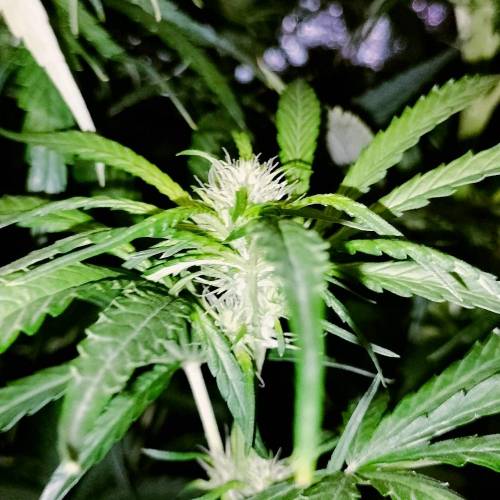
TommyBVRSA75 The height of problems if it can be done in a week... there’s no way to deal with temperatures at night of 31ºC and 78% RH. If that affects any of us, it can definitely affect a plant, and the absorption rates and watering through passive hydroponics are revealing themselves at an astonishing rate of almost a 24-liter tank every two days, which we've been experiencing in the last days of this week. Anyway, the phenotype of this wonderful strain is proving to be very resilient, being an F1 and then with its fast genetics included. The truth is that a couple of weeks ago we changed the light cycle to enter flowering, and what has happened in the last two weeks is essentially a continuation of explosive vegetative growth (stretching in height), and the strength with which the grow continues to push is visible.
There’s something to note, especially in summer, that the phenotypes of F1s tend to be exaggerated and I explained. They feed enormously, develop "wildly," and are grows of excessive vigor.
There’s an important lesson to interpret what’s happening. First, that conditions of heat and high RH are synonymous in the "fast" with an unseen vigor. I thought there would be signs of stress throughout the line, but no. The grows are developing incredibly, and something that is noticeable is that stress factors end up being favorable conditions for the complete development of the grow.
The outline of the buds on the upper plans is already notable, and we’ll have to keep a close eye on the necessary water in the coming days. As I’ve said, water consumption (and of course, nutrients too) is through the roof, and we need to pay major attention to ensure the system doesn’t run out of water. Another important note is that in the tray where the pots are, roots have already started developing that tend to obstruct the APU pump, and this situation is of great importance, so that the water in the tank can drain to the tray without interruptions and without causing root death and, with it, irreversible damage to the grows.
Then, another important note concerns how the Smart Mats (special absorption fabric strips) are functioning effectively. In recent times, with the high water consumption, the explosion of root mesh spaces, and the obstruction of the level pump, which allows the water to drain to the right point without excessive runoff, and also, with the limits created by the temperature and RH factors we’ve been having in the last 4 days, all the care and attention I can have as a grower, "now is the time." In other words, now is exactly the time to bring out the best from past knowledge from other seasons, to work with the best of a scientific criterion where the evidence of what is done well is the formula for success.
So, we are in the midst of a season that could be a reference for observing and putting into practice the best teachings in the future. So many times, when we work with growth charts based on nutrients, water, and light quantity, all of this becomes relative, as practices are largely the repetition of habits that we observe to be favorable, according to the practice of experience, trial, and error, and with that, we adapt to the existing reality, what we have both in material terms and in actions that we’ve learned from previous times that work well for us. And in this, cannabis grows and not just that, like everything in the realm of botany, as a therapy to improve ourselves as people and souls.
If you look at the photos, the growth is unstoppable. And we’re trying everything... from reducing light intensity, cutting down on compounds that allow the roots to continue integrating nitrogen, and trying whether it’s with LST or twists, or with two SCROG nets at different heights to change the direction of verticality. What this season, and especially what the Fast strains have, is an excessive tendency for ideal heat conditions for strains like the parental ones of the Sweet Afghan F1, both the Black Domina and the Haze that provided the remaining gene alleles, have been decisive for the four monsters (literally) that are in development, and by week 8, what I ask of God Jah and cross my fingers for is that the vertical growth finally comes to an end. As you can see, the buds are already popping out everywhere, and with these four ladies of this size, the harvest will be something to respect, and what would be desirable is for the central colas to produce gigantic buds to counterbalance all the vegetative matter that has emerged.
Final note for you to pay attention to the twists at the tops of the colas so that we gain space to escape from the lamps and thus, we have buds in the end that do not get burned by the light intensity (on the dimmer of the lights we’re already at 70% intensity and lowering as necessary to protect the plants from the enormous stress they are undergoing).
I leave you as always with a prayer to God Jah, who protects us from those who harm us and works for us to find happiness in all the wonderful things in the pursuit of perfection as Humans as beings of light...
Green greetings to all the brothers...
3 likes
comments
Share
Used techniques
LST
Technique
ScrOG
Technique
Defoliation
Technique
10
Week 10. Flowering3y ago


127 cm
Height
12 hrs
Light Schedule
27 °C
Day Air Temp
6.0
pH
Normal
Smell
845 PPM
TDS
91 %
Air Humidity
26 °C
Solution Temp
27 °C
Substrate Temp
11 liters
Pot Size
4 liters
Watering Volume
16 cm
Lamp Distance
Nutrients 5
Spicy Poker - General Nutrition solution
0.15 mll
The Witcher's Potion - Bloom Base
4.75 mll
The Witcher's Potion - Acti Boom
1.85 mll
TommyBVRSA75 Hermanos Growers
Very notable changes at week 10, and very motivated by the combination of what has been happening since week 6 and the onset of flowering. And I'll explain it in the best way... as I told you and showed you in photos, the extremely high temperatures, the humidity that skyrocketed in the last ten days, the characteristics of this Afghan "fast," the endless vertical stretch; the exacerbated growth of thin and unproductive branches at the base, and the enormous rates of water and nutrient absorption from Canna (very good by the way, but that have the characteristic of providing growth in the lower part of the grow,... all in all contributed to the growth of "trees" in a very limited space, and with all these factors, it has been necessary to impose very important changes for the last month of bud multiplication and fattening, and the changes introduced are radical but, in my opinion, necessary to achieve a harvest that is very rational between quality of buds and quantity of the same.
First radical change, the nutrients... we have switched from the CANNA formula for coco to the Spanish vegan The Witcher's Potion, especially the formulation for bud multiplication and fattening. The "feeding" from CANNA contributed to having long grows in vertical size and excessively full of secondary branching at the base until about a little over a week ago, which at this point in the grow and heading towards the end, would disperse the concentration of energy needed for flower development. That thin branching, coming directly from the stem, with a couple of unnecessary small leaves and at most a hint of "hairs," which after harvest and drying, turn into nothing (even for decarboxylating for edibles, they have minimal utility),... in other words, green matter with no utility at all and more "sucking" the life force from the upper areas of the grows. So you will see in the photos that the "ladies" have been heavily defoliated, leaving only the starts of the upper areas of the grows, where we want the buds to grow with great vitality, contributing to a quality harvest.
As you will see in the photos, the entire upper part of the grows is maintained, where you will notice the twists from the Super Cropping applied (really, a super...super twist) to move the tops of the grows away from the source of the two Hydro Mars LED panels (both 150 watts, totaling 300 watts, from which we have reduced power through the existing dimmer system, and at this moment we have the power of the panels at 65% of the total, meaning that the panels project instead of 300 watts - 150 each - 190 watts - 95 watts on each panel - and on top of that, over the edges, I have applied two flowering PLED tubes, each with 26 watts, which at a distance of 15 centimeters cover a significant flowering area - where the twists of the tops of the grows have been directed, which now at the distance and power of the PLED are shielded from stress and burns... and if you notice, at least there is a small hint of buds on one of the branches that already showed light burn.
With the arrangement of the Mars Hydro panels over the center, we have managed to provide light to the center of the grow area, maintaining the necessary light input until the end of the grow, and with the PLED tubes over the areas not covered by the panels and secured at a higher level than the panels - on the bars that form the top of the grow cabinet skeleton, and with the "gentle" 26 watts from the warm lights of the PLED tubes, it is ideal for the balanced development of the buds, and in reality, in just six days, it is very evident that the current light scheme is now perfectly arranged to guarantee the growth and fattening of the buds in the four grows.
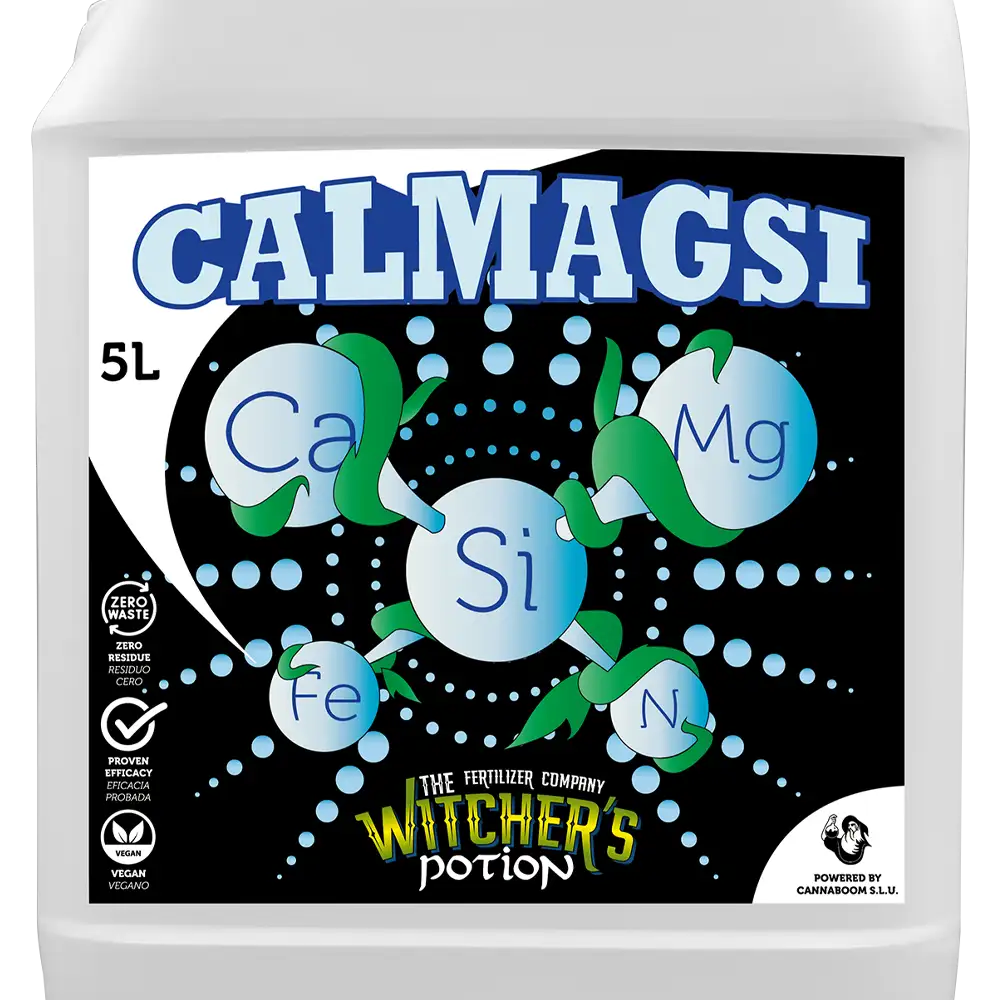
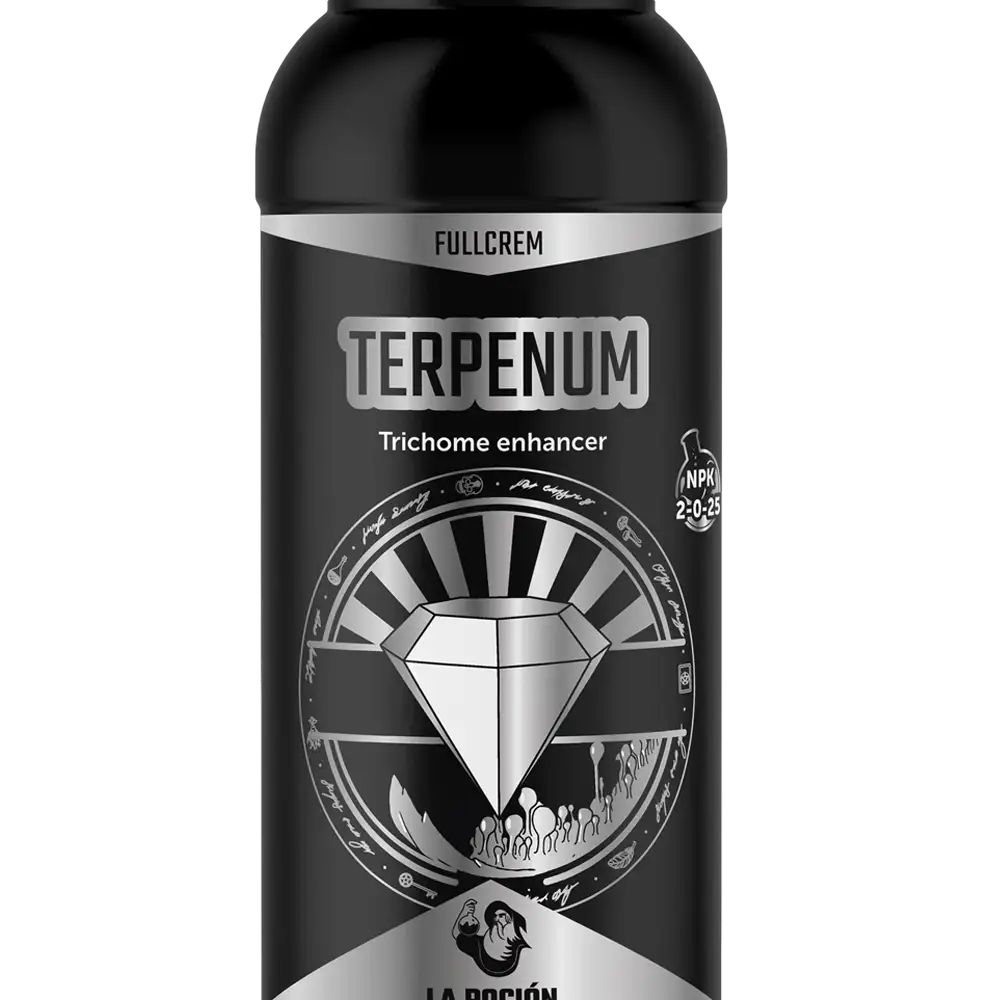
As I told you, the change from CANNA nutrients to The Witcher's Potion has also produced almost immediate effects. In the last week using the CANNA plan, the pH was over 6.2 and the EC around 2.20, with The Witcher's Potion plan, we have lowered to a pH of 5.9 and an EC of 1.70, and what has been perfectly visible as a change has been the explosion of buds; the immediate stop of vertical growth and especially the wilting of the narrow branches at the base of the grows and the dropping of everything that was excessive in the number of old primary leaves located at the base of the grow. In other words, everything that meant what I mentioned over the weeks, regarding the excess vegetative - thin branches with no possibility of bud formation at the base of the grows - with the change of "feeding," and it is very important for you to notice that with CANNA and the Coco A and B compounds - with significant nitrogen input - and as I also mentioned, perhaps that is why the "vegetative" was prolonged "to infinity," with the composition of The Witcher's Potion and the compounds that the current cycle of the grows imposes on us, we have thus shifted from high doses of nitrogen, changing the focus to the EDTA (chelates) compounds in the "wizard's" formulation, and bringing in significant inputs for the moment we are in - with a very interesting CalMagSi formula and three very balanced flowering compounds (Actiboom - Bloom Base and PK Boom)... and as I show you again in the photos, the formation of buds is tremendously notable, their size increase and fattening (it is very evident to the touch that the buds are still in the initial phase tending to be very hard, and some of the photos can show you the multiplication of terpenes and resin droplets.
At this moment, highlight the somewhat citrus smell that surely comes from the Black Domina heritage of the strain. In other words, it promises, and in the coming weeks, I hope that what the photos can show is the final stretch of a cannabis of outstanding quality.
So, with this very long diary entry, which I recommend you read because many notes provide important lessons, and that is the main mission of GrowDiaries - not just photos for the "slow motion," but much more importantly, to give all the brother growers and interested parties notes on the beautiful "journey" of cannabis growth.
And finally, always that highlight to God Jah and what he does to protect us from everything that could harm us - from pests, to mistakes, to neighbors and bad vibes-.
Green greets to all the brothers... and until next week, as God Jah wills...
6 likes
1 comment
Share
Used techniques
LST
Technique
HST
Technique
ScrOG
Technique
Defoliation
Technique
13
Week 13. Flowering3y ago


130 cm
Height
16 hrs
Light Schedule
24 °C
Day Air Temp
5.9
pH
Strong
Smell
1270 PPM
TDS
96 %
Air Humidity
25 °C
Solution Temp
24 °C
Substrate Temp
24 °C
Night Air Temp
11 liters
Pot Size
4 liters
Watering Volume
16 cm
Lamp Distance
Nutrients 7
Spicy Poker - General Nutrition solution
0.15 mll
The Witcher's Potion - Bloom Base
5 mll
The Witcher's Potion - Acti Boom
3 mll
TommyBVRSA75 Entering the last three weeks and throughout the line, the signs of the end of the cycle are extremely visible.
Restrictive option for placing my 130w Blurple Phytoled, as there’s no need for such an expressive light force at the end of the cycle like the combination of the TS 1000 from Mars Hydro and the alternation to the 26w PLED... plus, restricting the lights helps the flowering process to happen faster, with less stress, and above all, saving on the bill. With this dimmer reduction, the maturation of the buds will happen much more quickly and effectively.
As you’ll see in this week's photos, what we want to show is the structure of terpenes and the resin glands of the buds.
The buds from these Afghan phenotypes are very beautiful, and the sweet hashish and skunk aroma is delightful, which will bring us one of those wonders to enjoy on autumn nights, watching a good movie and feeling the arrival of the cold and rain.
Meanwhile, I’m already thinking about the next strains, and in order of destination, I’m almost tempted to do "heads or tails" among the ladies I’ve been considering for their merit and beauty... and so, if you help me with "heads" for my set of four in hydroponics, looking ahead to the winter photoperiod season, I’m leaning towards planting two Blue Skunk from Sendo Seeds and two more, Biscotti from Zambézia. With the flowering and the conditions of humidity, temperature, and types of strains, we will finally have, if God Jah wishes, all the best. Follow for your enjoyment the goodness that our Afghan "fast" teaches us. God Jah be with everyone and keep us safe from harm.
1 like
comments
Share
Used techniques
HST
Technique
ScrOG
Technique
FIMing
Technique
Defoliation
Technique
14
Week 14. Harvest3y ago
Happy Harvest Day!


9/10
Rated
In the end, and in a more timely manner, due to the evidence of very good terpene maturation, in the last two weeks and because of the fast cycle in indoor with the summer conditions we have experienced, here the plant's cycle is completed and today I finished harvesting. Four grows of the S.A.D (Fast) from Sweet Seeds and the cycle accounting, by irony of fate, took exactly 14 weeks from seed to harvest... in the last five days it became quite evident that the grows had reached the end and the last week had implications at the level of switching to a 130 w + 2 PLED flowering tubes of 26 watts, totaling 182 watts for the end of the cycle, and the panorama that the pocket microscope showed us was of a clear percentage of milky globular terpenes and the option taken was based on wanting to have a yield focused on the mental aspect without the need for monstrous buds. The strain is an Afghan (the desirable and expected is that well-being that the Hindu Kush genetics have) and if it allows us to be well placed and without knocking us down without action, the parentage of the Black Domina will already give us a smoke to enjoy wonderfully and without exaggeration or couch-lock. Well, what can I say?!? The harvest point has been perfect and overall everything has turned out in the best way - a respectable harvest and a promising smoke.
Thus, as not always... God Jah on the way... the afternoon has been eventful, starting from the need to do a perfect trim and then we will move on to curing in my special mahogany cabinet, which is phenomenal in providing a dry enough environment that is sterile from fungi, pathogens, and insects. I leave you the photo of the large number of branches and the very competent way in which a wet trim was done with almost no loss of terpenes. In a very competent manner, here you have the final result of the Sweet Afghan "Fast" created in coco and with passive hydroponic watering. We will repeat very soon, starting in just a few weeks, a regular photoperiod grow and with the autumn/winter conditions, the next strain will be chosen not only for the overall quality of the final product but so that the strain to be chosen will be a monument to botanical beauty (something purple and surely "feathered" from some USA genetics will almost certainly be next).
As always, thank you very much for joining me in another grow and season and for your comments and strength that you pass on to me. Green greets, brothers....
Show more
Original
Spent 65 days
Ger Veg Flo Har
102.5 g
Bud wet weight per plant
70 g
Bud dry weight per plant
4
Plants
Normal
Difficulty

Creative, Giggly, Happy
Positive effects

Depression
Medical effects

Citrus, Earthy, Sweet
Taste
Height
Day air temperature
Air humidity
PPM
PH
Light schedule
Solution temperature
Night air temperature
Substrate temperature
Pot size
Lamp distance


TommyBVRSA75 Easy to grow, despite very high temperatures and humidity. The Fast genetics from Sweet Seeds continue to impress with their excellence. With the amount of resin, terpene globules, aromas, and the hardness of the buds, what's coming is no joke.
3 likes
comments
Share
Equipment Reviews










8 comments
Sort by
popularity
popularity
newest
oldest

Sweet_Seeds  commentedweek 03y ago
Thank you very much for sharing a new diary with one of our strains. 😊
We hope you enjoy it. 😋
Sweet smokes,
- Apolo
likes 3
TommyBVRSA75 commented3y ago
@Sweet_Seeds, your Afghans Fast is a dream and I'm really curious to feel the Hindu Kush blood of this lady of yours. For all the reasons and because these strains in summer, even indoor, are a wonder. I always say that the beauty of Afghan strains isn't in their lanky phenotype, but in their flavors and aromas, and in that, they are unbeatable, just like you are as a seed bank. Keep delighting growers with your wonders. A shoutout to the Ganesh of seeds...
likes 3
TommyBVRSA75 commented3y ago
@Sweet_Seeds, I would like to know how I can get your official support for my diary. I would love for my diary to be accessible to Sweet Seeds followers since I'm having a magnificent grow and I want to share it with as many fellow growers as possible here on GrowDiaries. A big hug to you all.
likes 2
Sweet_Seeds commented3y ago
@TommyBVRSA75, Hi buddy! If you share on instagram, my colleagues sometimes share some posts from our followers.
We do not have any ability to share content on Growdiaries.
Sweet smokes,
Apolo
likes 2

ceo5fvf2 commentedweek 43y ago
This is an excellent diary with very detailed information about the grow that everyone can benefit from. Nice work!
likes 2

Hou_Stone commentedweek 03y ago
Happy growing bro💪! 🌲best🌲wishes🌲
likes 2

420DeepGrow commentedweek 103y ago
It looks pretty good, keep it up!
like 1
420DeepGrow commentedweek 03y ago
Good luck with your grow, bro!
like 1

the end.
Enjoying this diary? Follow for more updates!

Prefer the old Diary view?
Go back to the old Diary view