


Light upgrade question
RemoveYourChainsstarted grow question 6mo ago
I have a 250W vipar p2500 LED currently. my power budget is ~400W
Would you buy a single bigger new light or would you buy 1-2 smaller ones to use with the existing light?
What brands/model would you recommend?
Solved
Setup. Lighting
likes
00110001001001111Oanswered grow question 6mo ago
it doesn't matter... whichever has a better resulting coverage - distribution of light - will be better if all other factors are the same. PPF or umol/s PAR is the key specification to compare in that regard. if it produces the same rate of PAR photons, the results will be very similar and only deviate due to dsitribution of light.
So, if 2 lights better covers the area, then sure...
in most cases it'll make very little difference so i woudln't overspend for either context.
400w can mean drastically different things due to differences in efficacy -- how well it converts electricity to photon production in the wavelength range plants can use (PAR).
High efficacy = quality. If something is priced high but not around 2.8-2.9 umol/J efficacy, it's over-priced garbage. The best way to assess this is to compare to the testing paramaters on the diode manufacturer's website, like the LM301 from samsung.com. It's tested at 0.2w per diode, so longevity and effeicacy is tied to that fact. Piping moe rpower through that diode will cause it to die faster and operate less efficiently. Slight deviations are not so bad, but doubling and tripling has a significnat impact. Any LM301-based light up around .4-.5w per diode and higher are not going to last "50,000" hours and it's efficacy is nowhere near the high end even if it advertises something close to 3umol/J.
umol/J, simplified... just multiply watts x umol/J and it should equal the umol/s PAR output of the light.. one more way to double-check the light manufacturer's spec sheet... many, if not most lie through their teeth, so you always have to compare to the diode manufacturer testing specs. Those can be trusted.
lights are simple. if they use a good diode, use a proper amount of diodes relative to power, and have some decent heat dissipation, it will be an excellent light regardless of brand name. Learn how all that jives together and it's easy to recognize a high quality light... and easy to size one correctly for your needs.
400w with a high efficacy light will be around 1100umol/s PAR output. Less efficient lights will fall short of that.
12-hour operation
1100 / 900PPFD = 1.22 m^2 coverage for ~39 DLI (daily light integral) That's how much a high efficacy 400w of light could cover -- assuming shape of lights fit area of coverage.. i assume you can apply common sense like that when looking at options. the math is a ballpark. Always have to adjust based on observed growth pattern due to local variables. this gets you close.
18h
for autoflowers you could cover 50% more area while operating 18 hours per day. Or, with vege phase of photoperiods, you run the light at 67% and cover the same 1.22m^2.

Ketamineanswered grow question 6mo ago
I would buy the single light with more power. I would get a 315 LEC IMO
1 like
Complain

ATLien415answered grow question 6mo ago
obligatory 'SF is in the middle of almost certainly going bankrupt over a lawsuit regarding their labelling of their diodes' reply since we have multiple people acclaiming their lights due to diode listing.
wont give a brand recc but i would go with a single unit and have it be much more powerful than your largest draw you plan on using it with. economics run after run after run is down to work hours and efficiency. likely any light off amazon even these days is gonna be fire for the first run. i advise against two but you could use superposition to get your custom par map and it would be accurate for the most part
1 like
Complain
Crusty_Juggleranswered grow question 6mo ago
Always go with more lights!
- Better spread
- Accomodate different plant heights
- Back-up if a light breaks
Don't go by brand but by diodes and driver:
Diodes = Samsung LM301 (any subtype), Cree J series
Driver = Meanwell HLG or XLG series, Inventronics
1 like
Complain

HinduGodanswered grow question 6mo ago
DAT WOULD DEPEND ON DA SET UP!! PEOPLE DO LIGHT TESTS ON DA YOUTUBE!!! EXAMPLE DA MIGRO GUY!!!!
3 likes
Complain

JimmyWhiteanswered grow question 6mo ago
Hello,
I'd decide it depending on the grow space. Bigger space, I'd buy and use additional lights to hit the plants from different angles. Smaller space, I'd buy one powerful light, in your case 400w.
I'm really happy with Spider Farmer and Mars Hydro LEDs. Would recommend Spider Farmer G or FC series depending on your budget.
Happy grows and good luck!
1 like
Complain
Similar Grow Questions
Solved

Fayah_Burn
Grow Light AdviceHelloo growmies!
I've got a question.. I need a new light for vegging (only) in a 80x80cm tent.
I am thinking of eather the LIGHTWAVE T5HO 60 CM (48W) or
MarsHydro TS 600 (100W)
Has some one experience with those lights? Is it worth spending double on electricity with the MH?Setup. Lighting
5y ago
7
10
Solved

painspk
When to raise light potency with autoflowersI don't really know when to raise the amount of light when growing autos.
I think I'll wait for them to complete 15 full days and then I'll raise the LED panel to 50cm, change from 20% to 40% potency and observe how they behave.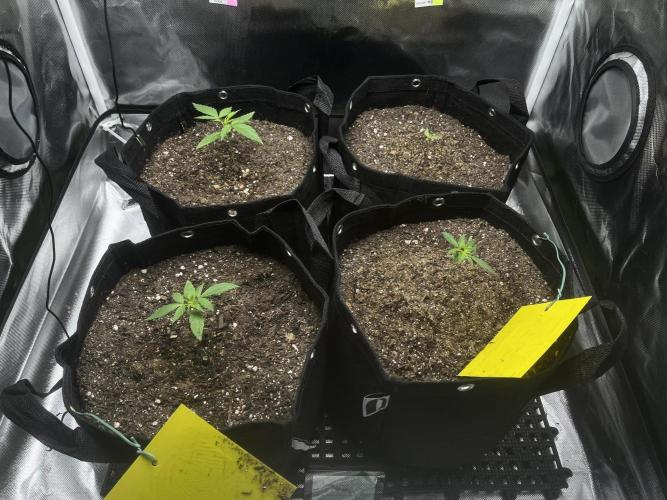
Week 2
Setup. Lighting
6mo ago
1
1
Solved

Pinkpanther
Combination tent/light/potsI'planning to buy grow tent and I want to know the best performance aea/pots/ligth combination. My idea is work with 300cmx300cm tents, led light of 120x110cm (can cover 150cmx150cm), pots of 2 gallons, I want to add co2 and automatic irrigation system.Setup. Lighting
7y ago
1
2


Solved

ohighoan
Looking for advice growing plants indoor and outdoor at the same timeSo I’m wondering if it’s ok to grow a plant indoor and outdoor. Id like to put them out only on nice days then bring them back in. Come flower time around august id like to do the same thing. Will this stress them? And will this effect how much par I need to drive down on them?Setup. Lighting
Setup. Outdoor
4y ago
3
3


Solved

Greenfingeress
Lights to seedlings how far apart should they be?Hi there,
I am doing my seeds in soil I have a 250watt lights
Can anyone tell me how far away should my seedlings be from the light when coming through as so not to get stretching on them😊
Any options will do ?❔❓❔
ThanksSetup. Seeds
Setup. Lighting
Setup. Seedling
6y ago
4
4
Solved

ITAIvangrower
Sonlight apollo 8 plus box 80x80x160Buonasera a tutti growers, vorrei sapere ho intenzione di comprare questa lampada, ho trovato un affare da un amico attualmente ho un box 80x80x160cm con un hps 250 ma non sono molto soddisfatto e vorrei passare a una sonlight apollo 8 plus vi metto il link, grazie in anticipo 🙏https://www.idroponica.it/led-coltivazione-indoor-sonlight-apollo-plus-8~27322.h… Show moreSetup. Lighting
6y ago
1
3
Solved

zkittlezjunior
How Much Buds can i get from 150W Cob Led with using lst techniques in auto ?Like i asked.I have 150W Full Spectrum Cob Led.The amount of lux is about the 12K by the way.So im gonna grow only one plant like auto royal dwarf or white widow auto.Do you think how much grams can i get with this condition?Buds. Not fattening
Other. General questions
Setup. Lighting
6y ago
1
2

Solved

LAzerBEAN
matching cobs to drivers? CLUO4j-1818c9what driver would i need to run four citizen cluo4j-1818c9?
Setup. Lighting
6y ago
2
2
Solved

Smokey89
LightingCan I run my led lights on veg&bloom during the veg stage or is it best to stick to just vegSetup. Lighting
6y ago
1
2
Solved

Meimei99
brand LEDs are used effectively back to the highest G/watt worldwide, its standard and everyone loves to use it?brand LEDs are used effectively back to the highest G/watt worldwide, its standard and everyone loves to use it? Hope I will get a good answer because I am looking to buy led light
Plant. Other
Setup. Lighting
5y ago
1
1


Solved

arkhive
LED's wont shut completely offLights seem to go on a "standby mode" instead of being all the way shut when timers switch them off. Should I buy some other timers? These were brand new, cheap ones though and both the same. Lights are HLG 600 RSPEC and both did this.
Week 4
Setup. Lighting
6y ago
1
2
Solved

Mel_Macallan
Hi, can anyone tell me if it's normal, or why those lower branches are stretching so much? I have only one 50w cob light. Which apparently produces equivalent to 150watt... Is that enough? I have only one plant and a very small grow box. Thanks for any advise :)
Setup. Lighting
6y ago
4