


Likes
Comments
Share


@Kraken85
Follow
Problème d intracteur d' aire ,
Obliger de le lancer une fois en route. il à fait son temps 12 ans,
tourne av du mal , à changer.
Rinçage en cours.





Likes
5
Share


@CreamyNuggets
Follow
So far all plants have been harvested. (3x Bubba Pupil, 1x purple wreck, 1x AK-47, 1x Godberry). The first bubba pupil and AK-47 were harvested a week and a half ago and now have been jarred for 1 week +/- a few days. All pictures are of the bubba pupil and AK. I will come back and update once the other plants have been trimmed.
The first Bubba Pupil, which was the tallest of the 3 and most stretched out, yielded exactly 4.5 Oz dry weight. The smell is starting to get stronger after a week. It smells grapey but has a weird funk to it. It must be the “pupil” funk everyone talks about. This plant looked like it wasn’t going to yield much, but I was pleasantly surprised. The lowers were dense and compact which contributed to a good amount of decent sized buds. Overall, I’m pretty pleased with the yield and quality from this plant.
The AK-47 seemed like it was going to be a heavier yielder, but it ended up only yielding 2.5 Oz dry. The main colas were far during flower and dense when dried, but this plant had little to no lower quality buds. Everything below the main canopy seemed like it was airy and not worth jarring up. This plant smells a little bit fruity, but I can’t really put my finger on it. Super dank smelling, not skunky, but it smells like it is going to be gaseous once it cures up a bit longer.
The Godberry yielded a total of 3.25 Oz. She was the best smelling by far out of all of the girls in the tent. Super fruity and sticky as hell. The resin content on her was definitely the highest of them all.
I will be back to update once the last 3 plants are trimmed and jarred for a final weight and overview.

Likes
7
Share


@BudXs
Follow
Super busy with a move and a big garden reno. Sorry, this is the only update for this week

Likes
6
Share


@Mr_nugs_lover_David
Follow
Beautiful strain, very very purple intense color, will make content on her by the day, can't really show very well the plants at night but I had to update the diary so, sorry about that. Very citric aroma just like her sisters, wonderful strain to grow and harvest fast. And she makes your garden look more colorful. I love this auto strain guys very recomended.


Processing
Likes
10
Share


@AokEnt
Follow
Weened off the veg nutes completely. I'm pretty much done messing with the scrog from here as well. From here on it's monitoring the plant health until flush and that's it.




Likes
67
Share


@Hashy
Follow
Grow diary 11.
This grow I'm running 4 diaries, one for each strain in the tent. So my plan is instead of a week being 7 days, my weeks are most likely going to be every 10 days. I think I'm going to take pictures every 5 days so there is a mid week and end week shot.
I'm germinating in my propagation tent which is secret jardin dp60. I soaked the seeds in water for 15 hours. The seeds sank so i took that as a good sign. After the seed had soaked for 15 hours I then soaked the rockwool cube for 30 mins in PH 5.8 water with 0.5ml/L hydroguard. Gave the cube a shake and let it drain for 30 mins before placing the seed pointy side down so the top of the seed is level with the cube. Covered seed with a loose bit of rockwool. Placed into propagator with the sunblaster t5 lights on constant. After 71 hours the seed popped
TEMP
MAX 34.2C
AVG 30.1C
MIN 25.8C
HUMID
MAX 86.3%
AVG 80.3%
MIN 57.2%
VPD
MAX 2.07
AVG 0.83
MIN 0.64
Hopefully back in 10 days.

Likes
20
Share

@cangrowz
Follow
Grow Diary Update – Lemon Haze 🍋
So langsam geht es Richtung Ende. Am Samstag oder Sonntag werde ich die linke von den beiden Pflanzen ernten. Die kleinere lasse ich noch etwas länger stehen, da sie bei der Bud-Entwicklung noch gut nachlegt und sicherlich noch etwas Potenzial hat.
Generell bin ich wirklich überrascht, wie stark die Buds in den letzten Wochen noch aufgebaut haben. Gerade gegen Ende haben die beiden Lemon Haze nochmal ordentlich Masse zugelegt.
Außerdem habe ich gestern schon die **Seeds für den nächsten Run bestellt: Mimosa x Orange Punch Auto von Barney’s Farm.
Davon werde ich zwei Pflanzen starten, allerdings erst, wenn die beiden Lemon komplett fertig sind und das Zelt wieder frei ist.
Die Runtz Auto lasse ich einfach nebenher weiter wachsen und schaue mal, was daraus wird.
Der Geruch der Lemon Buds ist inzwischen richtig stark geworden – sehr citrus-lastig, genau so wie man es von einer Lemon erwartet. 🍋
Happy Growing Growmies 🌱
Likes
3
Share


@CreoWeed
Follow
Hey guys,
Another Explosive week has passed and the plant seems to not stop growing, I have some side branches reaching 80cm while the main branch stopped at 68cm.
I really hope it can produce nice buds. At the moment it still a little bit 'empty' hoping week 7 will make the flower explode, I really hope so...
For now it's all, stay tuned and stay high nice people!

Likes
6
Share


@Naujas
Follow
The girl is fantastic :) she looks strong, healthy and happy :) next week, I will defoliate her to give energy to the flowers, and at the same time improve air circulation closer to the stem :) everything is going smoothly and well :).


Likes
10
Share


@Abendkraut
Follow
GH cheese is growing nicely puffy flowers with a lot of trichomes. Looking forward to tight buds full of kief. Crossing fingers that the cheese flavour is pronounced.
22/03
New Video uploaded

Likes
42
Share


@Dr_Boom
Follow
She continues to show good growth. I had to do some more defoliation this week to remove the bigger fan leaves...again. She's showing good bud formation and I am enjoying watching her grow. She is nice therapy after my heart attack. Growing relaxes me and gives me almost as much relief as the medicine I am growing.
Likes
3
Share


@Krautbauern
Follow
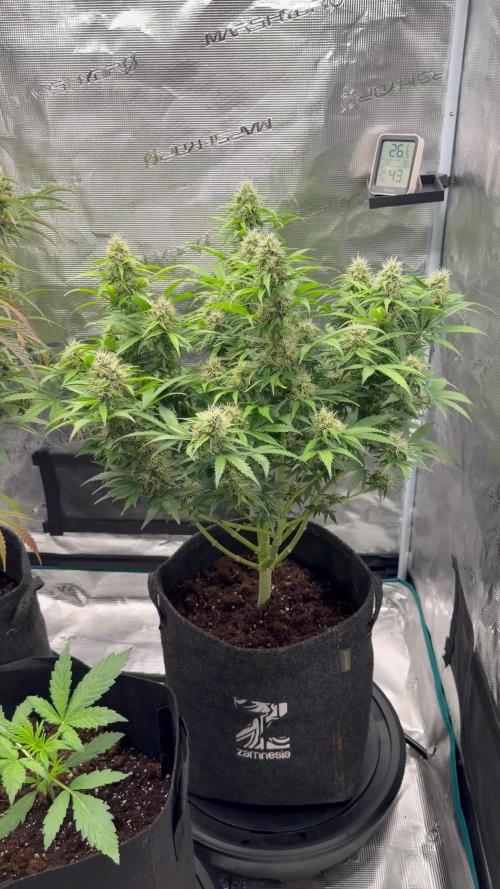
papaya cookies has now completed her stretch. typical for papaya, she develops purple/pink pistils. such a beauty. hopefully the weather will stay good enough for her bulk.
Likes
30
Share


@PEAKYPLANTERS
Follow
Hi guys, What's up?
Welcome back
I wanted to share with you the growth of this wonderful specimen
With a Formula 1 start, she burned all her roommates on the spot
Smells and colors are starting to take their shapes 😉😋
Likes
13
Share


@Paul_on
Follow
This is the Strawberry 🍓 Cola Sherbet from @Sweetseeds.com that I put in the same fabric pot ,as the last one ,I shocked , so this one has been on 12/12 since her first breath , and for a 5 wk old plant/f1 it is surely showing its vigorous growth and diversity in light hours from seed ,suits a lot of growers ,especially now a days wanting to try more flavours in shorter time frames are in demand and with quality seeds there very little f&ck ups too 😀 @Sweetseeds,
i do recommend ,Highly 👌💯
Likes
2
Share


@Altitonans_Fulmen
Follow
For most crops, a slightly acidic soil pH between 6.0 and 6.8 is ideal because it optimizes nutrient availability. When soil pH rises above 7.0 (alkaline), the concentration of hydrogen ions H+ drops significantly, and they are replaced by calcium, magnesium, or sodium ions on the clay colloid exchange sites. To naturally lower alkaline soil pH, you can add organic matter (carbon-rich materials), which produces weak organic acids as it decomposes. Maintaining this slightly acidic range stimulates a highly active, diverse microbial community; these microbes decompose organic matter and release carbon dioxide CO2, which plants absorb through their roots and leaves to boost photosynthesis and sugar production. Furthermore, the added organic carbon acts like a sponge, drastically improving the soil's water-holding capacity.
While soil biological activity does involve cellular electron transport, electrical conductivity (EC) in soil is actually a measure of dissolved mineral salts, not a voltage carried by individual microbes. Soil microorganisms secrete organic acids and chelate metallic and non-metallic minerals, transforming locked-up inorganic compounds into bioavailable organic complexes. Unlike harsh synthetic fertilizers that can dehydrate soil life in high concentrations, these naturally chelated nutrients safely nourish the plant, creating a thriving, self-sustaining ecosystem where plants can efficiently synthesize their own food.
Metal-based: Could include elements like iron, manganese, copper, or zinc, which are essential nutrients for plants but can exist in forms not readily accessible.
Non-metal-based: Examples like calcium carbonate, phosphate, or sulfur are also important for plant growth and potentially serve as building blocks for the organic salt.
Chelation in a plant medium is a chemical process where a chelating agent, a negatively charged organic compound, binds to positively charged metal ions, like iron, zinc, and manganese. This forms a stable, soluble complex that protects the micronutrient from becoming unavailable to the plant in the soil or solution. The chelate complex is then more easily absorbed by the plant's roots, preventing nutrient deficiency, improving nutrient uptake, and enhancing plant growth. Chelation is similar to how microorganisms create organic salts, as both involve using organic molecules to bind with metal ions, but chelation specifically forms ring-like structures, or chelates, while the "organic salts" of microorganisms primarily refer to metal-complexed low molecular weight organic acids like gluconic acid. Microorganisms use this process to solubilize soil phosphates by chelating cations such as iron (Fe) and calcium (Ca), increasing their availability.
Added sugars stimulate soil microbial activity, but directly applying sugar, especially in viscous form, can be tricky to dilute. Adding to the soil is generally not a beneficial practice for the plant itself and is not a substitute for fertilizer. While beneficial microbes can be encouraged by the sugar, harmful ones may also be stimulated, and the added sugar is a poor source of essential plant nutrients. Sugar in soil acts as a food source for microbes, but its effects on plants vary significantly with the sugar's form and concentration: simple sugars like glucose can quickly boost microbial activity and nutrient release. But scavenge A LOT of oxygen in the process, precious oxygen. Overly high concentrations of any sugar can attract pests, cause root rot by disrupting osmotic balance, and lead to detrimental fungal growth. If you are one who likes warm tropical high rh, dead already. Beneficial, absolutely, but only to those who don't run out of oxygen. Blackstrap is mostly glucose, iirc regular molasses is mostly sucrose. Sugars, especially sucrose, act as signaling molecules that interact with plant hormones and regulate gene expression, which are critical for triggering the floral transition. When sucrose is added to the growth medium significantly influences its effect on floral transition.
Probably wouldn't bother with blackstrap given its higher glucose content. Microbes in the soil consume the sugar and, in the process, draw nitrogen from the soil, which is the same nutrient the plant needs. Glucose is not an oxygen scavenger itself, but it acts as a substrate for the glucose oxidase (GOx) enzyme, effectively removing oxygen from a system. Regular molasses (powdered if you can), as soon as she flips to flower or a week before, the wrong form of sugar can delay flower, or worse. Wrong quantity, not great either. The timing of sucrose application is crucial. It was more complicated than I gave it credit for, that's for sure. When a medium's carbon-to-nitrogen (C:N) ratio reaches 24:1, it signifies an optimal balance for soil microbes to thrive, leading to efficient decomposition and nutrient cycling. At this ratio, soil microorganisms have enough nitrogen for their metabolic needs, allowing them to break down organic matter and release vital nutrients like phosphorus and zinc for plants. Exceeding this ratio results in slower decomposition and nitrogen immobilization, while a ratio below 24:1 leads to faster breakdown and excess nitrogen availability.
Carbon and nitrogen are two elements in soils and are required by most biology for energy. Carbon and nitrogen occur in the soil as both organic and inorganic forms. The inorganic carbon in the soil has minimal effect on soil biochemical activity, whereas the organic forms of carbon are essential for biological activity. Inorganic carbon in the soil is primarily present as carbonates, whereas organic carbon is present in many forms, including live and dead plant materials and microorganisms; some are more labile and therefore can be easily decomposed, such as sugars, amino acids, and root exudates, while others are more recalcitrant, such as lignin, humin, and humic acids. Soil nitrogen is mostly present in organic forms (usually more than 95 % of the total soil nitrogen), but also in inorganic forms, such as nitrate and ammonium. Soil biology prefers a certain ratio of carbon to nitrogen (C:N). Amino acids make up proteins and are one of the nitrogen-containing compounds in the soil that are essential for biological energy. The C:N ratio of soil microbes is about 10:1, whereas the preferred C:N ratio of their food is 24:1 (USDA Natural Resource Conservation Service 2011). Soil bacteria (3-10:1 C:N ratio) generally have a lower C:N ratio than soil fungi (4-18:1 C:N ratio) (Hoorman & Islam 2010; Zhang and Elser 2017). It is also important to mention that the ratio of carbon to other nutrients, such as sulfur (S) and phosphorous (P) also are relevant to determine net mineralization/immobilization. For example, plant material with C:S ratio smaller than 200:1 will promote mineralization of sulfate, while C:S ratio higher than 400:1 will promote immobilization (Scherer 2001).
In soil science and microbiology, the C:S ratio helps determine whether sulfur will be released (mineralized) or tied up (immobilized) by microorganisms.
A carbon-to-sulfur (C:S) ratio smaller than 200:1 promotes the mineralization of sulfate, when the C:S ratio is low, it indicates that the organic matter decomposing in the soil is rich in sulfur relative to carbon. Microorganisms require both carbon and sulfur for their metabolic processes. With an excess of sulfur, microbes take what they need and release the surplus sulfur into the soil as plant-available sulfate
A carbon-to-sulfur (C:S) ratio higher than 400:1 will promote the immobilization of sulfur from the soil. This occurs because when high-carbon, low-sulfur materials (like sawdust) are added to soil, microbes consume the carbon and pull sulfur from the soil to meet their nutritional needs, temporarily making it unavailable to plants.
200:1 C:S 400:1: In this range, both mineralization and immobilization can occur simultaneously, making the net availability of sulfur less predictable.
This dynamic is similar to how the carbon-to-nitrogen (C:N) ratio regulates the availability of nitrogen in soil. Just as microbes need a certain amount of nitrogen to process carbon, they also require a balanced amount of sulfur. Both mineralization and immobilization are driven by the metabolic needs of the soil's microbial population.
Sulfur is crucial for protein synthesis. A balanced ratio is particularly important in relation to nitrogen (N), as plants need adequate sulfur to efficiently use nitrogen. A severely imbalanced C:S ratio can hinder the efficient use of nitrogen, as seen in trials where adding nitrogen without balancing sulfur levels actually lowered crop yields.
Maintaining a balanced carbon-to-sulfur (C:S) ratio is highly beneficial for plant growth, but this happens indirectly by regulating soil microbial activity. Unlike the C:N ratio, which is widely discussed for its direct effect on nutrient availability, the C:S ratio determines whether sulfur in the soil's organic matter is released (mineralized) or temporarily locked up (immobilized).
Glucose will hinder oxygenation more than sucrose in a solution because glucose is consumed faster and has a higher oxygen demand, leading to a more rapid decrease in oxygen levels. When cells respire, they use oxygen to break down glucose, and this process requires more oxygen for glucose than for sucrose because sucrose must first be broken down into glucose and fructose before it can be metabolized.
In a growth medium, glucose is a more immediate and universal signaling molecule for unicellular and multicellular organisms because it is directly used for energy and triggers a rapid gene expression response. In contrast, sucrose primarily acts as a signaling molecule in plants to regulate specific developmental processes by being transported or broken down, which can be a more complex and slower signaling process.
Critical stuff.
Likes
Comments
Share


@Dankmark420
Follow
The one washing machine is CLEARLY going to be the biggest plant😅 but I love the phenotype of o.m.g we have gotten😍

Likes
39
Share


@GERGrowDesigns
Follow
Welcome to my Dutch Passion Diaries Competition 2025 entry!
For this competition, I’ve chosen the Indoor Feminized strain: Ice Cream Haze
Media from Week 16 or Flower week 5-6 After Moving into the New Tent for the flower weeks. Stage.
Here’s what I’m working with for the Final Tent after Moving for the Flower time :
• 🌱 Tent: 220x150x150
• 🧑🌾 Breeder Company: Dutch Passion
• 💧 Humidity Range: 40
• ⏳ Flowering Time: 8W-10W
• Strain Info: 20-25%THC, Sativa
• 🌡️ Temperature: 26
• 🍵 Pot Size: 0.5l
• Nutrient Brand: Narcos
• ⚡ Lights : 720W x 2
Dimmed to 400w Each at the Moment. Because of Heatwave ⭐
A huge thank you to Dutch Passion for allowing me to be a part of this amazing competition and for supporting the grower community worldwide! Your genetics and passion speak for themselves!
Curious to try these strains for yourself?
You can check them out and support me at the same time through my personal link:
https://dutch-passion.com/?a_aid=GGD
I would truly appreciate every bit of feedback, help, questions, or discussions – and of course, your likes and interactions mean the world to me as I try to stand out in this exciting competition!
Let’s grow together – and don’t forget to stop by again to see the latest updates!
Happy growing!
Stay lifted and stay curious!
Peace & Buds!
Likes
4
Share


@LittleBigTrees
Follow
So we're in week 3 veg , they've mostly outgrown their mutated leaves now and looking strong.