The Grow Awards 2026 🏆
Likes
Comments
Share
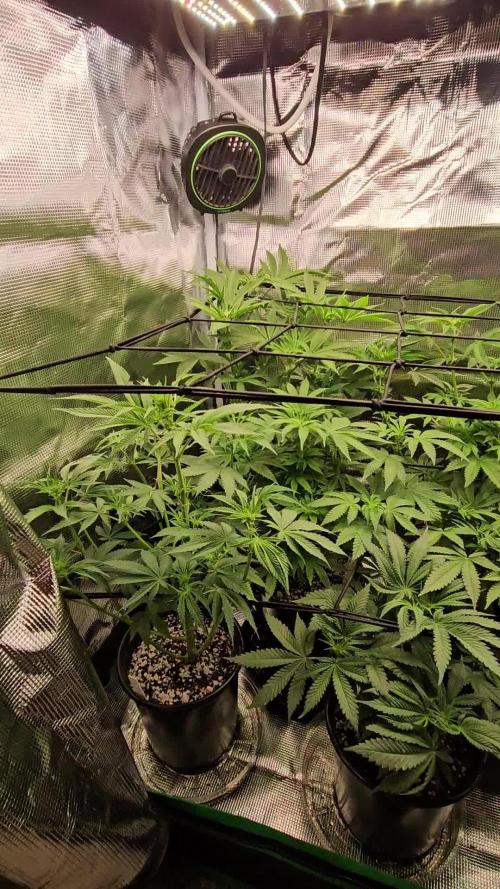
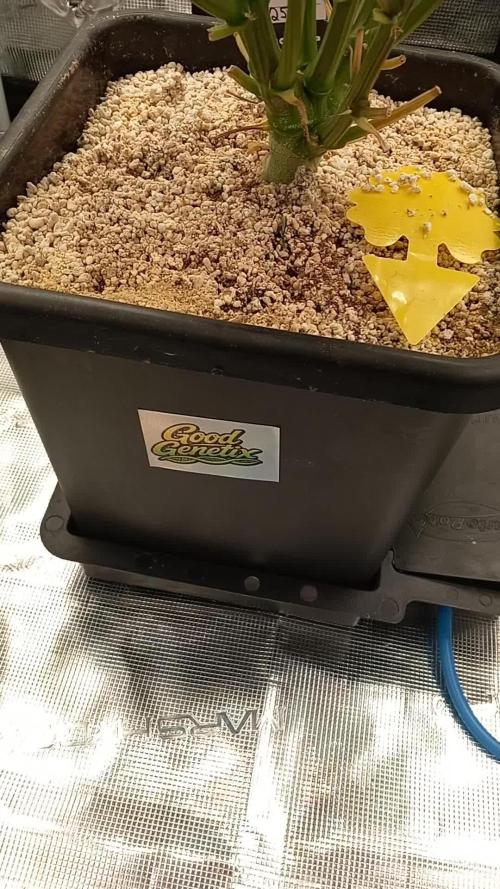
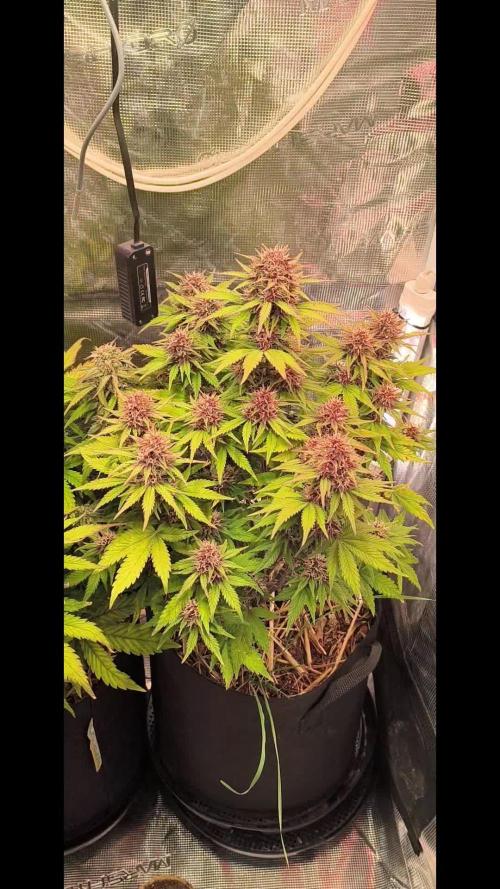
Welcome to my MilkyWay F1 Topped/Untopped Diary sponsored by RQS. Topped/Untopped Phenos 1/2 Pre Flower Days 12-15, Flower Days 1-4 Days 57-64. Plants are quick. Didn't put on much height during pre flower. 43 cm for the Topped (pheno 2), and 41 for untopped (pheno 1). The pistils surprisingly are 50/50 amber/white. They're in the fattening stage only a few days. I've added co2 for 12hrs and then they are going under my P1000 for 6hrs. Hoping to see some big buds. They are moving quickly. So, let's see. I've added a 13-14 PK booster from plagron with a few of their other products. With the 12hrs of extra heat and co2, they'll be needing a lot more nutrition. Diet/Defoliation/Temperature Was on a Full Plagron natural line and a few of their other products, and I've added a 13/14 PK booster, with fish force and a few others. I done a 10-15% defoliation removing many fan leafs, focusing on the middle to allow better airflow was done after pre flower. And more will be done coming into her next week "10" and light lollipoppoing at the end to clear any possible larf areas was done this wk. So, what's therenow will be brought to harvest, a lot is very far away, so I need to get a blue HID I think to control tight Inter nodes in veg, I'll do this as I gain more experience. 28-29c is maintained for the co2 addition and under the P1000 the temp is brought back down to 26c with no additional co2. And ppfd is lowered to 850 ppfd but its a deep penetrative led light I'll give it that. Actually it carries the highest ppfd into your canopy than any 100w out there, and this is the 2021 version. They've an upgrade. Much respect to Vipar, this light and the Spiderfarmer have been my veg lights the past Yr, and this yr I've used these both and they've produced some quality bud. The cbg is done fully under them and the plant is amazing. Diet, Shes on the Full Plagron Natural line, soil and all. "Pro mix" with mega worms to add later. With PK, green sensation, fish force, power roots, vita race, "dummies sent me 2x of these instead of Start" Silic Rock, Pure Zym Sugar Royal. And Terpinator. "Power Roots has been pult, its time recommended by plagron. The roots are plenty and they drink close to 1L of fluids a day. Normally I don't like given so much stuff. But all are different, (expect Terpinator and SR they've the same purpose but its only 1 feed of the Terpinator a wk, by itself 370ppm 6.1ph 15.5c temp.. Co2 Co2 is maintained at 1000-1300ppm for 12hrs. And then when they go back under my p1000 they get ambient co2 levels 675ppm. The co2 is been ate at 350ppm every hr. Mind you most of these girls aren't hitting a high ppfd that's needed to convert into sugars. I've shuffled my 3 fans. 2 fans 1 on the top left blowing above canopy and 1 on the other side. A small one is at the bottom that keeps the heavy co2 off the ground. And my moving my fans, the co2 went from 1000 to 1300 shows, right air-flow is paramount. Thankfully I've a sensor that reads every second and is so sensitive it allows you to move your fans and shows how much longer co2 lasts if kept at an level with the foliage.. WARNING: Co2, is no joke. You can die from inproper use. I fully advise if anything you get a top sensor at least to known your levels and then you can jerry rig whatever. If not using a full kit. I highly urge to have it only in use while you're there to monitor it. No way should it be left on. As co2 is heavy it'll flow down your stairs and your beloved pets will be the 1st to suffer. It doesn't take a lot of gas even from a 1L bottle to fill a 12x12M room to 500ppm.. mine does 3x1L bursts every hr at 0.00001L a burst. Thanks to my rep James's for the seeds & merch. The rolling tray is constant use. My bird sings its praises. The grinder, possibly the best out for grinding. Goes through wet bud like dry. It grinds it that well. When I'm trying the get a small of her tetpine profile. COUPONS Spider-Farmer "ggst" EU (for now) 3% Mars-Hydro "ggs" WW 3% Zamneisa "GROWITGD" 20%
Likes
36
Share
Freaky se porte bien pour l’instant, elle n’a pas l’air d’attirer les limaces. Je vais commencer à l’alimenter en thé de compost oxygéné pour la booster un petit peu
Likes
25
Share
ANTHOCYANIN production is primarily controlled by the Cryptochrome (CR1) Photoreceptor ( !! UV and Blue Spectrums are primary drivers in the production of the pigment that replaces chlorophyll, isn't that awesome! 1. Diverse photoreceptors in plants Many civilizations, including the sun god of ancient Egypt, thought that the blessings of sunlight were the source of life. In fact, the survival of all life, including humans, is supported by the photosynthesis of plants that capture solar energy. Plants that perform photosynthesis have no means of transportation except for some algae. Therefore, it is necessary to monitor various changes in the external environment and respond appropriately to the place to survive. Among various environmental information, light is especially important information for plants that perform photosynthesis. In the process of evolution, plants acquired phytochrome, which mainly receives light in the red light region, and multiple blue light receptors, including his hytropin and phototropin, in order to sense the light environment. .. In addition to these, an ultraviolet light receptor named UVR8 was recently discovered. The latest image of the molecular structure and function of these various plant photoreceptors (Fig. 1), focusing on phytochrome and phototropin. Figure 1 Ultraviolet-visible absorption spectra of phytochrome, cryptochrome, phototropin, and UVR8. The dashed line represents each bioactive absorption spectrum. 2. Phytochrome; red-far red photoreversible molecular switch What is phytochrome? Phytochrome is a photochromic photoreceptor, and has two absorption types, a red light absorption type Pr (absorption maximum wavelength of about 665 nm) and a far-red light absorption type Pfr (730 nm). Reversible light conversion between the two by red light and far-red light, respectively(Fig. 1A, solid line and broken line). In general, Pfr is the active form that causes a physiological response. With some exceptions, phytochrome can be said to function as a photoreversible molecular switch. The background of the discovery is as follows. There are some types of plants that require light for germination (light seed germination). From that study, it was found that germination was induced by red light, the effect was inhibited by subsequent far-red light irradiation, and this could be repeated, and the existence of photoreceptors that reversibly photoconvert was predicted. In 1959, its existence was confirmed by the absorption spectrum measurement of the yellow sprout tissue, and it was named phytochrome. Why does the plant have a sensor to distinguish between such red light and far-red light? There is no big difference between the red and far-red light regions in the open-field spectrum of sunlight, but the proportion of red light is greatly reduced due to the absorption of chloroplasts in the shade of plants. Similar changes in light quality occur in the evening sunlight. Plants perceive this difference in light quality as the ratio of Pr and Pfr, recognize the light environment, and respond to it. Subsequent studies have revealed that it is responsible for various photomorphogenic reactions such as photoperiodic flowering induction, shade repellent, and deyellowing (greening). Furthermore, with the introduction of the model plant Arabidopsis thaliana (At) and the development of molecular biological analysis methods, research has progressed dramatically, and his five types of phytochromes (phyA-E) are present in Arabidopsis thaliana. all right. With the progress of the genome project, Fi’s tochrome-like photoreceptors were found in cyanobacteria, a photosynthetic prokaryotes other than plants. Furthermore, in non-photosynthetic bacteria, a homologue molecule called bacteriophytochrome photoreceptor (BphP) was found in Pseudomonas aeruginosa (Pa) and radiation-resistant bacteria (Deinococcus radiodurans, Dr). Domain structure of phytochrome molecule Phytochrome molecule can be roughly divided into N-terminal side and C-terminal side region. PAS (Per / Arndt / Sim: blue), GAF (cGMP phosphodiesterase / adenylyl cyclase / FhlA: green), PHY (phyto-chrome: purple) 3 in the N-terminal region of plant phytochrome (Fig. 2A) There are two domains and an N-terminal extension region (NTE: dark blue), and phytochromobilin (PΦB), which is one of the ring-opening tetrapyrroles, is thioether-bonded to the system stored in GAF as a chromophore. ing. PAS is a domain involved in the interaction between signal transduction-related proteins, and PHY is a phytochrome-specific domain. There are two PASs and her histidine kinase-related (HKR) domain (red) in the C-terminal region, but the histidine essential for kinase activity is not conserved. 3. Phototropin; photosynthetic efficiency optimized blue light receptor What is phototropin? Charles Darwin, who is famous for his theory of evolution, wrote in his book “The power of move-ment in plants” published in 1882 that plants bend toward blue light. Approximately 100 years later, the protein nph1 (nonphoto-tropic hypocotyl 1) encoded by one of the causative genes of Arabidopsis mutants causing phototropic abnormalities was identified as a blue photoreceptor. Later, another isotype npl1 was found and renamed phototropin 1 (phot1) and 2 (phot2), respectively. In addition to phototropism, phototropin is damaged by chloroplast photolocalization (chloroplasts move through the epidermal cells of the leaves and gather on the cell surface under appropriate light intensity for photosynthesis. As a photoreceptor for reactions such as escaping to the side of cells under dangerous strong light) and stomata (reactions that open stomata to optimize the uptake of carbon dioxide, which is the rate-determining process of photosynthetic reactions). It became clear that it worked. In this way, phototropin can be said to be a blue light receptor responsible for optimizing photosynthetic efficiency. Domain structure and LOV photoreaction of phototropin molecule Phototropin molecule has two photoreceptive domains (LOV1 and LOV2) called LOV (Light-Oxygen-Voltage sensing) on the N-terminal side, and serine / on the C-terminal side. It is a protein kinase that forms threonine kinase (STK) (Fig. 4Aa) and whose activity is regulated by light. LOV is one molecule as a chromophore, he binds FMN (flavin mononucleotide) non-covalently. The LOV forms an α/βfold, and the FMN is located on a β-sheet consisting of five antiparallel β-strands (Fig. 4B). The FMN in the ground state LOV shows the absorption spectrum of a typical oxidized flavin protein with a triplet oscillation structure and an absorption maximum wavelength of 450 nm, and is called D450 (Fig. 1C and Fig. 4E). After being excited to the singlet excited state by blue light, the FMN shifts to the triplet excited state (L660t *) due to intersystem crossing, and then the C4 (Fig. 4C) of the isoaroxazine ring of the FMN is conserved in the vicinity. It forms a transient accretionary prism with the tain (red part in Fig. 4B Eα) (S390I). When this cysteine is replaced with alanine (C / A substitution), the addition reaction does not occur. The effect of adduct formation propagates to the protein moiety, causing kinase activation (S390II). After that, the formed cysteine-flavin adduct spontaneously dissociates and returns to the original D450 (Fig. 4E, dark regression reaction). Phototropin kinase activity control mechanism by LOV2 Why does phototropin have two LOVs? Atphot1 was found as a protein that is rapidly autophosphorylated when irradiated with blue light. The effect of the above C / A substitution on this self-phosphorylation reaction and phototropism was investigated, and LOV2 is the main photomolecular switch in both self-phosphorylation and phototropism. It turns out that it functions as. After that, from experiments using artificial substrates, STK has a constitutive activity, LOV2 functions as an inhibitory domain of this activity, and the inhibition is eliminated by photoreaction, while LOV1 is kinase light. It was shown to modify the photosensitivity of the activation reaction. In addition to this, LOV1 was found to act as a dimerization site from the crystal structure and his SAXS. What kind of molecular mechanism does LOV2 use to photoregulate kinase activity? The following two modules play important roles in this intramolecular signal transduction. Figure 4 (A) Domain structure of LOV photoreceptors. a: Phototropin b: Neochrome c: FKF1 family protein d: Aureochrome (B) Crystal structure of auto barley phot1 LOV2. (C) Structure of FMN isoaroxazine ring. (D) Schematic diagram of the functional domain and module of Arabidopsis thaliana phot1. L, A’α, and Jα represent linker, A’α helix, and Jα helix, respectively. (E) LOV photoreaction. (F) Molecular structure model (mesh) of the LOV2-STK sample (black line) containing A’α of phot2 obtained based on SAXS under dark (top) and under bright (bottom). The yellow, red, and green space-filled models represent the crystal structures of LOV2-Jα, protein kinase A N-lobe, and C-robe, respectively, and black represents FMN. See the text for details. 1) Jα. LOV2 C of oat phot1-to α immediately after the terminus Rix (Jα) is present (Fig. 4D), which interacts with the β-sheet (Fig. 4B) that forms the FMN-bound scaffold of LOV2 in the dark, but unfolds and dissociates from the β-sheet with photoreaction. It was shown by NMR that it does. According to the crystal structure of LOV2-Jα, this Jα is located on the back surface of the β sheet and mainly has a hydrophobic interaction. The formation of S390II causes twisting of the isoaroxazine ring and protonation of N5 (Fig. 4C). As a result, the glutamine side chain present on his Iβ strand (Fig. 4B) in the β-sheet rotates to form a hydrogen bond with this protonated N5. Jα interacts with this his Iβ strand, and these changes are thought to cause the unfold-ing of Jα and dissociation from the β-sheet described above. Experiments such as amino acid substitution of Iβ strands revealed that kinases exhibit constitutive activity when this interaction is eliminated, and that Jα plays an important role in photoactivation of kinases. 2) A’α / Aβ gap. Recently, several results have been reported showing the involvement of amino acids near the A’α helix (Fig. 4D) located upstream of the N-terminal of LOV2 in kinase photoactivation. Therefore, he investigated the role of this A’α and its neighboring amino acids in kinase photoactivation, photoreaction, and Jα structural change for Atphot1. The LOV2-STK polypeptide (Fig. 4D, underlined in black) was used as a photocontrollable kinase for kinase activity analysis. As a result, it was found that the photoactivation of the kinase was abolished when amino acid substitution was introduced into the A’α / Aβ gap between A’α and Aβ of the LOV2 core. Interestingly, he had no effect on the structural changes in Jα examined on the peptide map due to the photoreaction of LOV2 or trypsin degradation. Therefore, the A’α / Aβ gap is considered to play an important role in intramolecular signal transduction after Jα. Structural changes detected by SAXS Structural changes of Jα have been detected by various biophysical methods other than NMR, but structural information on samples including up to STK is reported only by his results to his SAXS. Not. The SAXS measurement of the Atphot2 LOV2-STK polypeptide showed that the radius of inertia increased from 32.4 Å to 34.8 Å, and the molecular model (Fig. 4F) obtained by the ab initio modeling software GASBOR is that of LOV2 and STK. It was shown that the N lobes and C lobes lined up in tandem, and the relative position of LOV2 with respect to STK shifted by about 13 Å under light irradiation. The difference in the molecular model between the two is considered to reflect the structural changes that occur in the Jα and A’α / Aβ gaps mentioned above. Two phototropins with different photosensitivity In the phototropic reaction of Arabidopsis Arabidopsis, Arabidopsis responds to a very wide range of light intensities from 10–4 to 102 μmol photon / sec / m2. At that time, phot1 functions as an optical sensor in a wide range from low light to strong light, while phot2 reacts with light stronger than 1 μmol photon / sec / m2. What is the origin of these differences? As is well known, animal photoreceptors have a high photosensitivity due to the abundance of rhodopsin and the presence of biochemical amplification mechanisms. The exact abundance of phot1 and phot2 in vivo is unknown, but interesting results have been obtained in terms of amplification. The light intensity dependence of the photoactivation of the LOV2-STK polypeptide used in the above kinase analysis was investigated. It was found that phot1 was about 10 times more photosensitive than phot2. On the other hand, when the photochemical reactions of both were examined, it was found that the rate of the dark return reaction of phot1 was about 10 times slower than that of phot2. This result indicates that the longer the lifetime of S390II, which is in the kinase-activated state, the higher the photosensitivity of kinase activation. This correlation was further confirmed by extending the lifespan of her S390II with amino acid substitutions. This alone cannot explain the widespread differences in photosensitivity between phot1 and phot2, but it may explain some of them. Furthermore, it is necessary to investigate in detail protein modifications such as phosphorylation and the effects of phot interacting factors on photosensitivity. Other LOV photoreceptors Among fern plants and green algae, phytochrome ɾphotosensory module (PSM) on the N-terminal side and chimera photoreceptor with full-length phototropin on the C-terminal side, neochrome (Fig. There are types with 4Ab). It has been reported that some neochromes play a role in chloroplast photolocalization as a red light receiver. It is considered that fern plants have such a chimera photoreceptor in order to survive in a habitat such as undergrowth in a jungle where only red light reaches. In addition to this, plants have only one LOV domain, and three proteins involved in the degradation of photomorphogenesis-related proteins, FKF1 (Flavin-binding, Kelch repeat, F-box 1, ZTL (ZEITLUPE)), LKP2 ( There are LOV Kelch Protein2) (Fig. 4Ac) and aureochrome (Fig. 4Ad), which has a bZip domain on the N-terminal side of LOV and functions as a gene transcription factor. 4. Cryptochrome and UVR8 Cryptochrome is one of the blue photoreceptors and forms a superfamily with the DNA photoreceptor photolyase. It has FAD (flavin adenine dinucle-otide) as a chromophore and tetrahydrofolic acid, which is a condensing pigment. The ground state of FAD is considered to be the oxidized type, and the radical type (broken line in Fig. 1B) generated by blue light irradiation is considered to be the signaling state. The radical type also absorbs in the green to orange light region, and may widen the wavelength region of the plant morphogenesis reaction spectrum. Cryptochrome uses blue light to control physiological functions similar to phytochrome. It was identified as a photoreceptor from one of the causative genes of UVR8 Arabidopsis thaliana, and the chromophore is absorbed in the UVB region by a Trp triad consisting of three tryptophans (Fig. 1D). It is involved in the biosynthesis of flavonoids and anthocyanins that function as UV scavengers in plants. Conclusion It is thought that plants have acquired various photoreceptors necessary for their survival during a long evolutionary process. The photoreceptors that cover the existing far-red light to UVB mentioned here are considered to be some of them. More and more diverse photoreceptor genes are conserved in cyanobacteria and marine plankton. By examining these, it is thought that the understanding of plant photoreceptors will be further deepened.
Likes
54
Share
@valiotoro
Follow
Once again GALACTIC buds! And once again cant add the comment lol
Likes
8
Share
@HighKing
Follow
I dried them for 9 days and now they are in jars with bovedas ready to cure for 1 month. Very strong and sticky weed. I love it ! Another great thing : they are not hard to grow. Make sure you wont train them too much and they will be fine. Big and strong plants.
Likes
50
Share
@Rwein93
Follow
Ciao ragazzi e bentornati da me per una nuova pagina di questo diario!😉 Che dire ragazzi tutte le sorelle sono fantastiche.😍 La numero 1 è il capo famiglia, davvero imponente. La numero 2 ha staccato le altre di 5 cm, ora è lei la più alta con i suoi 155 cm. La numero 3 invece ha i buds già bellissimi. Nel complesso crescono bene e forti con una distanza intermodale marcata che le fanno respirare bene. Ora le fragoline misurano circa 1 cm di diametro e quelle della numero 3 misurano circa 1.5 cm💪 L odore inizia a marcare i suoi aromi, pungenti note di mapo (Citrus × tangelo) si mischiano a leggeri sentori di gasolio.😋 Ho defogliato loro nel giorno 67 e ho allargato tutti le apicale dalla pianta 1 con Lst, i nuts rimangono invariati.👍 Eh niente! Anche per questa settimana è tutto ragazzi. Grazie a tutti per aver guardato e restate sintonizzati per nuovi aggiornamenti.🙏 Buona settimana e felice crescita 🌱 🌱 🌱
Likes
5
Share
@Xpie77
Follow
Verslag Derde Week Bloei: Seriotica Deze week bevind ik mij in de derde week van de bloeifase van mijn Seriotica-planten. Het is een cruciale periode waarin de ontwikkeling van de toppen duidelijk zichtbaar begint te worden. Hieronder beschrijf ik mijn observaties en acties. 1. Groei en Ontwikkeling De toppen zijn deze week flink toegenomen in omvang. De haren beginnen een melkachtige kleur te krijgen, en de harsproductie neemt zichtbaar toe. Bij aanraking ruik ik een intens aroma, wat een goed teken is voor de kwaliteit. 2. Verzorging Ik heb extra aandacht besteed aan: Voeding: Een aangepaste voedingsmix met extra fosfor en kalium om de bloei te ondersteunen. Ik heb de EC-waarde stabiel gehouden rond [waarde] en de pH gecontroleerd op [waarde]. Watergift: Dit heb ik aangepast aan de verhoogde behoefte door de groei van de toppen. Ik geef elke dag [hoeveelheid] ml water per plant. Lichtcyclus: De lichtintensiteit is stabiel op [waarde] gehouden, en de lichtcyclus blijft 12 uur aan en 12 uur uit. 3. Klimaat Het klimaat in de kweekruimte is stabiel gebleven: Temperatuur: Overdag rond de 24-26°C en 's nachts 18-20°C. Luchtvochtigheid: Ik heb de luchtvochtigheid verlaagd naar [waarde]%, om schimmelvorming te voorkomen. 4. Uitdagingen Ik merkte deze week een lichte verkleuring op enkele bladeren. Dit duidde op een mogelijk tekort aan magnesium. Ik heb onmiddellijk ingegrepen door [oplossing, zoals toevoegen van CalMag] toe te voegen aan de voedingsoplossing. 5. Verwachtingen Als alles volgens plan verloopt, verwacht ik dat de toppen de komende week nog verder zullen zwellen en dat de harsproductie verder toeneemt. Ik blijf alert op tekenen van stress of tekorten. --- Reflectie Deze week voelde ik me zelfverzekerd over de verzorging van mijn planten. Door consistent te monitoren en kleine aanpassingen te doen, heb ik het gevoel dat ik de planten optimaal kan ondersteunen. Ik kijk uit naar de verdere ontwikkeling! --- Als je specifieke details wilt toevoegen, zoals exacte voedingswaarden of observaties, laat het me weten!
Likes
29
Share
Hi guys So here is my 10 plant auto run from fastbuds 420 genetics. I will update weekly on this one. So I'm going to be using 3 gal fabric pots filled with biobizz lightmix soil. I will be putting into solo cups after the 18 hour soak then transferring them to there for ever pots. Im looking forward to this run and trying to get 20oz + dry and cured out of this 4x4 tent grow. Part 2 of germination in operation in solo cups with root juice. Hopefully 10 out of 10 pop.
Likes
51
Share
Well, it was my first diary here, and I'm really happy to had found this amazing community that is so eager to help! It gave me the opportunity to win the first giveaway in my life 😂 And it was from RQS! These seeds are in my new grow diary, and I really thankful for all the gift received! A special thank to Pol from the RQS staff! A special thanks to everyone who watched me grow here, and I hope to contribute with the community more and more!
Likes
19
Share
Likes
28
Share
@FarmZOG
Follow
Week 7 Day 42 our VPD is getting higher day to day, we in the 1.2 - 1.4 range hard week of defoliation this past week and its not over Day49 we had good development but we still fighting environmental conditions all over the place We need environment concistency and we're not getting it 💚
Likes
25
Share
@KivzBudz
Follow
In the end I’m very happy how this first Grow went. Tomorrow I’m gonna finish the other half and update some pictures. Curing begins now, can’t wait to smell and taste the full cured terpens! 😋🌱
Likes
4
Share
Ya esta recuperada de la carencia, le he hecho un riego foliar con Vita Race que le a sentado bastante bien y la planta se le ve mucho mas saludable
Likes
76
Share
@Natrona
Follow
Special thanks to @DreamIT for showing me how to add music and animation to video. Check out my fountain video above for a short clip. Thanks to @UnorthadoxDude for influencing me ( by visual curiosity) maybe twisted an arm to buy some carnivors. Well I happened to find some at our annual master gardener plant sale. I will be putting some in the tent. Lots of growth in my carnivores. Flowers on Sundew.
Likes
29
Share
Day 29: No defoliation today. Giving the plant a rest after accidentally breaking the branch yesterday. Watered with nutrients (1ml G, 1ml SR). Took just under 3ltrs including run off. Day 30: Removed 3 of the original fan leaves attached to the main stem. There’s 2 left still to be removed. It seems all of a sudden the bud sites are staring to look like flowers. It doesn’t look like there’s not many bud sites. There’s also not a lot of leaves, it’s not what I would call a bushy plant (yet anyway). This suits me, well it does if the yield is good. Day 31: Watered with nutrients (1ml G, 1ml SR). Took around 3ltrs. I clipped off one more of the original big fan leaves so now there’s only one left. I also pulled in the two branches furthest to the right, bracing them off each other. Day 32: I don’t think worried is the correct word, but I am definitely conscious of the fact that this plant leaves are small and sparse (photos attached), it I’m used to battling plants that have too many leaves. There’s only 7 proper bud sites which at the moment look like they will be small. Branches are also very skinny. All this could be because of the strain itself or it could be due to the fact that the bulb I used from weeks 1 to 4 was only 125watt CFL compared to the 200watt CFL which I have always used. That’s the only difference between this and any other plant I have grown. The flowers are very well formed considering it’s not even 5 weeks old yet. Sure all we can do now is just see how it goes. Day 33: Just continued to use the Force to make the plant grow. Removed the the last two original fan leaves. *Due to commitments in the real world this week will only be five days long. Next week will be 9 days long to balance everything out.