


Likes
Comments
Share


@ROY4L_GU4RD
Follow
Branches couldn't manage the weight so everything caved in like dominoes smh. I decided to chop on rainbow cake to help with air flow. Humidity is at 45 degrees steadily but im not risking mold or mildew this late in the grow. I added Ripen to the nutrient regimen at 5ml per gallon.


Likes
3
Share


@Bluedreaming
Follow
Lkve this strain and will revist in the future. What can you ask for in a strain??? Strap in for a quick bloom. 54 days and ready to chop!!!! She can handel a good shot of nutes and can handle fluctuations in ppm well. Week 3 is always a fun week as the floweres swell at an incredible rate and seem to eat the stem they are attached to. Great strain fun fast grow. Oh and forgot to mention how fast the clones take root, 5-7 days "wow"
Thanks for checking out my grow, hope you have success and best wishes growing forward!!! ✌️

Likes
17
Share


@greennug
Follow
Plant are doing great smells are coming out amazing and bud are tightening and growing rapidly. Daily uploads until harvest.


Likes
11
Share


Likes
44
Share


@SooSan
Follow
13 jours de 12/12
OK il y a du changement !
Dans la partie du scrog vertical le stretch n’a pas été assez fort
J'ai donc abandonné la culture verticale pour cette fois
J'ai donc fusionné le bas de la tente pour avoir un espace de 90x60x90
Le ts1000 a été retiré pour laisser la place aux barres du FC-E 4800
Et bien sur gros LST pour gagner en surface et gagner 20 à 30cm de hauteur
Vu qu’il y a 16 plantes mais que sur growdiaries on ne peut mettre que 8 variétés j'ai divisé en 2 diaries pour le bas de la tente
1️⃣
🏠 90x60x90
☀️ FC-E 4800 => puissance a 20%
🍁
1x Black Bomb / Philosopher Seed
2x Amnesia Lemon / PEV Seeds
1x Blueberry / PEV Seeds
1x Blueberry / 00 Seeds
1x Wappa / Paradise Seed
1x Dark Phoenix / Green House Seed
1x Quick Sherbet / Exotic Seeds
1x Mango Cream / Exotic Seeds
1x Banana Frosting / Sensi Seed
1x Hindu Kush / Sensi Seed
4x Fast Mix / Sweet Seed
📎 https://growdiaries.com/diaries/122084-grow-journal-by-soosan
📎https://growdiaries.com/diaries/124052-grow-journal-by-soosan
2️⃣
🏠 30x60x50
☀️TS1000 => puissance a 50%
🍁 4x Quick Sherbet - Exotic Seed
📎 https://growdiaries.com/diaries/122080-grow-journal-by-soosan


Likes
10
Share


@sunshinegroww
Follow
Here we go in partnership with Zamnesia and Plagron so far good start ,dont have time to enter the competition so im thinking i will mainline this one

Likes
16
Share


@danwho
Follow
2/8 (day 43 flower)
Full drain and fill today. Replaced CO2 as well. Plants are maturing at different speeds so harvest will be interesting to say the least. After seeing the stress nanners from late last week, I decided to leave the nutriemts at a slightly elevated level until closer to the end of week 7. Top off nutrients are right around 450ppm.
2/9 (day 44 flower)
Had to support one branch with a wooden dowel on the back left plant. The buds on that plant are getting so large and heavy. It is making the branches lean over other colas and block the light. This is why I decided to support it slightly, but I think the branches could support more before truly snapping - just not interested in pushing the limits and obscuring other buds.
2/12 (day 47 flower)
Adding supports where needed for heavy colas that are toppling over. Trying to keep the canopy from falling over and creating humidity concerns during these last few days of flower. Buds are nice and dense covered in trichomes! Reservoir PPM is very stable along with pH - a nice change from last grow where my pH was swinging wildly.
2/14 (day 49 flower)
PPM of the reservoir is rising when checking in the evening (650ppm), indicating it is no longer up taking nutrients at the same rate - time to begin the flush. Full drain and fill of the reservoir during the evening, 350ppm, 6.1 pH after drain and fill. Top off water will be strictly pH adjusted and hydro guard.
Buds are getting heavy, so working to manage the weight and stability of the canopy. As seen by the extra strings and dowel rods showing up as the week progressed.

Likes
6
Share

@SzkolaZiola
Follow
Day 60 of 12/12
HARVEST TIME
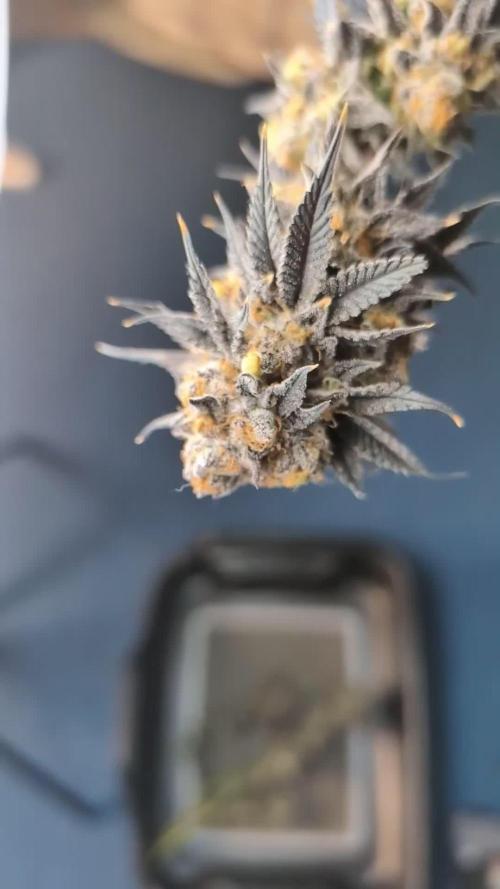
They are soooo fine I barely have words.
Weak-neck gland trait is a fact. I was collecting FRESH, "WET" (non-dried) flowers for Fresh Frozen - the amount of trichome heads just breaking off during that process was astounding. Air was full of trichome heads every time I touched a branch or a bud.
I repeat - it was non-dried flowers, straight from a branch, from alive, watered plant - and I collected a few grams of loose heads in my TrimBin. Crazy stuff. I also pressed it and I got top-shelf rosin - without dryiyng and sieving or bubble ice wash. Mind blown 🤯
8 plants
60 days (8.5 weeks) of flowering under 12/12
4x4 ft tent
466W Mars Hydro light
= 2166g
of Whole Plant Fresh Frozen material (just trimmed buds + some trichome-covered leaves)
Now floweres are in deep freeze -36°C waiting to be washed for bubble hash and pressed into live rosin in the near future.
Likes
19
Share


@Lazuli
Follow
The grow took 13 weeks and 3 days total, all my blue dream got harvested between 12-14 weeks, thats really good with the yield that comes of them
Likes
50
Share


@Hou_Stone
Follow
5th week I continue the defoliation for my 3 Noris Cakes. And I missed the cut on one them 😱, but she is slowly recovering...🙌
🌗Switching to flowering this week, I reduced the length of the day by 1 hour each day until reaching 12 hours night time / 12 hours daylight on the 33rd day!🌞
🌺On the 33rd day I apply a layer of organic nutrients mixed with a little soil that I add to the top of each pot.
I added 35 grams of BioBloom to each of my pots🌺
------------------------------------------------------------
💧Watering
I water all my pots the same day but with more or less water.
Simply by lifting them;
A light pot is a dry pot and will need more water,
A heavy pot is a wet pot and will need less water.
On average I water each pot with:
Day 29 : 0.5 L
Day 33 : 1 L with 0.8 grams of bio enhancer/L
I use tap water, adjust the ph to around 6 and water
------------------------------------------------------------
🔥❄️Temperature of the week :
Day : 19-23°C (Humidity : 65-80%)
Night : 14-17°C (Humidity : 75-85%)
Outside the tent it is around 16°C with 70% humidity
The humidity is a little too high, I hope it will drop a little and I won't have a problem with mold during flowering😅🤞
------------------------------------------------------------
🚀Equipment of the week ⭐️ :
Light FC3000 Mars hydro. power 95% at 50cm
Extractor 6 inch Mars Hydro. power 1/10. ON 24/24h
2 fans to circulate the air inside the tent. Each on for 30 minutes then off for 1 hour. this rhythm repeats itself in a loop
I'm removing my heat mat this week.
------------------------------------------------------------
📜Links :
Nori Cake seeds 🌱 :
https://shop.greenhouseseeds.nl/feminised-cannabis-seeds/nori-cake/
Mars Hydro : 5% off with my discount code "houstone5" 💪
https://www.mars-hydro.com/?acc=hou-stone
👨🚀My Instagram❤️️:
https://www.instagram.com/hou_stone420/
------------------------------------------------------------
Tanks for your visit😀💚

Likes
6
Share


@Jrae420
Follow
All is well. Continue to defoliate. But I’m slacking lol. Will continue to defoliate


Likes
3
Share

@cangrowz
Follow
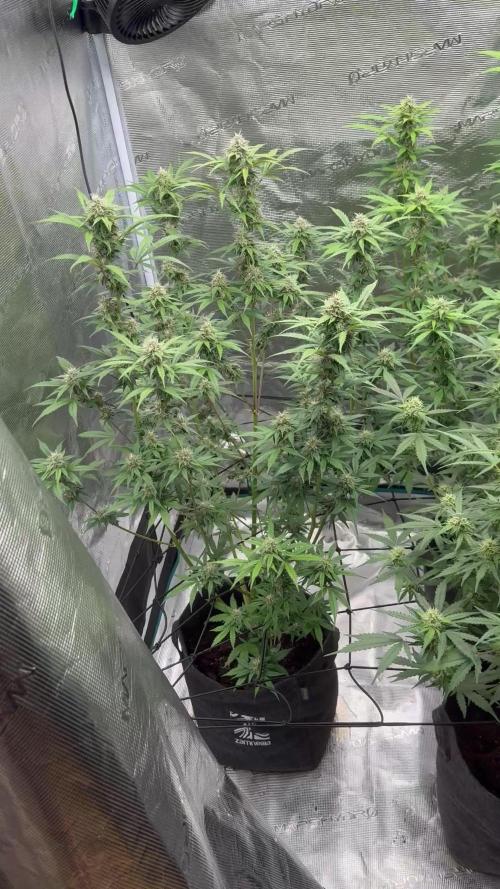
Nur noch eine Woche noch, Ab jetzt nur noch Wasser, Heute das letzte mal gedüngt.

Likes
13
Share

@Bncgrower
Follow
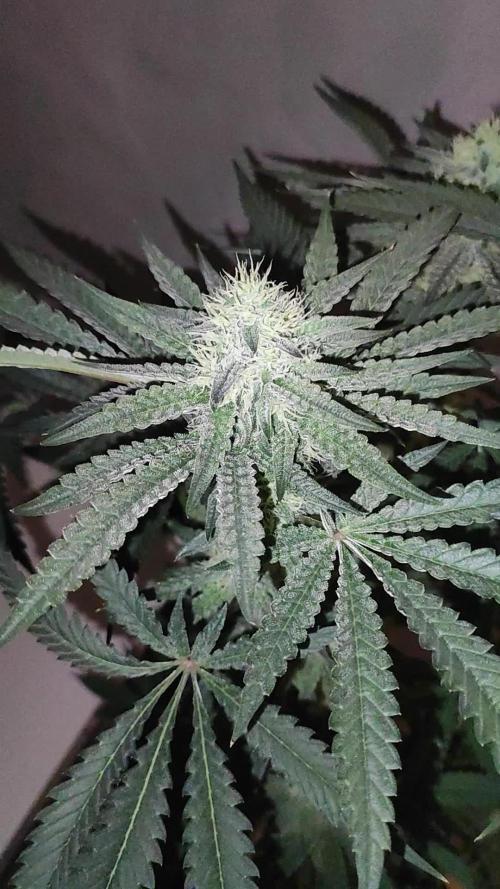
Another week successfully completed... All the plants are developing very well, the flowers are plumping up nicely, and all the plants smell great... Everything is as expected, and now we're closer to the end than before... Happy growing to all! 🌱🌿💪
Likes
3
Share


Likes
24
Share

@Ultraviolet
Follow
The cannabis strain Grape Guava can be a purple strain, depending on its specific phenotype and genetic makeup. While not all phenotypes of Grape Guava are purple, some variations, such as the Zatix Grape Guava, are noted for their striking purple appearance due to the genetic expression of anthocyanin pigments.
In a garden of green, Grape Guava gleams,
With its fruity aroma, enchanting dreams.
Clusters of grapes, guava's sweetness ignite,
A strain so divine, in purple and white.
Euphoria whispers, a lush fruity haze,
Grape Guava's embrace, a tranquil daze.
Off and away.@1400ppm. The increased CO2 allows plants to thrive at higher temperatures, which in turn necessitates higher humidity to maintain the ideal VPD for healthy growth and transpiration. 80F -5F = 75F LST with 70% RH = 0.72 kPa. Higher temperatures and humidity promote rapid growth, nutrient uptake, and photosynthesis while maintaining a lower stress level. Temperature influences the rate of enzymatic reactions involved in aerobic respiration. Enzymes, such as those involved in glycolysis, the Krebs cycle, and the electron transport chain, work most efficiently at an optimal temperature range. In low temperatures, enzymatic activity will slow down, thus reducing the rate of aerobic respiration. In high temperatures, enzymes can become denatured, thus impairing their function and stopping the process of aerobic respiration. Glucose is the primary fuel for aerobic respiration. The rate of aerobic respiration increases with the availability of glucose, as it is the starting point for glycolysis. If glucose levels are low, cells may rely on alternative energy sources such as fatty acids or amino acids , but these processes may yield less ATP or be less efficient. To determine this effect, carbon dioxide volume was measured (as carbon dioxide is an output of aerobic respiration)
A seed germinated via skotomorphogenesis (in the dark) will generally develop faster in its initial stages to reach light, though it will be etiolated (elongated and weak) and will switch to slower, more robust photomorphogenesis (light development) once it emerges into light. While skotomorphogenesis is a rapid, growth-oriented process for soil escape, it's a temporary phase; photomorphogenesis is a more sustainable development program that prepares the seedling for photosynthesis.
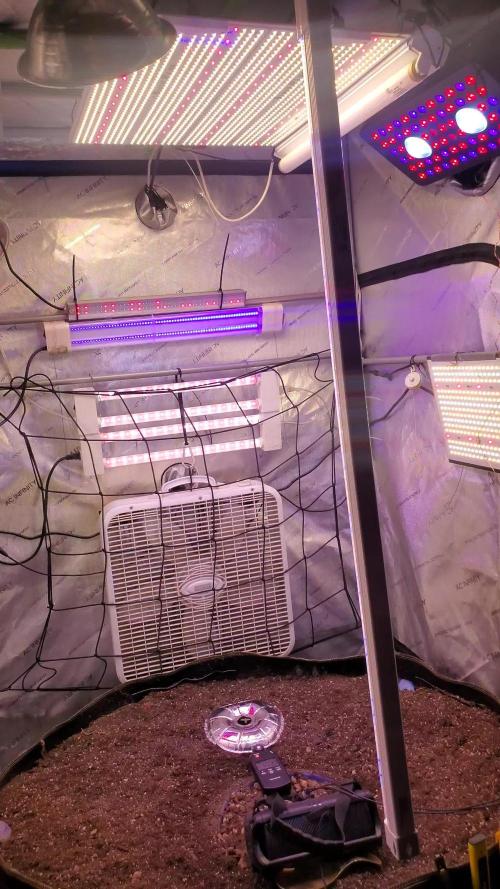
18/6 with the 6 being IR instead of darkness, keeping temps overnight a neat 77F-80F. PPFD overnight 1.8.
Think of my tent as a lung. What goes in must come out. When the rate of air going out exceeds the amount of air coming in, it creates a negative pressure. Tent concaves (bends in). If set up correctly, your RH will begin to drop slowly to the desired level you set, and the extraction turns off when it reaches 50% RH. The plant, as it performs cellular respiration, will always be releasing more water into the air, so the RH% of the tent overnight will always increase, so long as oxidative phosphorylation is occurring. As soon as the RH% creeps back up to 55%, the extraction turns back on, over and over, this creates a strong pressure differential which will work wonders on your grow. replicating high and low pressure fronts in nature, critical for oxygen diffusion, but more importantly, full control of your RH%.
Moisture will not transfer from a saturated atmosphere to another if that air is already at or above its saturation point, meaning the air can't hold any more water vapor. Once I understood that water is produced as a by product during cellular respiration, specifically at the very end of the electron transport chain (ETC) where electrons are finally transferred to molecular oxygen, the higher the RH of the air, the more resistance there is for more moisture to be added to that environment, and effects the ease with which it does so. But none of that water comes from the pot; it's pulled from the air. If you run high daytime RH, your medium/pot is 100% reliant on transpirational root pull to move water. ZERO evaporation happens across the atmosphere if the tent air has high RH%, the medium cannot release its water through evaporation. Once a canopy develops, light no longer slowly wicks and evaporates from the topsoil. The Soil-Plant-Atmosphere Continuum (SPAC) describes the continuous pathway and process of water movement, driven by a gradient in water potential, from the soil, through the plant's roots, stem, and leaves, and finally evaporating into the atmosphere through transpiration. There is evaporation, there is transpiration, then there is evapotranspiration; Evapotranspiration (ET) is the combined total of two processes: evaporation (water lost directly from soil and surface water into the atmosphere) and transpiration (water released from plants to the atmosphere through their leaves). Evapotranspiration represents the total amount of water that moves from the medium into the air. There is no such thing as a medium with too much water, only a medium that retains too much for too long.
The water must always flow efficiently from one atmosphere(Medium) to another(Air) in a timely manner. Moisture is a critical factor for bacterial growth and decay. Dictating how long it's allowed to sit in any one location for any given period is a key preferred control. To ensure a net reduction in a bacterial population, the rate of removal (ET) must exceed the rate of bacterial growth (decay rate), which is often modeled as a growth rate for the specific bacterium under the given conditions. By optimizing daytime VPD, we also optimize conditions for bacterial growth to explode exponentially above 77°F.. If water is allowed to sit in a medium without an escape within a timeframe, nothing good will happen. IF High RH is maintained overnight as well as during the day, placing 100% of water movement at the behest of daytime transpiration, roots can only pull where they can reach, and if soil is compressed above a certain point, moisture will become trapped in a medium with no way of moving day or night. This will begin the countdown for decay to take hold. When water stagnates in a medium, it loses oxygen, creating anaerobic conditions that foster the growth of harmful microorganisms like bacteria and fungi, which can produce toxins and disease vectors.
Thigmomorphogenesis, the process by which plants respond to mechanical stimuli like touch by altering their growth and development, resulting in significant morphological changes to improve survival against mechanical perturbations. This complex response involves sensing touch and initiating physiological and genetic responses, leading to changes in form and structure over days or weeks. The process is triggered by physical forces such as wind, rain, or touch. Plants adapt to these stimuli by changing their shape and structure, which may include slower growth, thickened stems, or altered leaf development. Plants possess sophisticated mechanisms to detect even subtle mechanical stimuli and initiate responses. A variety of molecules, including calcium ions, jasmonates, ethylene, and nitric oxide, are involved in signaling these mechanical inputs. Touch can induce the expression of genes that encode proteins for calcium sensing, cell wall modification, and defense mechanisms. A plant exposed to constant wind may become shorter and sturdier. A plant that is touched frequently might grow slower to conserve energy and develop thicker cell walls. These changes increase a plant's resilience and ability to survive in harsh environments.
Let's get Thiggy with it.


Likes
28
Share


Likes
8
Share


@Sur_cannabico
Follow
Cursamos la segunda semana, aún aplicamos bajas dosis de fertilizantes estas pequeñas van bien hasta ahora
9 días