


Likes
Comments
Share


@TST1313
Follow
Veräuft sehr gut, aber mein Problem ist,das ich nicht genau weiß ,welche Blätter besser noch weg können,und welche Sie benötigt.Bei meinen letzten Grows habe ich zuviel abgeschnitten,und die Pflanzen haben es mir nicht gedankt.Jemand einen Tip.Habe dutzende Tutorials geschaut,aber es ist trotzdem schwer.
P.S so ein Stretch gibt es gar nicht ca 60cm in 3 Wochen gewachsen,glaubt mir Keiner!!!
Habe jetzt ca 30% Blätter abgeschnitten, es werden noch etliche folgen.Am WE wird sie nochmal richtig entlaubt,will sie nicht so stressen!!

Likes
10
Share


@Organic473
Follow
Defoliated all her larger leaves awaiting some
Branches….so far so good.


Likes
26
Share


@420DeepGrow
Follow
Gracias al equipo de Seedsman y XpertNutrients sin ellos esto no sería posible.
💐🍁 Bubba Cheescake:
Bubba Cheesecake es un cruce de Bubba Kush anterior al 98 con Cheese Cake (Wedding Cake x Exodus Cheese). Se trata de un híbrido 70% índica con muy buenos rendimientos, alto en THC y bajo en CBD. Bubba Cheesecake prospera en interiores y exteriores. En interior se aconseja un corto periodo de crecimiento vegetativo debido a la cantidad de estiramiento que presentan las plantas. Las plantas pueden crecer hasta una altura de 250 a 350 cm. cuando se deja crecer naturalmente al aire libre. En interior, la floración dura entre 60 y 65 días, con rendimientos entre buenos y altos, de 400 a 550 gr/m2. Las plantas de exterior son capaces de producir entre 700 - 800 gr. peso seco. En las latitudes norteñas, en exterior, los productores pueden esperar cosechar a principios de octubre. Los cogollos son grandes y duros como piedras. Las plantas maduras muestran atractivos colores púrpuras y azules y brillan con una resina pegajosa que cubrirá las manos del cultivador si no tiene cuidado. El componente Wedding Cake agrega dulzura al sabor del regaliz y el aroma es terroso y musgoso. La producción de THC es muy alta con un nivel bajo de CBD. El efecto es intensamente narcótico, fuerte y duradero.
🌻🚀 Consigue aqui tus semillas:
🍣🍦🌴 Xpert Nutrients es una empresa especializada en la producción y comercialización de fertilizantes líquidos y tierras, que garantizan excelentes cosechas y un crecimiento activo para sus plantas durante todas las fases de cultivo.
Consigue aqui tus Nutrientes:
https://xpertnutrients.com/es/shop/
📆 Semana 11:
Tras una semana de buen tiempo sigue estirando dia tras dia.
Sigo aplicando nutrientes con la dosis recomendada por el fabricante

Likes
Comments
Share

@Blast
Follow
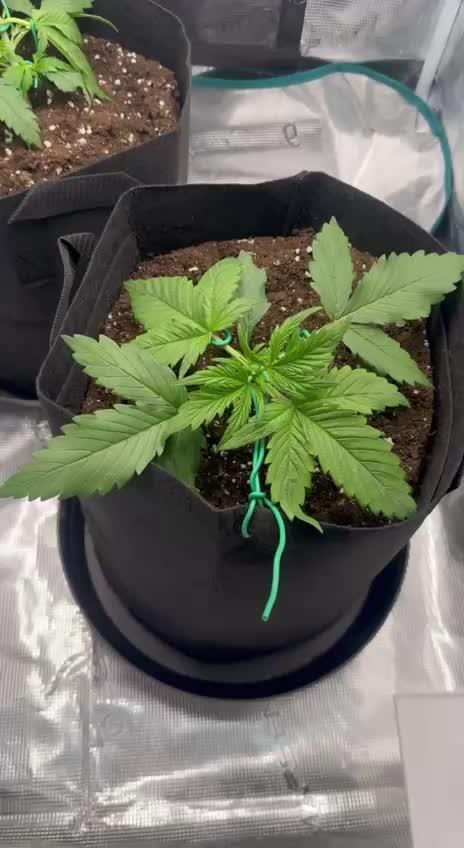
07.02 Попытался делать LST. Главный стебель довольно толстый уже, особо не выгибал. Посмотрю далее на реакцию
12.02 — Проведение LST (с клипсами)

Likes
6
Share


@Santi_nf
Follow
Las mejores de donde sacaré esquejes son por orden cachalote 3,8,7,1,6
Y de las ak 9,8,1,5
Son las mejores de momento .
entra en flora las siguientes variedades en el armario 2skywalker og runtzxl ,1 razubery,1 black toffee ,1panty punch todas autos.
1Scrambler haze,2 critical Windows ,1 hard diesel,1 fast skunk,1tutty Candy todas feminizadas.

Tutti Candy · Zmoothiez

Critical Widow · Pev Seeds

Sweet Skunk Fast Version® · Sweet Seeds
Skywalker OG Runtz XL Auto · Sweet Seeds

Cheese Berry · 00seeds

Hard Diesel · Gea Seeds

Scrambler Haze · Blimburn Seeds
AK · Gea Seeds
Cachalote · Gea Seeds
Gealato Kush · Gea Seeds
Gorilla Glue #4 · Gea Seeds
Somango · Gea Seeds
Likes
6
Share


@Smokeyrobinsonthc
Follow
At the end of week three, I transplanted and topped the plants. I also added CO₂ to maintain levels between 800-1250 ppm to support optimal growth.

Likes
32
Share


@midEastern
Follow
Girls look fresh and healthy..green and vigor.
Almost too big for those pots..last week in those pots and then to 5 gal + some clones to cut and go to flower in the sun.
Got BF Pineapple Chunk seeds shipping right now so will be reported next diary.
Likes
5
Share


@Ghost444
Follow
Hey guys I had to fast forward to the end of her journey. I will post the remainder of the grow weeks later. I ran into some issues a couple weeks into flowering. I was using Tiger Bloom after about four to five weeks of veg. She loved it. Once she went into flowering her second week I introduced Big Bud nutes as well. Once I started using Big Bud she started to show signs that something was off. My water ph was about 6.3-6.4. And I used the minimum amount of nutes according to the directions. I will post pictures of the bad signs. So I flushed her just in case she was locked out or too much nutes. I flushed her with Flawless Finish and pure ph water. I due think this had some impact on her growth during flowering, but I am still excited about her final outcome so far. I have placed her in complete darkness for 48 hrs and will be harvesting her. She turned out very large with nice size buds and colas thanks to LST. Her buds are even more frosty than before the dark period. Also I placed ice at the base of her around her stock. She’s seems to be just a bit more frosty. We’ll see. I will post harvest soon

Likes
4
Share


@Naujas
Follow
the girl looks quite well :) from today I will leave her alone, I hope it won't be too much for her for 6-7 weeks :) I'm going on vacation, so there will be an update, but not soon :) good luck to everyone

Likes
12
Share


@greymane
Follow
These two girls are starting nicely.
Still nursing the third pot.. I’ll update on it later as well.
** Update **
The third girl popped on 9/8. She’s looking healthy as well

Likes
14
Share

@mijk_85
Follow
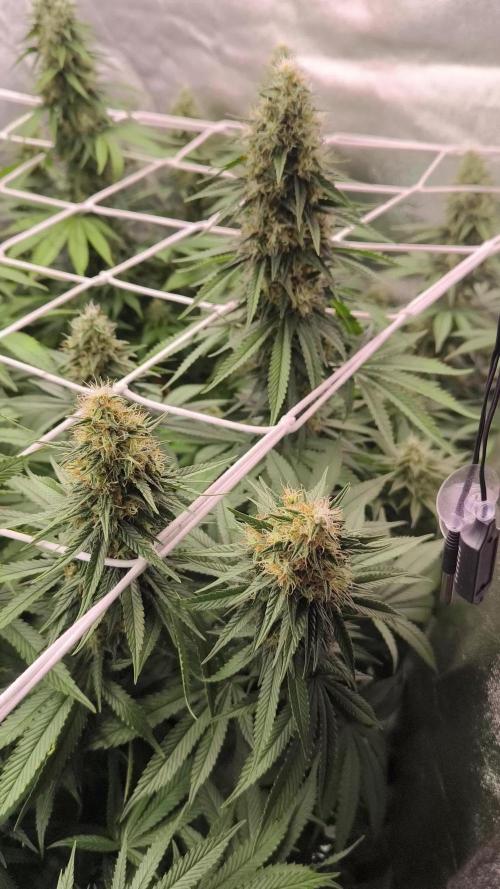
Takže tady máme 45.den květu. Nepatrně nám to nakynulo,takže radost veliká. Jen teda cukru málo. Ale paldy samy o sobě lepí jak blázen. Breeder píše dobu kvetu okolo 8 týdnů (56 dní),ale mám to v plánu držet až někam k 70 dni. Jednak to je standardní postup a jednak mě nutí okolnosti (návrat z dovči). Ať to roste bando 🙂

Likes
11
Share


@Kirsten
Follow
☆♡ Gorilla Cookies: I've noticed a leaf fell off the bottom. I think I may've overdone the nutes.
She's growing tremendously. I top dressed with the below, as the rest of my plants.
I will only use PH'd water for the next several waterings, probably with Biosys or seaweed. ♡☆
16.2.25:
I decided to check out the lower canopies of all plants to see if I need to get rid of any foliage.
I did get rid of a few small branches and leaves.
However, whilst I was doing this, I saw more garden pegs from my LST remaining.
There were about 6 or more in Pink Mist alone. Additionally, on Watermelon, there were some left in, too.
I'm so annoyed to see that because the plants are really stretching, and I could've potentially disrupted this by leaving the pegs in for all this time without realising it.
🤞 that I haven't compromised things too much. We'll see.
I watered today with 2ltrs of dechlorinated water PH'd to 6.3 containing the following nutrients;
♡ .8g Green Leaf Nutrients PK booster
♡ .5g Ecothrive Biosys
I ordered quite a few things for the garden. I got Greenleaf Nutrients Sea K(elp) and Mega Crop Parts A+B. To go with their PK Booster I got last month. I'm excited to try it all together. Next run, maybe just using these. We'll see how it goes.
18.2.25:
The plants are going crazy for water! Everything is getting used right up so fast!
Today, I decided to add some more Black Strap Molasses to add some carbs and other micronutrients. I'll add the jar with the label in the photos section above.
I watered a very small amount to each plant.
What I put in:
♡ Black strap molasses 150g
♡ 2g Sea K(elp) Greenleaf nutrients.
I dissolved everything in 4ltrs of dechlorinated water PH'd to 6.4.
19.2.25:
I received the majority of the garden purchases that I made. I'm still waiting for the Ecothrive Life Cycle. I wanted to top dress, but it's been delayed unfortunately.
I am using my Greenleaf nutrients products which I bought on Amazon. I got the Mega Crop 2 part system Part A and Part B. I have the Sea K(elp), and the bud explosion PK booster.
I really wanted to get some of their sweet candy asking read many positive reviews. Unfortunately, for me, this is unavailable to buy currently. So that's a little disappointing.
I needed to do a good watering so when my nutes were delivered today, I got excited 🤗
I watered 2ltrs of dechlorinated water per plant, PH'd to 6.4, containing the following nutrients:
♡ 1g Mega Crop Part A
♡ 1g Mega Crop Part B
♡ .5g Sea K(elp).
The plants drank this up within a few hours.
I'm going to try and hold off on watering in hopes that my Ecothrive Life Cycle will arrive so I can top dress and water it in then.
20.2.25:
My Ecothrive Life Cycle arrived yesterday, and the plants are ready for their top dress and a good watering in.
I have some Biobizz Light Mix, Canna Coco,and perlite. I'm going to use this as a base to mix my amendments in.
I'm going to fill my 5 gallon bucket with about 4.5 gallons of my top dress mix. I will distribute this across 6, 4-5 gallon pots. Then I will water in well with Greenleaf nutrients Mega Crop Parts A+B and Sea K(elp).
I've made a crude attempt to video mixing my top dress. Don't listen to the audio. lol, my YouTube didn't stop playing whilst I recorded this 😂
So anyway, I added the following amendments to the above base mix of 4.5 gallons;
♡ 3 TBSP Ecothrive Life Cycle
♡ 3 TBSP Vitalink Bat Guano
♡ 3 TBSP Ecothrive Charge
♡ 1 TBSP RHS Mycorrhizal Fungi granules
♡ 6 TBSP Ground Cinnamon.


Likes
7
Share

@DogDoctorOfficial
Follow
🍬 Candy Rain Auto by Zamnesia | Week 5 (Late Vegetative Growth / Pre-Flower)
🍬 The Patient One – Growing at Her Own Pace
Every grow has a story, and not every story begins perfectly.
Candy Rain is the only survivor from this folder. Losing her sister early in the project was entirely on me, and that's simply part of growing. Every mistake becomes another lesson, and rather than focusing on what was lost, this diary celebrates the plant that kept pushing forward.
Despite her delayed start, she's proving that healthy genetics and a stable environment can overcome a rough beginning remarkably quickly. While she's developing a little more slowly than the rest of the room, each passing week brings noticeable progress, and she's steadily writing her own success story.
This project continues documenting how autoflowers perform under a true 12/12 From Seed schedule from germination, challenging the common belief that this lighting regime prevents vigorous development. Supported by the complete Plagron feeding program, grown under the Future of Grow Black Series LED, and thriving inside the Zamnesia-sponsored 8×8 Adventure, Candy Rain is becoming another reminder that every plant deserves the opportunity to shine in her own time.
And this week...
She's beginning a brand-new chapter.
🌱 Week 5 – No Rush, Just Progress
Although I'm still considering this her final week of vegetative growth for reporting purposes, the plant is clearly standing at the doorstep of flowering.
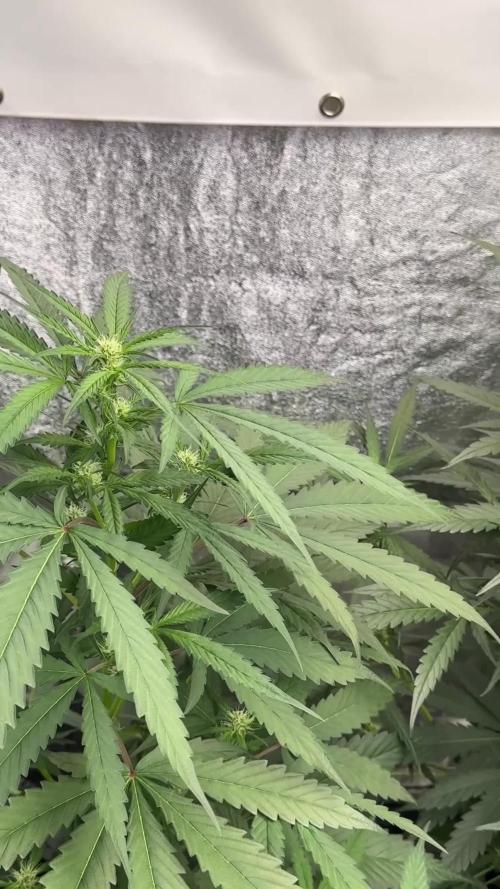
Fresh white pistils are appearing across the upper growth, signaling that the transition is now underway. Unlike some of her neighbors that stretched almost overnight, Candy Rain is making the change more gradually, continuing to strengthen her structure before committing all of her energy to flower production.
Standing around 69 cm tall, she's currently one of the smaller ladies in the room, but there's nothing weak about her. Her main stem has thickened beautifully, the branch spacing remains clean and open, and every new node seems ready to become a future flowering site.
She simply isn't in a hurry.
Sometimes the plants that take their time during vegetative growth surprise us once flowering truly begins, and I'm excited to discover whether Candy Rain has one of those stories waiting to unfold.
🌿 Training & Plant Development
Training has remained simple and stress-free throughout the grow.
Low Stress Training helped open the canopy early, while regular leaf repositioning continues allowing light to reach developing branches without removing healthy foliage.
A few of the older leaves still carry small scars from the early stages of the grow. Those marks are simply reminders that the beginning wasn't perfect.
The important part is what the plant is telling me today.
Every piece of fresh growth is emerging healthy, vibrant, and beautifully green. The stems continue strengthening, the canopy remains balanced, and new flowering sites appear a little larger with every passing day.
Older leaves tell yesterday's story.
New growth tells tomorrow's.
💧 Nutrition & Irrigation
This week I made one intentional change.
Even though I'm still closing her vegetative chapter, Candy Rain has now joined the same feeding schedule as every other flowering plant inside the room.
Current feeding:
• Terra Grow — 1.9 ml/L
• Terra Bloom — 1.9 ml/L
• Pure Zym — 1 ml/L
• Sugar Royal — 1 ml/L
• Power Roots — 1 ml/L
• Power Buds — 1 ml/L
Rather than keeping her on a reduced vegetative program, I decided to support the transition she's already showing naturally.
With an EC around 1.78 and pH maintained at 6.0, she's accepted the new feeding schedule without showing any signs of stress. The newest growth remains healthy, the foliage stays richly green, and the plant appears completely comfortable with the nutritional change.
Now she's eating exactly like the rest of the room.
We'll see over the coming week whether that extra support helps her settle fully into flowering.
🌡️ Environment
The environment continues providing stable conditions throughout the flowering room:
Day temperature: 29°C
Night temperature: 25°C
Relative humidity: 60%
Solution temperature: 21°C
Root zone temperature: 21°C
CO₂: approximately 639 ppm
Even during the warmer summer days, the healthy root zone, consistent irrigation, and excellent airflow continue allowing every plant to develop comfortably.
The ecosystem remains balanced, and Candy Rain seems perfectly happy within it.
👀 Looking Ahead
Next week should officially mark the beginning of flowering.
I'm expecting the stretch to become much more noticeable as hormones shift fully toward bloom, and it'll be fascinating to see whether she begins closing the gap between herself and the rest of the room.
Right now she may be the slowest plant in the tent, but she's also showing steady, healthy development every single week.
Sometimes patience is rewarded with something truly special.
For now, I'm simply letting her tell her own story.
🙏 Final Thoughts
Not every plant follows the same schedule.
One of the most enjoyable parts of growing is learning to work with each individual plant instead of expecting every seed to perform exactly the same way.
Candy Rain has reminded me of that every week.
She isn't racing anyone.
She isn't trying to be the biggest.
She's simply growing at her own pace, building a healthy structure, and preparing for the next stage when she's ready.
Whether she finishes alongside the rest of the room or a little later, she has already earned her place in this project by showing that patience can be every bit as beautiful as speed.
A huge thank you to Zamnesia for making this incredible project possible, Plagron for providing consistently reliable nutrition, Future of Grow for delivering outstanding lighting, and to everyone following this 8×8 Adventure here on GrowDiaries.
Your support, comments, and shared passion for growing make documenting every week an absolute pleasure.
Until next week…
Growers love and happy growing! 🌱💚


Likes
7
Share


@saintetiennegrows
Follow
This strain was a pleasure to grow. No problems presented at all. She is very stress resistant and has some unique structural formations. She smells like a variety of citrus flavors when grown but after being harvested she smells exactly like an orange grove.

Likes
15
Share


@Dunk_Junk
Follow
Closer to the end than the beginning now!
I'm thinking another couple of weeks, lets keep an eye on the pistils and see when they all turn colour.

Likes
16
Share

@LST420
Follow
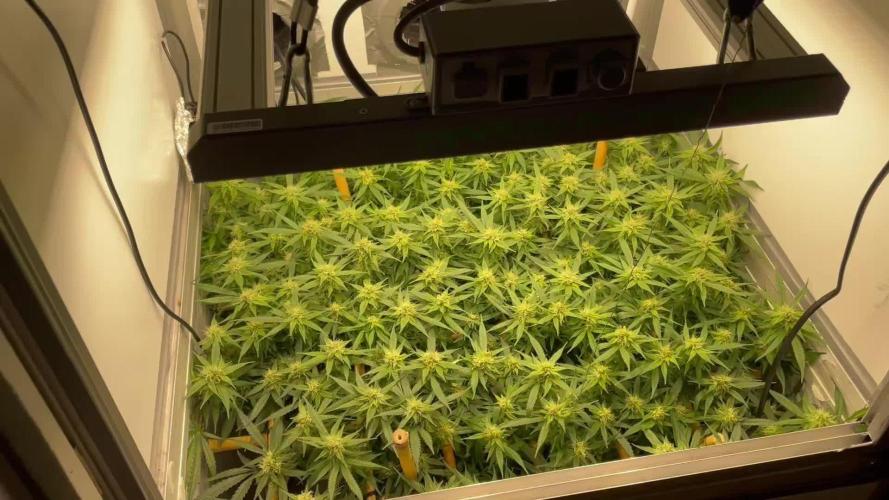
Week 16
The buds really start to form and smell now. And because of the high density of buds I regularly defoliate so they all get the maximum amount of light.

Likes
4
Share


@eldruida_lamota
Follow
Venga familia que ya viene la cosecha de estas Permanent Maker de Seedstockers, que ganas que tenia ya de darles machetazo.
Que locura de variedad , me encantó cultivarla , aún con la plaga de trips que sufrí aguantaron y sacaron unas flores alucinantes.
Las flores aparte de piedras, se ven resinosas.
a sido una genética con la que disfruté bastante, no fue complicada cultivarla. Os la recomiendo si os gustan las genéticas con alto thc.
Agrobeta:
https://www.agrobeta.com/agrobetatiendaonline/36-abonos-canamo
Mars hydro:
Code discount: Eldruida
https://www.mars-hydro.com/
Hasta aquí es todo , espero que lo disfrutéis, buenos humos 💨💨.

Likes
45
Share


@Ultraviolet
Follow
2nd net is up. Early bud formations are promising. holding up to the extremes pretty well, some leaves taking minor damage, but overall, she is holding up, gave her 1 night at 50F see how she would react, stressful. Not advised as it messes with her metabolism, but I want to see if it triggers any anthocyanin response. Love to see her purp up but no signs yet.
Homework.
If Rubisco activity is impaired and it cannot properly function or regenerate its substrate, the plant's leaves are likely to turn a pale green or
lime green, a condition known as chlorosis. Essentially, Rubisco activity is highly regulated and susceptible to various environmental and metabolic factors that can cause it to become inhibited, leading to an apparent failure in RuBP regeneration due to a lack of consumption.
Rubisco regeneration is intrinsically linked to nitrogen supply because Rubisco is a major sink for nitrogen in plants, typically accounting for 15% to over 25% of total leaf nitrogen. The regeneration phase itself consumes nitrogen through the synthesis of the Rubisco enzyme and associated proteins (like Rubisco activase), and overall nitrogen status heavily influences the efficiency of RuBP regeneration. RuBisCO is a very large enzyme that constitutes a significant proportion (up to 50%) of leaf soluble protein and requires large investments in nitrogen. Insufficient nitrogen supply limits the plant's ability to produce adequate amounts of RuBisCO, thereby limiting the overall capacity for photosynthesis and carbon fixation. Maintaining the optimal, slightly alkaline pH is crucial for the proper function and regeneration of Rubisco. Deviations in either direction (too high or too low) disrupt the enzyme's structure, activation state, and interaction with its substrates, leading to decreased activity and impaired RuBP regeneration. (LIME GREEN CHLOROSIS)
Structural Component: Nitrogen is an essential building block for all proteins, and the sheer abundance of the Rubisco protein makes it the single largest storage of nitrogen in the leaf.
Synthesis and Activity: Adequate nitrogen supply is crucial for the synthesis and maintenance of sufficient Rubisco enzyme and Rubisco activase (Rca), the regulatory protein responsible for maintaining Rubisco's active state. Nitrogen deficiency leads to a decrease in the content and activity of both Rubisco and Rca, which in turn limits the maximum carboxylation rate, Vmax, and the rate of RuBP regeneration Jmax, thus reducing overall photosynthetic capacity.
Nitrogen Storage and Remobilization: Rubisco can act as a temporary nitrogen storage protein, which is degraded to remobilize nitrogen to other growing parts of the plant, especially under conditions of nitrogen deficiency or senescence.
Nitrogen Use Efficiency (NUE): The allocation of nitrogen to Rubisco is a key determinant of a plant's photosynthetic nitrogen use efficiency (PNUE). In high-nitrogen conditions, plants may accumulate a surplus of Rubisco, which may not be fully activated, leading to a lower PNUE. Optimizing the amount and activity of Rubisco relative to nitrogen availability is a target for improving crop NUE.
Photorespiration and Nitrogen Metabolism: Nitrogen metabolism is also linked to the photorespiration pathway (which competes with carboxylation at the Rubisco active site), particularly in the reassimilation of ammonia released during the process.
To increase RuBisCO regeneration, which refers to the process of forming the CO2 acceptor molecule Ribulose-1,5-bisphosphate (RuBP) during photosynthesis, the primary methods involve optimizing the levels and activity of Rubisco activase (Rca) and enhancing the performance of other Calvin-Benson-Bassham (CBB) cycle enzymes.
Biochemical and Environmental Approaches:
Optimize Rubisco Activase (Rca) activity: Rca is a crucial chaperone protein that removes inhibitory sugar phosphates, such as CA1P (2-carboxy-D-arabinitol 1-phosphate), from the Rubisco active site, thus maintaining its catalytic competence.
•Ensure optimal light conditions: Rca is light-activated via the chloroplast's redox status. Adequate light intensity ensures Rca can effectively maintain Rubisco in its active, carbamylated state.
•Maintain optimal temperature: Rca is highly temperature-sensitive and can become unstable at moderately high temperatures (e.g., above 35°C/95F° in many C3 plants), which decreases its ability to activate Rubisco. Maintaining temperatures within the optimal range for a specific plant species is important.
•Optimize Mg2+ concentration: Mg2+ is a key cofactor for both Rubisco carbamylation and Rca activity. In the light, Mg2+ concentration in the chloroplast stroma increases, promoting activation.
•Manage ATP/ADP ratio: Rca activity depends on ATP hydrolysis and is inhibited by ADP. Conditions that maintain a high ATP/ADP ratio in the chloroplast stroma favor Rca activity.
Enhance Calvin-Benson-Bassham (CBB) cycle enzyme activity: The overall rate of RuBP regeneration can be limited by other enzymes in the cycle.
•Increase SBPase activity: Sedoheptulose-1,7-bisphosphatase (SBPase) is a key regulatory enzyme in the regeneration pathway, and increasing its activity can enhance RuBP regeneration and overall photosynthesis.
•Optimize other enzymes: Overexpression of other CBB cycle enzymes such as fructose-1,6-bisphosphate aldolase (FBA) and triose phosphate isomerase (TPI) can also help to balance the metabolic flux and improve RuBP regeneration capacity.
Magnesium ions, Mg2+, are specifically required for Rubisco activation because the cation plays a critical structural and chemical role in forming the active site: A specific lysine residue in the active site must be carbamylated by a CO2 molecule to activate the enzyme. The resulting negatively charged carbamyl group then facilitates the binding of the positively charged Mg2+ion. While other divalent metal ions like Mn2+ can bind to Rubisco, they alter the enzyme's substrate specificity and lead to dramatically lower activity or a higher rate of the non-productive oxygenation reaction compared to Mg2+, making them biologically unfavorable in the context of efficient carbon fixation. The concentration of Mg2+ in the chloroplast stroma naturally increases in the light due to ion potential balancing during ATP synthesis, providing a physiological mechanism to ensure the enzyme is activated when photosynthesis is possible. At the center of the porphyrin ring, nestled within its nitrogen atoms, is a Magnesium ion (Mg2+). This magnesium ion is crucial for the function of chlorophyll, and without it, the pigment cannot effectively capture and transfer light energy.
Mg acts as a cofactor: Mg2+ binds to Rubisco after an activator CO2 molecule, forming a catalytically competent complex (Enzyme-CO2-Mg2+). High light + CO2) increases demand: Under high light (60 DLI is a very high intensity, potentially saturating) and high CO2, the plant's capacity for photosynthesis is high, and thus the demand for activated Rubisco and the necessary Mg2+ cofactor increases. Mg deficiency becomes limiting: If Mg2+ is deficient under these conditions, the higher levels of Rubisco and Rubisco activase produced cannot be fully activated, leading to lower photosynthetic rates and potential photo-oxidative damage.
Optimal range: Studies show that adequate Mg2+ application can enhance Rubisco activation and stabilize net photosynthetic rates under stress conditions, but the required concentration is specific to the experimental setup.
Monitoring is key: The most effective approach in a controlled environment is to monitor the plant's physiological responses e.g., leaf Mg2+ concentration, photosynthetic rate, Rubisco activation state, and adjust the nutrient solution/fertilizer to maintain adequate levels, rather than supplementing a fixed "extra" amount.
In practice, this means ensuring that Mg2+ is not a limiting factor in the plant's standard nutrient solution when pushing the limits with high light and CO2.
Applying Mg2+ through foliar spray is beneficial to Rubisco regeneration, particularly in alleviating the negative effects of magnesium (Mg) deficiency and high-temperature stress (HTS). While Mg can be leached from soil, within the plant it is considered a mobile nutrient, particularly in the phloem. Foliar-applied Mg is quickly absorbed by the leaves and can be translocate to other plant parts, including new growth and sink organs.
Foliar application of: NATURES VERY OWN MgSO4 @ 15.0g L-1 in a spray bottle.
Foliar sprays are often recommended as a rapid rescue measure for existing deficiencies or as a supplement during critical growth stages, when demand for Mg is high. Application in the early morning or late evening can improve absorption and prevent leaf burn.
The starting point [of creativity] is curiosity: pondering why the default exists in the first place. We’re driven to question defaults when we experience vuja de, the opposite of déjà vu. Déjà vu occurs when we encounter something new, but it feels as if we’ve seen it before. Vuja de is the reverse—we face something familiar, but we see it with a fresh perspective that enables us to gain new insights into old problems. Come walk in the enchanted forest.