


Likes
Comments
Share


Likes
12
Share

@CheeRz
Follow
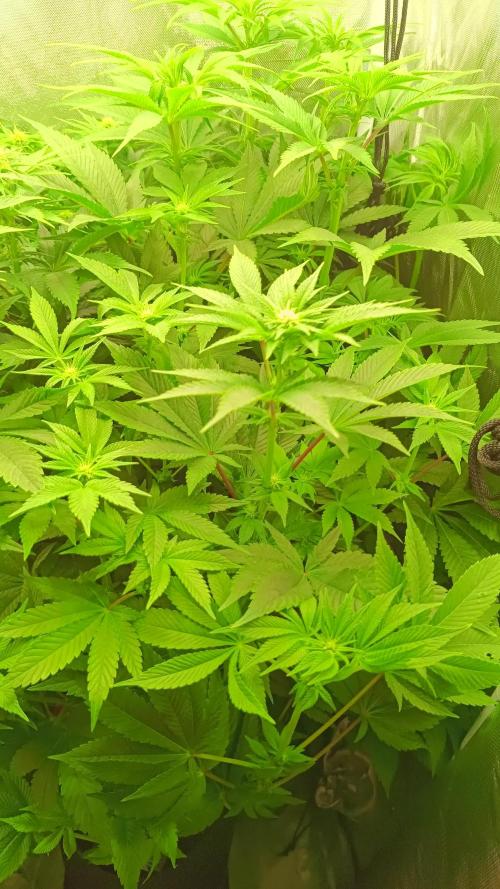
Lady runtz has started to form buds. I'm more than happy with the growth so far. Meanwhile I'm having problems with the height. I'll probably have to remove the fan and charcoal filter from the tent to make more room at the top.


Likes
24
Share


@MediciGrade
Follow
6.02 Growth has picked up since raising the PH of my nutrient solution to 6.25-6.5. I also began foliar feeding at lights off with 5 ml/g of Cal-Mag Plus. I added .25 tsp/gallon of recharge when feeding today. It raised the PH of the solution to 7.0 and will monitor over the next 48 hours for results.
6.04 When I tied down the big plant I split the stems where they were topped the 2nd time. Taped them up and cinced with plant ties.
6.06 End of week 9. Installed my automatic watering manifold with hydro halos. I've been feeding 3 times/day for the past week, and I won't have time to hand water 5 or 6 times a day during flower. Will probably need 1 more full week of veg before I flip to 12-12.

Processing
Likes
15
Share


Likes
16
Share


@TerpDaddy
Follow
Day21- the blueberry is really starting to blowup. I have a feeling she’s gonna be a big one. Grapefruit was having some problems but seems to be rebounding nicely. Very light lst this week and won’t do much more but will have to defoliate.
Likes
4
Share


@MrrNice
Follow
**English**
The light was changed to 12/12 . The plants are growing well, so far I have nothing to complain about.
**Deutsch**
Das Licht wurde auf 12/12 umgestellt. Die Pflanzen wachsen gut, bisher habe ich nichts zu beanstanden.

Likes
4
Share


@Kitties_and_Colas
Follow
More defoliation later this week, will update photos :) ... bud sites just barely starting to form, I absolutely love this strain, it's not like other Cali Kush I've tried, it hits like an indica, so much so, we use is as a night time herb
Likes
2
Share


@GhostBlvckPhant0m
Follow
“The Wock” 7 Weeks🤙🏾 Ladies are crushing its! I’ve for sure found 2 phenols I want to keep going based on structure and growth. The first was actually going to be a throw away. I didn’t like how lanky she was in her solocup stage. I instead topped her to slow down lateral grown and threw her in a 2 gallon bag to do her thing. She is now in a 7 gallon bag and has the best structure of them alll IMO. My 2nd pheno is a Tri-leaf mutation and it throws tops like no other! The perfect mother plant and is why I chose her as pheno #2. The 2 plants that were topped at the 5th node are bushing out more and more, just like it like it. There are 2 natural growing plants are doing great as well. They have nice bushing with one main cola. All plants will be defoliated 5 days before flip. The nose coming from these ladies is LOUD and I mean LOUD! Sour Candy and Burt Fuel! I’ll be taking cuts and flipping these ladies soon! Happy Growing PSGX Family! 🚀PSGX to the 🌕 #Phant0m
Likes
Comments
Share

@Organic_bud21
Follow
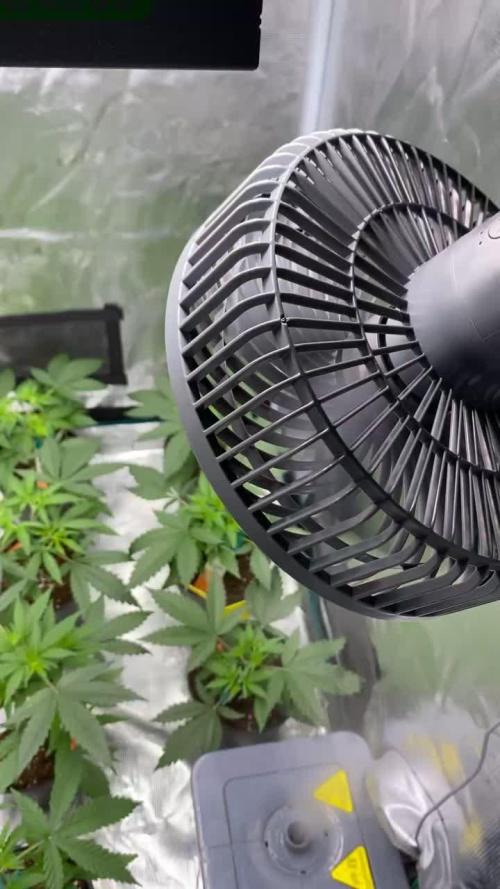
Diese Woche wurde nach und nach getoppt über 3 Tage hinweg. Sobald die ersten Triebe des 4ten Paares entwickelt waren, habe ich das Unterste paar Triebe + Blätter und die Keimblätter entfernt. Pro Pflanze möchte ich diesmal mit 6 Haupttrieben arbeiten. Nachdem ich mit allen fertig war und die Wunden 1 Tag geheilt waren, habe ich wieder B-52 mit Break Thru zusammen eingesetzt um Stress zu minimieren und den Wachstum zu fördern. Ab jetzt fange ich auch an alle 3 Tage mit 10-15% Drain zu gießen. Fürs nächste Mal ist auf jeden Fall vorgemerkt, dass als erstes umgetopft wird in den Endtopf bevor ich Toppe, um Zeit zu sparen. Wir sind in vegi Woche 4 und werden die 5te zur Erholung nach dem umtopfen brauchen und ich muss noch ins Netz einarbeiten. Das lief nicht ganz wie geplant, aber die Pflanzen sind alle zu 100% gesund. Die Green poison F1 scheinen mehr Probleme mit den thripsen zu haben als die anderen. Ich denke das liegt an den schwach vorhandenen Geruch. Alle anderen sind bisher Geruchslos. Ich arbeite auch noch ohne Filter.

Likes
5
Share


@DemonDabsSolventless
Follow
Hello dear confreres,
Today I start a completely new journey for me, which is indoor cultivation.
- Goals
Germinate 10 seeds and create an environment with good crops
- Method chosen
Hydrated Jiffys with 400ml of water + 0.4ml of VodooJuice + 0.4ml of CalMag
After hydration, we place the seeds on the discs and give them 24/0 light and wait.

Likes
55
Share


@Ultraviolet
Follow
High UV-B radiation can necessitate increased magnesium because it plays a crucial role in mitigating the stress and damage caused by UV-B exposure. High UV-B can lead to the production of harmful reactive oxygen species, and magnesium helps the plant's antioxidant systems and chlorophyll function to cope with this stress, making adequate magnesium supply essential for plant health under such conditions.
Why UV? To do with the way anthocyanin is different from other pigmentations in that its colouration is not attached to the cell itself, it's a pH thing, if you force the color through high dose, as soon as she stops being in that environment, it will begin to revert back to chlorophyll, nitrogen deficiency causes anthocyanin to be produced in the first place, and nitrogen is needed to create new chlorophyll. When plants have a nitrogen deficiency, they produce anthocyanins to protect the leaves from stress while they try to salvage remaining nutrients, like nitrogen, before leaf drop. 24:1 C:N carbon&nitrogen ratio in medium will trigger autophagy, which will begin the dumping of nitrogen into the soil to feed micros as they FEED on nitrogen to convert carbon sugars into chemical energy via cellular root respiration (calcium/phosphorous VITAL for sugar processing). Couple the UV with a nitrogen dump for all the colors of the rainbow, and remove the possibility of allowing the conversion back to chlorophyll. 10/14 mimics late autumn, winter is coming, maximizing genetic expressions of desired purple genes if they do exist, I have seen no indications that I'd expect from previous grows. Oxygen is the oxidizer; if a soil cannot breathe, nothing good will EVER happen.
Raised UV to lower the dosage.
The leaves begin producing a protein hormone called florigen (produced via the Flowering Locus T gene). DELLA proteins.
The plant measures the duration of the night by monitoring the amount of Pfr that has reverted to Pr.
I imagine it like an egg timer with sand. You can speed up the flow of sand one way or another, determined by what type of red light and the ratio overall.
The standard flowering cycle for many indoor plants is 12 hours of light and 12 hours of darkness. By applying a short pulse of far-red light at the very beginning of the dark cycle, a grower can trick the plant's internal clock. Forcing the conversion: A pulse of far-red light (730 nm) rapidly converts the active (P_{fr}) back into the inactive (P_{r}) form, simulating several hours of dark reversion. This amplified "sleep" signal causes the plant to believe the night started hours earlier than it actually did. For a short-day plant, this rapid reset means it can perceive a 14-hour night even though it only received 10 hours of darkness. This allows growers to use a 14/10 light cycle (14 hours of light, 10 hours of dark) without disrupting the flowering of short-day plants, as the far-red pulse makes the night effectively "long enough". This provides plants with more light for photosynthesis and can speed up the flowering process.
What about all night? Or a pulse (15-30min)?
High Pfr (Far-Red) overnight mimics a short night:If you maintain a high Pfr:Pr ratio overnight, the plant never receives the signal that a sufficient dark period has occurred. This mimics the conditions of a short night, during which Pfr levels remain high. Flowering is inhibited: As a result, the plant will not flower. This is the same effect that is observed when a flash of red light interrupts a long night, which instantly converts any Pr back to Pfr and resets the dark-reversion clock. But it's not that simple, I do not necessarily want a 14/10 for the entirety of the flower. Suppose you give a 12/12 with the pr/pfr conversion to make her more of a 10/14. It may not be the best option for the entirety of flower.
A photoperiod cannabis plant will develop differently under a 14/10 light cycle compared to a 10/14 cycle during the flowering phase. The differing lengths of light and darkness trigger different hormonal responses, influencing the plant's growth, final yield, potency, and maturation time. A faster maturation time in flowering cannabis offers quicker harvests and lower potential risk, but can result in diminished potency, lower yields, and a less complex flavor and aroma profile comparatively. The trade-offs depend on the grower's priorities and the specific cannabis genetics.
14/10 physical light cycle with pr/pfr conversion for optimal yield to make the plant think it's on a 12/12. After the first 4/5 weeks of flower, when trichomes ramp up, I will change it to 12/12, keeping the pr/pfr conversion. I should switch her to a more 10/14. Although this is stressful, make sure she is not suffering from undue stress from other areas. If enough stress accumulates, there is a chance the increased levels of jasmonic acid will make her pop a few seeds. Be aware, play it by how she is at the time.
If you want to make the 10/14 make sure one also applies a second pulse of far-red light (15-30min) two hours into the dark period. This mimics an even longer night, causing the plant to perceive a very short day of 10 hours and a long night of 14 hours. A pulse of only far-red light during a short-day plant's dark period will not disrupt its sleep. Unlike a pulse of red light, which would actively interrupt the dark period and inhibit flowering, far-red light promotes the biochemical state that signals a long, uninterrupted night.
This simulates the shortening days of late autumn/winter and can stress the plant, triggering a defensive response. Some growers report that this low, controlled stress can increase resin and trichome production as the plant works to protect its flowers. This mimics a natural outdoor harvest cycle where days get progressively shorter and nights longer. Reduce relative humidity during the late flowering stage to around 30%. This is another controlled stressor that can boost trichome production while reducing the risk of mold.
Unlock the full genetic potential and allow for maximal expression of desired genes during critical times.
Autoflowers contain genetics from the Cannabis ruderalis subspecies, which evolved to flower automatically based on a predetermined internal clock, or age that flowers based on age rather than light triggers, red and far-red light do not play a role in initiating the flowering stage. However, they significantly affect other aspects of the plant's growth and morphology. The premise that autoflowers do not use phytochrome red (Pr) to phytochrome far-red (Pfr) conversion for any function is incorrect. Like other plants, autoflowers utilize the phytochrome system to sense their light environment and manage processes like germination, shade avoidance, and vegetative growth, even if the phytochrome system isn't what signals them to flower.
Thank you 🙏
Almost time. Sound the horn! Maintaining 12-1600ppm by the morning's compensation point alone. She is consistently experiencing noticeable growth every day. Sulfur is in prior to flower, medium loaded with abundance, CEC charged, as the plant grows, so does its respiratory footprint. The exhaust fan starts to flare up at night far more often. The pH is unlocking hydrogen, allowing the plant to cycle CEC for its needs, which is optimal for soil microorganisms. It is charged with controlled doses of sucrose at optimal uptake temperatures. Full negative pressure diffusion setup linked to RH for nights, with negative pressure linked to daytime heat extraction. Just need to throw in the second net, switch spectral ratio and enjoy the show.
The struggle of the butterfly to escape through its caterpillar sac strengthens its wings; without this struggle, it would not be able to fly.
Likes
6
Share


@Ninjabuds
Follow
What a week it’s been so hot it’s been hard for the ac to keep up with the heat along with the heat the grow tents produce. Now with the big flower tent harvested the ac should be happy with me todo.
Likes
Comments
Share

@BenandLippisfinest
Follow
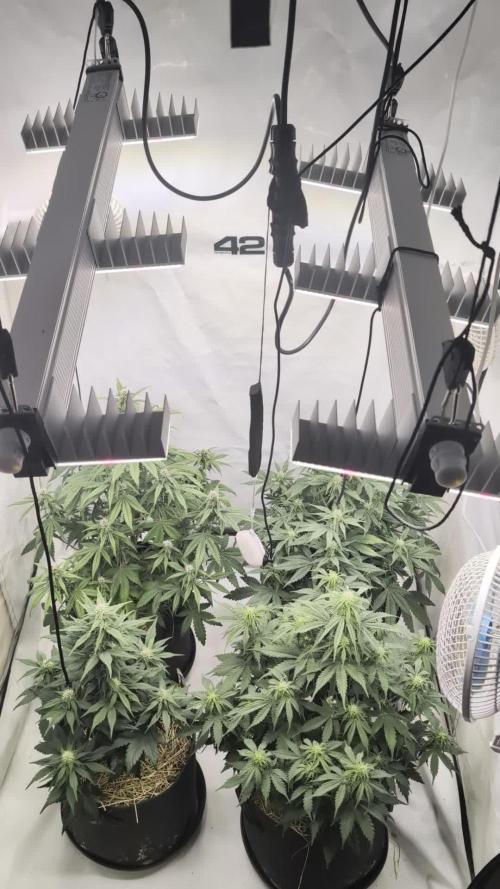
Die Lemon Cherry Cookies wird innen so lila, richtig schön anzusehen, leichter Magnesium Mangel den wir aber beheben können, die anderen entwickeln sich prächtig morgen wird entlaubt
The Lemon Cherry Cookies are turning a lovely purple color inside, really beautiful to look at. They have a slight magnesium deficiency, but we can correct that. The others are developing splendidly; they'll be defoliated tomorrow.
Likes
15
Share


@710_Squish
Follow
This has been a busy week for the plant. She had her 2nd nodes removed, she was topped at the 4th, and lst set. She didn't even slow down through it all.

Likes
19
Share


@proud_to_grow_loud
Follow
I switched my nutrients to Nectar For the Gods because I didn't have the funds in the beginning to do so. I got their spartan regiment with the extras. Photo-plus and SLF-100 which I use separately and not during feeding. Im watering everyday and feeding every other day. Water days I use SLF-100 and the next water day I use tea with Photo plus. my tea I use bloom by cultured biologics organic easy bloom and compost worm castings from my personal vermicomposting bed. alternating water days with the slf and photo plus was a massive growth in buds. They dense' nd up and just started putting on trichomes. brilliant brand- Nectar! OCGFAM for life now. Feeding is a pain but damn its worth it.
Pricy but worth the investment!


Likes
35
Share


@StonedandSteady
Follow
Happy Growing and Hope Everyone is Well! These Ladies are Growing into thier 10th Week of Veg and Looking Magnificently Made like Mini Jungles and Phenomenally *Femed* from the Right!
#Pre-Sexed 4/9/21 #Opium/#PabloEscobar *Fems* breed by Team #DivineSeeds #DivineSeedsSquad #DivineSeedsBreedingCompany and #SuperCropping continued! I'm Very Excited and Extremely Gracious!!!
Heck Yeah Growmies and Growmets!!! Check Out these Confirmed Females with thier Wild Pistol Hairs popping and I'm still Training and Widening them Out with #SuperCropping Everything looks Expanded and Growing Great!
After #SuperCropping the plant will Grow Bushier, Produce More Buds, and possibly even Produce More THC! This is how the plant naturally responses to danger and protects itself! Growers take advantage of this technique to get Bigger Yields and More Potent Buds than would be produced otherwise!
#Opium *Fem* breed by #DivineSeeds #DivineSeedsSquad #DivineSeedsBreedingCompany
Origin:Afghanistan
Type:Indica/Sativa
Flowering:63 Days
THC:29%
Harvest:1000 g/m2
Height:150-205 cm
#PabloEscobar *Fem* breed by #DivineSeeds #DivineSeedsSquad #DivineSeedsBreedingCompany Topped, Trained, Super Cropped and Looks Spectacularly Gorgeous!!!
Origin:Canada/Columbia
Type:Indica/Sativa
Flowering:71 Days
THC:>25%
Harvest:700 g/m2
Height:180-200 cm
She's Awesomely Trained, Topped and Strengthening out while spreading her Wings to fill her 10 gallon Grow Bag from Broski #www.as420.ca in 9 Weeks of Veg!
Getting Trained out into thier 9th Week of Veg and Looking Mighty Fine!!! Thier getting Humongous and Hearty in thier 10 gallon Grow Bag from Broski #www.as420.ca These Cannabis plants are Camping out in the Closet for a week or so! Lol
This is my 2nd run using the Osree.Light QB1000w and Everything is Mesmerizing!!!
My #Opium and #PabloEscobar *Fems* from #DivineSeeds Regs: SalamiLegF3's×2 and FireAlienRomulan look$ Outstandingly Awesome and Growing Up Phenomenally Fine into thier 8th week of Veg in our 2- 10 gallon The Grow Bags from Broski #www.as420.ca and also 2- 5 gallons as Well! Our others are Super and Breed by #thehumancannabiniod #AlienBloodGenetix #TNBNaturals #Foop
Yo!!! Thanks Again for All the Love and Support my fellow Growmies and Growmets!!! These Magnificent and Magical Ladies are Growing in our 48×24×60 ViparSpectra Official Club 🌿 ®️ Grow Tent and under our #Osree QB1000w and #GrowStarStore Kokokala QB1000w and our Mater×2, Lavender×3, Sunflowers×5 and The 6 Brand New and Fresh Starts are Wonderful with a Huge Hint of Fantastical Fire is my #SalamiLegF3×2 by Broski #thehumancannabiniod #DankFlowGenetics #EastCoastSeedBank #FireAlienRomulan by Broski #AlienBloodGenetix my #PabloEscobar and #Opium by Team #DivineSeeds #DivineSeedsBreedingCompany We Grow with #Growatt 600w with #FoopOrangicBioSciences and #TNBNaturals The Enhancer Co2 Despersal canister and ph'd them w/ Declorinated watering w/ TNB ph Up and Down! Totally Top Quality Topz all Around! Thanks Again #GallowGlas420 #HarleyGrower #thehumancannabiniod #AlienBloodGenetix #TNBNATURALS #FoopOrangicBioSciences #www.as420.ca #divineseeds #divineseedssquad #divineseedsbreedingcompany #BioFlux Family's and Teams!!! Your Genetics are Merry Magnificent, Mega Marvelous and Mighty Medical! Love um!!! I really Can't stress enough how Thankful and Grateful I am of All of you and what you've Shared with Us! Means the World!!! It's definitely a Pleasure being able to Grow with these Phenomenal Grow Lights! Please Enjoy! BudBrothers4-Life! Cheers Famz!!! Much Props and Much Topz!💯🔥 #Osree #GrowStarStore #Growatt #TNBNaturals #TNBTeam #FoopOrangics #GrowYourOwn #Bliss
https://instagram.com/divine.seeds?igshid=1r90iwe9xiwz8
https://instagram.com/thehumancannabinoid?igshid=17k159pumklkq
https://www.instagram.com/alienblood_genetix_official/
https://instagram.com/as420.ca?igshid=1f116alw054wp
The Grow Bags: https://www.as420

Likes
12
Share


@Herbalist7
Follow
Harvest was great.. by far grew the biggest and the best. My favourite of the bunch.. Smokes really clean and gave me a little more than 2 ozs which i was greatful for as its an autoflower. Afghan Mass XXL definitley top quality seed and strain!


Likes
8
Share

@Growbody
Follow
Willkommen zu meinem Growbericht der Cafe Racer Automatik von Blimburn Seeds. Die Samen sind von Zamnesias Tribe Programm als automatische Überraschungssamen angeboten worden.
Der neue AirPot Gen. 7 mit 20 Liter kommt hier wieder zum Einsatz.
Die Bio Hanferde von Sonnenerde wird wiederverwendet und mit 220 Gramm Monster Bud Mix Living Soil von BIONOVA x zamnesia und 2 Litern BioBizz Wurmhumus angereichert.
Und die zamnesia Smart Start Plugs mit Plagron's seedbooster plus haben sich bewährt.
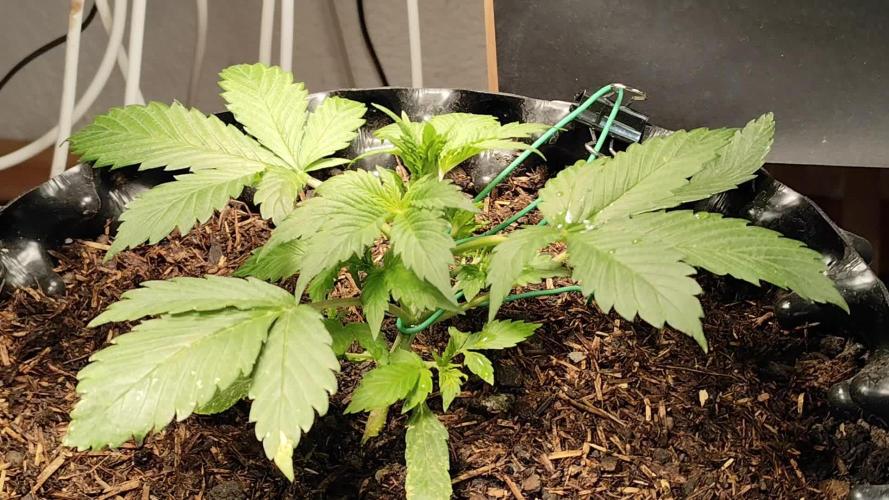
Tag 29: Die Cafe Racer Automatic von Blimburn Seeds hat das LST ohne Probleme weggesteckt.
Tag 32: Sie ist sehr schön buschig geworden diese Woche. Nochmal etwas LST angewendet.
Schön, das du dir meinen Bericht ansiehst. Schau gerne wieder rein. 👋😎

Processing
Likes
13
Share


@mr_smooke
Follow
we pass 6 weeks of flowers. buds are getting fulled and the smell is so so beautiful. Here on pics is day 31 of flowering. On feeding menu is again Iguana Juice Bloom, I spend all Mother earth. it is awesome nutrients. will buy it again.
