Likes
Comments
Share
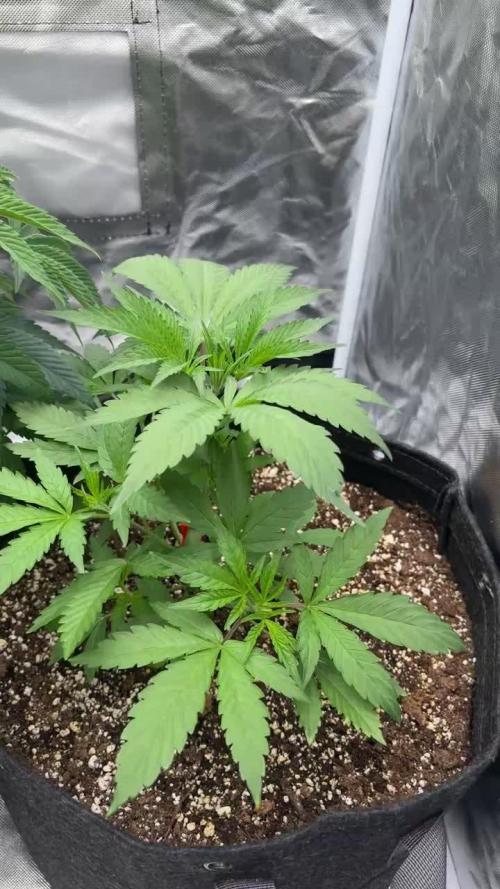
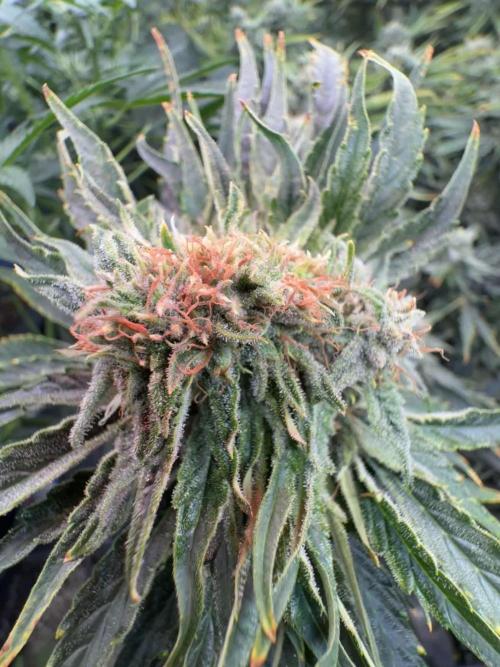
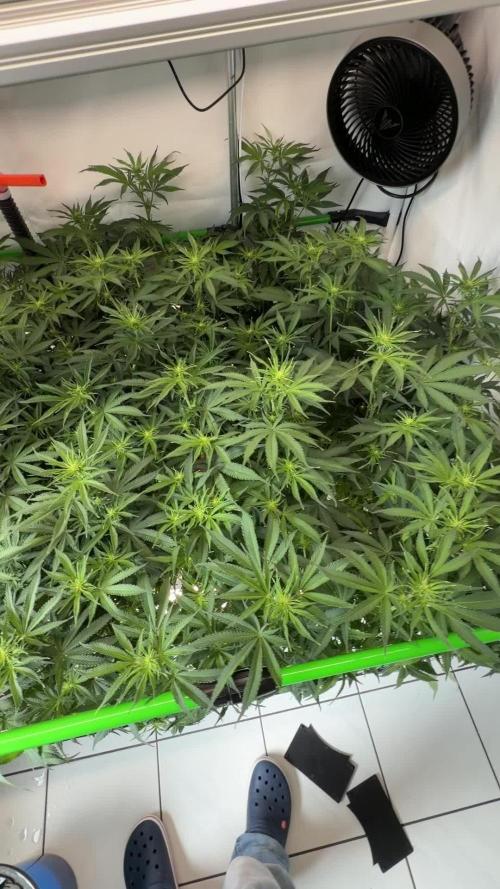
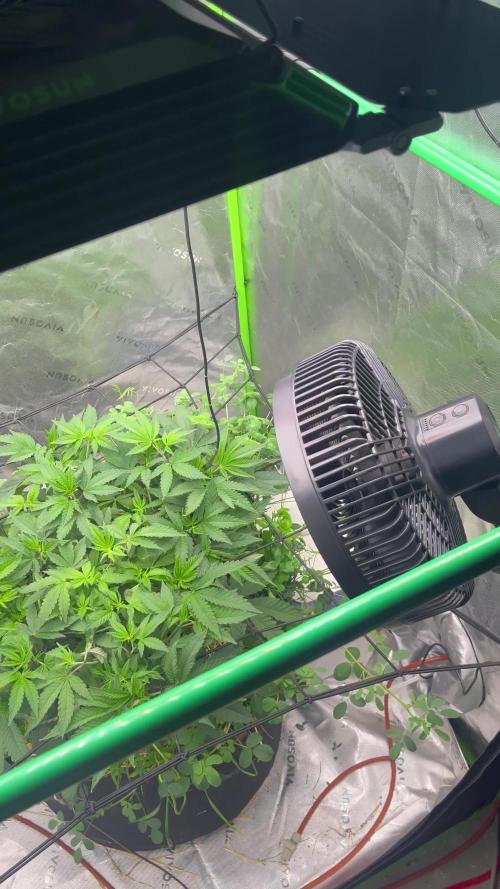
Hey Leute, heute ein kleines Update vom Blütetag 32. Ich würd mal sagen die Woche is nicht ganz so rund gelaufen, war aber auch nur ne Frage der Zeit bis die ersten Fehler passieren und sich erste Probleme zeigen. Insgesamt bin ich zufrieden, der Stretch is vorbei und die Pflanzen trinken mittlerweile deutlich weniger. Leider hatte ich Temperatur und Feuchtigkeitsprobleme und die Fußbodenheizung mögen die Mädels glaub auch nicht wirklich. Die Papaya Frosting macht sich immer noch prächtig, ist Frosty as fuck und riecht echt richtig nice. Bei den andern drei geht alles bisschen langsamer und sie sind glaub nicht ganz so happy, aber richtig übel haben sie mir auch noch nichts genommen. Die Blue Cheese hat braune spitzen die sich nach oben rollen, mein verdacht kalte Zugluft und zu warme Wurzeln von der Fussbodenheizung (steht direkt vor der zuluft). Irgendwie haben auch alle Lila spitzen und die Pink Chai bekommt grade ganz Lila Blätter, hatte mal ein gekipptes Fenster vergessen und es war während der Lichtphase nur 19 grad. Andere Idee wäre Kaliummangel durch zuviel Kalzium, aber eher unwahrscheinlich weil die eingerollten Blätter angefangen haben als ich das Fenster vergessen hatte. Die Woche werd ich bisschen Greenhouse Booster geben und mal CalMag wieder runterfahren, so ganz hab ich kein vertrauen das die Erde durchhält bis zum Schluss. Schönes Wochenende wünsch ich euch! 🖖
Likes
6
Share
@Kominest
Follow
Did some defoliation and lollipopping but Iam sick since some days so I didn’t do perfect but still something . Watered on day 9 with calmag and biogrow(for some nitrogen) . Had the dli to high on 55 and turns down to 45. Some small signs of calmag deficiency on upper leaves . A light fruity smell is slowly introducing himself
Likes
45
Share
5ª Settimana di Fioritura 💐💐💐💐💐 👁️ : buongiorno amici della CampaCavallo 💚, oggi vediamo la bella sticky broccoli 💧🥦 intenta ad occupare tutti gli spazi della rete. E devo dire che ci sta riuscendo proprio bene. Cosa ne dite? ⛽ : leviamo il solito succo preparato con una base ph Perfect di Advanced Nutrients, Big Bud e Bud Candy... Più aggiungiamo Il Tocco Magico di Green Sensation gentilmente 💚💜 offerto da plagron
Likes
2
Share
@TowersD
Follow
The plants are in the 2nd week of flower and the pistols are staring to show it. That confirms that all of the plants are female.
Likes
21
Share
Heyókȟa I desire naught but the study of nature, to find my way back home. 12x12=144, A dodecahedron is a polyhedron with 12 faces, and in coordination chemistry, it refers to a geometry where ligands surround a central metal atom (in this case, Magnesium) in a specific, 8-coordinate arrangement. Dodecahedrane is a hydrocarbon, meaning it's composed solely of carbon and hydrogen atoms. The carbon atoms are arranged at the corners of a dodecahedron, a 3D shape with 12 pentagonal faces. The water molecules in the dodecahedron form hydrogen bonds that are individually slightly weaker than in either the dimer or the tetramer. However, because three-quarters of the O -H groups in the dodecahedron form hydrogen bonds, it has a more negative energy per molecule than has either the dimer or the tetramer. Magnesium (Mg2+) is the essential, central metal ion in the chlorophyll molecule, crucial for photosynthesis by enabling light absorption and energy transfer. It is chelated by four nitrogen atoms within the porphyrin (or chlorin) ring structure. Chlorophyll appears green because it reflects light in the green region of the visible spectrum, specifically between 490 and 570 nm. The main resonance electronic frequency of a neutral Magnesium (Mg) atom corresponds to the transition from the ground state to the first excited state. Resonance Line Wavelength of Mg2+: 285.1nm (UVB light). The central atom of the chlorophyll molecule is Magnesium (Mg2+), which is coordinated within a porphyrin ring. The electronic "resonance frequency" of this central atom—meaning the frequency at which its electrons absorb energy—is primarily driven by the electronic transitions (ETR) of the surrounding conjugated chlorin ring structure, rather than a discrete atomic transition of the Magnesium atom itself. The resonant electronic frequencies of the chlorophyll porphyrin (technically, a chlorin) ring are determined by the energy required to promote π-electrons within its conjugated system, primarily appearing in the blue and red regions of the visible spectrum. In standard physics, Chloryphyll b has peak absorption at 460nm (Blue). If we take the peak wavelength 460nm and a UV-B, UVR8 peak absorption wavelength 285nm Tryptophan-285 (W285) Sensing protein. 460/285=1.618 Φ, "natural harmony" and the "structure of light". The cryptochrome photoreceptor (CRY) is a UV-A/blue light receptor that shares this dual sensitivity with several other biological structures and functions, including significant sequence similarity and a common evolutionary ancestor with DNA photolyase enzymes. These are light-activated enzymes that use blue/UV-A light to repair DNA damage caused by UV-B radiation in plants. Dodecahedrane (C20H20) is a hydrocarbon with a cage-like structure where carbon atoms form 12 pentagonal faces (a regular dodecahedron). It is highly symmetric (icosahedral), contains no delocalized electrons (no aromaticity), and has minimal angle strain, but significant torsional strain. Water Dodecahedron (H2O) forms hydrogen-bonded cages. While individual hydrogen bonds in this structure are weaker than in the linear dimer or tetramer, it has a more negative total energy per molecule. This is because three-quarters (75%) of the groups are involved in hydrogen bonding, creating a very stable, closed-shell configuration. a 3D carbon hydrocarbon (C20H20) to stable water clusters in hydrate, while the Magnesium ion acts as the central activator within a conjugated ring in biological systems, with its electronic absorption dominated by the ring, not the atom itself. Effective quantum efficiency of photosystem II, often denoted as ΦPSII In horticultural lighting, adding 730 nm (far-red) LEDs alongside standard red/blue lights has been shown to increase canopy photosynthesis by 20–30% in several crops by acting synergistically with shorter wavelengths. However, the limitation is that excessive, pure IR/Far-red light (without accompanying red light) can trigger the "shade avoidance response," causing plants to grow tall, weak, and spindly rather than robust. Knowing is half the battle however, engineering or utilizing infrared light (specifically the 700-750 nm far-red range) is a viable method to boost photosynthetic efficiency. It acts as a bridge to allow PSII to utilize a broader spectrum of light, breaking the traditional 700 nm barrier. Extend, then multiply. UVR8-mediated signaling (often in conjunction with CRY proteins) triggers protective mechanisms that maintain the stability of the photosynthetic apparatus (including LHCII and reaction center proteins), thus ensuring that the efficiency of Photosystem II remains higher in UV-B-exposed plants compared to plants lacking this receptor. ΦPSII indictates the rate of electron transfer from water to plastoquinone, which drives the production of ATP and NADPH. There is a close link between ΦPSII and the true rate of CO2 fixation (Φ*co2), particularly in C4 plants. Effective quantum efficiency of photosystem II, often denoted as ΦPSII, represents the proportion of light absorbed by Photosystem II (ΦPSII) that is actually used in photosynthetic electron transport. It is a key indicator of how efficiently a plant is using light for photosynthesis, as opposed to losing it as heat or fluorescence. ΦPSII (effective quantum yield of photosystem II) functions primarily as a "multiplier" (a coefficient of efficiency) rather than an additive factor when estimating the overall photosynthetic electron transport rate (ETR). Multipliers are considered far more beneficial than additions because they generate exponential growth, leverage existing resources to their full potential, and create sustainable, self-multiplying capacity, rather than just incremental, linear increases. Humans, and most other mammals, rely on other mechanisms, such as nucleotide excision repair, to manage and repair UV-induced DNA damage. As such, humans do not have the direct, light-driven repair mechanism that photolyase offers in plants.
Likes
9
Share
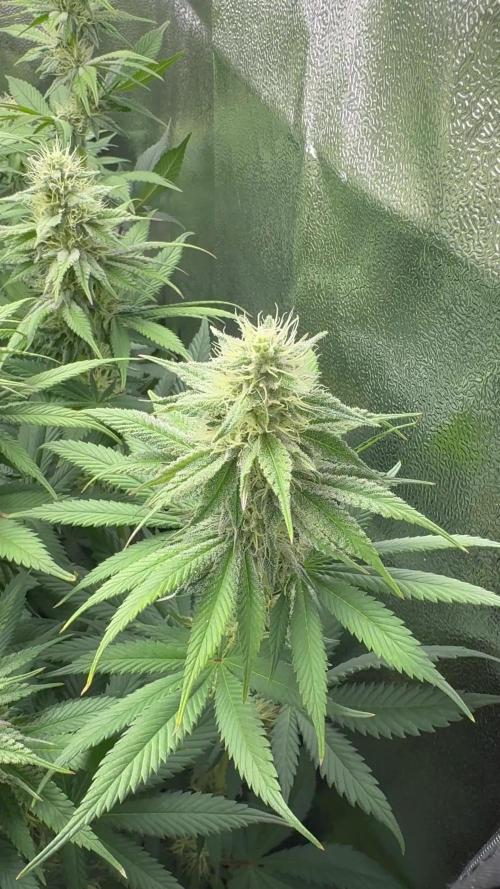
Final week of flower she's only been given plane water she will be cut down in a few days the dark colour on the leafs are really showing
Likes
Comments
Share
@Robom069
Follow
Day67/68 lookin very good dont know what else to do than lettin them grow
Likes
82
Share
Hello growmies! Welcome to week ten of An Epsilon Adventure! Massive thanks to both Shogun and Royal Queen Seeds for sponsoring this grow! I have been fertigating and also emptying the de-humidifier water into the driest looking substrate as it fills up. I have been keeping the tent door open and pushing more air through with fans. Daily Updates ### Week 10 Day 1 11:00 27/8 Photographed. ### Week 10 Day 3 17:00 29/8 Photographed. ### Week 10 Day 4 06:00 30/8 Fertigated 4l ### Week 10 Day 5 23:00 31/8 Have inspected very closely. I have had to tied up just about every branch on plant 2 as the buds are rapidly approaching peak density and the weight of them is causing all the stems to bend over. Despite not having a main cola, if I manage to harvest, dry, and cure this plant, I think it's going to exceed 100g. The highest buds are showing around 2-3% amber - I am counting the days now, this girl is very close. The harvest window is open, but I am waiting for about 10 times more amber. Interestingly. using the loupe I have discovered that plant 1 is likely to be the next to be harvested despite both plants 4 and 5 being ahead of her. She is showing early signs of fade and I am seeing about 1% amber. No fade, no amber on the other three plants. Some heat stress/damage on higher fan leaves. Not concerned, nothing do be done, the plants got too big and I am only happy to be able to keep them upright and still in the tent, even though they are higher than the light. I will take proper photos tomorrow. --- Thanks for reading growmies! 👊 ========== Tent: 120cm x 120cm x 180cm Light: 600w HID Elite Dual Spectrum HPS + Angel Wing Reflector Air: 5" duct fan system with carbon filter ~300 m3/hour + RAM 9" floor fan + 4" intake fan Pots: Air Pruner Fabric Pots 30l - UGro XL Coco + horticultural grade perlite (~20%) Seeds supplied by Royal Queen Seeds https://www.royalqueenseeds.com Nutrients supplied by Shogun Fertilisers https://www.shogunfertilisers.com/en ==========
Likes
40
Share
week 3 kicked off and the flowers are really atarting to take shape! 27” tall now! the stretch is unbelievable
Likes
36
Share
@nonick123
Follow
Día 37 (08/07) Ajustes de LST en todas las plantas! 🚀 Día 38 (09/07) Ajustes de LST en todas las plantas. Las ramas inferiores están creciendo como un cohete! 🚀😍 Riego con 250 ml H2O pH 6,5 Día 39 (10/07) Las plantas se muestran sedientas! Creo que el cepellón está lleno de raíces y piden el trasplante! El crecimiento no se ha visto afectado de momento Riego con 500 ml H20 pH 6,5 Día 40 (11/07) Paso a regar con 500 ml / día, ya que hace mucho calor (30 ºC) y efectivamente las plantas ya han copado la maceta de raíces Las ramas de nodo inferior se han quedado enanas tras el entrenamiento, de modo que las elimino y aplico canela en polvo en los cortes Riego con 500 ml H20 pH 6,5 Día 41 (12/07) Riego con 500 ml H20 pH 6,5 Clones! Mi experimento vuelve a demostrar que NO necesitas complejos productos de clonación ni sistemas para obtener clones! Hace 15 días puse 2 clones con el tallo sumergido en miel durante 5 minutos en una maceta de 400 ml con PRO-MIX HP BACILLUS + MYCORRHIZAE He mantenido la humedad alta con una cúpula de humedad casera hecha con una botella de agua PET de 5 litros cortada por la mitad y pulverizando a diario. Han estado los 15 días en mi terraza con luz indirecta, y temperaturas que rondan los 30 - 32ºC durante las horas centrales del día Hoy los he trasplantado a una maceta de 1 litro porque ya habían formado raíces y empezaban a formar nuevas hojas! 🐥🐥🚀🐥🐥 Día 42 (13/07) Riego con 500 ml H20 pH 6,5 Día 43 (14/07) Trasplante a maceta definitiva de 21 litros de ROOTPLUS Pot de GSKOREA GLOBAL! Estas macetas son una maravilla! Proceso de trasplante: Se prepara con 17,85 Litros (85%) de sustrato PRO-MIX HP BACILLUS+MYCORRHIZAE + 1,05 Litros de Humus de Lombriz (5%) + 2,01 Litros de Insect Frass (10%) + 210 gramos de Earth Vibes Super Soil (10 g/L substrato) Se llena la maceta de sustrato con las manos (limpias) y rompiendo los trozos más gruesos, para que el sustrato esté aireado y esponjoso, sin presionar Se coloca una maceta vacía de 6,5L para que quede la forma perfecta de la maceta donde están actualmente Se espolvorea la parte proporcional de la probeta de microorganismos sobre el agujero de trasplante Se saca la planta de su maceta actual (bonitas raíces 😍) y se coloca en la maceta final Se riega muy lentamente hasta percolación profunda con H2O EC 0,5 pH 6,5 Una vez asentada, complemento con un riego de 500 ml con 25 ml/L de Humus de Lombriz Liquido Se coloca mulch (acolchado) de paja para evitar traspiración excesiva y cuidar a los microorganismos del suelo A ver como reacciona al trasplante! Aplicación foliar Kelp hidrolizado de Lurpe Solutions a 0.25 ml/l Realizo ajustes de LST aprovechando el trasplante a la nueva maceta. De momento tienen una canopia muy bien formada! 💦Nutrients by Lurpe Solutions - www.lurpenaturalsolutions.com 🌱Substrate PRO-MIX HP BACILLUS + MYCORRHIZAE - www.pthorticulture.com/en/products/pro-mix-hp-biostimulant-plus-mycorrhizae
Processing
Likes
29
Share
So the girls are 4.5 weeks old there abouts. Happy with 4 of them (ish) seem to be transitioning to flower now so hopefully they get a nice stretch as there really short making me panic a little. Can see purple straight away.
Likes
39
Share
Hey growmies, It’s been 31 days since flipping to flower, my tent is filled with buds. I think I managed to recover this plant, if you look back to week 10 and 11 you can see this plant was struggling, losing her dark green colour and yellowing. I raised my lights, getting PPFD from 1100 down to 850, I have also started feeding organic nutrients. The organic nutrients alone will feed my plants, but my soil needed a recharge, too. I suspect a lot of the soil bacteria started dying back, so to try and replenish the ranks I topdressed with worm castings, and created a compost tea using molasses and organic worm castings. Neem oil was not enough to get rid of the few thrips I had, so I opted for Spinosad, an organic bioinsecticide which is derived from the fermentation juices of a soil bacterium called Saccharopolyspora spinosa I decided spinosad was the best option because it’s organic and safe to spray in flower, neem oil can’t go on flowers, reducing its effectiveness. After just one dose of spinosad applied in a foliar spray, My garden is pest free, and it looks like the tea and organic fertiliser is also getting color back into my plant. The smell so far is mainly skunk, no oranges (yet) but it's clear this run is back on track. The trichomes are okay, I've had frostier strains, I can still see new calyxes growing, so she's definitely still putting on more weight, it might be to early to call anything I also included some pictures of the clones, they really show what a difference ScrOGging makes, since the clones were topped once and let to grow naturally
Likes
48
Share
Info: Unfortunately, I had to find out that my account is used for fake pages in social media. I am only active here on growdiaries. I am not on facebook instagram twitter etc All accounts except this one are fake. Have fun with the update. Hey everyone 😁. Not much has happened this week :-). Last week's pump failure delayed the whole thing for a few days 😅. As the lower leaves are now starting to turn yellow, they should show their first roots in the next few days 😊. The water was completely exchanged again because the EC value has risen again. The small cups were sprayed every day so that the air humidity remained in the upper area. Otherwise everything was cleaned and the pumps, heating rod, etc. checked for their function. I hope you have a lot of fun with the update. Stay healthy and let it grow 🍀🙏🏻 You can buy this Strain at https://www.amsterdamgenetics.com/product/kosher-tangie-kush/ Type: Kosher Tangie Kush ☝️🏼 Genetics: Kosher Kush X Tangie 👍 Vega lamp: 2 x Todogrow LED CXB3590 COB 55 W 1 x Sanlight S2W 62 W 💡 Flower lamp : 2 x Todogrow LED CXB3590 COB 55 W 1 x Sanlight S2W 62 W 💡 ☝️ Grow Aero System : Growtool 0.8 ☝️ Fertilizer: Canna Aqua Vega A + B , Canna Aqua Flores A + B , Rizotonic, Cannazym, CANNA Boost, Pk 13/14, Canna Cal / Mag, Canna Ph - Grow, Canna Ph-Bloom ☝️🌱 Water: Osmosis water mixed with normal water (24 hours stale that the chlorine evaporates) to 0.2 EG. Add Cal / Mag to 0.4 Ec Ph with ph- to 5.2 - 5.8 💦 💧
Likes
14
Share
@Weedbadk
Follow
Día 1 y todas geminaron vamos a usar lst a todas y algunas lst y poda apical Día 5 desde puesta en sustrato Solo pulverizó
Likes
54
Share
@MrJones
Follow
MrJones Cream Mandeiran Auto XL - ViparSpectra XS2000 240W Infrared Full Spectrum LED Grow Light ´🍪⊱╮🍪╰⊰🍪 WEEKLY GOALS 🍪╰⊰´🍪⊱╮🍪 🏡Indoor - 3"x4"x8" Custom Built Grow Closet 🌞Environment - 80F and 50%Humidity - using Humidfyer as needed. 🌾LST and Defoliation - this strain likes to stretch! 🗓️Week 2 Seedlings ⚱️5-Gallon 📊6.2 PH 💧 Feeding / Using Dr. Earth Dry Organic Amendments - Home Grown & Bud / Bloom Booster 🌞ViparSpectra XS2000 240W x2 Infrared Full Spectrum LED Grow Light 🕷️ IPM - Will be using Green Cleaner" 1 OZ per Gallon, and CannControl from Mammoth alternating between products each month for Integrated Pest Management. ´🍪⊱╮🍪╰⊰🍪 PLANT UPDATES 🍪╰⊰´🍪⊱╮🍪 📝 Notes - Girls are just blowing up, they have doubled in size and started producing their second and third nodes, the leaves look perfectly healthy! The ViparSpectra XS2000's are just killing it! ╰⊰🍪╰⊰´🍪⊱╮🍪╰⊰🍪╰⊰🍪╰⊰´🍪⊱╮🍪╰⊰🍪╰⊰🍪╰⊰🍪⊱╮ 🔶Sunday 06.27.21/ Continuing feeding just H20 PHed to around 6.0/6.5 🔶Monday 06.28.21/ Plants are just doing great, no water needed for today! 🔶Tuesday 06.29.21/ Plants are looking good, the soil is still moist going to water in the morning, along with a nice top dressing! 🔶Wednesday 06.30.21/ So I topped dress with 7 TBS Dr. Earth Flower Girl and 3 TBS Dr. Earth Home Grown 🔶Thursday 07.01.21/ If you could only see how these girls are doing from the beginning of the week until now they have at least doubled in size! 🔶Friday 07.02.21/ Just watering with H20 PH - 6.2 🔶Saturday 07.03.21/ Trouble-free grow, great lights these ViperSpectra XS-2000 they run so cool for the amount of light they put out! ╰⊰🍪╰⊰´🍪⊱╮🍪╰⊰🍪╰⊰🍪╰⊰´🍪⊱╮🍪╰⊰🍪╰⊰🍪╰⊰🍪⊱╮ Cream Mandarine XL Auto®️ Information Tall-stemmed auto-flowering strain. This high-yielding 4th generation auto-flowering strain is the resulting hybrid from the cross between selected specimens of our Cream Mandarine Auto®️ (SWS29)) and a Super Tai’98 elite clone. The genetic coming from the Super Tai’98 elite clone contributes with interesting Sativa characteristics to this hybrid, such as bigger size, but also subtle aromatic and spicy tones with hints of wood and nuts. The so much appreciated Cream Mandarine Auto®️ genetic contributes with traits from the Indica side, such as high flower and resin production, but also sweet and fresh aromas with tones of citric fruits of the mandarin orange type. DATA SHEET Variety SWS55 Indica: 35% / Sativa: 63,4% / Ruderalis: 1,6% THC: 18-23% · CBD: 0,6% Indoor Yield: 450-650 g/m2 Outdoor Yield: 50-300 g/plant Indoor/Outdoor Harvest: 9 weeks from germination Height: 110-150 cm
Likes
12
Share
After a incredible stretch in the first week of flower she continues to grow vigorously now to almost 60cm. Small defoliation/lollipop 🍭 on the bottom was needed to maintain her on top form, after defoliation a faint smell of lemon/lemongrass filled the air around the plant, which shows the tendencies for this to be a citrus powerful one. She is also showing thin Sativa like leaves with vivid light green, I like that a lot in my grows
Likes
17
Share
@Optimus
Follow
24/12 Switched to 12/12. Let’s go! Need to reduce humidity, which hits 80-90% at night (daily about 60-70%)! Ordered a dehumidifier.