





@DeepRootsGrowTrees
Follow
KICKASS AUTO by KANNABIA
Week #11 Overall
Week #5 Flower
This week she continues to pack on weight as her buds develop some density to them. The trichomes just shine in the sunlight. Overall she's doing great being outside no issues!!
Stay Growing!!
Kannabia.com KICKASS AUTO


@JoeGrowsGas
Follow
These buds were hands down the best out the whole harvest all the buds from the top to the bottom were fully developed without popcorn nugs with amazing purple hues while also being quite dense very impressed !!!!


@nonick123
Follow
Día 101 (09/09) Riego con 500 / 1000 ml H2O pH 6,5
Parece que se ha parado un poco el amarilleamiento que subía tan rápidamente por las plantas!
Día 102 (10/09) Riego con 500 / 1000 ml H2O pH 6,5
Excepto LemonPaya, todas las plantas empiezan a llenarse de tricomas! 😍
Día 103 (11/09) Riego con 500 / 1000 ml H2O pH 6,5
Estoy emparanoiado con que la floración va lenta...
Día 104 (12/09) Los cogollos no se están formado correctamente... Algo pasa... Los pistilos tienen un extraño color verde y no engordan...
OnionOG #1 es la única que tiene un ritmo normal...
Riego con 250 / 500 ml porque las temperaturas empiezan a bajar a 25 ºC diurnos / 22 ºC nocturnos y está bajando el consumo de agua...
Día 105 (13/09) La deficiencia empeora... Solo se salvan OnionOG #1 y KS1 #2...
Día 106 (14/09) La deficiencia sigue empeorando... Solo se salvan OnionOG #1 y KS1 #2...
Día 107 (15/09) La floración se ha ido al traste! (Excepto OnionOG #1 y KS1 #2)
Tras preguntar a Lurpe, GD e IG concluyo que el super soil tiene un bloqueo de nutrientes
Debido al bloqueo, se ha detenido la floración en 4 de las 6 plantas
Siguiendo las recomendaciones de Lurpe, hago flush hasta que el agua de escorrentía tiene una EC 2,5 (1250 PPMs)
A ver si les da tiempo a recuperarse...
💦Nutrients by Lurpe Solutions - www.lurpenaturalsolutions.com
🌱Substrate PRO-MIX HP BACILLUS + MYCORRHIZAE - www.pthorticulture.com/en/products/pro-mix-hp-biostimulant-plus-mycorrhizae


@R1pp3r
Follow
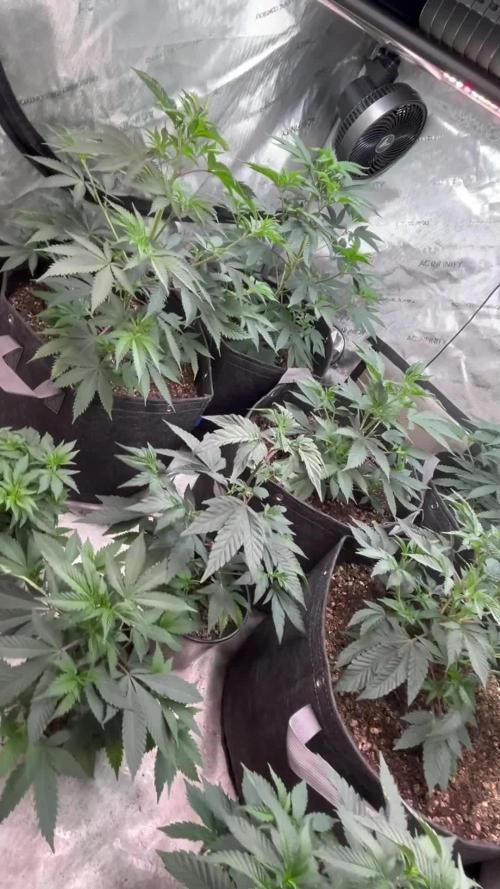
Sigue manteniendo su misma altura, pero se ah estirado bastante a los lados.
Ah llegado a expandirse unos 8cm aproximadamente a los lados ya lleva unos 53x53 cm aprox


@Insaniac_0
Follow
(11/25-12/01)
Hope everyone enjoys the daily progressions of overhead and side profile (Organized Chaos) Unfortunately they have too much of a toll for me to keep up with with 3 sets of grows going now, so this was the last week I am doing them on this set. I will try to add a video and black back or cover pics by end of week every week.
Week 3 Notes & Observations:
As mentioned last week, Plant 1 remains the supreme plant now and is producing nice stretch in the node spacing but is still showing a different type of leaf shape than plant 2. No issues from the mainline topping and they seem to be going okay. I will be topping again this weekend for the second of 3 total topping sessions. This topping will be 2 tops off the ends of the last and will produce 4 main colas.
**OOPS**
was being a little too aggressive in my HST while trying to set the mainline on both plants today. P1 was just a little rip of the skin, I taped her up and suspect she will be fine. However, on P2, I nearly snapped the whole branch off. I taped it and crossed my fingers hoping it works out in a week or two, but have serious doubts it will be able to mend such a large break. We'll see because I am posting ALL of the grow, the good and the bad.
VPD and PPFD:
This week I will hold the humidity in the tent to about 70-75% and temps will be monitored for 70- 75F daytime and 66-71F overnight. Im not adjusting my lights and look to control them 350ppfd max. Meaning slight increase over last week but mostly just growth increase.
Feed & Monitor:
***All feeds with nutes use either a whole ratio or combination of "Veg Mix" and "Bloom Mix"concentrates DILUTED in water until a total ppm of add-in is reached using a (Total Dissolved Solids) TDS Meter measured in PPM (parts per million). The "Veg Mix" concentrate will eventually be added in smaller ratios and "Bloom Mix" concentrate will eventually replace the "Veg Mix" concentrate entirely. The ppm and ratios of each feed will be listed when I feed. Veg mix recipe is on week 2. Bloom Mix recipe will be noted in this top message of the week that I make it.***
Day 28 (last feed was day 22)
Tested and Calibrated my ph pens. Starting weight from each pot was 18 lbs and 8 oz, P1 weighed 15lbs 12oz and P2 was 15lbs 4oz before feed. Each plant got 1 gallon of de-chlorinated tap water with 300ppm Veg Mix concentrate added (recipe on week 2 and makes 1 gallon at about 3600 to 4000ppm concentrate to dilute each feed, i.e. I only fed 300ppm above the purified water ppm this feed) The ph on this feed was balanced to 6.0ph to combat the original higher runoff ph from the first runoff feed. After feed P1 weighed 22lbs 3oz (21lbs 2oz after last feed) and P2 weighed 21lbs 14oz (20lbs 14oz after last feed). I got about 5cups of runoff on P1 (9 cups last feed) and 5 cups on P2 (7 cups last feed) . Runoff for P1 ph was 6.45 with 1170ppm (6.45ph with 980ppm last feed) and P2 was 6.45 with 1230ppm (6.45 with 1130ppm last feed). Top soil tested at: P1 6.35,6.3,6.33,6.33 for an avg of 6.327 (6.497 avg after last feed) and P2 tested at 6.47,6.37,6.26,6.51 avg 6.402 (6.46avg after last feed) - next feed will be 6.3ph as Im liking where the ph is so I dont see any issues, but will continue to monitor this way.
Day 34 (last feed was day 28)
Tested and Calibrated my ph pens. 1st Starting weight from each pot was 18 lbs and 8 oz. Before feeding this time, P1 weighed 14lbs 14oz (15lbs 12oz before last feed) and P2 was 14lbs 7oz before feeding (15lbs 4oz before last feed). Each plant got 1.5 gallons of de-chlorinated tap water with 98ppm Veg Mix concentrate added to flush any salt builds in the soil (recipe on week 2 and makes 1 gallon at about 3600 to 4000ppm concentrate to dilute in each feed, i.e. I only fed 98ppm above the de-chlorinated tap water ppm this feed) Due to this soil showing a possible calcium deficit, I am starting a 1ml per gallon add-in to test on all plants using this soil, so I added 1.5ml of CaliMagic (General Hydroponics 1-0-0) to each plant's feed then I ph balanced before feeding. The ph on this feed was balanced to 6.3ph. I used knitting needles to help both aerate the soil and create new water pathways for the roots. (a practice I may consider a new feeding standard) After feed, P1 weighed 21lbs 9oz (22lbs 3oz after last feed) and P2 weighed 21lbs 7oz (20lbs 14oz after last feed). I got about 11cups of runoff on P1 (5 cups last feed) and 11 cups on P2 (5 cups last feed). Higher runoff volume was expected with the feed volume increase for flush this round. Runoff for P1 ph was 6.65 with 838ppm (6.45 with 1170ppm last feed) and P2 was 6.60 with 879ppm (6.45 with 1230ppm last feed). Top soil tested at: P1 6.58,6.57,6.58,6.67 for an avg of 6.600 (6.327 avg after last feed) and P2 tested at 6.47,6.61,6.64,6.64 to avg 6.590 (6.402 avg after last feed) - next feed will be 6.0ph as I'm still liking where the ph is, but rather see it closer to 6.3 or 6.4 top and bottom. I dont see any issues with the feed's data other than the possible calcium deficit and I will continue to monitor runoff ppms as I expected this to be higher with more runoff.
Hope everyone enjoys the daily progressions of overhead and side profile (Organized Chaos) Unfortunately they have too much of a toll for me to keep up with with 3 sets of grows going now, so this was the last week I am doing them on this set. I will try to add a video and black back or cover pics by end of week every week.


@SmokingTiki
Follow
D16 : So far, the weather is really cloudy for the month of June and the plants stretched due to the lack of light. Since this is their final pots I decided to add a bit of soil around the stem to stabilize them. So far, it works pretty well. To test their stability, I've tried to blow on the plant before and after and the difference was clear!
The weather was bad this week but knowing that, the plants grew pretty well.
Parameters :
-------------------------------------------
Humidity range : 60-70%
Temperature range : 18-21°C
SUN Average : cloudy
Plants heights at the end of the week :
-------------------------------------------
Apricot : 12 cm
Gorilla Punch : 10 cm
Orange Sherbet : 10 cm
Pound Cake : 12.5 cm


@biggreens420
Follow
Did a little move around as the gorillas we're taking over the light so we get better light spread buds packing up nice and tight not much else to report....added the 3rd light not a hps though a mars hydro 960 thougt id better do it due to the gorillas taking over and just trying it out gonna try one for the last week in my gorilla and gsc diaries also see what there like thanks for reading happy growing guys


@BusyBeeFarmer
Follow
To push the pest resistance test even further (so far, the plants have shown resilience against fungus gnats, thrips, and excessive humidity), it’s getting too risky to allow the gnats to continue affecting my roots. As a test, I sieved fine sand from my garden and spread it over the soil to eliminate the gnats' living space. I gave the plants a good watering before applying the sand, and now I’ll leave it like this for a week. By the end of the week, I plan to repot them anyway, so we’ll see if this method clears up the gnat problem.


@BeggarsBelief
Follow
So everything took off in flower, I was super harsh with the defoliating which initially I regretted, but was surprised with how they packed out during the following weeks. In general it's impressive how hardy these plants are. Even the outdoor grows yielded some quality. Add some more nuets (overdrive and carbo load), before flushing about 14 days before harvest, next time I'll do this earlier and really the Runtz could have gone another week but my drying needs to happen in the same space as my growing for now. Apologies for the quality of image, I'm just using my phone and some bits I have to document, I collect records too, so expect weird noises lol. Build a rotating plat from a lazt susan I found, has been the best piece of kit added this season.


@MicroHidroGrow
Follow
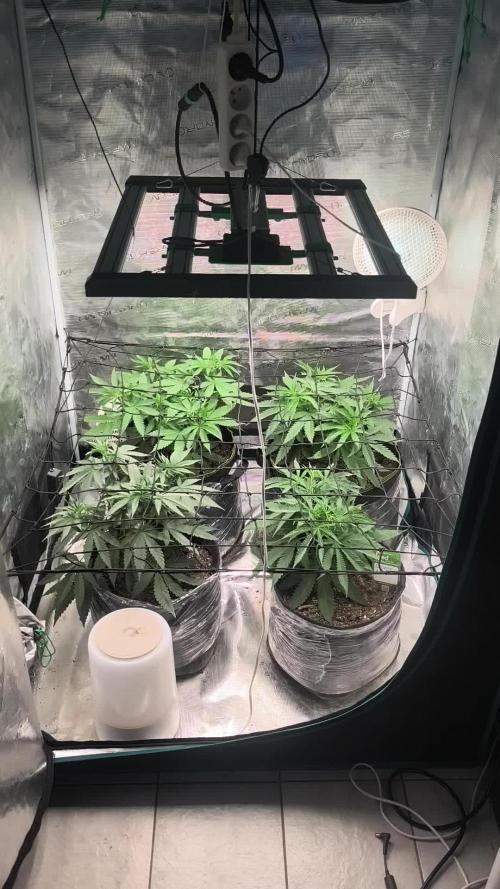
Ya estamos en proceso de formación de la flor. Se ven algunas más grandes que otras. Pero a grandes rasgos estan muy parejas. Me preocupa un poco la cercanía a la luz, dado que estoy en 15cm y cualquier estirón extra, sería una complicación. Vamos a ir viendo como se dan las cosas, pero al momento, no me puedo quejar. Las plantas se ven bien y saludables.
Día 24. Se empieza a notar el engorde. Esperando a que aparezcan las hojas de azúcar, que ya se empiezan a visibilizar las primeras. Voy a ver si puedo conseguir overdrive de advanced para cuando se terminen de formar las flores. Entre tanto solamente tuve un inconveniente de pérdida de agua por una manguera que moví al atar las plantas, pero ya repuse la solución perdida y todo va encaminado. No sé si van a tardar las 6 semanas que dice el catálogo, pero cuanto mucho serán 8. Seguiré actualizando.
Día 26. Las flores empiezan a yomar su forma voluminosa. Estoy en duda sobre si agregar PK la semana próxima o la otra. Quizá empiece a usarlo en el próximo depósito. No quiero tampoco sobrepasarlas y agregar el producto antes porque tengo entendido que puede ser contraproducente. De todos modos me quedan dos días para el cambio de solución, así que voy a ver cuando termine la semana. Entre tanto, ya empiezan las emociones.
Día 28. Hice ina poda de hojas bien fuerte. Ya de esa forma dejo expuesto a la luz todo lo que tiene que terminar de engordar y de paso me esquivo posibles problemas de humedad. Al final voy a usar el PK de greenhouse que tengo, pero voy a subir la dosis. Mañana se viene el cambio de solución, para lo que sería la ante última semana en teoría. Vamos a ver como evoluciona, porque los cambios son muy abruptos de una semana a la otra. Y llegado el momento miraré los tricomas, como para ir haciéndome a la idea.


@DeeDeeKushner
Follow
Day 19 of flower, I went ahead and lollipoped both girls. This will be my last time defoliating that heavy. As the days go by, I will defoliating here and there. They’re growing strong and healthy as well. 51 days until I harvest. I can’t wait!
Catch yall on the next update ✌️🏾


shorts_status_processing


@IndicaRising
Follow
START OF WEEK 4 FLOWERING. NUTRIENTS SAME 4 ML PER LITER RO WATER OF BOTH A & B. 2 ML PER LITER BIG BUD.
MIXED UP 8 LITERS OF NUTRIENT SOLUTION
---------------------------------------------------------------------------------------------------------
Day 64 April 18th - 2019 Both ladies had a little trim to get rid of thick interior.
Day 64 April 18th - 2019 Both Jessica Rabbit & Elly May were fed 1.5 liters of nutrient mix.
Day 64 April 18th - 2019 Temp in tent is @ 78.4° F.
Day 64 April 18th - 2019 Humidity in tent is @ 51%.
Day 64 April 18th - 2019 Jessica Rabbits Coco temp is @ 70.2° F.
Day 64 April 18th - 2019 Elly Mays Coco temp is @ 70° F.
---------------------------------------------------------------------------------------------------------
NOTE - Day 65 April 19th - 2019 The Lady in the coffee can is a clone from the Blue Cookies. The clone was 2 weeks old put in soil in the coffee can
It was put in the tent straight to flower No Veg time at all the clump of leaves at the bottom was how tall it was.
I have been feeding Her the same Nutrients I am using for Coco flowering with the Big Bud for Coco.
---------------------------------------------------------------------------------------------------------
Day 65 April 19th - 2019 Both Ladies are looking good after their little trim.
Day 65 April 19th - 2019 Temp in tent is @ 81.1° F.
Day 65 April 19th - 2019 Humidity in tent is @ 55 %.
Day 65 April 19th - 2019 Jessica Rabbits Coco temp is @ 71.8° F.
Day 65 April 19th - 2019 Elly Mays Coco temp is @ 71.6° F.
Day 66 April 20th - 2019 Ladies are looking good coming alone.
Day 66 April 20th - 2019 Temp in tent is @ 79° F.
Day 66 April 20th - 2019 Humidity in tent is @ 40 %.
Day 66 April 20th - 2019 Jessica Rabbits Coco temp is @ 69.3° F.
Day 66 April 20th - 2019 Elly Mays Coco temp is @ 69.4° F.
---------------------------------------------------------------------------------------------------------
Day 67 April 21st - 2019 Both Ladies received 1 liter pre-mixed solution
---------------------------------------------------------------------------------------------------------
Day 67 April 21st - 2019 The girls are looking fine.
Day 67 April 21st - 2019 Temp in tent is @ 79° F.
Day 67 April 21st - 2019 Humidity in tent is @ 47 %.
Day 67 April 21st - 2019 Jessica Rabbits Coco temp is @ 70° F.
Day 67 April 21st - 2019 Elly Mays Coco temp is @ 70° F.
Day 68 April 22nd - 2019 Ladies are looking good no issues.
Day 68 April 22nd - 2019 Temp in tent is @ 71.2° F.
Day 68 April 22nd - 2019 Humidity in tent is @ 57 %.
Day 68 April 22nd - 2019 Jessica Rabbits Coco temp is @ 67.6° F.
Day 68 April 22nd - 2019 Elly Mays Coco temp is @ 66.6° F.
Day 69 April 23rd - 2019 Both Ladies looking good.
Day 69 April 23rd - 2019 Temp in tent is @ 69.4° F.
Day 69 April 23rd - 2019 Humidity in tent is @ 61 %.
Day 69 April 23rd - 2019 Jessica Rabbits Coco temp is @ 65.7° F.
Day 69 April 23rd - 2019 Elly Mays Coco temp is @ 64.8° F.
Day 70 April 24th - 2019 Both ladies are coming alone.
Day 70 April 24th - 2019 Temp in tent is @ 67.1° F.
Day 70 April 24th - 2019 Humidity in tent is @ 61 %.
Day 70 April 24th - 2019 Jessica Rabbits Coco temp is @ 65.2° F
Day 70 April 24th - 2019 Elly Mays Coco temp is @ 64.0° F.







@DogDoctorOfficial
Follow
🥒 Project Blue Tent – Week 8
Pickle Lemon Haze F1 – Pheno B (Folder 14B)
Hello everyone, and welcome back to another chapter of Project Blue Tent! 💙🌱
If you're discovering this diary for the first time, welcome aboard!
Project Blue Tent follows four individual plants from seed all the way through harvest, with each phenotype receiving her own dedicated diary.
All four sisters share the same tent, lighting, irrigation, nutrition, environmental conditions and overall training strategy.
The idea is simple:
Keep the variables as consistent as possible and let the genetics tell the story.
And this week...
The story is getting very interesting.
Because all four girls have entered flowering with absolutely no intention of slowing down.
Today we're giving the spotlight to Pickle Lemon Haze F1 – Plant B.
And once again...
She's shining. 💙🌱
────────────────────────
🌸 Week Eight – Flower Has Arrived
The Blue Tent has officially entered the next chapter.
After seven full weeks of vegetation, we're now running 12/12, and the response from the plants has been immediate.
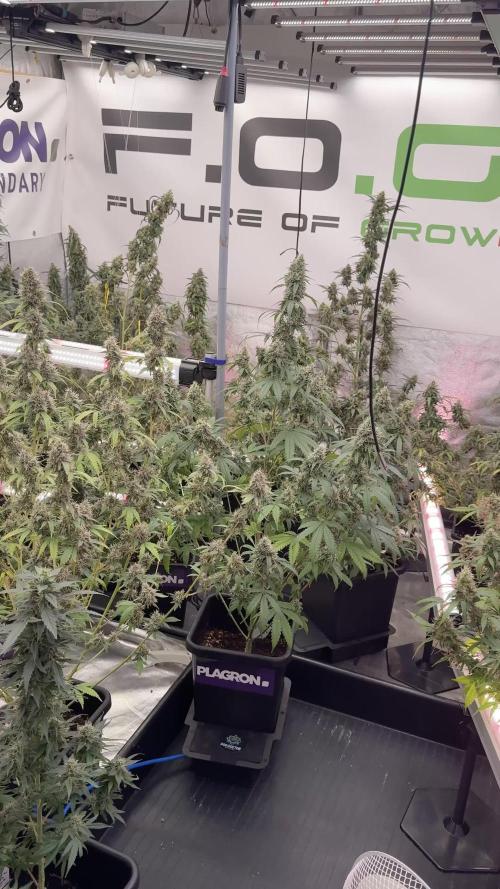
Plant B is now sitting around 81 cm, compared with approximately 60 cm when we finished the vegetative phase.
That's a serious amount of growth in a very short period.
And what's particularly impressive is that the plants aren't simply stretching upward.
They're developing everywhere.
The branches are extending.
New growth is appearing rapidly.
Flowering sites are becoming more obvious every day.
And the first real signs of bud development are now beautifully visible throughout Plant B's structure.
This is the point where all those weeks of preparation start becoming meaningful.
The SCROG gave us the structure.
The defoliation opened the canopy.
The training created the framework.
And now...
Flowering is filling that framework.
────────────────────────
🌿 Pickle Lemon Haze F1 – Plant B
Plant B continues to be one of those girls that makes me stop and look twice.
Her foliage is lush, vibrant and beautifully green, and the overall health of the plant is exactly where I want it to be.
The developing flowers are progressing quickly, with fresh pistils and new growth appearing throughout the canopy.
And despite the speed at which she's developing, she's still maintaining a remarkably even structure.
That's something I really appreciate about this phenotype.
She has always been a cooperative plant.
She responds well to training.
She builds strong lateral growth.
And even now, with flowering underway and the stretch accelerating, she's still giving us a canopy that is relatively easy to manage.
At least...
As easy as four extremely vigorous plants can be. 😂
────────────────────────
💥 Super Cropping – Keeping the Canopy Under Control
The biggest challenge right now isn't getting these girls to grow.
They've already made that part very clear.
The challenge is managing how quickly they're growing.
We're continuing to use super cropping on selected branches as another tool for managing the most vigorous vertical growth.
The idea is to reduce the dominance of certain shoots, redistribute growth and encourage stronger branching points as the plants continue developing.
And these girls are making me work for it.
I'll carefully work a branch down...
Come back later...
And somehow it's already standing back up again.
😂🌱
They're determined.
But that's actually what makes this stage so interesting.
We're not trying to stop their natural growth.
We're trying to work with it.
The canopy is already very even, and we're simply making small interventions where necessary to keep the most aggressive growth from getting too far ahead.
Whether we'll successfully keep everybody compact throughout the stretch?
Well...
Let's see.
They certainly haven't read that part of the plan.
────────────────────────
🌸 Bud Formation – Things Are Moving Quickly
One of the most exciting changes this week is the speed of flower development.
We're only at the beginning of flowering, yet Plant B is already showing beautiful formation throughout the canopy.
The sites we've spent weeks creating and positioning are now beginning to transform.
Pistils are appearing.
Clusters are becoming more defined.
And every day there's another little sign that tells me:
We're properly in flower now.
This is one of those moments where you can finally see the purpose behind all the earlier work.
The individual branches aren't just branches anymore.
They're becoming future flowers.
And Plant B has plenty of them.
────────────────────────
🌱 Seven Weeks of Vegetation – Was It Too Much?
Looking at Plant B now, I'm still wondering whether I gave these girls too much vegetative time.
Seven weeks of vegetation is considerably longer than I normally run.
Usually, I'd flip earlier.
But the extra time gave us something valuable:
A very established canopy.
Strong branches.
A developed root system.
And a structure capable of supporting a lot of flowering growth.
The downside is becoming very obvious now.
These plants have an incredible amount of momentum.
They grew from roughly 60 cm to around 81 cm incredibly quickly, and they're still moving.
So there is definitely a little bit of:
"What have I created?" 😂
happening in the grow room right now.
But worrying about it isn't going to make the plants grow slower.
We've prepared them.
We've trained them.
We've opened the canopy.
We're managing the stretch.
Now we watch.
And we see where these girls want to take us.
────────────────────────
💡 Strong Light From the Beginning
The transition into flowering also means we're starting with approximately 800 PPFD across the canopy.
I want these girls to have strong light available from the beginning of flower rather than slowly creeping toward higher intensity.
They're already extremely vigorous, so the idea is to give them the photons they need while closely observing how the canopy responds.
The challenge is balancing that strong light with the environmental conditions and the very significant stretch we're already seeing.
I'm particularly interested in seeing whether the combination of strong light and continued canopy management can help keep the plants from becoming excessively elongated.
Because if there's one thing Plant B has demonstrated this week...
It's that she has absolutely no shortage of energy.
────────────────────────
🌡️ Blue Tent Environment
The room continues to run with remarkably consistent conditions across all four sisters.
This week's recorded averages were:
• 🌡️ Day Temperature: 27°C
• 🌙 Night Temperature: 27°C
• 💧 Relative Humidity: 67%
• 🥥 Substrate Temperature: 24°C
• 💦 Nutrient Solution: 19.1°C
• ⚗️ pH: 5.81
• ⚡ EC: 2.09 mS/cm
• 💨 CO₂: approximately 666 ppm
• 💡 Light Schedule: 12/12
• 💧 Irrigation: approximately 1.4 L/plant/24h
• ? Pot Size: 8 L
• 📏 Plant Height: approximately 81 cm
One thing that continues to stand out is the relatively small difference between day and night temperatures.
We're sitting around 27°C for both.
That can contribute to continued stretching, and considering how quickly these girls are already growing, it's something I'm keeping firmly in mind.
But for now, Plant B is responding beautifully.
Healthy foliage.
Strong development.
Rapid flower formation.
And no obvious signs that she's unhappy with her environment.
────────────────────────
🥥 Feeding – Supporting the Transition
The flowering nutrition is now established.
Current feeding:
• Plagron Hydro A — 2 ml/L
• Plagron Hydro B — 2 ml/L
• Plagron Hydro Roots — 1 ml/L
• Plagron Power Buds — 1 ml/L
• pH Plus — 0.03 ml/L
• pH Min — 0.03 ml/L
Current EC:
2.09 mS/cm
pH:
5.81
The plants are consuming aggressively and developing extremely quickly, so the nutritional strategy is now supporting that transition without making unnecessary changes simply for the sake of changing something.
Plant B's colour is exactly what I want to see.
That beautiful, lush green foliage is telling me that she's handling the current program very well.
And when I look at the flowering sites developing throughout the canopy...
I'm certainly not seeing a plant asking me to interfere.
So for now:
We stay consistent.
Observe.
Measure.
Adjust only when necessary.
────────────────────────
💧 The Drip & Drainage System – One Continuous Loop
The automatic irrigation and drainage setup has become one of my favourite parts of this project.
Plant B is now receiving approximately 1.4 litres of nutrient solution every 24 hours through the drip irrigation system.
The process is beautifully simple.
The drippers deliver the nutrient solution directly to the coco.
The solution passes through the substrate and feeds the root zone.
The resulting runoff drains into the collection trays underneath the grow bags.
From there, the drainage pipe carries the water toward the pump.
The pump removes the collected runoff and returns it toward the reservoir, creating a recirculating irrigation and drainage loop.
Water goes in.
The plants use what they need.
Runoff is collected.
The pump moves it away.
And the system continues its cycle.
It's a remarkably elegant setup when everything is working properly.
And right now...
It is working wonderfully.
The plants are growing rapidly, their water demand is increasing, and the system is keeping irrigation consistent without requiring me to manually water four increasingly thirsty plants every day.
That consistency is especially valuable in a project where we're deliberately trying to keep the four sisters under comparable conditions.
It's another variable we can keep controlled while we watch the genetics express themselves.
────────────────────────
🕸️ Managing the Canopy During the Stretch
The SCROG has already done its main job.
Now we're using the structure we've created to manage flowering growth.
The canopy remains impressively even.
There are no huge dominant towers completely taking over the room.
Instead, the flowering sites are distributed across the surface we've spent weeks building.
But the stretch is happening quickly.
So we're continuing to watch the taller shoots and selectively using training and super cropping where necessary.
This isn't about constantly manipulating the plant.
It's about making small corrections before a branch becomes a major problem.
A little intervention now can be much easier than trying to fix an overly dominant branch later.
And Plant B has responded very well so far.
She's stretching...
But she's stretching into a structure.
That's exactly what I wanted.
────────────────────────
🌿 Plant B's Personality Is Still There
This is one of my favourite things about Project Blue Tent.
From above, the four sisters can look almost identical.
Same tent.
Same lights.
Same irrigation.
Same nutrients.
Same environment.
And yet...
Spend enough time with them and their personalities start becoming obvious.
Plant B remains one of the more naturally cooperative phenotypes.
She's vigorous, but her structure remains usable.
She's growing rapidly, but the canopy hasn't become chaotic.
She's producing flowering sites quickly, while maintaining that beautiful green foliage we've been watching since vegetation.
And now she's showing another characteristic:
She doesn't seem particularly interested in slowing down.
😂🌱
Which, honestly, is a pretty good problem to have.
────────────────────────
🌸 From Canopy to Flowers
There is something incredibly satisfying about looking at Plant B now and remembering what she looked like only a few weeks ago.
Back then, we were talking about:
Topping.
SCROG.
Empty squares.
Branch positioning.
Defoliation.
Canopy management.
Now we're talking about:
Flowering sites.
Pistils.
Stretch.
Bud formation.
And eventually...
Bulk.
That's the transition we've been working toward.
The plant has moved from building the machine to using the machine.
The canopy is the foundation.
Now the flowers get to take over the story.
────────────────────────
👀 Looking Ahead
The next couple of weeks should be fascinating.
All four sisters are moving incredibly quickly, and Plant B is right there with them.
We'll continue managing the canopy as needed.
We'll keep an eye on the stretch.
Super cropping will remain one of the tools available when individual branches get too ambitious.
The irrigation system will continue providing its consistent cycle.
The flowering nutrition will continue supporting development.
And the environmental conditions will remain under close observation.
Most importantly...
We don't need to panic about the speed.
Yes, they're growing fast.
Yes, I may have kept them in vegetation longer than usual.
Yes, the warm nights aren't exactly helping us keep the stretch compact.
But the plants are healthy.
The canopy is remarkably even.
The flowers are forming beautifully.
And Plant B is looking absolutely fantastic.
So...
Let's see where this goes.
🌸💙
────────────────────────
💙 Thank You
A huge thank you to Zamnesia for making Project Blue Tent possible and for giving us the opportunity to explore these Pickle Lemon Haze F1 genetics phenotype by phenotype.
A heartfelt thank you to Plagron for the Premium Growbags and Hydro nutrient line supporting these girls throughout their journey and now through the beginning of flowering.
A special thank you to Zamnesia for the Phytonaut LED lighting helping us create such a strong, even canopy and now providing the intensity we're using during the transition into flower.
And a massive thank you to Mars Hydro for the automatic drip irrigation and drainage system.
Watching the drippers, coco, runoff collection, drainage lines, pump and reservoir work together has been incredibly satisfying.
The system has become an important part of keeping the entire room consistent.
Thank you as well to GrowDiaries for providing a place where growers from around the world can document their journeys, exchange experiences and learn together.
And finally...
Thank you to everyone following Project Blue Tent. 💙
Plant B has officially entered flowering.
She's stretching.
She's building flowers.
She's producing lush, beautiful growth.
And she's making it very clear that seven weeks of vegetation gave her plenty of momentum.
😂🌱
For now, the canopy remains beautifully even.
The flowers are developing quickly.
The super cropping is helping us manage the most ambitious branches.
The irrigation system is doing its job.
The nutrition is supporting the transition.
And Plant B...
Well...
She's simply shining.
Four sisters.
One environment.
One experiment.
And four plants that somehow manage to make every week more interesting.
Let's see what the next chapter brings.
Until next week...
Growers Love, happy growing, and take care everyone! 🌱💙