


Likes
Comments
Share

@Rare_Terps_5280
Follow
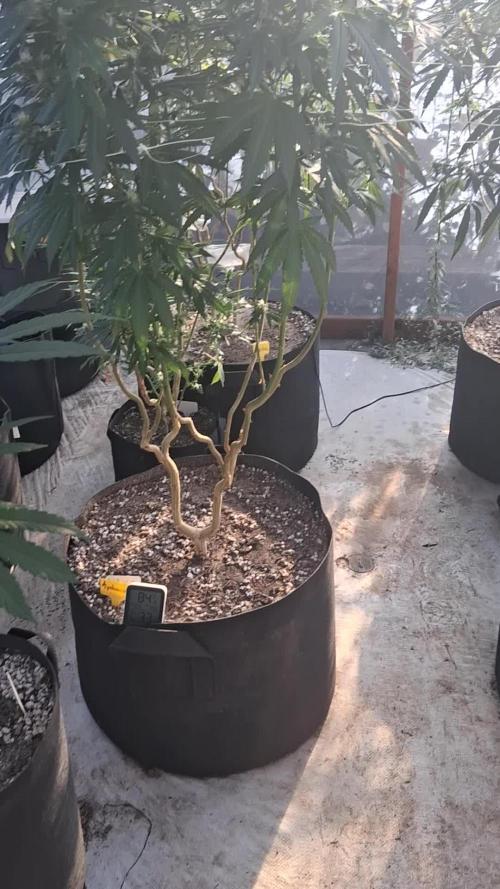
This tall gal flipped to flower over past few weeks, 3rd week. Started new nutrients to bulk her up and get those terps popping. Shes over 6ft now and about 1.5ft from top of green house so hope growth upward slows a bit.

Likes
12
Share


@Northern_Ent
Follow
Aug 10: small but fast this Chemdawg is going to be ready pretty soon. I’ll resist the urge to harvest for a couple more weeks.
Using the UV lights for a few hours at mid-day. Early in using it, but I think it helps.
Aug 11: another perfect cannabis weather day with all day sun and five hours of UV lights. Ideally I’d have another set of four lights so to get full coverage I’m rotating the plant 90 degrees every 1.5 h or so for five hours total coverage. With the uniform manifold this isn’t a problem as the overall light coverage is quite even.
Anyway, she’s getting some good strong light so some trichome production should kick in here soon. Looks good.

Likes
8
Share


@AustinRon
Follow
Week 11 - Flower 7
Sangria - by Twenty20 Mendocino
4Q 2022
Flower Week 6: Wednesday 15 March - Tuesday 21 March 2023
Start of Week: [ 2022-03-15, SA20 78:F:11:1]
End of Week:
[ 2023-03-21, SA20 84:F:11:7]
HeightWeekStart: [ 14.5, in]
HeightWeekEnd: [14.5, in]
Start Date: 28.12.2022 # Seeds Wet
Harvest Window: 17 - 27 March 2023, 79 - 89 Days
EnvironmentGermination
- LightDistance: [ 14.5, in]
- LightStrength: [911, 505, µmol/m2/s]
- Temp: [ 79, 85, °F]
- RH: [ 73, pct]
- HumidifierTrigger: [ 69, %]
Fertigation
(BioAg, Mammoth-P)
__________________________
Wednesday 15 March 2023
SA20 78:F:11:1
- BluMats allowed to water ~1/2 Gal . . . There’s a bubble in the top of the carrot, which is why it doesn’t shutdown. Sensor (carrot) tubes have to be AIR FREE. Will continue to manually start & stop.
Thursday 16 March 2023
SA20 79:F:11:2
- Goal Today: Forward: Lower Lights to achieve < 79°F

- Top Watered: [ RootedLeafPeakBloom, 2, ml, l], amt: [ 1, l]: # Potassium Based Finisher
Friday 17 March 2023
SA30 80:F:11:3
- [ ] Turn Water ON?
Saturday 18 March 2023
SA20 81:F:11:4


Sunday 19 March 2023
SA20 82:F:11:5
- 1 Liter Resin Bloom @ 0.8 EC
- TEMPS < 79F
- RH ~65
Monday 20 March 2023
SA20 83:F:11:6
Tuesday 21 March 2023 - HARVEST DAY
SA20 84:F:11:7
- Allowed probably 1/2 - 3/4 watering Thursday, 1 Liter of CalMag Fuel w/ Resin Bloom Friday, 1 Liter Resin Bloom @ 0.8 EC Sunday
- Opened and cut - and THE HOUSE IS LOUD! Beautiful slightly (nicely) sweet floral with full spectrum of dark and medium tones.
- Bottom Line: The Aroma of Sangria is inviting, friendly, and calming. It says, 'Hi there! Do you want to be my friend?'

Likes
12
Share


@Kakui
Follow
Flower41, riego con EC 2.6 y pH 6.3, los cogollos están muy gruesos y densos, definitivamente este cultivo debería ser mucho más productivo que el anterior.
Flower44, riego con EC 2.5 y pH 6.2, a un par de días de terminar el proceso y cosechar.

Likes
19
Share


@Naturalist
Follow
Watered straight water on day 130, runoff & pH still high at 5/3230, raised lights to 23" above the canvas do give better coverage but only getting between 17,000-35,000 lux so I'm under lit for flower, might be upgrading to HLG Scorpion R Spec LED.
Added half a tsp NPK Microbes Bloom Stage today, hopefully this will help.


Likes
9
Share


@Warhead
Follow
🗓️95 3/28/21 🌖 🌻60
🔆 12/12
🌡️ 79°
🌁 58%
⚗️732
💧6.0
📝 one of my branches has gone polyploidy.
🗓️97 3/28/21 🌕 🌻62
🔆 12/12
🌡️ 80°
🌁 58%
⚗️567
💧6.2
📝 Added 1ml of PH⬇️
🔆Light schedule 🌡️Air temp. 🌁Humidity 💧PH ⚗️TDS 🚰Water added 📏Height 📊Nutes added ♻️Reservoir change

Likes
3
Share


@The_Lonely_Farmer
Follow
So I have decided too pot up the 3 toronjaz girls into bigger pots, 1 because the older girl needed it but 2 also because I feel they needed space and a new home too stretch their roots out 🌱
The above blend will hopefully help these girls soldier through these first crucial weeks, let's keep our fingers crossed 🤞
I'll be doing light lst over the next week for the older girl, maybe top her end of week 3 maybe 4 depending on how she grows 🌱
Light feeds slow and steady will do as new too aptus buy I hope I can do well with them as they seem really simple too use and also their website has lots of usefull info incase I'm in need 🙏👏👊
These will be tidied up and given this space too their selves once my fastbuds testers in the back there are ready for new pots and their new space I have waiting 🌱


Likes
23
Share


@MistaOC
Follow
*******************************************
11.02. Day 16
*******************************************
13.02. Day 18
*******************************************
16.02. Day 21
*******************************************

Likes
20
Share


@RakonGrow
Follow
5 Tage Zelt , aber ich glaub ich trenn da noch einige dinge . alles recht fett geworden .
So vom 4 Tag im Trockenzelt mal Photos gemacht. DAs ist also die aktuelle Budgröße .
Eine sehr fluffige Sorte !!!
Es ist endlich Zeit fakten zu schaffen . Die Ernte hat glatt ein 5 Liter Messbecher gefüllt und hat dabei 145 Gramm erbracht. Die Buds sind eher fluffig als fest . Ein gutes Beispiel dafür das die Buds zwar riesig aussehen , aber eigentlich nichts wiegen. Obwohl das optisch mein Größter Grow war, ist die Erntemenge doch weit aus geringer ausgefallen . Geschmack ist kräftig würzig mit einer Methol Note . Die Trichome sind von einem Sidebud genommen. So wirklich gut getroffen hab ich den Erntezeitpunkt nicht . Aber es klebt und klebt und klebt . Einfach perfekt fürs Vapen durch meine Wasserpfeife .
Likes
Comments
Share

@bigsmoke42069
Follow
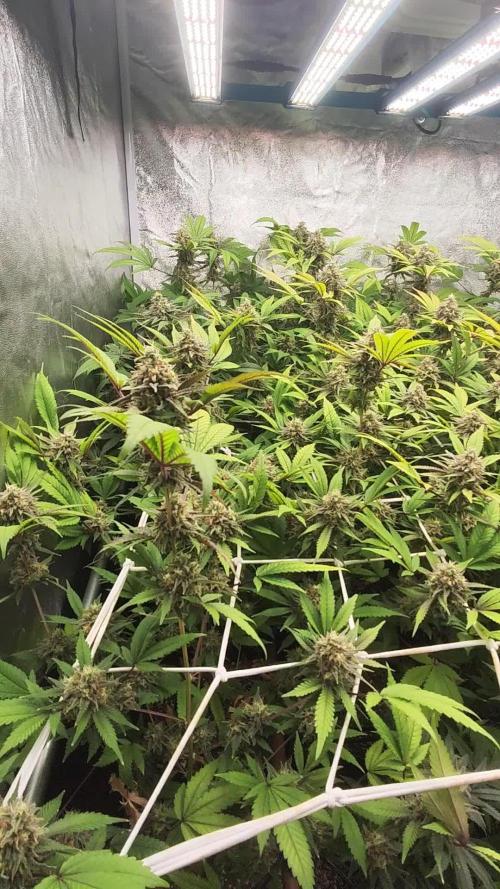
Week 7 (1.29.26 --2.5.26)
took photos on 2.5.26
2.1.26
Transitioned to ripen nutes
2.3.26
Transitioned to T.A. FinalPar


Likes
2
Share


@ao_grows1978
Follow
Week 2 for the solo Afghani went smooth. Looked a little slow to develop her first proper set of leaves, but the root development should help speed up her progression. Still feeding off the slow release 444 and is now regularly drinking about 2oz of water every other day. I also spritz the bottom of the outer cup to keep moisture levels high for stretching roots. She's about 36" from the light. Hoping to get a little stretch to make training easier. Added a couple new pics to get the week caught up. Stay tuned, week 3 starts training.
Likes
5
Share


@Ninjabuds
Follow
It's amazing how quickly the weather can change. Just a few weeks ago we were bundled up in our warmest coats, and now it's finally starting to feel like springtime. With temps in the 40s and 50s, it's the perfect time to get outside and enjoy the sunshine.
My pound cake plant is finally getting somewhere. It's totally weird, because the stems turned this super cool purple color. Soon it's going to be covered in pound cake buds that'll be ready to eat. I'm thinking fancy frosting might be the way to go, but I'm also considering something fruity on top.
Likes
21
Share

@Cooky_420L
Follow
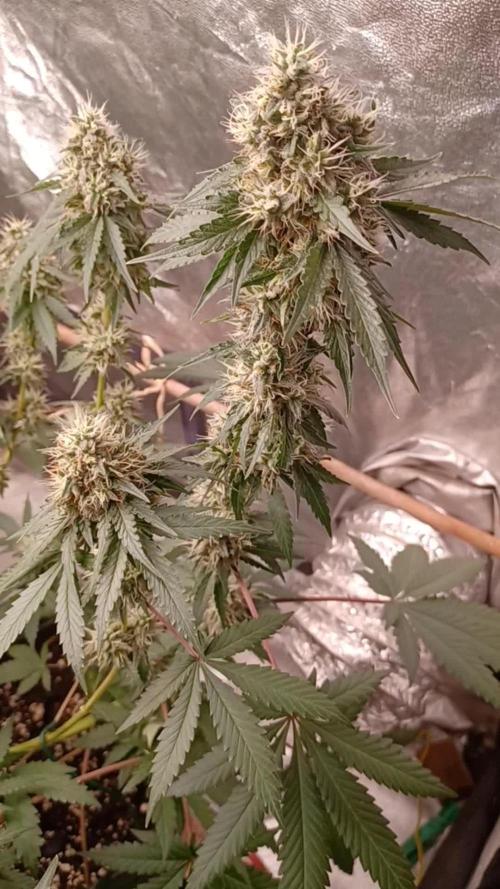
7' semaine de floraison 86 jours de vie et 47 jours de flo , elles vont bien la semaine c'est bien passé, ayez elles gonfle . Elles ont reçu encore de l'engrais à 2.2 d'EC (5ml terra Bloom, 1.5ml PK13, 1ml Green sensation)
Merci aux Growmies qui me suivent ✌️ Bonne semaine de culture à tous les p'tites ✋️ vertes 🌱🌞🌱


Likes
3
Share

@Grow4ever
Follow
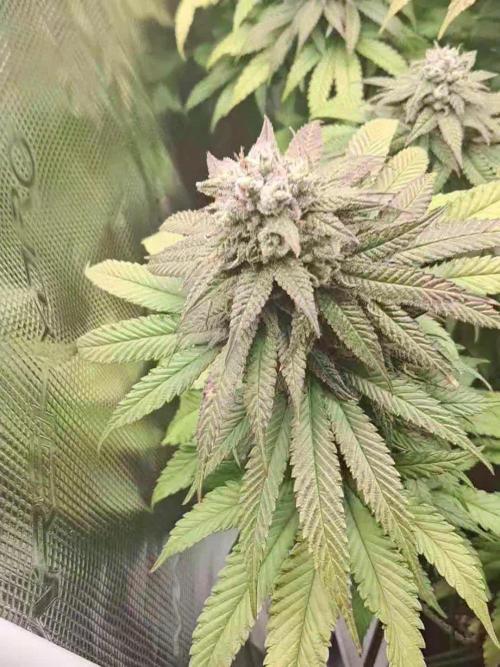
Absolute Pracht.
Die Pineapple Express macht ihrem Ruf alle Ehre.
Duftet süß und fruchtig, ziemlich genau wie mein erster Phäno. Buds sind bisher bei ihr am dicksten.
Likes
2
Share


@Ultraviolet_
Follow
We become aware at such times of man's wonderful ability to bring seemingly unrelated elements into harmonic balance, and receive a glimpse into a world where everything exists in conscious sympathetic attunement to everything else. When we listen to a piece of music that seems to strike a beautiful chord somewhere inside us, or view a painting that simply glows with harmonic awareness well executed, we probably do not spare much time to contemplate the wonderfully intricate combination of vibrations that our sensors make it possible for us to perceive. We tend to appreciate the relationship between the parts of something by an awareness of the harmony or dissonance of the whole. This ability enables us to say "what a beautiful house!" instead of "analysis has proven that this collection of building materials exhibits certain elements of harmonic proportion." While this ability to instinctively appreciate the beauty of true harmony has an important role to play in evolution, a more analytical understanding of the laws involved can be most useful. This is especially so if we wish to create works of art where each part exists in true harmony, not only with the other part of that particular whole, but with the universe within which the creator and the created exist.
Everything vibrates. From the most dense matter to the most subtle cosmic rays, everything which our senses allow our thoughts to become aware of, can be specified in terms of wavelength or frequency of vibration. These two terms define the same thing, but from different points of view.
The following are the approximate wavelengths of various energy carriers:
Cosmic rays 0.000,000,001 mm
Gamma rays 0.000,000,1 mm
X rays 0.000,500 mm
Ultraviolet rays 0.003 mm
Visible light 0.006 mm
Infrared 0.01 mm
Sound waves 1 meter
Radio waves 300 meters
Violet light 400 nm to 450 nm
Blue light 450 nm to 500 nm
Green light 500 nm to 570 nm
Yellow light 570 nm to 590 nm
Orange light 590 nm to 610 nm
Red light 610 to 700 nm
1 nanometer (nm) = 0.000,000,1 cm = 1/10,000,000 cm
If a guitar string is plucked and we hear a sound, it is not too difficult for the human mind to associate this sound with the vibration of the guitar string. With color it is quite different. It is difficult for us to conceive that the color of a substance is not an inherent property of the substance itself, but an indication picked up by our senses of that substance's ability to absorb or reflect the light which happens to be shining on it at that moment. Neither the matter nor the light is colored. What happens is that the brain learns to differentiate between the frequencies reflected or transmitted by the substance the eyes are focused on. The same thing happens with sound. When we say "Oh! Listen, they're playing my favorite song," what we really mean is: "My brain has stored within it a particular pattern of frequencies. I have compared the new information being received with this stored pattern and have deduced the answer that the two patterns are similar within certain specified tolerances." The 'pleasure' involved could have something to do with our running the pre-recorded pattern at the same time, in 'sympathy' with the new pattern as it is received.
The word sympathy describes very well our ability to appreciate color and sound. It also describes the reason behind certain elements of harmony. For instance, if a substance vibrating at 100 cycles per second (tone 1) is in the proximity of another substance vibrating at 200 cycles per second (tone 2), we could perceive, if we had the right equipment, a certain sympathetic relationship between the two.
We will see from this that there is a uniform doubling of the first tone seen in the second. At various points along the waves, the two are the same in amplitude. At other points, they are at opposite poles to each other. This doubled frequency has more points of similarity to the original than any other frequency except the original itself. If the equipment we had available for measuring these two frequencies was a soundboard amplifier and a pair of ears, then we would hear what would sound to us like one tone. If we had the opportunity to hear one at a time, we would hear that although they sound the same, one is higher in pitch than the other. This characteristic of 'the same but different in pitch', musicians have called the octave. Any two tones produced where one has exactly doubled the frequency of the other is called an octave. Speaking in ratios, an octave would appear then as the ratio 2:1 or 1:2, depending on whether we are talking of an octave up or down.
A single note produced by almost any instrument will contain more than one wavelength or frequency. It will have a dominant frequency, the wavelength of which we would call the note's 'fundamental' or 1st harmonic. It will also have a varying number of upper harmonics, gradually fading in intensity into infinity or silence.
Natural harmonics always have the same pattern of intervals between them. The interval between the 1st and 2nd harmonic is a perfect octave; between the 2nd and 3rd a perfect fifth; between the 3rd and 4th a perfect 4th; and so on, the intervals becoming smaller and smaller until they lose any relationship with the western 12 tone scale as it exists at the moment. Just as an octave has certain elements of sympathy with its fundamental, so some intervals have been noted to be more perfectly in sympathy with the fundamental than others. The ratio of the 'perfect 5th' or interval of 7 semitones, as it occurs in the harmonic series, is 3:2 or 2:3, while that of the 'perfect fourth" is 4:3 or 3:4. All the tones in the western 12 tone scale can be expressed in terms of the ratio between the upper tone and its fundamental. This would seem to be an ideal way of generating a scale from any given fundamental and several attempts have been made to do this, the Pythagorean system being probably the most well known. Although when working with a single tone instrument playing on its own, the Pythagorean formula works wonderfully well, if we had several instruments tuned this way together and asked them to play almost any western music, we would find that at times they sounded quite out of tune to each other.
The lack of flexibility of the various scale systems based on the harmonic series has led to what is known as the 'tempered' scale. This uses as its primary unit of interval the ratio of the octave or 2:1. It then proceeds to divide the interval between any fundamental and its upper octave into 12 smaller intervals by applying the ratio: two to the one-twelfth power, to one (21/12:1). This equals 1.059463094, so by multiplying any frequency by this number, we will obtain the tempered semitone next up from our fundamental. We will also find that any tone twelve semitones up from any other tone, in a scale generated in this way, will have exactly double the frequency.
If we took the note middle C on a piano and halved the wavelength, we would have the note C one octave above. If we halved this, we would have the C above, and so on. However, within about 6 octaves, we would find that although a 'sound' was being produced, no human ear could perceive it. If we kept on going, halving and producing upper octaves of our fundamental C, we would proceed through the infrared band, into the visible light spectrum. If we happened to be outside during the day, we would, for one octave only, see the note C with our eyes. The next octave above would already be in the ultraviolet band, and outside the eye's sensitivity range. If we can think of color as being an indication of a substance's vibratory rate or wavelength, we may begin to see a relationship that could exist between the color and sound spectrums.
The logical extension of what has so far been said is that there exists a scale in the color spectrum that corresponds exactly to the scale in the sound spectrum, each color tone being an octave of the equivalent note in the sound range.
This is not the end of the story but only the beginning. If we can for the moment accept that any wavelength in one band has upper and lower octave stretching out to infinity, then the next question is 'fine, but what shall we use as our fundamental? A particular color? A particular sound frequency?' The musicians among us will probably say 'A 440'. This means that the note A should vibrate at 440 Hertz, or 440 times per second. They would tell us that this is standard pitch has been adopted by most orchestras around the world; pianos are tuned to it, instruments are constructed to formulas based on it, and so to them it would probably seem the most appropriate place to begin. Some of these musicians may know of the battle that is still raging with regards to this being the standard, but few would know why A = 440 Hz was chosen except that it worked when it was set to be a suitable compromise between the many different pitches in use at the time.
432 Hz is said to be mathematically consistent with the patterns of the universe. Studies reveal that 432 Hz tuning vibrates with the universe’s golden mean PHI and unifies the properties of light, time, space, matter, gravity, and magnetism with biology, the DNA code, and consciousness. When our atoms and DNA start to resonate in harmony with the spiraling pattern of nature, our sense of connection to nature is said to be magnified.
Another interesting factor to consider is that the A=432 Hz tuning correlates with the color spectrum, while the A=440 Hz is off. Audiophiles have also stated that A = 432 Hz music seems to be non-local and can fill an entire room, whereas A=440 Hz can be perceived as directional or linear in sound propagation.
Once you adopt the idea that sound (or vibration in general) can have an equalizing and harmonizing effect (as well as a disturbing effect), the science of harmony can be applied to bring greater harmony into one's life or tune to specific energies. There is a form of absolute and relative harmony. Absolute harmony can, for example, be determined by the tuning of an instrument. The ancients tuned their instruments at an A of 432 Hz instead of 440 Hz - and for a good reason. There are plenty of music examples on the internet that you can listen to in order to establish the difference for yourself.
Attuning the instrument to 432 Hz results in a more relaxing sound, while 440 Hz slightly tenses up the body. This is because 440 Hz is out of tune with both macro and micro cosmos. On the contrary, 432 Hz is in tune. To give an example of how this is manifested microcosmically: our breath (0,3 Hz) and our pulse (1,2 Hz) relate to the frequency of the lower octave of an A of 432 Hz (108 Hz) as 1:360 and 1:90.
It is interesting to note that 432 Hz was the standard pitch of many old instruments and that it was only recently (19th and 20th century) the standard pitch was increased. This was done in order to be able to play for bigger audiences. Bigger audiences (more bodies) absorb more of the lower frequencies, so the higher pitch was more likely to “cut through”. One of the oldest instruments of the world is the bell ensemble of Yi Zeng (dated 423 BC), tuned to a standard F4 of 345 Hz, which gives an A= 432 Hz. The frequency of 345 Hz is that of the platonic year! Similarly, many old organs are tuned in A=432 as well; for example, St. Peter’s Capella Gregoriana, St. Peter’s Capella Giulia, S. Maria Maggiore in Rome.
Maria Renold’s book “Intervals Scales Tones and the Concert Pitch C=128 Hz” claims conclusive evidence that 440 Hz and raising concert pitch above scientific “C” Prime=128 Hz (Concert A=432 Hz) disassociates the connection of consciousness to the body and creates anti-social conditions in humanity.
The difference between concert pitch A=440 Hz and Concert A=432 Hz is only 8 cycles per second, but it is a perceptible difference of awareness in the human consciousness experience of the dream we share called existence.
Likes
6
Share


@AcidBurn_40
Follow
30.09.24 BT#10
Guten Abend liebe Growmie's ✌️😃
Es läuft soweit alles wie es soll , die Ice Cream Cake hat ein kleines Stickstoff Defizit heute erst mal den Drain gemessen lag noch imm Bereich des erträglichen 6,0 Ph. Wollte ausschließen das zu ein niedrigen Ph wert oder ein zu hoher die Stickstoff Aufnahme gehemmt wurde aber alles im Lot.
Deswegen bekommt Sie beim nächsten Gießen ihre Gewünschte Position Futter ohne Bedenken eine Nährstoffsperre zu festigen.
So macht Sie sich gut klar sie ist gerade nicht in der Lage Ihr Blattwerk weiter auszubauen geschweige Blüten vernünftig zu bilden.
Wird sich erholen dann ist sie wieder voll dabei bis dahin weiter so.
Vielen Dank an alle die vorbeigeschaut haben bleibt cool and stay High.
Mögen all eure Ladys Gesund und prächtig wachsen und euch mit schmackhaften Stuff versorgen 🔥🍀
■■■■■■■■■■■■■■■■■■■■■■■■■
30.09.24 BT#10
Good evening dear Growmie's ✌️😃
So far everything is going as it should, the Ice Cream Cake has a small nitrogen deficit today first measured the drain was still in the range of the tolerable 6.0 Ph. Wanted to rule out that too low a Ph value or too high the nitrogen uptake was inhibited but everything was fine.
That's why the next time she is watered she will get her desired position of food without having to worry about consolidating a nutrient barrier.
In this way, it makes itself clear that it is not in a position to develop its foliage any further, let alone form flowers properly.
It will recover and then it will be back in full swing until then.
Many thanks to everyone who has stopped by, stay cool and stay high.
May all your ladies grow healthy and splendid and provide you with tasty stuff 🔥🍀