


Likes
Comments
Share


@ZhulenejJohny
Follow
Zdarec growers, tenhle týden jsem ubíral hnojky a od příštího týdne jedeme flush. Sekec cca za týden. Možná ještě sejmu plachťáky třeba na posledních 5dní. Peace


Likes
313
Share


@Tower84
Follow
🌿 Mentha de Croco von Terpyz 🇩🇪
Woche 25 und mittlerweile ist bei beiden Pflanzen das Höhenwachstum endgültig Geschichte 🌿. Die linke Mentha de Croco steht weiterhin bei etwa 2,18 m, während die rechte Pflanze sogar noch etwas weiter auf 2,37 m gewachsen ist 📏🚀.
Bei der Budentwicklung liegt die linke Pflanze weiterhin vorne 🌸. Die Buds sind schon deutlich weiter entwickelt und werden langsam richtig interessant. Beim Reiben an den Zuckerblättern kommt mittlerweile ein extrem intensiver, zitroniger und fast schon lösungsmittelartiger Geruch zum Vorschein 🍋. Ein wirklich spannendes Aroma, das ich so bisher noch nicht bei einer meiner Pflanzen hatte 👃🔥.
Die rechte Pflanze verhält sich dagegen momentan deutlich zurückhaltender. Ihr Geruch wirkt erdiger und weniger intensiv 🌱. Aber die Blüte ist noch lange nicht abgeschlossen und gerade beim Terpenprofil kann sich in den kommenden Wochen natürlich noch einiges verändern. Ich bin deshalb sehr gespannt, ob sich die beiden Phenos am Ende noch stärker auseinanderentwickeln 👀🌸.
Was mir ebenfalls zunehmend auffällt: Das Cultivar scheint wirklich zur Ausbildung riesiger Buds zu neigen 😳🌸. Genau das lässt mich inzwischen etwas nervös werden, denn auch meine beiden Pflanzen beginnen, ordentlich Masse aufzubauen. Ich bin gespannt, ob die Zweige das Gewicht der Buds gegen Ende der Blüte tatsächlich problemlos tragen können 💪🌿. Nach den Erfahrungen mit den starken Herbststürmen werde ich das auf jeden Fall genau im Auge behalten 🌬️.
Ansonsten passiert momentan gar nicht so viel. Heute bekommen beide Pflanzen noch einmal Almicanna Komposttee 🍵. Danach heißt es eigentlich nur noch beobachten und die Pflanzen machen lassen.
Der Wasserverbrauch liegt aktuell bei ungefähr 4 Litern pro Pflanze und Tag 💧. Je nachdem, wie warm es tagsüber wird, schwankt das natürlich etwas. Durch die deutlich kühleren Temperaturen ist der Bedarf mittlerweile wesentlich niedriger als noch vor einigen Wochen 🌡️.
Ich würde sagen, dass wir jetzt ungefähr Halbzeit bei der Blütenentwicklung erreicht haben 🌸⏳. Und genau ab jetzt wird es richtig spannend. Die nächsten Wochen werden zeigen, wie gut das Wetter mitspielt und wie sich die Buds unter den Bedingungen des deutschen Herbstes weiterentwickeln 🍂🌧️.
Wenn alles nach Plan läuft, wäre Ende Oktober ungefähr der angepeilte Erntezeitraum ✂️🌸. Bis dahin kann allerdings natürlich noch einiges passieren. Jetzt heißt es Daumen drücken für möglichst viel Sonne, wenig Dauerregen und vor allem keinen großen Sturm mehr 🤞☀️🍂.
🌿 Mentha de Croco by Terpyz 🇬🇧
Week 25 and by now the vertical growth is definitely over for both plants 🌿. The left Mentha de Croco is still around 2.18 m, while the right plant has reached an impressive 2.37 m 📏🚀.
The left plant is still ahead in bud development 🌸. The buds are noticeably further along and are starting to become really interesting. When rubbing the sugar leaves, the aroma has become extremely intense, very lemony and almost solvent-like 🍋. It’s a really fascinating terpene profile and definitely something I haven’t experienced with one of my plants before 👃🔥.
The right plant is much more subtle at the moment. Its buds have a more earthy and less intense aroma 🌱. But flowering is still far from finished, and the terpene profile can obviously change quite a lot over the next few weeks. I’m therefore very curious to see whether these two phenotypes will become even more different by harvest 👀🌸.
Another thing I’m noticing more and more is that this cultivar seems to have a tendency to produce absolutely huge buds 😳🌸. And that makes me a little nervous, because both of my plants are starting to build some serious bud mass as well. I’m really curious whether the branches will be strong enough to support the weight of the buds towards the end of flowering 💪🌿. After dealing with some strong autumn storms earlier in the season, I’ll definitely be keeping a close eye on them 🌬️.
Apart from that, not much is happening at the moment. Today I’ll give both plants another Almicanna compost tea 🍵. After that, it’s mostly a matter of observing and letting the plants do their thing.
Water consumption is currently around 4 litres per plant per day 💧. It varies a little depending on how warm it gets during the day, but the significantly cooler temperatures have clearly reduced their water demand compared with a few weeks ago 🌡️.
I would say we are probably around halfway through the flowering development now 🌸⏳. And from this point on, things are going to get really interesting. The next few weeks will show how well the weather cooperates and how the buds develop under German autumn conditions 🍂🌧️.
If everything goes according to plan, late October would be the approximate target harvest window ✂️🌸. But a lot can obviously still happen before then. Fingers crossed for plenty of sunshine, not too much continuous rain and, above all, no more major storms 🤞☀️🍂.

Likes
37
Share


@Hellhazard
Follow
Pistals are browning, trics are mostly cloudy with very little amber yet (60x microscope). Leaves are still green, but fading to lighter colour now. A tiny bit more frosting is happening
BLOODY Skunk! She still smells of cat piss urine and hasnt been fed anything but Flawless Finish for over a week. I suppose the amount of greenery leaf she had is keeping her fed all this time. The buds are pretty large but considering I used the entire lineup of Advanced Nutrients PH perfect and added in Terpinator, had her under 375watts of intense Vero29 COB lights and 250W of Mars Hydro epistar LEDs... I just do not understand why more frosting didnt happen.
Next week will be the kill update and we will see how much WET weight she has.
Video/pics added for my friend @Wheetobeme who seems to be the only person following this mess of mine :D :D :D

Likes
Comments
Share
@Thegrungegsx11
Follow
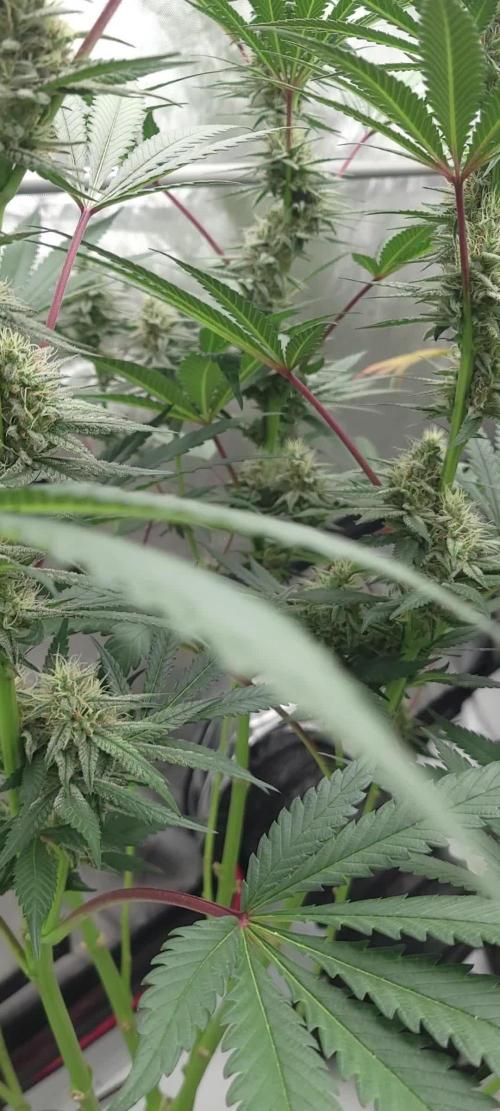
Just finishing week 6 of flower. The Guillotine Gas is stacking spears while the Alien Icicle is building boulders. I'll be running these ladies back from clone. They'll be in at least in 5 gallon pots for the run.
Likes
26
Share


@561honda
Follow
Chimera was 🔥 I got 8oz and a 1/2 . 4oz from the more purple leafs one and the least purple leafs had 4 and 1/2oz and i broke one top main branch by accident .Had 50 grams of sugar leaves and 100 grams of regular fan leaves ! Made 100g of regular fan leaves to 1 stick of butter and was night night i didnt think it would work but it actually did !! 😆 The more purple one smells and taste fruity and sweet and the other less purple was smelling like gas and now smells and taste like straight lemon 🍋!!⛽️ 🔥 💣 Next grow will be 12 clones in 2 gallon square pots in 100% coco and automatic watering every 6hrs and switching from Fox Farm to Athena blended nutes and see what happens !!!! 😆
Likes
4
Share


@Filiaes
Follow
23.06
Day 59 of bloom, from now on I check the trichomes more often.
26.06
Cleaned the tank and prepared a new solution, to flush the plants, since I see enough amber trichomes developing. I still add some major nutrients. EC level is at 0.6. I will continue to flush until 04.07 - day 70 of bloom, afterwards I will waterstress them, if they are not ready already.


Likes
10
Share


@StonedFarm
Follow
09/21/24 - Purple Punch 👊 & Green Crack 💚
Both these girls got the lollipop 🍭. All the winners stayed 🏆 😂. They got a bump up in the PPM, and we also increased the TPS Signal for the 3gallon dunk to now 3ml. 100% Bloom juice now. Runoffs are in the 6.3-6 4. So they thriving.
09/24/24 - Purple Punch 👊 & Green Crack 💚
Both these girls are drinking heavy, and already starting to see frost on the PP. We have them a top feed of just pH 7.2 water, to hit the 6.4 runoff.

Likes
4
Share

@FireAntTheGrower
Follow
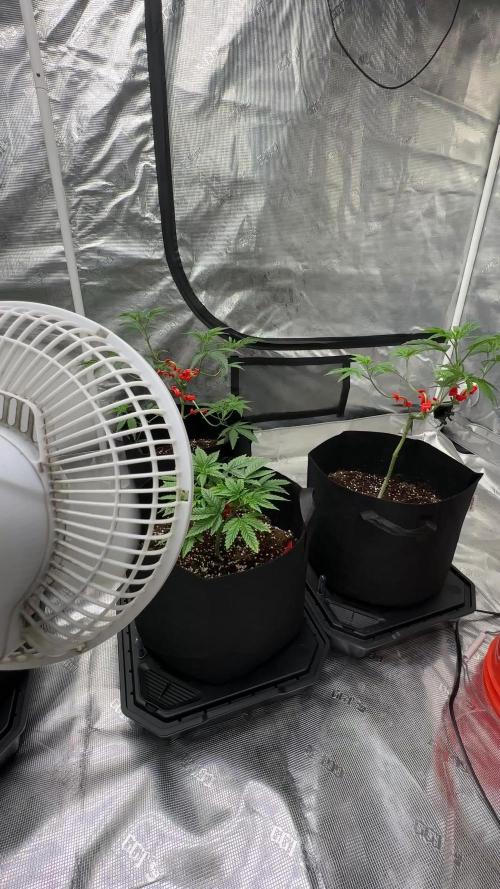
Going on 4th weeks in vegetative stage. Added more red lst clips to foam a table or even canopy as they grow towards the lights. Cut off lower branches that I knew not going to be as strong, but growing big buds due to activating the self watering system I set my ph low as it’ll uprising by next Friday. I’m juice bout this grow going to turn out 10x better plus got the cannatrol long been waiting. Let go :)
Likes
30
Share


@Canadian
Follow
I use all 3 General hydroponic nutrients and they are two different pot sizes the Moby Dick is in 30 liter and the blue amnesia is in 18 liters has a very strong odor and blue amnesia is maturing at a faster rate then the Moby Dick.
a scrog net is being used in order to give support to the upcoming buds.
I am also actually on week 4 I just made a mistake calculating the week.
this is my first grow ever.
also I'm not sure if using the scroll net it's a good idea for support rather than tying those branches up .
I am watering every two days feeding nutes every single time at 900 to 1000 PPM ph at 6.2 the plans have not show any signs of stress but I am worried if it is too much nutrients the plant seems to grow very fast after every watering and seems to be loving it.
the blue Amnesia XXL Auto it's growing in soil with 30% Coco and the Moby Dick XXL auto it's growing in hydroponic soil.
the seeds were germinated on jiffy's and 100% germination rate plus the genetics seems to me very resilient to heat and everything else including lots of nutrients.
the moby Dick XXL auto are the two in the front closest to the camera the two farthest to the back of the tent are the two blue amnesiaXXL auto.
today day 31 i did some pruning actually lots of pruning hopefully don't cause stress to the plants or even worse cause them not to bud that nicely regardless the scrog net seems to be working just fine helping them access more light and making it easy for cutting leaves that are no longer needed.
32 yesterday after watering and sleeping today they have show no signs of stress in fact they starting to stretch in the buds that we're not getting sufficient light have start to grow also yesterday from the 16 liters I prepare instead of 3 ml of grow formula I add 6 1/2 to compensate for stress and the need of healing and having new grow stretch. also temperature has dropped dramatically outside making my house cold down from 24 degrees C to 19° at night internal temperature is remaining the same from 30 to 26 C.
Day 33 I have been raising the scrog net every day and the light everyday this plant is growing very fast I also notice that where the fan is hitting all the time that plant is bigger I have been moving the fan to other sections of the grow tent to see if any reaction happens and it looks like it makes the plant grow faster . I will not be moving the Scrog net any higher Rather I will introduce another one once they require more support .
Day34 notice some of the top leaves are showing a curving down like over-watering without actually over water I think they're showing signs of too much nitrogen .for the next water session I will hold back on nitrogen until I see signs of a fully recovering meaning leafs pointing up.
thank you for reading have a happy grow.

Likes
6
Share


@thenotillwizard
Follow
The Red Hot Cookies are looking beautiful. Very nice looking buds with fantastic colors. Very promising in terms of bag appeal :)
The pheno 1 shares many traits with the GSC. The effect is amazing despite of the quite boring terpene profile which is unidimensional (very sweet base notes along with creamy peach head notes that reminds me of the peach flavored campino hard candys). The high has the soothing and calming effect of the GSC while being more uplifting and energizing.
The pheno 2 is more on the Tangie side for both the effects and the terp profile. The high is energetic but a little bit racy. The limonene content seems far higher than the myrcene, and it translates itself in both the taste and the effect. I will be looking for a Tangie-dom pheno that is richer in myrcene, in hope of getting more of the tangerine taste/aroma and the relaxing effect that we can find in the Tangie and Tangerine Dream strains.
As for the Amherst Sour D, they all share the same woody and tropical aromas with subtle specific nuances (pepper, fuel, skunk/sulfur, lavender). The effects go from slightly sedating to highly energizing and euphoric. A great afterwork hard hitting sativa that tastes awesome, without being the terp bomb of the year.
The Dinamed CBD plus is a very short, bushy and stalky plant. The Pheno 1 smells like straight pine/fir on sweet and fruity base notes. The structure is nice with lots of lateral branching and the buds are looking very good too. I could have got a way better yield be giving her an extra 10 days of veg.
The pheno 2 is more one the fruity/fuely/tart side. Definitely not the best pheno. Very slow growth...

Processing
Likes
26
Share


@Dunk_Junk
Follow
Day 124 - I change the lights to 12/12... She is flowering, but painfully slowly. I have never put an auto on 12/12 before so I don't know if it will help.
Day 126 - The buds are quite airy I have to say. I don't think she will yield all that much. I am definitely smelling grape though. Fruity. It's nice! I will stick with it, the trichomes are changing to cloudy but the pistils have too many white hairs yet. Also their brown colour is not that dark but I don't think they are getting any darker.

Likes
40
Share


@CampaCavallo
Follow
4ª settimana di fioritura 💐:
Buongiorno a tutti gli amici della CampaCavallo, quarta settimana di fioritura e vediamo che la biscotti di zamisa da gonfiando per bene i suoi fiori.
Iniziamo a sentire sulle dita il suo profumo fruttato, citrico. Dimmi un titolo del
Abbiamo ripulito la parte inferiore della pianta, quella più in ombra...... sembra che la ragazza si sia anche ripresa da quella Artiglio di azoto👏🏻👍🏻

Likes
19
Share


@Chubbs
Follow
420Fastbuds
FBT2306 Week 9
What up everyone. Weekly update on these two show stoppers and all I can say is 👌. They both are showing some really crazy colors and buds are nice and dense covered in trichs. I checked them under magnification and trichs are still clear and cloudy and I'm shooting for an 80/20 split of cloudy to amber. No major issues besides some fading in the leafs but that's expected at this point in flower. Guessing maybe another week or two before the chop. All in all Happy Growing.

Likes
4
Share


@Hix57
Follow
Jour 35 et tout roule ! Ma plante se développe à merveille, même si elle a décidé de stopper son élongation assez tôt, ce qui lui donne un aspect trapu et compact.
Je suis plutôt satisfait de mon suivi, car j'ai réussi à éviter les erreurs du passé, comme le surdosage d'engrais. La terre est suffisamment riche en nutriments organiques pour subvenir à ses besoins.
Hâte de voir comment elle va évoluer dans les prochaines semaines
Jour 35
Engrais : max mais pas de NPK sauf phosphore et potassium a petite dose.
Remarque : la plante ne s'est pas étirée suffisamment



Likes
21
Share


@OGTrauma
Follow
Now it’s our POST PANDEMIC VIRGO SEASON & as Spring and ‘Fiestas Patrias’ are coming here homies!!! Have Big Gas Puff on my Behalf! 👽
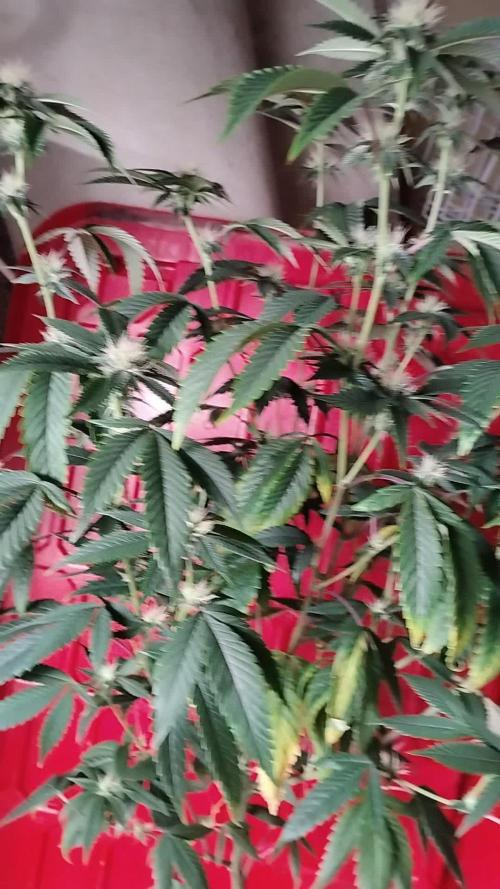
Declaring on September the First, Im Setting officialy the photopheriod as 20/04 hours resting too, they start in midnight as they will help to provide an ideal temperature at night, and thats the reason why stick with covering most of the day yet respecting some time off the grid, as for both mary jane plant processes like foliar feeding or the transplant depicted below and electronics used requires a bit of resting as lifespam testing and recomendations tend to stick on ‘calm your tits homie’ even on autoflowering scenarios, last consideration is the electricity bill as can become bothersome in some countries too.
Moving on plant growth , I personally consider up to this date , a healthy growth even when i changed the substrate it has quite a possitive impact and that’s on having a number of survivors above the mínimum of plants i want to be spread each on 11 lt of ’ Organic Life Light Mix’ for the most oustanding Killer Kush FV, by using the growth vigor & not stressed AF criteria , as it’s always good to do backups in case i had a strong damping-off or like a bad germination scenario. Notice the quirk of ‘Pot on Pot’ made the transplant a bit easier, and how can make some small upgrades if added in your grow , if its on your market and fits your style as well.
Regarding to feeding, new transplant soil was watered with Hesi boost, Top candy and BAC Calmag’s 2.0 (I chose this Brand specifically as it present other useful micronutrients on its composition ), as they first ones show to have quite a stimulant and refreshing effect on the babies, considering the size of more than decent root samples took before being moved on their final containers. This experience also introduced me the carencies i must attend usually on these type of soils, who also i do consider that being this deal of too light substrate, is a deal of a trade off too , like, im saying this this Organic Life Light Mix it’s not a bad product at all but consider is way more needy unlike traditional soils or even fuck, this shit is more airy than other light soils compositions hhahah, so, final words here, like at the same time the speed gained plus not a total damping off on germination phase & good interaction with fertilizers i use as plant interaction shows quite a good evolution, specially being keen on carencies and disbalances are faster to present and faster to attend , it requires more handling specially on feeding like all shit that is making this grow go at super fast speed , as i took some pics of root mass and it’s development shows it’s quite advanced yet on the optimal point to transplant.
PS: I will stay with the non finalists , the more pansy Killer Kush aren’t totally discarded as the point of having backups to have a better coverage regarding to uncertainity of germination and the fact that still fuck up things and shit my pants in the near future, as usual, im a shitty grower if not noticed ! 😂😂😂.
HAVE A BIG DICK ENERGY SEPTEMBER MFS !!!
// i'm uploading the photos asap as possible :P

Likes
32
Share


@BigBadLion
Follow
Week 3 of my soon-to-be purple ladies! 😻
Everything was going well but I noticed these issues:
- The girl on the back is stretching waaaaay more and is less "leafy" than her sister. Perhaps she has more sativa in her DNA?
- Leaves on both girls love to twirl around, specially on the girl on the front.
- The stem on both girls is still weak and the girl on the front no longer needs the extra help she needed!
Weather where I live is getting colder for some odd reason (it should be the opposite, damn!) and the "purple" is... perhaps starting to show a little? Which is good!? 😮
Anyway, that's all for this week. See you all next one and I hope you'll all enjoy the photos and the timelapse! 😁
Likes
4
Share


@Altitonans_Fulmen
Follow
Genetics provides the blueprint, but the environment builds the house. To think otherwise shows outdated logic. A genetic freak will always be a freak, but for the other 99.99%, perfect environmental optimization coaxes average seeds into performing beautifully. You don't need a legendary, expensive clone to get a super yield. If you keep your light at the right distance, keep your tent at a stable 74°F–77°F, and prevent the root zone from drying out, you will naturally unlock the maximum genetic potential of whatever seed you planted. You are giving the builder the exact tools it needs. But doing that in 5 gallons is playing on Ironman mode. Want real yield? 4x15gallons or, even better, one big oxygen-infused 100-gallon.
Maximizing your canopy footprint efficiently requires that larger volume to build a sufficient chemical buffer and hold consistent moisture. Small pots restrict the plant's metabolic runway, forcing an aggressive metabolic rate that will eventually crash the crop's vascular system, even under a pro's supervision. 15 gallons maintains a perfectly structured wet/dry cycle while letting you push environmental metrics to their absolute limits across the 9 cardinal parameters of plant growth.
Dialing this in allows one to force the plant's photosynthetic efficiency to its absolute genetic ceiling of 4% to 5%. Hobby growers operate at a heavily bottlenecked 1% to 2% light conversion efficiency; a strictly managed, pharmaceutical-grade environment can double that, unlocking the plant's true potential. To get there, though, you need pharmaceutical-grade controls, a deep knowledge base, and a lot of money. Keep your setup realistic and grounded until you have the experience first; otherwise, you're just throwing cash down the toilet.
1. Light Intensity (PPFD)
2. Light Quality (Spectrum)
3. Air Temperature
4. Relative Humidity (VPD)
5. Dissolved Oxygen (DO) / Root O₂
6. Substrate Moisture (VWC)
7. Nutrient Strength & Balance (EC/pH)
8. Root Zone Temperature
9. Carbon Dioxide (CO₂)
If any one is bottlenecked, the entire energy process is bottlenecked to that %..
Geographical location heavily dictates genetic expression, which in turn influences and interacts with soil composition and its nutritional properties. This, in conjunction with the location's specific weather and unique environmental conditions, is what truly drives gene expression.
Unless a cultivar is grown under the exact same conditions across the board, there is no way its genetic heritage will remain identical. Each generation grown in a different meteorological and geographical location will ultimately alter its genetic expression. The idea that a "magic seed" can bring back long-lost genetics and behave exactly as it did in the past is ridiculous; the precise environmental conditions of thousands of years ago simply no longer exist.
To pretend otherwise relies on an outdated, unchecked version of how "genetics" actually works that is far overdue for a rethink. Genetics are not completely predetermined.
The reason people still think of genetics as fixed is because of how we historically taught Mendelian genetics (the classic Punnett squares from school). It taught us that "DNA = Outcome." While that is true for basic traits (like whether a pea is wrinkled or smooth), it completely ignores quantitative traits (like flavor, yield, and stress tolerance), which are heavily influenced by the environment.
A seed carries a specific genetic code (genotype), but the physical expression of that code (phenotype)—such as the plant's flavor, smell, size, and nutritional value—is heavily dictated by its surroundings. The exact same seed grown in two different regions will yield entirely different results.
The unique mineral composition, microbial life, and fungal networks of a specific geographic location, combined with local weather patterns and UV levels, act as a custom recipe. This recipe directly influences how the plant develops its chemical and nutritional properties. Environmental factors act as "switches" that turn specific genes on or off without altering the underlying DNA sequence. These changes in gene expression can sometimes be passed down to the next generation, meaning the plant actively adapts to its new home in real-time. When a cultivar is grown in a new meteorological location, each subsequent generation undergoes rapid localized adaptation. The plant naturally favors traits that help it survive that specific environment, shifting away from its original ancestral state within just a few generations. Because the precise atmospheric conditions, soil biology, and climate of thousands of years ago no longer exist, an ancient seed grown today will inevitably express itself differently. Modern agriculture increasingly recognizes that we cannot separate a plant's genetic heritage from the unique environment in which it is grown.
Commercial facilities in the world use 5 gallons of high-frequency fertigation (crop steering) and feed 10x a day, not stating that it's not possible or beneficial.
For indoor home growing, I'd go with the 15-gallon (VERY MINIMUM for MAX heads) watering once a day at high, dialed-in metrics. The reason a true 4% to 5% total efficiency is considered a hard biological wall isn't that other growers lack understanding—it is because of how energy is lost at a cellular level in C3 plants (like cannabis) under artificial light.
The difference in efficiency of conversion might only be a couple of %, but here is the thing that's undeniable.
The 4% to 5% total photosynthetic efficiency wall is a hard quantum mechanical and biological reality for C3 plants under artificial light. It is dictated by the physics of photons, the limits of Rubisco, and massive energy losses through photorespiration and metabolic maintenance. While a commercial facility chases economies of scale, often compromising individual plant microclimates, a highly dialed-in home grower can leverage small-scale dynamics to push Canopy Utilization Efficiency to its absolute thermodynamic limit.
A home grower running large-volume living soil or oxygen-infused substrates (like a 15-to-100 gallon bed) creates a self-regulating, high-buffer biome. This stabilizes the 9 cardinal parameters, prevents vascular crashes, and maximizes Canopy Utilization Efficiency and Electron Transport Rates (ETR) in a way a 10,000-square-foot warehouse simply cannot replicate. Localized adaptation and phenotypic plasticity blow the "static genetics" myth out of the water. Terroir is real, and the environment acts as a master programmer, flipping epigenetic switches.
Alpha to Omega.
Lights are 58 inches from the main source to the top of the pot and the soil surface. If you added up all the lights in the tent, it would be 1100w-1200w total across 14 lights. Using them all at once is far too much for a plant and incredibly difficult to deal with environmentally. The lights are fixed in position; side lights have dimmers, allowing for pinpoint precision of PPF. Fixed at 58 inches, cannot move them closer to increase intensity. Instead, achieve optimal PPF by distributing smaller wattages across a massive, multi-fixture matrix. Triggering specific plant defenses without melting the canopy.
What's the point/blah blah wattage?
Never really go above 600W at any one time. Lights come on in the east of the tent and set in the west. At sunrise and sunset, the red-to-far-red R:FR light ratio drops because the sun's low angle scatters red light more than far-red light. This shift reduces active Pfr and increases inactive Pr, mimicking Mother Nature herself.
Deployed a lighting system featuring extra 660 nm deep-red and extending the spectrum up to 780 nm achieves the full Emerson Enhancement Effect by simultaneously balancing Photosystem II (PSII) and Photosystem I (PSI) to maximize quantum yield. By pairing deep-red photons with far-red photons, you trigger a synergistic biological response where the resulting photosynthetic rate is higher than the sum of both wavelengths used individually. This practice directly leverages the updated extended Photosynthetically Active Radiation (ePAR) framework. The Emerson effect accelerates plant metabolism and heat capture; you must proactively scale up your ambient room temperature, nutrient delivery, and CO₂ supplementation to prevent the light from stalling out your cannabis plant.
UVA stays high all day from morning to night, but UVB peaks at solar noon (middle of 18-hour days) when the sun is peak. Morning color starts at 2k-3k; by noon it goes to 5k- 6k and back to 2-3k for sunset, with differing P:FR at light off.
The extra-blue light is to assist with photoreactivation of UVB damage. No more yield loss for me. Using extra blue light for photoreactivation is what I do. Blue/UVA light activates photolyase enzymes, which directly repair DNA damage caused by UVB radiation.
But what's the point if it's not for yield?
Ultraviolet (UV) radiation—specifically UVA (315–400 nm) and UVB (280–315 nm)—acts as a critical environmental signal that programs a plant's photoprotective genes to unlock its true photosynthetic potential. When growers push crops to their absolute photosynthetic maximum via high-intensity light and elevated carbon dioxide, the photosynthetic machinery easily becomes overwhelmed. Emerging photobiology research demonstrates that UV radiation prevents this limiting bottleneck; it triggers specific transcription factors and signalling networks that fortify the plant's cellular defenses, allowing it to process extreme light levels without sustaining structural damage.
There are 8 limiting factors of plant growth; when carbon dioxide becomes the 9th limiting factor of plant growth, it shifts the growth curve from exponential to linear. The restriction after that is "photoprotection" against reactive oxygen species (ROS), managed via non-photochemical quenching (NPQ) and the xanthophyll cycle, which bridges into precise hydrogen and redox dosing.
UV radiation, particularly UVA, and the synthesis of zeaxanthin are critical for the xanthophyll cycle to function.
It's not chasing purple strains... One likes to call it chasing the limits of growth, trying to make the linear exponential, just like father mathematics prefers.
In order to do that, must control every environmental variable and compound the plant’s metabolic rate. True exponential growth means the rate of increase matches the current mass at every stage, requiring a closed-loop system where light, CO2, and nutrition lock into a synchronized upward curve. First, you must attempt to understand what restricts it. Precise hydrogen and redox dosing.
Nature mathematically optimizes quantum energy transfer and light absorption efficiency within the photosynthetic machinery, as it naturally dictates energy scaling hierarchies and resonance dynamics. Most won't even understand that; once you do, it changes everything.
Constructive interference occurs when two or more overlapping waves meet in phase, meaning their crests and troughs perfectly align. Their amplitudes add together, creating a new, amplified wave with greater intensity than the individual components.
Constructive interference is the foundational mechanism that establishes a resonance hierarchy across physical, structural, and acoustic systems.
Chromophore spacing is tuned to sub-nanometer precision to match the wavelengths of absorbed light, forcing constructive interference.
Light-harvesting proteins form geometric rings and lattices. These shapes act as physical resonators, trapping and focusing the wave energy.
This same principle dictates how opera singers shatter glass, how musical instruments resonate, and how bridges withstand structural vibrations. Nature uses the exact same math to harvest a photon as an engineer uses to design a concert hall.
When you push high PPFD and elevated CO₂, you create a metabolic bottleneck. The plant cannot process the energy fast enough, leading to electron backup, light-induced damage, and a collapse from exponential growth into a flat, linear rate. UV light acts as the regulatory valve that prevents this collapse.
In standard agronomy, Liebig's Law of the Minimum dictates that growth is limited by the scarcest resource. When you maximize water, nutrients, light, temperature, and CO₂, the bottleneck shifts to metabolic processing speed and photoprotection. By controlling the Redox state of the plant using UV, the xanthophyll cycle, and managing ROS, you can prevent the plant from hitting a hard photosynthetic ceiling. Instead of the growth curve flattening out (linear or plateauing due to photoinhibition), the plant continues to compound its metabolic rate efficiently. You are forcing the plant to operate at peak thermodynamic efficiency.
By matching the UVB peak with sustained UVA and shifting Kelvin temperatures (2K to 6K), you are damaging the plant just enough to trigger defensive genes, while simultaneously providing the exact light energy needed to repair that damage instantly.
UVA radiation and specific blue wavelengths accelerate this enzymatic conversion. Zeaxanthin acts as a structural sponge that absorbs excess excitation energy from chlorophyll and dissipates it safely, preventing ROS formation. Without UV signaling, the xanthophyll cycle cannot keep pace with extreme light, leading to dynamic photoinhibition (yield loss).
The addition of Spirulina is primarily for zeaxanthin, as it contains a lot. But on top of that, the active Hawaiian Spirulina in the matrix was cultivated in open ponds using a combination of 100% fresh potable water from Hawaiian aquifers and ultra-pure, deep ocean water containing all 94 trace minerals & elements. Then gently dried using patented Ocean Chill Drying technology and cold-pressed to ensure maximum nutrient levels. Spirulina, a blue-green alga, is rich in nitrogen, phosphorus, and potassium (NPK), making it an excellent source of nutrients for plant growth. Studies have shown that Spirulina can be used as a biofertilizer, effectively replacing chemical fertilizers, especially for nitrogen, with a whopping NPK of 10% (N), 20% (P), and 20% (K). Rich in proteins, amino acids, trace minerals, and plant growth-promoting compounds.
Zeaxanthin is a vital plant pigment that accumulates under intense light to drive non-photochemical quenching (NPQ), acting via thermal energy dissipation, direct singlet oxygen scavenging, and thylakoid membrane stabilization.
The violaxanthin cycle (or xanthophyll cycle) reversibly converts violaxanthin to zeaxanthin via antheraxanthin to protect plants from photooxidation.
Understanding this interconversion is vital for optimizing non-photochemical quenching (NPQ) and pushing photosynthetic limits under high-light stress.
Ascorbic acid (vitamin C) is a natural antioxidant that plants produce internally to neutralize harmful reactive oxygen species caused by photosynthesis and high light stress. Acts as a co-factor for enzymes like violaxanthin de-epoxidase in the xanthophyll cycle, which safely dissipates excess light energy.
1g ascorbic acid will neutralize 100% of chlorine in upwards of 30 gallons of tap water. If your local tap water uses chloramines (chlorine bonded with ammonia) instead of free chlorine, you will need roughly 20% to 30% more ascorbic acid to completely break the tougher chemical bond.
Molecular hydrogen and hydrogen-rich water act as selective antioxidants that help lower oxidative stress. They neutralize toxic reactive oxygen species like hydroxyl radicals and boost natural antioxidant defense systems in biological and plant systems exposed to high-intensity light or abiotic stress.
UVA and UVB act as stress signals that upregulate the plant's secondary metabolism. It forces the plant to build an internal "sunscreen" (flavonoids and anthocyanins) and fortify its cellular defenses before the peak solar noon crisis. This keeps the metabolic highway open.
In nature, the ambient ratio of UVA to UVB at solar noon sits roughly between 10:1 and 20:1 (depending on latitude and elevation). In a high-PPFD indoor matrix, maintaining a strict ratio—often aiming for around 12:1 to 15:1 UVA to UVB—provides the optimal signaling threshold.
Balancing Far-Red (FR) light at "light-off" to manage the phytochrome photo-equilibrium (Pfr to Pr conversion) in tandem with the UV schedule. Omg, the logic.
Hydrogen concentration and redox signaling as secondary messengers in this high-intensity loop.
Under the intense solar noon matrix, the pH of the thylakoid lumen drops. This acidic environment activates the enzyme Violaxanthin De-Epoxidase (VDE), which converts violaxanthin into the photoprotective zeaxanthin. VDE cannot function in a vacuum; it strictly requires ascorbic acid (Vitamin C) as an electron donor to run this conversion. If a plant undergoes heavy light stress and runs out of internal ascorbic acid, the xanthophyll cycle stalls. The plant can no longer engage in Non-Photochemical Quenching (NPQ), leading to immediate singlet oxygen O2 formation and destruction of the thylakoid membrane. This is "The Ascorbic Acid / Xanthophyll Engine"
Using ascorbic acid to neutralize chloramines in your water isn't just protecting your rhizosphere biology it actively prevents the degradation of your nutrient solution's redox potential before it ever touches the roots.
When pushing plants to the absolute edge, traditional antioxidants can be a double-edged sword because they blindly neutralize all free radicals. This is a problem because some Reactive Oxygen Species (ROS) act as critical signaling molecules telling the plant to grow. Molecular Hydrogen H2 is the Selective Kill-Switch.
Molecular hydrogen H2 is a revolutionary tool because it is a selective antioxidant. It ignores beneficial signaling ROS (like mild hydrogen peroxide) and targets only the most destructive, cell-shattering radicals—specifically hydroxyl radicals OH) and peroxynitrite.
By dosing hydrogen-rich water or managing hydrogen redox signaling, providing an emergency pressure-release valve for the plant's electron transport chain. It keeps the cellular environment stable enough that the plant never has to downregulate photosynthesis to protect itself. This maintains cellular voltage.
To trigger this defensive matrix without stunting the plant, you cannot simply blast UV indiscriminately. You must use UVA as the "scout" and UVB as the "enforcer. High UVA acts via the cryptochrome and phototropin photoreceptors to upregulate the expression of the HY5 transcription factor and prime the VDE enzyme. When the sharp spike of UVB hits at solar noon via the UVR8 receptor, the plant's biochemical "sunscreen" (flavonoids and anthocyanins) and its zeaxanthin pools are already pre-staged and waiting. This prevents the temporary stunting or "lag phase" usually associated with sudden UVB exposure."
The final masterstroke is aligning this UV defense with a Far-Red (FR) lights-off routine. The Red-to-Far-Red Drop: At the end of the photoperiod, knocking out the blue/UVA spectrum and leaving a targeted burst of pure Far-Red (730nm) instantly flips the plant’s master switch. It converts active Pfr to inactive Pr in minutes rather than hours.
UV radiation and high-intensity lighting keep the plant in a highly alert, photoprotective state that requires massive ATP expenditure to maintain. By forcing an immediate Pfr/Pr) conversion at lights-out, instantly commanding the plant to cease defensive expenditure, lower its metabolic respiration rate, and transition directly into nighttime cellular repair and carbohydrate translocation. Maximizing the efficiency of its "sleep." every ounce, every last piece.
Highly synchronized biological dance, balancing the exact input of electrons with the exact mechanism to dissipate them safely when they overflow.
*Ascorbic acid is not recommended to be used in DWC, as it creates biofilm that will clog lines.
Onward!