Likes
Comments
Share
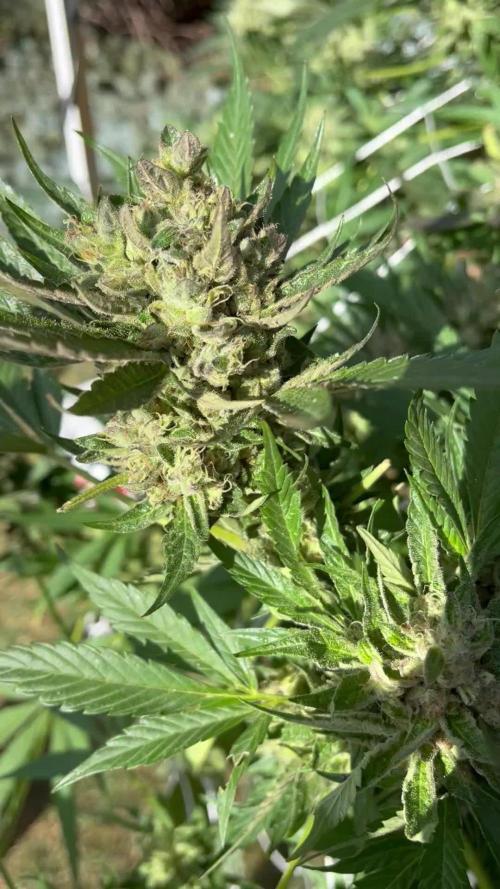
Week 8 begins for Glueberry OG, she's looking happy and healthy after week 7 and the extra feeding. One week closer to the flush! Looking forward to the finish line!
Likes
70
Share
@MrJones
Follow
Sky Walker ~~~~~INDOOR~~~~~ DAY 77 Above Dirt 💬SATURDAY - 11.11.23 These ladies continue to blow up, I moved them into a 4x4 space under the Mars Hydro FC-6500 I am going to look at some defoliation and pruning, they will be moved over into 7-gallon pots, then some final tie-downs added into the training, also started a compost tea today, see recipe below. 💬SUNDAY - 11.12.23 - The ladies like their new space, today I defoliated, topped, and pruned out the lowers, and insides, once these girls are moved over into their new pots, will be flipping these massive bushes! ~~~~~~~~~~~~~~~ 🌱Sky Walker 👨‍🌾🏽Sativa Jones 🌤️@Medicgrow420 SeedBank Seeds 📝@gaiagreenorganics 📝Bokashi Biochar ~~~~~~~~~~~~~~~ 📝 Skywalker OG Strain is a top-shelf Indica dominant hybrid. It is a cross of Original Amsterdam Blueberry, OG Kush, and the indica strain Mazar from Afghanistan, and is best known for its super potent effects and sky-high THC levels. ~~~~~~~~~~~~~~~ 📝 Compost Tea 3 Gallons of Dechlorinated H20 3 Cups Malibu Compost 2T Molasses 2 T Alfalfa Meal (DTE) 2 T Kelp Meal (DTE) 1 T Bat Guano (DTE) 1 teaspoon Rootwise Bio Elixir 1)- I used a small paint strainer to hold my composts, placing an air stone right in the bag and zip-tie it nice and tight - this allows air bubbles to really agitate the micro matter off of the compost and into your tea 2)- I like to mix in the molasses (microbe food) and start my main air stone, the dry amendments and Rootwise can be just measured in the bubbles 3) - Keep the temp of the water warm to 75F/85F - too cool and the microbes reproduce too slowly and too hot will kill them. I do not delete my teas and let the plant pots dry out slightly before feeding.
Likes
19
Share
@PeppaWutz
Follow
This week i had to lollipop and defoliate them. Really bushy stuff devolped :) No visible plan issues till know but i have some temperature problems (sometimes above 30 °C). Hopefully this will not affect the plans.
Likes
19
Share
Weather has been great so we've had alot of growth this week especially on the gorilla cookies,.. all look fine as of now, roll on next week 👌
Likes
2
Share
@tterpy
Follow
Fed with plain water 6/17/26
Likes
4
Share
Week 9: Flower - The First Harvest & Final Countdown! ✂️🌿 THE BIG CHOP IS DONE! Gorilla Z #1 has been harvested, and we're officially in the drying phase. Meanwhile, the remaining ladies are marching toward their own finish lines. Gorilla Z #1 - HARVESTED! 🎉 She's down! After weeks of growth, recovery from overwatering, and pushing through to the end, this girl finally got the chop. Trichome Check: Mostly cloudy/milky (peak THC production ✓) A few amber trichomes starting to show Minimal clear trichomes Harvest Timing: Honestly? I was in a rush—ran out of flower to smoke! 😅 But the trichomes were in a good window, so it worked out. Sometimes necessity makes the decision for you. Could've waited for more amber for a heavier effect, but she was ready enough. What's Next: Drying phase begins now Aiming for slow dry (60°F, 60% humidity if possible) Then comes the cure—patience will be tested again! The Relief: Finally got some homegrown coming down the pipeline. The timing couldn't be better! Gorilla Z #2 - End of Month Finish She's still chugging along in mid-to-late flower. Based on her current progression, she should be ready by the end of the month. Current Status: Buds filling out nicely Still getting full-strength bloom nutrients Recovery from overwatering is complete—she's back to full health Feeding Schedule: Full strength General Hydroponics Bloom Trio Cal-Mag Liquid Kool Bloom She'll stay on this program for another week or two, then transition to water-only flush before harvest. Heisenberg - Two Weeks Out & Starting the Flush! 💧 She's in the final stretch! About 2 weeks away from harvest, which means it's time to transition to the flush. The Flush Begins TODAY: Water only from here on out No more nutrients Flushing helps the plant use up stored nutrients in the leaves and buds Results in smoother smoke and cleaner taste Why flush? Removes excess salts and nutrients from the medium Forces plant to metabolize stored nutrients Improves final product quality (smoothness, taste, ash color) The leaves will fade and yellow—this is GOOD and expected during flush Current Status: Buds are dense and frosty Loving the Spider Farmer tent environment Healthy and vigorous despite approaching finish Key Observations & Real Talk Harvest #1 in the books! There's something incredibly satisfying about chopping your first plant of the cycle. All the work, the stress, the learning—it all comes together in that moment with scissors in hand. The staggered timeline is actually perfect: Gorilla Z #1: Harvested (drying now) Heisenberg: 2 weeks out (flush started) Gorilla Z #2: End of month (~3 weeks out) This spread means I won't be overwhelmed with trimming and drying all at once. Plus, continuous harvests = continuous supply! Running out of smoke as motivation: Look, we've all been there. Sometimes the best harvest window is "I'm out and I need flower NOW." 😂 The trichomes were good enough, and that's what matters. The Home Stretch Strategy For Heisenberg (flush phase): Plain water only, pH'd to 6.5 Monitor trichomes closely Watch for fade (yellowing leaves = plant eating itself = good!) Start thinking about chop day in 10-14 days For Gorilla Z #2: Continue full bloom nutrients for 1-2 more weeks Then begin her flush Harvest late February For Gorilla Z #1 (drying): Hang dry in dark, controlled environment Check daily—don't rush it! Stems should snap, not bend, when ready for cure Then into jars for the cure (the hardest wait of all) Next Week's Plan Monitor Gorilla Z #1 drying progress (resist the urge to sample too early!) Continue water-only flush on Heisenberg Keep feeding Gorilla Z #2 full strength Daily trichome checks on Heisenberg as harvest approaches Prep trimming station and cure jars for upcoming harvests Start planning the NEXT grow! 🌱 We're in the final stretch! One down, two to go. The finish line is in sight, and the reward is almost here. 🏁🔥 First harvest complete. Drying tent smells AMAZING. The wait for cure is going to be brutal but worth it! 💚✂️
Likes
29
Share
Grew nicely in the chalice and needed to be watered daily. Produced some beautiful buds and a pretty fat cola. Had no issues I had to worry about and overall grew a lot better than expected!
Likes
1
Share
@JayJay72
Follow
G'Day me ol muckers. This week ive been mostly jumping from piers with a tinny of VB in hand and diving on the local reefs looking for Muffs. 18.6.25 - feed -2ltr 19.6.25 - water 2ltr,1.5ltr 20.6.25 - water 1.5ltr 21.6.25 - feed 2ltr 22.6.25 - water 1.5ltr - more defoliation 23.6.25 - feed 2ltr 24.6.25 - water 1.5ltr heights 72cm, 50cm Its amazing to see just how different these pheno's are. I wonder how they will taste. They both are enjoying a good old feed and water. still thirsty little buggers. Anyways thanks for stopping by you gorgeous bogans. see ya next week. Peace.
Likes
34
Share
@cannasaxx
Follow
Sie wachsen und wachsen ohne Ende... Die Blüte zeigt sich langsam, also wird nächste Woche der Dünger umgestellt auf Blüte. Bis jetzt bin ich zufrieden 😎🍉🌈
Likes
7
Share
Gave them every 2-3 Days 2 Litre of Water now. Just once added CalMag Began to spread the lower Branches out. Was a little bit late. But i don’t want to give them much Stress Topped the last Bilbo at the End of the Week And the Deficiency goes away One Main Branch broken but i fixed it with Tape and LST Wire
Likes
1
Share
@NeoCat
Follow
TCP Auto has been an effortless grow so far. Everything is going smoothly. The smell is getting much sweeter now and has quite a nice citrus hint to it.
Likes
10
Share
I never grew a plant like this ! Buds are rock, denses, hard !!!
Likes
18
Share
week intel: we getting close to end of ripening , this week i raised drought , Nitrogen and E.C stress by feeding them 2 times per week and raised e.c to 3 to cause real stress that will help increase terpenes production stresses : Nitrogen deficiency Stress by removing the fertilizers that has N in them Drought stress via removing one meal in week high E.C stress around 1.7 and the other feeding day 3.0 , 2 times a week feeding: no more Nitrogen i feed them 2 times this week with this order : day 1 : i feed them high with Bio-Bizz Top-Max + Feeding Booster about 850 ppm - 1.7 e.c to cause a medium e.c stress. day 3 : no more feeding this day day 5 : i feed them very high dose of Bio-Bizz Top-Max + Feeding Booster around 1500 ppm - 3 e.c to cause high e.c stress guide of the week : be patient in the last weeks, never hurry for harvest because its the time of ripening in last 2 weeks you should let plants to do their work last weeks of ripening is the time to break the limits we should cause 3 stresses as i said above Nitrogen stress , Drought Stress , E.C Stress
Likes
4
Share
4/20/25 colors finally coming back to the 4/23/25 getting soil ready for transplant. i tried training her but its kind of awkward at the moment. i bent her at an already soft spot because i snapped the acai gelato clones top and was worried about 4/24/25 transplanted into a 5 gallon pot. added mykos and amended with 15 ml of dr earth 463 and 15 ml of dr earth 222 and 10 ml of microbe charge.
Likes
17
Share
@JurKush
Follow
it seems that the topping has slowed her down a bit but I hope everything goes well day 28 I reduced the frequency with which I fed the nutrients a bit
Likes
16
Share
@Bncgrower
Follow
Following the plan, we've reached the end of week 12. Apparently, everything is fine with this girl and all the others, nothing to worry about. This girl in particular already has a very pleasant smell, excellent bud structure, and beautiful color. Looking forward to the next few weeks! ✌️🌱🌿🍁 Happy growing, everyone!
Likes
14
Share
Start der 8. Blütewoche... Unheimlich durstig sind sie geworden. Die 20 Liter Pötte kommen an ihre Grenzen. Beim nächsten mal gibts 10 Liter oben drauf. Aber alles gut soweit, weiter gehts...
Likes
20
Share
We are in Flush !! Was giving them GH Flora series + rapid start + cal mag
Likes
23
Share
This has been another great week ! We are at day 36 end of week 4 and these ladies are getting nice and bushy! Still using the same dose nutrients just a little less rapid start at 1/2tsp per gal now PH at 6.5 still. The plants have now grown into 600 par an should start flowering this week!! Can’t wait to see what these ladies do this week😍😍 Stay Tuned Cheers an Happy HALLOWEEN 🎃 👻🔪
Likes
56
Share
What's in the soil? What's not in the soil would be an easier question to answer. 16-18 DLI @ the minute. +++ as she grows. Probably not recommended, but to get to where it needs to be, I need to start now. Vegetative @1400ppm 0.8–1.2 kPa 80–86°F (26.7–30°C) 65–75%, LST Day 10, Fim'd Day 11 CEC (Cation Exchange Capacity): This is a measure of a soil's ability to hold and exchange positively charged nutrients, like calcium, magnesium, and potassium. Soils with high CEC (more clay and organic matter) have more negative charges that attract and hold these essential nutrients, preventing them from leaching away. Biochar is highly efficient at increasing cation exchange capacity (CEC) compared to many other amendments. Biochar's high CEC potential stems from its negatively charged functional groups, and studies show it can increase CEC by over 90%. Amendments like compost also increase CEC but are often more prone to rapid biodegradation, which can make biochar's effect more long-lasting. biochar acts as a long-lasting Cation Exchange Capacity (CEC) enhancer because its porous, carbon-rich structure provides sites for nutrients to bind to, effectively improving nutrient retention in soil without relying on the short-term benefits of fresh organic matter like compost or manure. Biochar's stability means these benefits last much longer than those from traditional organic amendments, making it a sustainable way to improve soil fertility, water retention, and structure over time. Needs to be charged first, similar to Coco, or it will immobilize cations, but at a much higher ratio. a high cation exchange capacity (CEC) results in a high buffer protection, meaning the soil can better resist changes in pH and nutrient availability. This is because a high CEC soil has more negatively charged sites to hold onto essential positively charged nutrients, like calcium and magnesium, and to buffer against acid ions, such as hydrogen. EC (Electrical Conductivity): This measures the amount of soluble salts in the soil. High EC levels indicate a high concentration of dissolved salts and can be a sign of potential salinity issues that can harm plants. The stored cations associated with a medium's cation exchange capacity (CEC) do not directly contribute to a real-time electrical conductivity (EC) reading. A real-time EC measurement reflects only the concentration of free, dissolved salt ions in the water solution within the medium. 98% of a plants nutrients comes directly from the water solution. 2% come directly from soil particles. CEC is a mediums storage capacity for cations. These stored cations do not contribute to a mediums EC directly. Electrical Conductivity (EC) does not measure salt ions adsorbed (stored) onto a Cation Exchange Capacity (CEC) site, as EC measures the conductivity of ions in solution within a soil or water sample, not those held on soil particles. A medium releases stored cations to water by ion exchange, where a new, more desirable ion from the water solution temporarily displaces the stored cation from the medium's surface, a process also seen in plants absorbing nutrients via mass flow. For example, in water softeners, sodium ions are released from resin beads to bond with the medium's surface, displacing calcium and magnesium ions which then enter the water. This same principle applies when plants take up nutrients from the soil solution: the cations are released from the soil particles into the water in response to a concentration equilibrium, and then moved to the root surface via mass flow. An example of ion exchange within the context of Cation Exchange Capacity (CEC) is a soil particle with a negative charge attracting and holding positively charged nutrient ions, like potassium (K+) or calcium (Ca2+), and then exchanging them for other positive ions present in the soil solution. For instance, a negatively charged clay particle in soil can hold a K+ ion and later release it to a plant's roots when a different cation, such as calcium (Ca2+), is abundant and replaces the potassium. This process of holding and swapping positively charged ions is fundamental to soil fertility, as it provides plants with essential nutrients. Negative charges on soil particles: Soil particles, particularly clay and organic matter, have negatively charged surfaces due to their chemical structure. Attraction of cations: These negative charges attract and hold positively charged ions, or cations, such as: Potassium (K+) Calcium (Ca2+) Magnesium (Mg2+) Sodium (Na+) Ammonium (NH4+) Plant roots excrete hydrogen ions (H+) through the action of proton pumps embedded in the root cell membranes, which use ATP (energy) to actively transport H+ ions from inside the root cell into the surrounding soil. This process lowers the pH of the soil, which helps to make certain mineral nutrients, such as iron, more available for uptake by the plant. Mechanism of H+ Excretion Proton Pumps: Root cells contain specialized proteins called proton pumps (H+-ATPases) in their cell membranes. Active Transport: These proton pumps use energy from ATP to actively move H+ ions from the cytoplasm of the root cell into the soil, against their concentration gradient. Role in pH Regulation: This active excretion of H+ is a major way plants regulate their internal cytoplasmic pH. Nutrient Availability: The resulting decrease in soil pH makes certain essential mineral nutrients, like iron, more soluble and available for the root cells to absorb. Ion Exchange: The H+ ions also displace positively charged mineral cations from the soil particles, making them available for uptake. Iron Uptake: In response to iron deficiency stress, plants enhance H+ excretion and reductant release to lower the pH and convert Fe3+ to the more available form Fe2+. The altered pH can influence the activity and composition of beneficial microbes in the soil. The H+ gradient created by the proton pumps can also be used for other vital cell functions, such as ATP synthesis and the transport of other solutes. The hydrogen ions (H+) excreted during photosynthesis come from the splitting of water molecules. This splitting, called photolysis, occurs in Photosystem II to replace the electrons used in the light-dependent reactions. The released hydrogen ions are then pumped into the thylakoid lumen, creating a proton gradient that drives ATP synthesis. Plants release hydrogen ions (H+) from their roots into the soil, a process that occurs in conjunction with nutrient uptake and photosynthesis. These H+ ions compete with mineral cations for the negatively charged sites on soil particles, a phenomenon known as cation exchange. By displacing beneficial mineral cations, the excreted H+ ions make these nutrients available for the plant to absorb, which can also lower the soil pH and indirectly affect its Cation Exchange Capacity (CEC) by altering the pool of exchangeable cations in the soil solution. Plants use proton (H+) exudation, driven by the H+-ATPase enzyme, to release H+ ions into the soil, creating a more acidic rhizosphere, which enhances nutrient availability and influences nutrient cycling processes. This acidification mobilizes insoluble nutrients like iron (Fe) by breaking them down, while also facilitating the activity of beneficial microbes involved in the nutrient cycle. Therefore, H+ exudation is a critical plant strategy for nutrient acquisition and management, allowing plants to improve their access to essential elements from the soil. A lack of water splitting during photosynthesis can affect iron uptake because the resulting energy imbalance disrupts the plant's ability to produce ATP and NADPH, which are crucial for overall photosynthetic energy conversion and can trigger a deficiency in iron homeostasis pathways. While photosynthesis uses hydrogen ions produced from water splitting for the Calvin cycle, not to create a hydrogen gas deficiency, the overall process is sensitive to nutrient availability, and iron is essential for chloroplast function. In photosynthesis, water is split to provide electrons to replace those lost in Photosystem II, which is triggered by light absorption. These electrons then travel along a transport chain to generate ATP (energy currency) and NADPH (reducing power). Carbon Fixation: The generated ATP and NADPH are then used to convert carbon dioxide into carbohydrates in the Calvin cycle. Impaired water splitting (via water in or out) breaks the chain reaction of photosynthesis. This leads to an imbalance in ATP and NADPH levels, which disrupts the Calvin cycle and overall energy production in the plant. Plants require a sufficient supply of essential mineral elements like iron for photosynthesis. Iron is vital for chlorophyll formation and plays a crucial role in electron transport within the chloroplasts. The complex relationship between nutrient status and photosynthesis is evident when iron deficiency can be reverted by depleting other micronutrients like manganese. This highlights how nutrient homeostasis influences photosynthetic function. A lack of adequate energy and reducing power from photosynthesis, which is directly linked to water splitting, can trigger complex adaptive responses in the plant's iron uptake and distribution systems. Plants possess receptors called transceptors that can directly detect specific nutrient concentrations in the soil or within the plant's tissues. These receptors trigger signaling pathways, sometimes involving calcium influx or changes in protein complex activity, that then influence nutrient uptake by the roots. Plants use this information to make long-term adjustments, such as Increasing root biomass to explore more soil for nutrients. Modifying metabolic pathways to make better use of available resources. Adjusting the rate of nutrient transport into the roots. That's why I keep a high EC. Abundance resonates Abundance.