
Processing
Likes
Comments
Share
@Blakoby
Follow
Hopefully she doesn’t stretch too far, I’m in a 2x2x4
Likes
4
Share
This girl is surprising every week her growth has doubled after changing from 20/4 to 18/6 I noticed that she accepted the nutrients better she took more color height referring to her sisters she is bigger, beginning of flower, something fast even as sprinters are accepting increases of 100 ppm by irrigation without burning the lights are not so close to the canopy, usually the autos that don't grow much, come in search of lights elongating their grow more without light deficit, (strong light, further from the canopy.
Likes
61
Share
@Natrona
Follow
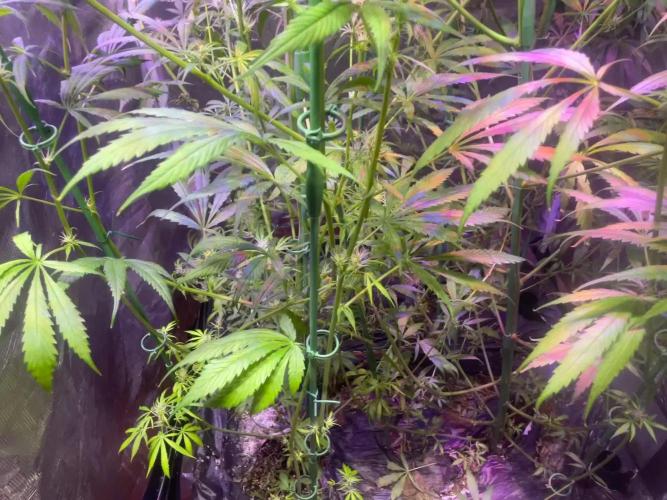
Auto Opiym is in flower and with some cooler night temperatures in upper 50s low 60s the buds and leafs are changing colors🤩 The feeder leaves are yellowing and the sugar leaves are changing to purple 💜 . I top dressed with 2 tbsp bloom soil as fertilizer. Her limbs are spindly ans can't support the weight of her buds. I added a hoop to support branches but many just bent over the wire. I don't see many amber trichomes so I wait.
Likes
7
Share
Smart 8 from medic grow Flipping within days here. amazing growth from all these clones Check out MEDICGROW website https://medicgrow.com/ Really excited to see what it can do I’m flower. Love the Bloom button which increases red spectrum when wanted/needed… Currently running at 40% Official Website: https://medicgrow.com/ Facebook: https://www.facebook.com/medicgrowled Twitter: https://twitter.com/medicgrow Instagram: https://www.instagram.com/medicgrow420/ YouTube: https://www.youtube.com/channel/UCNmiY4F9z94u-8eGj7R1CSQ Growdiaries: https://growdiaries.com/grower/medicgrowled https://growdiaries.com/grow-lights/medic-grow
Likes
31
Share
Info: Unfortunately, I had to find out that my account is used for fake pages in social media. I am only active here on growdiaries. I am not on facebook instagram twitter etc All accounts except this one are fake. Flowering day 40 since the time change to 12/12 h. Hi everyone :-) . The lady continues to develop her buds. Unfortunately, she had a little bit of cal / mag which was not too bad now Is why I'll let her go to the end like this. Otherwise she is developing very well and it won't be that long since she has started to use up her nutrients :-). Otherwise the tent was cleaned and everything checked. lots of fun and stay healthy 🙏🏻 You can buy this Strain at : https://www.royalqueenseeds.de/feminisierte-hanfsamen/220-pineapple-kush.html Type: Pineapple Kush ☝️🏼 Genetics: Pineapple x O.G. Kush 👍 Vega lamp: 2 x Todogrow Led Quantum Board 100 W 💡 Bloom Lamp : 2 x Todogrow Led Cxb 3590 COB 3500 K 205W 💡💡☝️🏼 Soil : Canna Coco Professional + ☝️🏼 Fertilizer: GHSC Powder Feeding Bio ☝️🏼🌱 Water: Osmosis water mixed with normal water (24 hours stale that the chlorine evaporates) to 0.2 EC. Add Cal / Mag to 0.4 Ec Ph with Organic Ph - to 5.5 - 5.8 .
Likes
26
Share
12/06: joyeuse saint Nicolas 🤗😇😎. Dernier rempote effectuer hier sans accrocs, merci les Trichodermas ;). Dernière semaine de veg. Je vais encore attendre 2 à 3 jours et je LST et fixe un filet pour aider les plants à diriger et supporter le futur poids de leurs fruits/fleurs...
Likes
7
Share
The girls recovered the same day as the topping last week. They have more than doubled in height and gain nodes quickly. Accidentally was giving wrong dose of nutes last week and corrected it this week. These strains are very hardy so far
Likes
17
Share
Week 3F begins. Raised the light a bit, will see if it makes a difference with the leaves. Bud sites are popping and looking good for their small size. Thanks for stopping by.
Likes
10
Share
@Prop207
Follow
15ml Sb 15ml CalMag 45ml PBPG Clones weren't ready, held off on flipping 12s till I have viable clones ready.
Likes
9
Share
@Chupus
Follow
Today I submerged it in water for several hours. In the evening I will transfer it to a paper towel
Likes
20
Share
Not particularly growing for speed or any dedicated reason this time round, just adding water and a abundande of positivity, gotta admit I do like the autoseed logo. Off we go again into the magical forest. (Arthrospira platensis) cultivated in high-alkaline, mineral-rich water in Kailua-Kona, Hawaii. It is renowned for having a higher nutrient content, including more carotenoids and essential fats, compared to other spirulina brands. It is frequently cited as a "complete food" due to its dense concentration of proteins, vitamins, minerals, and pigments. The nutritional profile of standard dried Spirulina platensis biomass. 3kg of spirulina powder has an approximate NPK ratio of 10-2-1 (or 10% Nitrogen, 2% Phosphorus, and 1% Potassium). Here is the breakdown of the nutrient content for 3kg of powder: Nitrogen (N): ~300g (10% of total mass) Phosphorus (P): ~60g (roughly 2% of total mass) Potassium (K): ~30g (roughly 1% of total mass) 3kg of spirulina powder is more than enough nitrogen for 4 cannabis plants in a 100-gallon pot—in fact, it is likely excessive and could cause severe nutrient burn or toxicity if not properly managed. Spirulina has a very high protein content (46% to 63% dry weight), which translates to a significant nitrogen source. It is often described as a 5-1-1 NPK fertilizer. 3kg (3000g) of powder in 100 gallons means 30g per gallon. General organic recommendations for potent amendments (like frass) are often around 1–3 tablespoons per gallon. 30g of powder is roughly 2-3 tablespoons, making this a very high-strength application rate if added all at once. Balance this with calcium/magnesium, and organic nutrient delivery in soil growing can lead to deficiencies in these nutrients. Not all of that 100 gallon is used, so figuring out precise measurements was ballpark, but there is about 10kg of engineered biochar in that pot. Mostly in the top half. Ideally, I'd have 25kg in a full active 100-gallon, but......... don't mess with something that is not broken. Roots do not utilize the entire 100 gallons. This has been a couple of years of trial and error, mostly error. The amount of cations you can add in grams depends entirely on the specific cation exchange capacity (CEC) of your biochar and the type of cation being added. Biochar CEC values vary widely, typically ranging from 4 to over 300cmolc/kg. Multiple Biochars in use, ranging upwards of 100cmolc/km. Different cations have different atomic weights Potassium K+ 39.1g/mol. Calcium Ca2+ 40.1g/mol. Magnesium Mg2+ 24.3g/mol. Nitrogen NH4+ 18.04g/mol. You get more nitrogen bang for your buck. It all depends on the CEC of the biochar you use, but brrrrrrrrrr roughly I'm looking at 500-600 grams worth of elemental cation exchange capacity, give or take. That's just for the biochar alone. Elemental cation exchange capacity refers to the ability of materials—such as soil, minerals, and biochar to adsorb, hold, and release positively charged ions Ca2+, Mg2+, K+, Na+, Al3+, and Zn2+. This capacity is a critical measure of nutrient availability in soil and energy density in electrochemical systems. Added calmag 2:1 to complement spirulina. Calcium (Ca): Approximately 150g - 300g of elemental calcium. Magnesium (Mg): Approximately 75g - 150g of elemental magnesium. So long as pH stays in 6.3 to 6.7 ish, the plant will unlock hydrogen. Plants will be able to cycle CEC for their own needs. Hydrogen ion pumping (proton pumping) is a fundamental mechanism used by plant roots to facilitate the cycling of nutrients within a medium's Cation Exchange Capacity (CEC), directly increasing nutrient availability. A growing medium's Cation Exchange Capacity (CEC) does not contribute directly to Electrical Conductivity (EC). CEC represents potential nutrient storage, while EC represents active nutrients in the water/soil solution. A medium with a high CEC can hold many nutrients, but if there is no water present, the EC will be low. 98% of plant nutrient uptake comes directly from the soil solution. 2% of nutrient uptake is directly from soil particles. Nutrients held on exchange sites (CEC) are not directly measured by EC until they are released into the soil solution through exchange with other ions (e.g., hydrogen ions from roots or fertilizer). Plants source the H+ ions (protons) used in cation exchange primarily by exuding carbon sugars into the rhizosphere, then microorganisms perform root respiration, which reacts with soil water to form carbonic acid H2CO3 that dissociates into H+ and bicarbonate. Roots also actively pump out H+ ions directly to acidify the rhizosphere, plants trade hydrogen produced through metabolism for essential nutrients held by the soil. In plant cells, the H+ (protons) used in proton pumping across the plasma membrane come primarily from the cytoplasm (cytosol). The protons are derived from internal cellular sources, including metabolic processes that release H+, and the regulation of intracellular pH homeostasis. Distilled water is highly useful in managing the electrical conductivity (EC) of a growing medium by allowing for precise control over nutrient concentration and assisting in the mobilization of nutrients from the cation exchange capacity (CEC) into the active, plant-available nutrient solution. Just add water & positive energy. Potential hydrogen. pH. + - , potential charge balance for hydrogen. So long as there is adequate oxygen in the soil and air and water moves at a decent interval, its practically impossible for the pH to skew in a soil that is taking in oxygen and releasing CO2 and nitrogen, I say practically, but meh, even with plenty of oxygen, the process of converting ammonium NH4+ to nitrate NO3- by bacteria releases hydrogen ions H+, which directly causes acidification (lowering pH). While water movement is necessary, consistent water moving through the soil can leach away basic cations Ca2+, Mg2+, K+, Na+, leaving behind acidic hydrogen and aluminum ions, causing pH to drop, especially in humid regions. High levels of CO2 in the soil (from intense respiration) dissolve in soil water to create carbonic acid, H2CO3, which lowers the pH. (barometric pumping removes that possibility) The pH in a cannabis cultivation environment, particularly in hydroponic or soilless setups, will often naturally drift towards acidic (lower pH) over time. Understand how to know when to lime the pH back up. Complex but critical. Once I understood this it helped ease the pain of understanding pH. Base saturation directly reflects the percentage of CEC occupied by base cations. Generally, as base saturation increases, soil pH increases because fewer acidic cations, H+ and Al3,+ are present on the soil colloid surfaces. At a pH of 7 or higher, the soil colloids are saturated with base cations, resulting in a base saturation of 90+%. While many sources include Sodium Na+ as a base cation, some calculations focused specifically on plant nutrients (like in some nutrient management contexts) may focus solely on the "Big 3": Ca2+, Mg2+, and K+. However, in soil science and CEC (Cation Exchange Capacity) measurements, sodium is usually included in the definition of total base cations, making it the "Big 4" base cations. At a pH around 5.5, soils often have a 45–55% base saturation, while a soil with a pH between 6.5 and 6.8 generally has an 80–90% base saturation. Base saturation is considered a reliable, albeit complex, indicator of soil fertility and the degree of soil weathering, acting as a crucial metric in soil classification and management. Once you take full control of the pH, so long as there is oxygen, and one keeps tabs on base saturation levels. Its near impossible for anything to go wrong. All you are essentially doing is adding water and waiting for any sign of deficiency. Not so much growing as eliminating the possibilities of things going sideways. Can't over or under water, can't skew pH, can't go anaerobic. Everything runs in optimal cycles, watering every 2 to 3 days or as required, depending on the rate of combined ET. A little warmer, a little drier, but never short on water. All the nutrients are already there in the medium, we still focus on the water, just not adding salts, but to mobilize nutrients held in the Cation Exchange Capacity (CEC) and move them into the active soil solution for plant uptake, the best supplements to add to water are fulvic acid, humic acid, or seaweed/kelp extract. Liquid solutions with high concentrations of essential trace elements. Distilled water has no alkalinity or minerals to help buffer or release nutrients. Adding these supplements turns the "empty" water into an active agent that forces nutrients off the CEC colloids into the solution for plant uptake. When to water? When Electrical Conductivity of soil gets low. No water, no conductivity.
Likes
2
Share
@Aleks555
Follow
Week 9 – Bloom in Full Swing! We’ve reached Week 9, and our Gorilla Girl from Sweet Seeds is thriving! She now stands tall at around 70 cm, with a strong structure and wide canopy supported by the SCROG net. The training and care are clearly paying off — she's growing vigorously and looking beautiful. We’re continuing with Xpert Nutrients Bloom Formula, and the results are impressive: lush foliage, strong branches, and flowers developing steadily. Big thanks to Sweet Seeds for the amazing genetics and to Xpert Nutrients for the top-notch support throughout the grow. Full bloom is here — and we’re loving every moment!
Likes
11
Share
Molto energetico e creativo a lungo andare stanchezza mentale e sonnolenza fantastico per serata con gli amici al pub
Likes
46
Share
@Chubbs
Follow
420 Fastbuds Week 6 Gorilla Punch Auto What up what up everyone. Week 6 update on these two has been interesting non the less. The bigger of the two still showing signs of some calmag deficiency from what it appears. I've added one teaspoon/gal of General Hydroponics 3 part flora series to the feeding to give them an added boost as well as the one/gal teaspoon of GH Calimagic. All in all they seem to be flowering OK. The Temps have dropped the last week making a constant 55'f-60'f in the day and down to the 30's at night so keeping the tents warm enough will have to be part of the battle from here on out. Happy Growing
Likes
26
Share
Day 29 29/07/24 Monday Nice feeding today with De-chlorinated tap water pH 6. Gave her 300 ml and she had a small run off. Getting chunky in the stem now 💪💚 Day 31 31/07/24 Wednesday De-chlorinated water pH 6 today with Plagron pk13-14 5ml to 5L Plagron power buds 5ml to 5L Used 300ml of the 5L solution. I will be using these on water days from now on as they are advised to be used every irrigation. We'll see how they perform 💪💚 Day 32 01/08/24 Thursday Another feed today using de-chlorinated tap water pH 6, there now taking 300ml every evening. Day 35 04/08/24 Sunday END OF WEEK 😁 De-chlorinated tap water pH 6 today with Plagron products. 300ml each. Had a issue with leaf invaders this week, I have treated and am checking every 48 hrs so far seems ok and not progressive. All plants look great, very healthy, one of the Overdose is way behind and due to space maybe culled at flower I'll see how she gets on.
Likes
8
Share
Hello Diary, The first week of flowering of the Milky Way is over. As you can see in the photos, the plant looks beautiful, the flowers have started to form, the branches are full of them and the shape of the plant is like a Christmas tree. Due to the large number of leaves, I remove a couple of extra leaves every week. Watering is a little more frequent, this week I added bio flowering booster with one watering. I don't always add supplements when watering, about once a week. The temperature at the Farm has risen slightly, around 28 degrees, which corresponds to the conditions outside, while the humidity is around 50%. Here is a quick overview of the week. 23/05/2023 - Day 24. Watering. I prepared 8 liters of water, lowered the pH. to 6.0 and added the first two components of the bio flowering booster. I watered all three plants on the farm with that amount. 27/05/2023 - Day 28. Watering and photography. This time I watered with clean water, I just lowered the p.H. 6.0. Milky Way F1 - 43 cm That's all for now, see you soon. And thank you all for your support.