


Likes
Comments
Share


@NONSENSE
Follow
,, the Flooring going well as you can see buds growing just perfect, I am using nutrients from Hesi.
No overdose, no PH correction.
Recommend


Processing
Likes
1
Share


@Nvchods3
Follow
esta semana se les realizo poda apical al 5to nudo, se vuelve a regar con enrraizante para que nuestra belleza se rexupere de lampoda

Likes
19
Share


@BudahBudz2020
Follow
To start off the week I've only just noticed that instead of 2 leafs and branches on each inter-node they're is 3 nice little mutation going on.....It was all normal through gemination and seedling stage can't wait to see her flourish
Day 29 Notes
Removed the lower fan leaves and side branches so I have 4 main tops to train I had 6 when i topped
Day 30 Notes
Watered with bio bizz grow bio bizz cal mag and bio heaven
Trained the 4 main branches
Day 33 Notes
Watered with bio bizz grow bio bizz cal mag and bio heaven and monkeys Root Shoot..also took a few fan leafs blocking lower branches
Processing
Likes
9
Share


@Divs_darkroom
Follow
She is a strong and resinous plant. I am seeing some kind of deficiency but I'm too far into flower to care about fixing it. Same thing happened to my last bluetoof. Same nutrient mix as the toof decay and that plant looks great. She smells sweet :)

Likes
14
Share


@Do_it_Dan
Follow
She's come along way now in the flush and hopefully chop this week, shes swealling now and oh my does she stink so gassy yet fruity, remember happy growing and stay green 😀 💚✌️

Likes
13
Share


@NanoLeaf
Follow
End of week 10 and so close to harvest!
I have finally decided to chop the Purple Lemonade because she has been ready for a few days now literally oozing out sweet sticky sugars and the trichomes were about 70/30 cloudy to amber ratio.
The other plants are about 90/10 and will be chopping the ladies soon.
Smoothest grow I’ve had. Also only the 2nd (Indoor) grow.
It’s nice to see some progress and will always try pushing to grow better and frostier flowers.
One love!


Likes
55
Share


@budsfromthesix
Follow
Day 43 of flower and no issues so far. Pheno #2 is stacking beautifully and is actually getting decently fat and she’s caked in trichromes. Pheno #1 is behind on the stack, colas are half the size which might be due the fact that she was topped 7 times, who knows. Super happy with the results so far. It smells like berries in there. I definitely feel this strain needs longer than 8 weeks. I’m aiming for 65 days of flower. Let me know if you guys think I should run her longer.
Update at Day 45:
White pistils have started reversing a bit and starting to grow brown. They seem to be doing pretty well. Pheno #1 is suffering from calcium deficiency but it’s too late inflower for me to try to do anything to fix it and the plant is pretty happy so I’m not worried. I’m still aiming to harvest at day 65.
Did a squeeze test today just to get a feel of what the terpenes smell like. Pheno #1 is leaning more towards emerald headband as it just smells like gas and I love gas despite her being a finicky bitch to grow I’m excited lol.
Pheno #2 is leaning towards blackberry kush as it just smells like fruity berries.

Likes
4
Share


@Kassus_Kush
Follow
Polly has been eating like a queen. A very thirsty plant. This is her last week before I start flushing. This was a very fun grow!

Likes
13
Share


@HIAZ_urbanbudfarmer
Follow
Hi Gromie's, well it's the end of another problem free week!
Week 9 going into week 10 of veg!
I don't usually veg for this long but I'm just trying to get the timing right for perpetual harvest.
Plants in flowering tent were harvested & drying now for 5 days, so these girls will be transferred to the flowering tent in the next few days for the start of flowering, I've allready planted new seeds for the following grow, so just trying to get on top of the timing for everything related with perpetual growing.
Thinking of setting up a 4x2 tent with a 4 inch extraction fan & filter for drying, so I can cut out around a week, that way as soon as I've harvested & cleaned the tent I can transfer plants from veg instead of having to dry in the flowering tent. Have developed really strong & thick structure's from the H.S.T & L.S.T training. Plants are nice & healthy.
Performed 1 last defoliation before they go to flower as they get very bushy quickly.


Likes
12
Share


@Kirsten
Follow
9.2.25:
The plants had a good watering, they're all still drinking a lot. Which is great, as that means growth, which, at this stage, we desperately need!
I went ahead and gave all the plants a thorough watering each with:
2ltrs of dechlorinated water, PH'd to 6.5 with:-
♡ 4ml of Xpert Nutrients Bloom Booster
♡ 4ml of Xpert Nutrients Cal-Mag amino acids
♡ 4ml Seaweed extract liquid
I don't know how this scrog net is going to work out.
I think the squares are too big. It's elasticated, which I like. However, I'm extremely cautious with watering and moving the net. It's only a matter of time before I break more branches. It's such a hassle with it in there, honestly. I can't get in the tent properly to even check the weight of pots, as it's all weaved through, and again, I will snap branches.
I did have a free net with the tent, which I think was smaller squares. I think I will use some other training next run.
It's really not my kind of setup. I'm too interested in moving things and inspecting the plants constantly.
The net is driving me up the wall. 😣 I'm considering removing it and trying something else, but it's also a bit too late for oldest plants.9.2.25:
Gave the plants another good soak.
I used 2ltrs of dechlorinated water PH'd to 6.4. It contained the following nutrients;
♡ 4ml of Xpert Nutrients Bloom Booster
♡ 4ml of Xpert Nutrients Cal-Mag amino acids
♡ 4ml Seaweed extract liquid
♡ 0.5g of Ecothrive Biosys.
The plants are undergoing explosive growth at this stage, which I'm thrilled by!
Purple Lemonade is turning purplish hues.
Pink Mist has so many bud sites and is looking very healthy.
Do-sì-dos is growing vigorously and looking promising, especially considering all my unfortunate mishaps! 😅
Watermelon also has considerable growth. However, my training has made a mess out of the structure. Which I consider another valuable take away.
Bubble
Likes
6
Share


@gabigarcia
Follow
It is already the fifth week of vegetation and they are incredible, the autoflowering ones above all are beautiful and it is also noticing how the critical x are growing little by little. ! (Any questions, or any advice you can give me leave it in the comments, I also speak Spanish)



Likes
37
Share


@PapaNugs
Follow
A great second week here as the girls stabilize. They got watered two times this week. All good growth. 📈
This girl is also doing real well. Not much to note cause all is on track currently!!
Dimmed to 40%
Here are the lights details:
Medic Grow Mini Sun-2 150W LED
Model: MN150-022
Spectrum mode: V1
Efficacy: 2.8 umol/J
Thanks for stopping by!
You can find the light on Grow Diaries:
https://growdiaries.com/grow-lights/medic-grow/mini-sun-2-150-watts
You can find the light on Medic Grow's website:
https://medicgrow.com/
Likes
16
Share


@Paultemp
Follow
Very Good but he need more time in flower like 2-3week .. I Will do better next time i hope 😂👍

Likes
82
Share


@UnorthadoxDude
Follow
Hello growmies! Welcome to week six of An Epsilon Adventure! Massive thanks to both Shogun and Royal Queen Seeds for sponsoring this grow!
So here we are at week six and every one of these girls are at a slightly different stage, it is quite fascinating to watch them develop one after the other.
Today I made the last adjustment to the light possible. I removed the adjustable hangers and affixed a carabiner which I tightly tied to the top of the tent bar. There is about 1.5 inches of space between the top of the shade and the tallest part of the roof of the tent. Plant 1 is already taller than this, and it looks like plant 6 and maybe even plant 5 are going to join it. It's a madness. I am sure you have already looked at the photos but just in case you do what I do and read the diary first...
Here is my assessment at the beginning of week 6:
Plant 1:
Height: 1st (137cm) - what can I say about this ridiculous plant? Day 36... 137cm tall. I have had to raise the light to as high as it is physically possibly to raise it and it's still not high enough. She is done stretching now, she may add 3-5cm over the next week or so but I don't expect more than that, so her top of her main cola going to have to develop above the level of the light. Nothing I can really do, nothing wise anyway. What a monster plant.
Maturation: 4th - early into flower - bud sites developing, pistils just starting to explode.
Plant 2:
Height: 4th (111cm) - this plant has been there or there abouts as the tallest plant for most of the grow, but she has topped out at 111cm. She will gain some during flower but not much more than a few centimetres. Very impressive plant, loads of bud sites, really big strong secondary branches. This one is going to be colas galore.
Maturation: 3rd - well into flower - all white pistils
Plant 3:
Height: 6th (95cm) For some brief days the tallest plant in the room, she peaked early and is now the "shortest" at "only" 95cm for this "50-70cm" strain. She is utterly dwarfed by four of her five sisters in just about every department, being quite a bit smaller even than plant 4 (although I have removed the most lower nodes from this plant). Compared with her sisters she is almost a runt... except that she is 25cm taller than the strain top-end average and matches the maximal height of the previous tallest Epsilon F1 plant I am aware of. It's not that she is small, actually she's pretty big for an Epsilon F1, it's just that the rest of the girls are on another level altogether. Plants 1, 5 and 6 are all absolute beasts.
Maturation: 1st - well into flower - first shades of brown in some pistils.
Plant 4:
Height: 5th (98cm) although only 3cm taller than plant 3, overall she is a much larger plant. Her secondary nodes are the same height as plant 3.
Maturation: 2nd - well into flower - all white pistils
Plant 5:
Height: 3rd (113cm) - one of the two thick/short girls who have grown at a similar pace all along - she is further ahead than plant 6 but not by much and I think she will probably exceed 120cm this week, though I do not think she will outgrow plant 1 or 6.
Maturation: 5th - early into flower - bud sites developing.
Plant 6:
Height: 2nd (120cm) - my predictions were correct about this girl and her continued growth. I now think she might actually outgrow plant 1, which is quite worrying.
Maturation: 6th - early into flower - bud sites forming - by far the least mature plant of the six.
###
Week 6 Day 2 23:00 30/7
Photographed. Raised the light. Rotated the plants. Inspected, measured and reported on each plant.
###
Week 6 Day 3 23:00 31/7
It has not escaped my attention that the plants that are more advanced into flower have darkened and have some burnt tips. I need to flush them and lay off the base nutes a bit. These plants are just growing and maturing so quickly that I cannot keep up.
###
Week 6 Day 5 02:30 2/8
Fertigated 3l of nutrient mix, without either COCO A or B.
###
Week 6 Day 6 01:30 3/8
photographed
---
Thanks for reading growmies! 👊
==========
Tent: 120cm x 120cm x 180cm
Light: 600w HID Elite Dual Spectrum HPS + Angel Wing Reflector
Air: 5" duct fan system with carbon filter ~300 m3/hour + RAM 9" floor fan + 4" intake fan
Pots: Air Pruner Fabric Pots 30l - UGro XL Coco + horticultural grade perlite (~20%)
Seeds supplied by Royal Queen Seeds https://www.royalqueenseeds.com
Nutrients supplied by Shogun Fertilisers https://www.shogunfertilisers.com/en
==========
Likes
14
Share


@GODSGIFT_2005_JM
Follow
For LIQUIDS & NUTES ******GREEN BUZZ NUTRIENTS***** organic.
Also i’m using their LIVING SOIL CULTURE in powder form!
MARSHYDRO ⛺️ has large openings on the sides which is useful for mid section groom room work. 🤩
☀️ MARSHYDRO FC 3000 LED 300W
💨MARSHYDRO 6” in-line EXTRACTOR with speed-variation knob, comes complete with ducting and carbon filter.


Likes
8
Share

@Marijuanaut
Follow
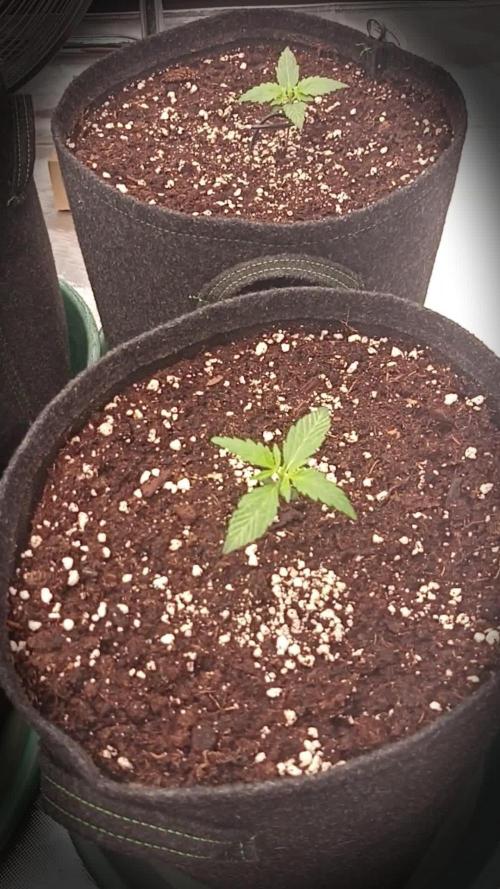
Today marks two weeks since germination and also the start of my journey with APTUS and their premium line program. 😎
First time working with these products so I´m gonna take it slow... mixing Regulator & Startbooster with PH at 6 and temp at 20ºC. 😉
Lowered the lights by 10 cms and the average for the week was 23,5ªC (temp) and 70% (hum). 😊
The supplies have arrived and the upgrades already installed... 2x 200mm duct vents for the side walls air entrance and swapped the 150 combi ducting for a 125 PhonicTrap acoustic ducting, that was just laying around here from a previous giveaway and wanted to test it out. Required a plastic reducer and some duct tape but the job was done 😅
As bonus a little trick I developed about placing sticky cards outside the tent near the side vent as first barrier and a little video with all the ladies together 😍
Really stoked with this one! 😋
Likes
5
Share


@CanarianGrow92
Follow
Last week of flowering for our strawberry gorilla from fastbuds 420
This week only water was given to the girls, as at the end of week we are harvesting the plants!
Very nice smells comes out of the tent, cant wait to try all of the fastbuds strains i have in the tent 🤗🤗🤗