


Likes
Comments
Share


Likes
21
Share


@helpmamagrow
Follow
Wanted to wait til they were healthier to flip but ended up just flipping anyway since I was running out of height space. Will probably defoliate more up until week 5 and then just let her do her thing after that!

Processing
Likes
3
Share


@Fibro_Witch
Follow
Transplanted into 6.5L pots for now until I figure out where to put them in the garden. I did a top layer of more Sprout Island Blend and then my own homemade compost the rest of the container. I figure keep it nice and mild on nutrition at first and then they can reach down for more if they need it. The compost has a lot of worm activity.
I also put them down a couple inches because they were so leggy to give them more support. I have them in a wire dog kennel with deer netting around the outside to keep critters from munching. They're much happier with actual sun and are taking in the fresh air well🌞
2 out of the 3 have red stems so maybe an indica hybrid?👀

Likes
3
Share


@DivineIndependence
Follow
This week shows a lot of stem growth as well as the presence of some clones! Too excited about how big the girls are getting have a feeling they are going to be getting bigger at a fast rate at this point. I am still keeping them on the same nutrient and light schedule at the moment. I have a lot more pictures and videos this week because lets be honest I am still getting the hang of this thang!

Likes
5
Share
@lolasher
Follow
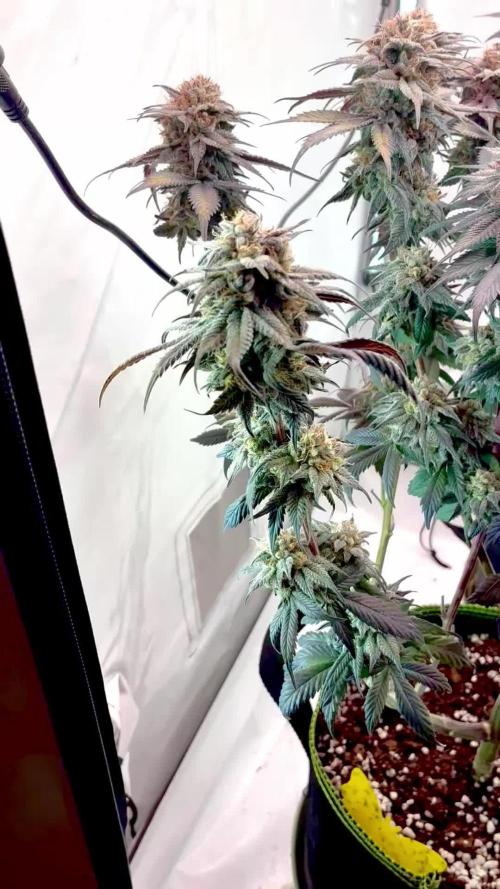
Alle Pflanzen wurden gestern geerntet und zum Trocknen, bei 16-18 Grad und rund 55-60% rlf aufgehängt.
Die Buds sind steinhart und es gab absolut kein Popcorn. Selbst die kleinsten Buds sind absolut brauchbar.


Likes
8
Share


@Kawannabic
Follow
RESUMEN DE CULTIVO: Esta cepa es brutal, resiste muy bien las manipulaciones y genera cogollos grandes y prietos, también soporta una fertilización poco controlada y ligeramente excesiva. Perfecta para alguien con pocos conocimientos (este es mi primer cultivo)
OLOR: No tiene un olor fuerte, una buena opción para quien necesita disimular el olor del cultivo.
SABOR: Su perfil de terpenos es muy bueno pero suave, varia en funcion de la planta, algunas tenían un sabor ligero, especiado y tirando a lo picante pero una en particular si sacó matices de olor y sabor muy dulces y afurtados entre el mango y el platano realmente buenos, me encantaría tener una madre de ese ejemplar.
EFECTOS: Tiene altos porcentajes de THC, a tumbado a más de un amigo, me parece una buena opción si buscas una variedad potente.
LO MALO: Poco malo tengo que decir, aunque tampoco es tan sabrosa como me hubiera gustado. Seguiré buscando otras variedades pero seguro que repito.

Likes
14
Share


@Esperanza7
Follow
I think the situation is very good. Im exciteed to see lst result
Day 20, lst show good results. She drink so fast now.
Day 21, going for week 4, what you think about she?

Likes
8
Share


@Kirsten
Follow
Orion F1 Liquid Nutrients:
The seedling is looking fairly unhappy. I will keep an eye on it.
The plant has been given its first dose of Mega Crop Part B to introduce some more nitrogen, hopefully she will begin to grow some more and start greening up.
The plant was watered when the pot was dried, to avoid mould and root issues.
8.5.25:
The plant was watered with 1ltr of dechlorinated water PH'd to 6.0. I added per litre;
♡ 1/4 TSP Mega Crop Part B
♡ 1ml Trace
PPM: 656
PH: 6.0.
☆ Xpert Nutrients PH down, up to 1ml.
☆ Ecothrive Neutralise 1 drop per litre from the 1ml pipette, which is attached.
This is my dechlorinator.
Let's see how she goes.
Thanks for stopping by 😊🍃✌️💚🤞

Likes
8
Share

@GoodTimesOrganics
Follow
Hi liebe Community und Willkommen zurück im Sensi Seeds Wettbewerb! 💚
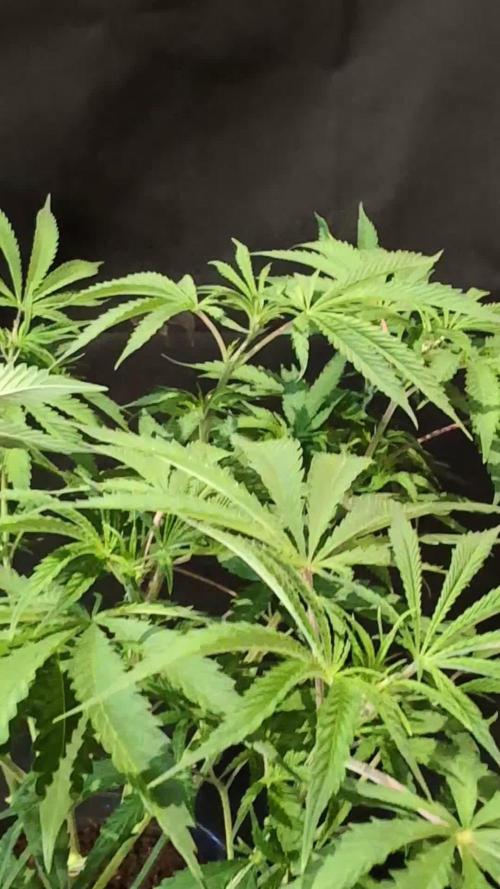
Nach der sechsten Wachstumswoche entwickelt sich die Chocolate Rainbow XXL weiterhin sehr homogen und geht von alleine schön in die Breite.
Die Seitentriebe wachsen an der Seite schön entlang Richtung Haupttrieb. Hatte schon lang keine so homogen wirkend breitgefächerte Pflanze.
Die Höhe liegt bei knapp 50 cm und sie entwickelt eher einen starken Indica Wuchs. Ihr Höhenwachstum gefällt mir sehr, da sie nicht in die Höhe schießt.
Die Bedingungen im Growschrank sind für die Wachstumsphase top!
—————
🌡️ Temp: 26
🌚 Temp: 18°C bis 19°C
💧 RH: 64%
🌬️ VPD: 1,1 kPa
☀️ ppfd: 330 mpm

Likes
20
Share


@Mr_nugs_lover_David
Follow
I removed the first set of nodes and started to train her using wires applying LST technique.she looks super green and healthy looks like she's loving the super soil that I prepare before the transplant

Likes
31
Share


@valiotoro
Follow
Beautiful buds super sticky✂️
Delicious smell something new to me!
Cant Wait the curing to taste this beauty
Likes
7
Share


@Dannyromanus
Follow
Last day of lights exposure.
The buds will now go into a 48 hours of darkness.
Last watering was done 2 days prior.
The plants will use the last bit of energy to produce more resine .
Trichomes are 10% amber .

Likes
11
Share


@adam_pawloski87
Follow
Such an amazing flower, really great especially a phenomenal hash producer yall will be super satisfied with this one!! She’s a shorty but Make sure you top 4 to 6 times or even more to have all them gooey bud producing heads , Dirtyblonde is absolutely an amazing plant!!

Likes
64
Share


@Chucky324
Follow
Hello.
I've harvested the Mega Mouth. WOW!!! I'm very impressed with this strain. Over 1.5 k for 5 plants. and it was finished by Aug 20 with the tents help.
I'm trying some new (for me) categories to add to my report.
Plant Stretch (PS) 1 to 5- 1 is hardly any stretch.
Bud Mutation (BM) 1 to 5- 1 is a beautiful normal bud- 5 is big weird growths like foxtails.
Trim- How easy or hard it was to trim up 1- you blow on the branch and hang it up. 5- Is very hard to trim takes a long time.
About- Best guess on the THC % (I've been smoking a long time)
Resin- 1 is super slippery 5- is very sticky like Gorilla Glue.
Size of Buds (SOB) 1- is very small 5- is the biggest buds
Dense- 1- is the lightest or fluffiest 5- is the rock hard buds your bud buster has trouble busting up.
Plant #1 Wet Trim 1647 g
PS. 3.5
BM 3.5
Trim 4
About 21%
Resin 4
SoB 4
Dense 4
Finished Dry Weight 289.5 g or 10.33 oz.
Plant #2 Wet trim 1606 g
PS 3,5
BM 3.9
Trim 4
About 22%
Resin 3
SoB 4.7
Dense 4.3
Finished Dry Weight- 302 g or 10.78 oz.
Plant #3 Wet Trim 1635 g
PS 3.7
BM 3
Trim 2.8
About 20%
Resin 2.8
SoB 3.7
Dense 4.5
Finished Dry Weight- 314 g or 11.21 oz.
Plant #4 Wet Trim 1753 g
PS 2.5
BM 2.5
Trim 3
About 22%
Resin 4 Falls off easily- Clumpy
Dense 2.5
Final Dry Weight- 343.5 g or 12.26 oz.
Plant #5- Wet Trim 1787 g
PS 3.5
BM 3.7
Trim 3
About 24%
Resin 2.5
Dense 2.5
Finished Dry Weight- 355.5 g or 12.69 oz.
The taste is sweet and smooth to go down with a nice balanced buzz. There was some pests around. I found thrips damage in veg and got some Spinosad to take care of that. Saw some fungus gnats around but they didn't do much damage. Easy to grow and trim. This is a recommended strain.
Chuck.

Likes
4
Share


@GWC710
Follow
03/02/2025 (Day 22)
Satisfied with overall growth. Tray watered with new feeding schedule from week 4:
1.8ml Calmag + 1.8ml Growell Plus 8:8:8 + 2ml wood vinegar to 1L RO water, phed to 5.8.
04/02/2025 (Day 23)
Did LST on DSD-2 and DSD-3. I am going to leave DSD-1 as it is.
05/02/2025 (Day 24)
Watered tray with :
1.8ml Calmag + 1.8ml Growell Plus 8:8:8 + 2ml wood vinegar to 1L RO water, phed to 5.8.
06/02/2025 (Day 25)
Did some more defoliation on DSD-2 and DSD-3. Applied foliar spray - 3ml wood + 2ml seaweed extract.
07/02/2025 (Day 26)
Removed big fan leaves from the top of DSD-1 to promote more growth on lower branches
08/02/2025 (Day 27)
Noticed substrate was still moist so skipped watering.
09/02/2025 (Day 28)
Prepared compost tea:
1 cup worm casting, 2ml seaweed extract, 2 tbl spoon molasses + 5L RO water, aerated with oxygen bubbler overnight.

Likes
59
Share


@Ganjagrandaddy
Follow
Day 92: Now entering their 9th flowering week , I was convinced they would be done at this point. The #1 in the inactive los soil seems to have stalled with very little changes to her this week. I have given her a blast of Mc at full strength into hopefully boost her for this next weeks flowering time. All of these ladies want to carry on and are not yet showing all cloudy . There isn't any amber trichromes around at all and the #2 +#3 have been adding new pistils to their buds , this again makes me feel they will go the full 11 weeks in flower but that could also mean another swell !. I will be growing more of this strain for sure in the future. They are all very pineapple smelling up close and they are beginning to add more frost now too.
Processing
Likes
12
Share


@n00bs
Follow
Esta semana entra nuevo apoyo: un LED Quantum Board de 65 Watts. Sigue mismo ritmo de riego.

Likes
36
Share

@Ganjagrandaddy
Follow
Day 56 ( 16 Flowering): I am in love with their appearance in this grow. They look surreal with their black smeared leaves and the contrast against the white pistils adds a dimension I have never seen in my grows before . They have been getting on with it quite happily and as the quickest to flowering and harvest according to their info , they should finish this week !!!. l I am glad that this is not the case and they have at least 2 weeks for sure. They smell so berry now , I cannot wait to smoke the finished article.
#1 The LOS girl is short and building her stacked buds now. She doesnt lookalike she will be a huge yield but her buds are beauties. I think I could have let her go without lst for a taller girl.
#2 is trained a little but not tied up the same as other in the grow. she has a good size to her and her buds look amazing too.
#3 Was the pale rubbery girl until the Mega Crop got busy making her green again. She is now quite a big lady and has had to move moved under the TSL-2000 to keep her happy without super cropping her. She is absolutely covered in small budlets
Likes
3
Share


@Aegon
Follow
will be back with this strains
im ok with No air conditioner!!!
dry : 60G it ok i will play this with strain’s again

Likes
33
Share


@KingSalomonsWeed
Follow
24.11. Tag 92 Blüte 61. Bald ist Kotelett.
Die Knospen kommen auf jeden Fall kurz unter die Dusche.
Also Resistent ohne ende. Das kann ich mit Gewissheit sagen.
Klein, auch wie beschrieben, gut.
Geruch ebenfalls.
Klebrig, fest.
Jetzt hätte ich gerne noch ein cooles Raucherlebnis. Darauf kommt es mir eh am meisten an.
Am liebsten ein Geschmackvolles lustiges high. Mal schauen.
25.11. In 8 Tagen bei Tag 70 ist Ernte.
Das ist die offizielle max Zeit vom Züchter Zamnesia.
Die müssen es am besten wissen.
Die Knospen wachsen noch. Keine Frage.
Die Blätter sehen mal so richtig beschissen aus(wortwörtlich).
Funktionieren aber alle noch.
Sind Saftig und so. HEXEN GEBRÄU.
Anderes kann ich nicht sagen.
Was ich sagen kann, bisher heben sich alle Zamnesia Sorten die ich kenne ab.
Mann erkennt eine eigene (Hexer) Handschrift.
Das Leben ist bunt, ihr seid mir willkommen ZAMNESIA.
28.11. Airfreyer dried weed. Ihr wisst schon... Eklig, bin aber neugierig.
Erster Jack Bong hit. (huarghh) zuviel Chlorophyll. Wirkung dezent..
Zweiter Jack Bong ( da war auch viel Staub drauf zu sehen.)
?? Lecker? Jau Lecker.
Apfel. Was? So richtig granini Apfelbonbon. Volles Pfund Erster und heftigster Geschmack, dann diesel (nicht zuviel), mit Zitrone afghan Geschmack, würde ich sagen.
Der Apfel blieb noch ca 15 min präsent auf den Geschmacksknospen.
Lecker Leute. Das habe ich nicht erwartet.
Der Turn: äh ja. Keine Ahnung. Ich war aktiv mit Grinsen. Habe ihn sehr genossen.
Airfryed weed war das... Jetzt freue ich mich sehr aufs baldige echte! Verkosten.
29.11. Tag 66 Blüte. Gedanken ans Kotelett kommen.
Und nach nem neuem Samen mit 10 Wochen Veggie(min, kaum stretch). Stellt euch bitte mal vor. Ganz viele nach Apfel duftende Knospen, oft getoppt und Riesengroß.
Ja, ich träume...
30.11. Kotelett. Es war recht einfach, da das meiste Knospe war. BLÜTE 67.
Nächste update für diesen Grow dauert. Erst trocknen, Curen...
30.11. Näh, das riecht nicht wie weed. Eher wie frisch gepflückte Äpfel!...?! Sehr Pflanzlich.
In der Nähe eines Apfelbaums ist das Quasi DIE stealth Sorte.
Tss. Sachen gibt es. Apfel weed. Unglaublich.
