The Grow Awards 2026 🏆
Likes
12
Share
@Andres
Follow
just cut 1 of my 2 hindu kush auto will inform in the next days...
Processing
Likes
3
Share
Still flushing, wait for the right time to harvest. 💪 Flushing ไปก่อนจ้า อีก1-2 สัปดาห์เก็บได้ละะ
Likes
19
Share
@Ketamine
Follow
Pretty good growth this week. Defoliated some. Increased light intensity
Likes
8
Share
Only Compost tea mix Worm,cow,fish, rabbit, chicken, two pieces deployed late
Likes
28
Share
@Brujha77
Follow
Start 5. Blütewoche Der Strech scheint langsam fertig zu sein und bisher machen sich die 3 recht gut. Heute gab's für jede noch 1l Wasser mit 1g/l Greenhouse Feeding BioEnhancer. Ende dieser oder Anfang nächster Woche bekommen Sie dann nochmal nen Composttee. Hin und wieder werden paar Blätter entfernt. Ansonsten ist nur zuschauen angesagt🥀🥀
Likes
25
Share
Cut the grow nutrient this week. This girl has been powering through as the lone survivor. Amazing trichome production for such an early stage. Should be another few weeks with this girl but shes already turning colors. 12/12 since September 5th, first buds September 14th.
Likes
13
Share
Recette du tco pour 20 litres. (Grammes : gr) 50gr biochar 250gr zéolite 3gr granulé Micro-Organisme IT45 10gr pollen d’abeilles 10gr levure de bière 3gr endomychorize 10gr consoude 20gr vers de farine 10gr cendre coque de ricin 12gr ortie microniser 15gr Kelp 10gr spiruline 10gr de cbd living soil 20ml de miel liquide 30ml de mélasse 20ml d’acide humiques et fluvic Mettre tous les ingrédients (sauf la mélasse ,l’acide h/f et le miel) dans un filtre 400micron, le placer dans un seau avec de l’eau (10litres). Rajoutez le miel et 10ml de mélasse Y mettre un micro bulleur alimenter sur une pompe à air et faire oxygéné le mélange pendant 24h. Rajout de 10ml de mélasse après 12h le début de la mise en route de la pompe. A la fin des 24h rajoutez le restant de mélasse et d’acide h/f, mettez y en plus 10litres d’eau au mélange. Reste plus qu’à arroser! j’y ai incorporé 7litre de mélange La veille j’ai préparé le pot à l’arrosage avec 500ml d’eau et 2gr de Bacillus IT35 Amyloliquefaciens X5 Bacillus Amyloliquefaciens : rhyzosphère, probiotiques. Aspersion et arrosage. Utilisable pour toutes cultures. La bactérie Bacillus Amyloliquefaciens se fixe dans la rhizosphère en se nourrissant des exsudats racinaires. En contrepartie, elle stimule la croissance racinaire en sécrétant des métabolites de croissance et solubilise le phosphore en sécrétant des phytases (enzymes). Effet probiotique consistant en l’utilisation de micro-organismes bénéfiques pour la nutrition et la santé des plantes. La spiruline, le plus riche et le plus complet des amendements organiques La Spiruline est une algue aquatique connue comme complément alimentaire, la Spiruline est aussi un amendement organique et écologique très complet. D'une grande qualité nutritive, elle apporte à vos plantes une quantité de nutriments, dont l'azote, phosphore, potassium, minéraux, acides aminés, vitamines, chlorophylle et protéine. Le charbon végétal actif est capable d’absorber jusqu’à cinq fois son poids propre en eau ainsi que les éléments nutritifs qui s’y trouvent. Il joue ainsi le rôle de catalyseur et d'amplificateur pour les fertilisants traditionnels, qu'ils soient d'origine organique ou minérale. Ce pourquoi il est idéal pour activer un sol et pour les thés de compost oxygénés. Le charbon végétal améliore la diffusion et la disponibilité des éléments nutritifs dans le sol et offre des conditions propices au développement des micro-organismes. Le Biochar peut être introduit dans une grande variété de sols. Il est particulièrement efficace dans les sols pauvres, difficiles et acides. Pour faire agir rapidement et efficacement sa capacité d’amendement, le charbon végétal est enrichi et biologiquement activé avec des micro-organismes. Le Biochar se comporte ainsi comme un structurateur et un activateur dans le but de valoriser les sols. Composition : • Charbon végétal actif 31%
• Matière organique 33%
• Matière sèche 75%
• C/N : 17
• PH : 7,2
• Azote (N) : 2,1 % dont 1,2 % azote organique
• Phosphore (P205) : 0,74%
• Potassium (K20) : 1,18%
• Calcium (Ca) : 6,8%
• Magnésium (MgO) : 0,65% Le pollen est l'ingrédient de base de la fabrication du miel par les abeilles. Riche en vitamines et minéraux, il est qualifié « d'aliment parfait », y compris pour les plantes ! Les zéolithes sont des roches cristallines, présentant des capacités d'adsorption particulièrement importantes vis à vis des polluants que l'on rencontre dans l'eau et dans certains liquides, ainsi que dans l'air et les gaz. Elles sont extrêmement poreuses comme les charbons activés et elles peuvent être chargées électriquement pour opérer comme des échangeurs d'ions. La zéolithe est un produit naturel qui respecte notre environnement. Utilisé dans le milieu industriel depuis de longues années déjà, ce minerai aux propriétés filtrantes particulières commence à se vulgariser dans le domaine de la piscine privée, de l'aquariophilie, des bassins d'agrément, de la récupération des eaux de pluie, ou encore de la culture des bonsaïs et autres plantations diverses par exemple... 4 points techniques majeurs : - Grâce à leur propriété hydrophile, les zéolithes peuvent adsorber l'eau jusqu'à 30% de leur poids total et sans aucune variation de volume : pas de gonflement en présence d'eau ni de craquement en cas de déshydratation comme certaines argiles. Les zéolithes sont d'ailleurs de puissants agents anti-mottant (anti-agglomérant). Cette propriété est très appréciée dans le cas des terrains de golf et autres aires de jeux. - Les zéolithes ne captent pas l'eau de façon irréversible, elles se comportent comme une réserve au voisinage des racines. Celles-ci peuvent capter l'eau en fonction de leur besoin. Les zéolithes permettent ainsi de réduire les besoins d'arrosage jusqu'à 35 %. - Une zéolithe se comporte comme une "Zone de Stockage" qui retient l'azote et les éléments minéraux nutritifs au voisinage des racines et les relâche lentement en fonction des besoins de la plante. Cela se traduit par une croissance harmonieuse mais rapide du végétal. - La capacité d'adsorption et l'énorme rapport surface/volume des zéolithes, vont permettre à la fois la rétention de la solution du sol et une bonne oxygénation au voisinage du système racinaire. Les zéolithes favorisent donc l'organisation biologique des sols en contribuant au développement de la micropopulation. L'apport en nutriments (N, P, K) est réduit de 20 à 25 %. Ces derniers, adsorbés par la zéolithe, sont beaucoup moins sensibles au lessivage et à l'évaporation. Composition minéralogique : * Chabasite 70 % * Phillipsite 2 % * Feldspath 5 % * Augite 3 % * Illite - Mica 2% Analyse atomique: * Sio2 52 % * AL2o3 17 % * CaO 5,7 % * K2O 6,1 % * MgO 2 %, * Na2O 0,6 % * Fe2O3 3,6 % Amendement calcaire, dolomie et gypse avec préparation microbienne à base de Bacillus Amyloliquefaciens IT45 et Saccharomyces cerevisiae LYCC6420 Formulation : micro granulés (1 – 1,6 mm) à base de rhizobactéries favorisant la croissance des plantes qui se multiplient et colonisent rapidement la zone des racines, et de levures Saccharomyces cerevisiae souche LYCC ayant un effet probiotique. Les PGPR produisent des enzymes qui solubilisent le phosphore à partir de complexes inorganiques et organiques dans le sol et stimulent la croissance des racines efficaces augmentant ainsi la zone d'interception des éléments nutritifs. Les levures LYCC permettent une occupation de la rhizosphère par une flore bénéfique. Composition :
• Matière sèche : 96,8%
• Matière organique : 91,5%
• N total : 6,6% dont N soluble dans l'eau 0,17%
• P total : 2%
• K total : 1,7% Micro-granulés : 
• Oxyde de calcium (CaO) total : 30%
• Oxyde de magnesium (MgO) total : 7%
• Anhydride sulfurique (SO3) : 13% La levure de bière est une matière vivante qui permet un meilleur fermentation pour les thés de compost oxygénés notamment conseillé pour accompagner les croissances ou apporter un gros coup de pousse pendant la floraisons. La levure stimule la vie des sols également à l'arrosage direct en apportant tout aussi bien que dans le TCO sa population l'espèce micro-bactérienne positive pour votre sols ainsi que des oligo-éléments et diverse vitamines. Composition : • 2,8% (N) total dont 1% (Norg), • 2,3% (P205) • 1,6% (K20) • 35% de MO • C/N : 8. PH : 8,4. Sous forme de poudre mouillable. Il contient des spores du champignon mycorhizien Rhizophagus Irregularis MUCL57891 avec des levures inactivées spécifiques. 2000 spores/gramme d’endomycorhize Rhizophagus Irregularis MUCL57891 et Saccharomyces Cerevisiae LYC6420 inactivée. Se connecte efficacement au système racinaire et forme un vaste réseau souterrain de filaments, qui agissent comme des extensions pour atteindre les nutriments et l’eau au-delà de la rhizosphère Composition : • Poudre contenant 2000 spores/g. d’endomycorhizes Rhizophagus irregularis La Consoude (Symphytum Officinale) est une plante présentant de nombreuses propriétés. Particulièrement riche en Potassium (K) organique, la consoude est une alliée idéale pour les périodes de floraison. La consoude a tout pour plaire : riche en vitamine B12, elle agira également comme stimulateur racinaire, mais aussi comme biostimulant cellulaire, grâce aux alcaloïdes, aux allantoïnes et jusqu'à 30% de protéine ! 100% déjection de vers de ténébrions.
Très riche en microorganismes, le guano de vers de farine est une matière directement composté par les vers. En effet, c'est bien la digestion de matières végétales par des larves, insectes ou autres arthropodes qui valident le processus de compostage, que ce soit en zone de production de cultures d'insectes, pour le compost maison ou la dégradation de litière forestière. Les bactéries et autres champignons obtenus grâce au système digestif de nos vers, permettent la dégradation accélérée des éléments nutritifs dans vos supersoils, et les symbioses permettant l'assimilation des éléments nutritifs. Cette bio-activation intense mettra dans vos sols, à la disposition de vos plantes, un panel tellement varié de nutriments frais qu'il nous est aujourd'hui technologiquement impossible de pouvoir tous les nommer et de les compter. Le guano de vers de farine fournit une grande polyvalence. Très équilibré, il s'utilise en entretien ou en apport ciblé seul ou en complément de d'autres amendements ou fertilisants organiques. Il agit comme un puissant activateur de sol et/ou de substrat. Cendre coque de ricin NPK 0,1-18,6-16,5. 0,1% (N-Azote), 18,6% (P205-Phosphore), 16,5% (K2O-Potasse), 11,7%(Ca0), 9,1 (Mg0) - Origine : Inde ACTION SOL • rend rapidement accessible au sol Phosphore, Potasse, Magnésium et Calcium. ACTION PLANTE • Apport aux stades agronomiques propices. • Produit riche en éléments fertilisants : combinaison NPK 35%. • Régularité de l’apport, milieu et fin de floraison. . Favorise la sénescence. Analyse chimique : • NPK 0,1-18,6-16,5 • N-Azote 0.1% • P205-Phosphore 18,6% • K2O-Potasse 16,5% • CaO-Calcium 11,7% • MgO-Magnésium 9,1% Ortie bio micronisée Stimule la vie du sol et la végétation. Composition : • 2,8% (N) total dont 1% (Norg), • 2,3% (P205) • 1,6% (K20) • 35% de MO • C/N : 8. PH : 8,4 KELP poudre
ascophyllum nodosum
- amendement sol Croissance et floraison - Meilleure germination - Meilleur développement racinaire Meilleure assimilation - Résistance aux stress osmotiques - Augmente la production de chlorophylle = plantes plus vertes = lumière mieux captée - Lutte contre le stress osmotique - Développement des Micro-Organismes dans le sol – Riche en vitamines, fer, iode, oligo-éléments, hormones de croissance auxines et cytokinines - Idéal en épandage et pour les thés de compost oxygénés. Important : notre Kelp est un goémon noir mais il n'est pas le varech bien moins fertile de la même famille qui est l'algue qui pullule et pollue la Bretagne, notre algue pousse uniquement à plus de 50 mètres de fond dans les grands courants froids au large de la Norvège.
Likes
28
Share
Overall, the garden is doing great. Had a scare with the WW with letting it dry out a little but it looks like its going to be fine. The pistils are starting to change color and leaves are starting to lose color but the buds are fattening up. I can't wait to see how they all turn out.
Likes
5
Share
@AustinRon
Follow
TH 1Q2025 - Week 6 - Bolt 3 
(ON Haze X Original Haze) X Northern Lights #2 “Todd’s Haze” Objective - 8 Female Plants, Topped ONCE @ Flip, 12” when topped - Modified Sea of Green Week’s Objectives - Auto-Fertigation Installed and operational - Twice/Day, 440 ml/ Day (Initial Rate) - 220 ml/Event Weeks Observations - We have a smattering of pistils showing - looks like pre-flowers with Haze morphology - Confirms (for me) the known property of Haze - that 7+ weeks of veg (from seed) is required BEFORE the plants can initiate flowering. (Noting that CUTS will be ready to flower @ Flip. Seeds Wet: 1139PM, 28.2.2025 Germinated: 2.3.2025 Flip: 21.3.2025 Harvest: 77 Days, DATE: 6.6.2025 _________________________________________ __ Fri Apr 11, 2025 TH 1Q25 22:F:3:1 EC: 1.8 LightDistance: [ 20.5, in] # We’re in STRETCH, ~1.5”/day! LightIntensity: [ 640, µMol/m2/s] - [x] TM-7: [ 0.125, g] # Prep - [x] Fertigation: [8.5:8.5:3.4:3.4:3.4:0:3.4] # [Primer A:Primer B:CalMag Fuel:Silica Skin:Lush Green:Root Anchor:Peak Bloom] - [x] Photosynthesis Plus: [ 6, ml] - [x] Quillaja 60 Powder: [scant] - [x] PCAL 1660: [ 0.5, gm] # Once or Twice/Week - [x] TM-7 (µNutrients): [ 0.125, g] __ Sat Apr 12, 2025 TH 1Q25 23:F:3:2 LightDistance: [ 18, in] # We’re in STRETCH, ~1.5”/day! LightIntensity: [ 703, µMol/m2/s] LightDimmer: [ 85, %] We’re bringing up Intensity SLOWLY, as the plants adapt. Allowing the plants to grow INTO the LightField and naturally raise PPFD as it does. - [x] TM-7: [ 0.125, g] # Prep - [x] Fertigation: [7.8:7.8:3.1:3.1:3.1:0:3.1:0.0] # [Primer A:Primer B:CalMag Fuel:Silica Skin:Lush Green:Root Anchor:Peak Bloom:Resin Bloom] - [x] Photosynthesis Plus: [ 6, ml] - [x] Quillaja 60 Powder: [scant] - [x] PCAL 1660: [ 0.5, gm] # Once or Twice/Week - [x] TM-7 (µNutrients): [ 0.125, g] __ Sun Apr 13, 2025 TH 1Q25 24:F:3:3 LightDistance: [ tbd, in] # We’re in STRETCH, ~1.5”/day! LightIntensity: [ tbd, µMol/m2/s] LightDimmer: [ 85, %] - [x] TM-7: [ 0.125, g] # Prep dilution in 250 ml plain water - [x] Fertigation: [7.8:7.8:3.1:3.1:3.1:0.0:3.1:0.0] # [Primer A:Primer B:CalMag Fuel:Silica Skin:Lush Green:Root Anchor:Peak Bloom:Resin Bloom] - [x] TM-7: [ 0.125, g] # Delivered - [x] Photosynthesis Plus: [ 6, ml] - [x] Quillaja 60 Powder: [scant] __ Mon Apr 14, 2025 TH 1Q25 25:F:3:4 LightDistance: [ tbd, in] # We’re in STRETCH, ~1.5”/day! EC: [ 1.9, mS/cm] - [x] TM-7: [ 0.125, g] # Prep dilution in 250 ml plain water - [x] Fertigation: [7.8:7.8:3.1:3.1:3.1:0.0:3.1:0.0] # [Primer A:Primer B:CalMag Fuel:Silica Skin:Lush Green:Root Anchor:Peak Bloom:Resin Bloom] - [x] Photosynthesis Plus: [ 6, ml] - [x] Quillaja 60 Powder: [scant] - [x] PCAL 1660: [ 1, tsp] # Once or Twice/Week __ Tue Apr 15, 2025 TH 1Q25 26:F:3:5 EC: [ 1.8, mS/cm] # [Primer A:Primer B:CalMag Fuel:Silica Skin:Lush Green:Root Anchor:Peak Bloom:Resin Bloom] - [x] Fertigation: [8.7:8.7:3.5:3.5:3.5:0.0:3.5:0.0] - [x] Photosynthesis Plus: [ 6, ml] - [x] Quillaja 60 Powder: [scant] - [x] Terps Plus: [ 2, ml] - [x] PCAL 1660: [ 1, tsp] # Once or Twice/Week __ Wed Apr 16, 2025 TH 1Q25 27:F:3:6 Stretched another 1.5” Main Canopy @ 740 (PPFD) Fertigation 1L/Plant/Day - 2 x 500 ml, 6 hour freq LightDistance: [ 17, “] LightIntensity: [ 740, µMol/m2/s] EC: [ 1.8, mS/cm] 
Fertigation Amount: [ 2.0, gal] # We’re a little low at a gallon/day … Light Intensity: [ 750, µMol/m2/s] # Adjust Light Height to Achieve. Light Dimmer: [ 100, %] # Photone is ok, but I think reads low . . . # [Primer A:Primer B:CalMag Fuel:Silica Skin:Lush Green:Root Anchor:Peak Bloom:Resin Bloom] - [x] Fertigation: [17.5:17.5:7.0:7.0:7.0:0.0:7.0:0.0] # [ 10, 4, 4] - [x] Photosynthesis Plus: [ 12, ml] - [x] Terps Plus: [ 2, ml] - [x] Quillaja 60 Powder: [scant] - [x] PCAL 1660: [ 2, tsp] # Once or Twice/Week’ __ Thu Apr 17, 2025 TH 1Q25 28:F:3:7 LAST HAND WATERING: FRIDAY We Start Auto-Fertigation Light Distance: [ 13.5, in] # 2“ Today EC: [ 1.8, mS/cm] # [Primer A:Primer B:CalMag Fuel:Silica Skin:Lush Green:Root Anchor:Peak Bloom:Resin Bloom] - [x] Fertigation: [16.9:16.9:8.5:8.5:6.8:0.0:6.8:0.0] # [ 10, 5, 4] - [x] Photosynthesis Plus: [ 12, ml] - [x] Terps Plus: [ 2, ml] - [x] Quillaja 60 Powder: [scant]
Processing
Likes
22
Share
2/10: I watered today with about 3/4 gallon each, plus cal-mag, signal, bembe, armor si, a little open sesame, and their final dose of endoboost. I took photos today, but forgot to snap a shot of the Soooperrunt. She's as tall as the short one now, just not as bushy. I think she'll make a fair amount of bud despite her sloooow start, smaller stature, and smaller pot. The tall one is keeping pace with the biggest plants in the garden. 2/11: Wife home sick today....postponing construction project to raise the lights....kinda scary....about 10"-12" from the tops now.. 2/12: I woke up to find the tallest of these bitches stretched another few inches and within 9 inches of the lights!!! I quickly drug everybody out of the closet and undertook the project. In addition to that project, I installed and hooked up my new AC Infinity 6" intake fan. It's pulling in fresh air from the soffit vent on the eave of the attic, and currently feeding the garden with 46f fresh air. I'm able to easily maintain daytime temps in the lower 70f's now. I am able to drive the nighttime temps as low as I want. The only issue is that the outdoor RH varies quite a bit, so I ordered a 30-pint dehumidifier to put in the top of the closet. It will battle with the evaporative cooler while the lights are on to keep it at 45% RH, but after the lights go off, it will lower the RH to 35% unti morning. After another couple of weeks, I'll kill the evap cooler altogether and try to maintain 35% RH 24/7. I'm optimistic that it will be the difference-maker in maintaining lower RH while I'm flushing all the plants during the last couple of weeks. That's usually such a challenge...especially with a bunch of 5 gallon pots. I also sprayed everybody with boomboom spray to try and mitigate the light burn damage that is likely to ensue. 2/13: Still stretching... about 12" from the lights again. I will wait to raise the lights until tomorrow when I feed them. I'm seeing calcium deficiency on a few plants, including a #9. Will up the dose tomorrow when I feed. 2/14: I fed them today with about 3/4 gallon each including grow big, big bloom, tiger bloom, cal-mag, signal, bembe, humic acid, and I switched over from Open Sesame to Beastie Bloomz. Raised the lights another couple of inches. I did some training on them and defo'd a little bit. 2/15: Installed the new dehumidifier and rigged the continuous drain on it...works great. 2/16: I rotated the edge plants and removed some old leaves. I added another 22w 3000k 4' bar light under the canopy. 2/17: I rearranged the garden and defoliated a little bit. That's it for week 8-
Likes
17
Share
@R2d2420
Follow
Good week , no issues to report. The Gelato glue are almost there. Starting to see a few amber ones & 90% 9f the rest are cloudy. The 5gallon are fatter & a bit more advanced than the 7gallon one. The Gelato are bigger but are a few weeks behind. The plastic pot stayed wetter and is more leafy than the fabric one. Still to early to say which will produce more or better buds
Processing
Likes
2
Share
Hey good morning Growers hope all is well with everyone and their family and plants Well there’s a lot going on over here at the 48219 Krud Buddy’s Grow House I found out when I transplanted my Wedding cake and Sherbertlato I put them into super soil I feed them twice lightly thank god cause I don’t have any burns or anything n their growing good to me everything is growing good to me way better than the auto flowers I started with but I did some cloning of my own and I’m loving how their taking on as well So here’s what’s going on strain by strain Gorilla Cookies & Peanutbutter Breath : as of Today April 25th they are on day 60 since I got them and have been sitting in the dark since last night for their 24hrs of darkness before flip to flower starting tomorrow morning thinking a good timing would b from 6/6 or 7/7 also I have them under my 600w budget led hanging 12’ above I can’t wait to see how they out and I have them under an scrog net I made Wedding Cake & Peanutbutter Breath: on May 5th it’ll be 60 days since I’ve had them I pretty much told everything bout them at the beginning Grape Pie & Girl Scout Cookies: it’s Been about 3 weeks And I must say they stretched fast their already 15’ tall the grape Pie is spreading faster any of the other clones I got I’m loving it I recently got Cherry Pie & Guava Cake x Cookie it’s bout week one going on two weeks and I must say when I got them I was kinda skeptical about them because they were so weak looking and the cuts on them were terrible but they look like they might turn out into something amazing idk but the pictures show it all as well as the clones I cut myself in clear plastic cups ands their on their second week of life I noticed roots on the 10th and put into cups on the 11th if I’m not mistaken I’m not around my chart so I’m not for sure but everything is going swell over here to me
Likes
7
Share
Great strain to grow. Have done outdoors a few times so had an idea that it would take well to SCROG but wow really even canopy and all the buds are nice and solid. Trimming was a sticky operation, so so much resin and red hairs. Looking forward to smoking it! Really really happy with the yield
Likes
13
Share
@Canadian
Follow
I feel sorry for my plans this 2 weeks I haven't been able to look after them properly I've been working long shift with Christmas approaching there's no time for anything so I was pushing in a lot of nutrients into them and I caused a nutrients lockout .I have flush them out with just clean water at the right pH 6.5 and they are responding very well from now on I will continue to Baby them so they gave the best result possible within the circumstances of the plants. Thank you for reading I will continue to update have a happy grow
Likes
2
Share
10/18 the mite and thrip damage is getting more obvious but all in all as a plant shes looking more 10/22 sprayed with safer brand insecticidal
Likes
56
Share
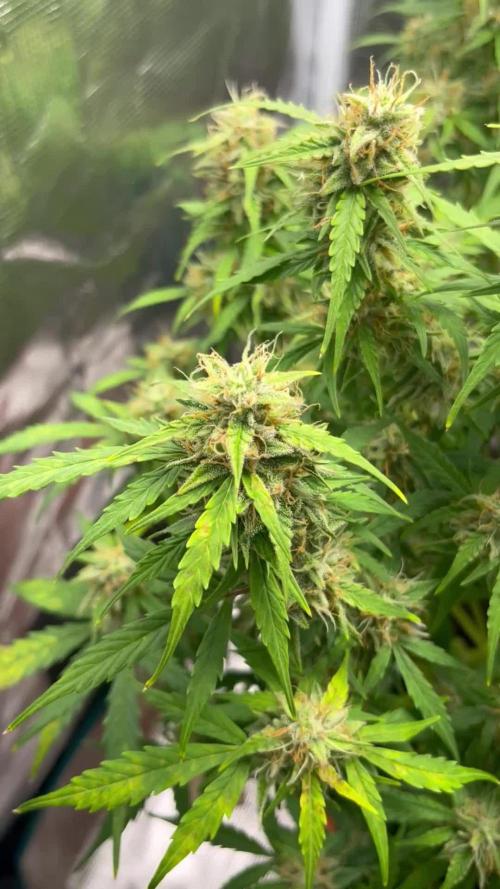
Hello everyone, weed brothers! these beautiful buds get bigger and bigger and their nutrition line is quite stable! their growth is going really well!
Likes
5
Share
@Stick
Follow
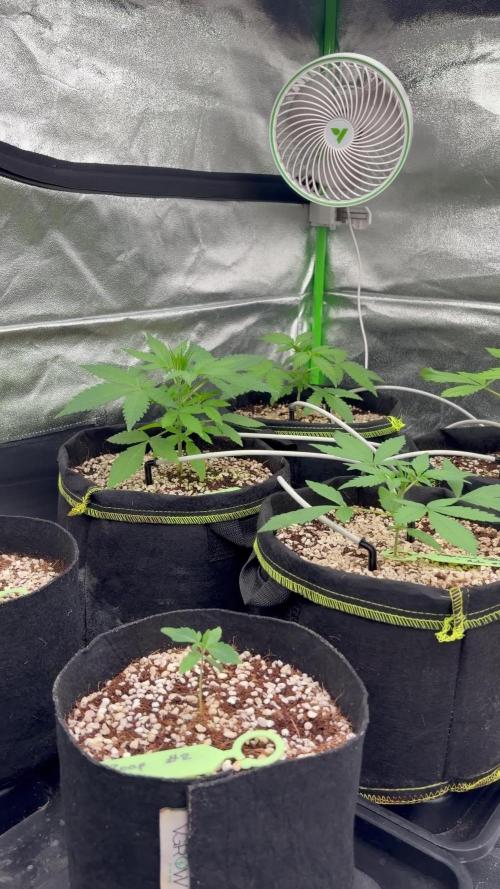
Clones are ready to become monsters, roots are exploring the fabric pots, while tops are growing vertically and creating new nodes everyday. I think it's almost time to trigger the flip, I'm limited with heights and these babies will probably stretch a lot. One more veg week and we'll jump into the flowering stage!
Likes
5
Share
Likes
4
Share
Thursday 16th march day 59 Harvested a couple days earlier then planned as my humidity was getting a bit high and worried about risking mold I decided to chop, have to get a good dehumidifier soon, everything looking lovely, nice and dense with very strong fruity potent smell definitely the best looking plants I have grown to date not the biggest buds but they look quality, chopped plants whole gonna do my best to keep the temp and rh% in the dry room as close 60/60 as I can to get a nice slow dry, 🍁😎 I only took the wet weight from 1 plant back left plant was 270g with large fan leaves removed