


Likes
Comments
Share


@Terpio1500
Follow
Week 4
Last week was good gave the last defoliation for day 21. Adding a higher feed for her.
This one got crazy pistil produced & it’s going all the way down the plant it’s the shortest out of the 3 but has the 2nd most pistil producing on it
Check out my IG for more content @therealterpio & check out my other dairies (jungle verde & Gelato Cake)

Likes
8
Share


@VanillaGorilla
Follow
OCT 14 - DAY 51 - She's starting to stack the buds tight and fat. great fun!
Likes
48
Share


@Nvchods3
Follow
esta semana le aplique big one de forma foliar para empezar a estimular la Pre-floracion !

Likes
6
Share


@lOlympusl
Follow
I was so excited to see some weed leaves pop out. Everyday the plants got noticeably bigger. I’m making sure their environment stays as consistant as possible. I did encounter my first issue. I went to refill my humidifier turns out the water had turned green. I emptied the tank into a glass you can see in the pics. Washed it and ill make sure to do so more frequently. I’m guessing it was stagnant for too long and algae grew? Has this happened to anyone? What cause it?

Likes
168
Share


@Still_Smoq
Follow
📆 Week 1, 6-12 May 2024
6 May - 3rd sprout appeared. Waiting for main root to appear before transferring.
8 May - Main root appeared on the 1st sprout, transferred to its permanent home (see pictures).
9-12 May - Observed and watched the seedling grow.
📑 Transferred seedling into permanent Deep Water Culture, 2 gallon system. I’ve always had the best response when the main tap root appears prior to this process, it helps to ensure success. This plant seems to be getting off to a slower start, but steady.
All seeds germinated, sprouted and became seedlings. I’ll be finding homes for the other 2 as my grows are limited by space and number. Another reason I like to only germinate a single seed at a time and primarily why it needs be viable. “One good seed is all you need”.
🍶 8 May initial nutrient solution started
🍽️ 8 May initial feeding schedule started
💧 Using reverse osmosis water with EC/TDS at 0
🐉 Nutrient solution EC 1.0 at 72 degrees F
🔆 Light power at 50%, DLI 12-15 canopy coverage at 18hrs
😤 Using PYPABL, Air Pump, 400GPH
That is it for this week. Thanks for the look, read and stopping by.

Likes
2
Share


@R_atata
Follow
In der elften Woche tut sich nicht mehr viel. Es herbstelt an den Blättern. Die Lemon Haze ist etwas schneller als die Euforia und hätte geerntet werden können. Es gibt nur noch wenige klare Trichome. Ich werde beide noch eine Woche stehen lassen und dann schneiden.


Likes
11
Share


@TgOgFaRms
Follow
🌿🔍 Week 7: Trichome Wonderland and Final Push! 🌿🔍
Hey there! Here's your weekly update with all the exciting developments in my grow:
🌸 The Smell is Popping: Week 7 brings a delightful aroma to my grow space. The scents are becoming more pronounced and captivating. 🌬️👃
🌈 Colors Galore: The plants are showing off their vibrant colors as the flowers mature. You'll notice burpling on the leaves and the emergence of orange and red hairs on The Queen plant. LOVE IT ! 🌺🎨
💧 pH and TDS Levels: Throughout the entire flower stage, my pH has remained steady at 6.33. That's great! As for the TDS levels, they currently stand at 750ppm and 1150ppm, providing the necessary nutrients for your plants. ⚖️🌱
⏳ Flowering Progress: The Queen is proving to be a quick finisher, with only 46 days of flowering under her belt. She's looking almost ready, and it's time to grab my handy DIY microscope to examine the trichomes closely. Keep an eye for the desired level of ripeness! 🔍🌿⌛
🍪 Oreo Big Stuff: Although not as far along as The Queen, the Oreo Big Stuff will need an additional week of flowering before she reaches her peak. 🍪⚡
🌿 Zweet Og: The Zweet Og requires a bit more patience. It looks like it will need at least two more weeks before it's ready for harvest. Keep monitoring her progress and let her mature fully. 🕒👀🌿
🧐 Drying Dilemma: Unfortunately, I currently am facing a problem with drying The Queen. She's positioned on the back left side of the grow tent with a scrog, making it challenging to remove her without disturbing the others. It's a tricky situation indeed! 😬🌿🏋️♂️
🌱 Future Plans: Despite this dilemma, overall, I'm extremely happy with how things are going. No herms or other issues have arisen, which is fantastic news. I'm even planning to do another run with The Queen, as I already have six clones ready to be transitioned into flowering immediately after this run. Exciting times ahead, especially since it'll be my first time flowering clones! 🌼🌿🌿
That's all for this week's update. Happy growing, lads, and remember to stay high on positivity! If you need any assistance or have any questions, feel free to ask. 🌿💪🌿✨





Likes
15
Share


@Hashy
Follow
********************************************
Week 6 Early flower (week 2 flower)
********************************************
Light cycle=12/12
Light Power=75w 31%
Extractor controller settings (during lights on).
High temp= 26c
Temp step=0c
High Rh= 58%
Rh step=0%
Speed max=10
Speed min=1
Extractor controller settings (during lights off).
High temp= 20c
Temp step=0c
High Rh= 60%
Rh step=0%
Speed max=10
Speed min=1
Smart controller settings (during lights on).
Lights on=9.00am
Radiator on= -19.0c
Radiator off=+19.5c
Smart controller settings (during lights off).
Lights off=9.00pm
Radiator on=-18.0c
Radiator off=+18.5c
VPD aim=0.9-1.3
DLI aim=30-35
EC aim=0.8-1.5
PH aim=6.0-6.5
💧💧💧💧💧💧💧💧💧💧💧💧💧💧💧💧
NPK= 10-10-20
Method= Automatic
Feed= Flower nutes
Neutralise=0.1ml/L
Katana Roots=0.2ml/L
Plagron bloom=5ml/L
Plagron Power buds=1ml/L
Easy Ph down=0ml/L
(1ml=24 drops, 1 drop=0.04ml)
Easy Ph Up=0.083ml/L
(1ml=24 drops, each drop is 0.04ml)
Ec=1.35 PH=6.4/6.3
Runs=10
Run times=3mins (0.7L/0.35L each)
Gap times= 17mins
Total runtime=30mins(7L/3.5L each)
Total flowrate= 0.233L/min(0.116L/min each)
Auto start time=10.00am
Auto stop time=1.03pm
💧💧💧💧💧💧💧💧💧💧💧💧💧💧💧💧
********************************************
********************************************
📅15/3/25 Saturday(Day 36)
📋
📅16/3/25 Sunday(Day 37)
📋 replaced batteries in wifi temp/humid sensor.
📅17/3/25 Monday(Day 38)
📋
📅18/3/25 Tuesday(Day 39)
📋 Small defoliation and leaf tuck.
💧
Automatic Flower nutes
Ec=1.35 PH=6.4/6.3
Volume=9L
Volume left=2L
Volume used=7L(ml/min)
Volume each=3.5L(ml/min)
Runoff.
Total runoff=L
Ec= PH=/
💧
📅19/3/25 Wednesday(Day 40)
📋
📅20/3/25 Thursday(Day 41)
📋
📅21/3/25 Friday(Day 42)
📋H=38cm D=26cm Dli=28.4 PPFD=657
Raised light, increased power to 100w
H=38cm D=39cm Dli=26 9 PPFD=623
********************************************
Weekly roundup.
📋 That's the 2nd week of flower finished, she hasn't really stretched that much, about 13cm during this week. She's nice and bushy, looks healthy so I'm saying this was a good week.
Back soon.
Take it easy.
********************************************

Likes
21
Share


@Jays_Not_Here_Man
Follow
A-Day 53 (into week 8) B&C-Day 49 (end of week 7)
A - She is stacking well, and feeling greasy! The smell is coming on stronger everyday, frost is just starting to build up. There is a distinct transition as the leaves go through veg to early flower to late flower. Uniform all around, not very tall, but she is hardy and thiccc!
B- Full flower now, so many tops! She has shown to be a slower flower developer than A, but the flowers she are developing are almost completely uniform all across the 🌱! I assume because there are so many they will be a little slower. I put her ties back on, and the middle shoots exploded with new stretch and growth, so she is still in that stretch/flower stage.
C- what can I say, patience is a virtue. She is looking lush and vigorous. With this being a slightly longer to finish auto strain, she has had time to recover from a) being a runt, B) having slow growth, c) having almost no training and lighter nutrient feeds her whole existence. This is also my control for Topping, she was not, A and B were. This strain is clearly hardy and able to withstand multiple techniques, we’ll see what the end the result is compared to her sisters.
All three plants received a full nutrient feed x2 this week. That was: 3 gallons dechlorinated water mixed with 12 ml Micro, 12 ml Bud, 20 ml Grow, and 6 ml Sensi Extra CalMag, PH’d to 6.2. And another very low feeding of 1/3 that mixture mixed into 3 gallons of water. Ive heard many growers who instead of just watering, they will do a much lower strength of nutrients included in their watering, and ultimately never not feed their plants nutrients until flush. Thoughts?

Likes
18
Share


@TheCannaProphet
Follow
~ FASTBUDS CHEMDAWG AUTOFLOWER~
'The history of the Chemdawg strain starts in the early 90s where a group of cannabis breeders from Colorado were following a band on tour and took some of their weed with them, they had named this weed “chem bud” due to the unique chemical and diesel flavors.
When they got to one of the shows, they sold a couple of grams to a group of friends who quickly realized those were some special buds and, lucky for them, the buds had a couple of Chemdawg seeds (before they actually knew what they were) which they stored.
When one of the friends, who was also a cannabis grower, went back to his home on the East Coast, he germinated some of the seeds and started selecting the best phenotypes to continue developing those genetics even further.
As you may know by now, his effort paid off, and soon enough there were two versions of this strain going around, one was Indica-dominant and the other was a Sativa-leaning hybrid.
Both of these versions quickly spread around and several breeders developed new strains with these genetics, getting known by almost every cannabis consumer, becoming extremely popular and giving birth to a lot of famous strains such as Sour Diesel and OG Kush, although this isn’t confirmed, several old-school growers swear by it.' *content credit to FastBuds
_______________________________________________________________________________________________________________________________________________________________________________________________________________________________________________________________________________________________________________________________________________________________________________________________________________________________________________________
The Spec's:
'These precious genetics were boosted by the Fast Buds team to provide a super tough, potent, and easy-to-grow strain.
This Chemdawg Auto from their 'Originals' line grows around 90cm and is very resilient to diseases and colder climates but watch out because if you’re growing outdoors, your neighbors will be able to smell it easily!
This strain can be cultivated even by beginner growers due to it requiring minimal maintenance and can produce up to 400gr/m2 in 8-9 weeks, this is one of the shortest varieties FastBuds offers and can be the perfect choice for those growing on a balcony or in a limited grow space.
As soon as the trichome production starts, you can expect a terpene profile that resembles a mix of chemicals that is a delicious blend of diesel, gasoline, and petroleum.
With up to 20% THC, you can expect a super potent high that will take you into another world and leave you there, while you relax with a strong corporal high that will leave your whole body melting, a perfect effect to relax after a long day of work or inducing a good night of sleep.' *content credit to FastBuds
~Chemdawg Auto~
Genes: Sativa 20%/Indica 80%
Genetics: Chemdog Autoflowering
Flowering: 8 – 9 weeks
Harvest: 350 – 400 gr/m2
Height: 60 – 90 cm
THC: Up to 20%
CBD: < 1%
Autoflowering: Yes
________________________________________________________________________________________________________________________________________________________________________________________________________________________________________________________________________________________________________________________________________________________________________________________________________________________________________________________
THE SETUP:
~Planted into Jiffy Peat Pellets that were hydrated with de-chlorinated water with SuperThrive added then ph'd to 6.0 @ 80℉
~Grown 100% organic in 10g fabric pots with Mother Earth 70/30 Coco/Perlite medium amended with 2tbs/g of Down To Earth 4-4-4 / 2 cups/g of Earthworm Castings / 1tbs/g of Dr. Earth Flower Girl 3-9-4, 1tbs/g of Dr. Earth Bat Guano, 3/4 cup of Down To Earth Azomite and 1 tsp/g Down To Earth Fish Bone Meal.
~24hr light cycle during Germination / 19/5 light cycle for Vegetation and 12/12 for Flower
~Straight water ph'd @ 6.2-6.8 when needed and weekly Compost Tea's.
________________________________________________________________________________________________________________________________________________________________________________________________________________________________________________________________________________________________________________________________________________________________________________________________________________________________________________________
WEEKLY UPDATES:
9/6- Day 37 of flower and harvest time is fast approaching with her trichomes, which are now checked daily, maturing rapidly being 80% milky now with the remaining being clear.
Daily watering's continue with 1g of straight de-chlorinated water ph'd to 6.7 @74℉ and also I'm turning her pot 1/4 turn daily as well.
9/8- Well, her trichomes are right about where I like them to be and she's ready for 48hrs. in the dark before I chop and hang her to dry for 10-12 days.
I'm watering her with 1g of straight de-chlorinated water ph'd to 6.7 @74℉ and will continue to water her while she's in the dark (cannabis continues to carry on with it's growth processes even while in the dark) so that her medium doesn't completely dry out. Keeping her watered will also help to extend her drying time to that ideal 10-12 day target.
This should be some epic smoke as her buds are absolutely crystalized with trichomes and her smell is AMAZING! 😛💚
9/10- Well she's been in the dark for 24hrs. now with 24 more to go. I'm keeping temperatures in the low to mid 60's℉ and the RH @ 45%. Tomorrow is 'Chop Day'! I'll be taking some pic's of her when she comes out of the dark and during harvest...Stay tuned, this is some 🔥!
I am continuing to water while she's in the dark with 0.5g of straight de-chlorinated water ph'd to 6.8 @67℉ to keep her hydrated.
9/12- Well she's out of the dark where she spent roughly 60 hours. I kept the temp's @ 64℉ and the RH at 45%.
After I brought her out I shot a few pictures of her, then plucked off all of the shade leaves. I then cut her off at her base and hung her whole. I'll keep the RH in the room @ 50% for the first 24hrs., then raise it to 55-60% for the remainder of the drying. I have the temperatures in the Dry Room at a constant 65℉ to help preserve the terpenes.
Hopefully she'll take 10-12 days to dry to the point that she's ready to be trimmed and jarred! Stay tuned for the harvest of this phenomenal cultivar! 💚🔥
~Thanks for stopping in! Things are wrapping up and harvest is right around the corner....Stay lifted and be Blessed! 😎🙏~

Likes
Comments
Share

@AestheticGenetix
Follow
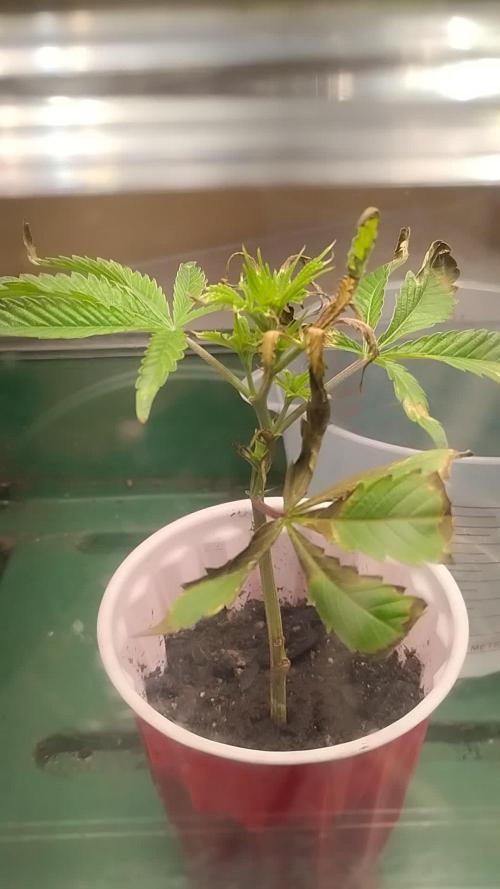
Started getting worried that I might lose this genetic. I didn't take care of her very well and just had her sitting around my house.
I was dealing with aphids in the tent and didn't want to bring her around that yet.
But during this time period she started losing leaves and getting crispy and wasn't showing any new growth.
But after 24 hours under a proper light with proper environment, she's almost instantly growing now. So new growth is good and means I'm not losing her
Check out my YouTube for long form content that I can't post here
https://youtube.com/@aestheticgenetix?si=pSk5e-kvp-nVYccc

Likes
2
Share


@Gardens_of_Of
Follow
She is experiencing a general yellowing all over. I contacted Advanced Nutrients support and they consulted me to increase the feeding. Let’s hope that she recovers fast.
On the other hand, she keeps growing buds. Maybe a little stunned. That’s why I am waiting another 2 days for lollipoping.

Likes
35
Share


@SativaSteve88
Follow
Flowering coming on really well now and things seem to be going ok, one plant stretching a lot faster than the other so hopefully it slows down want these to be a little smaller in size than my previous grow
Likes
4
Share

@VedoSGE
Follow
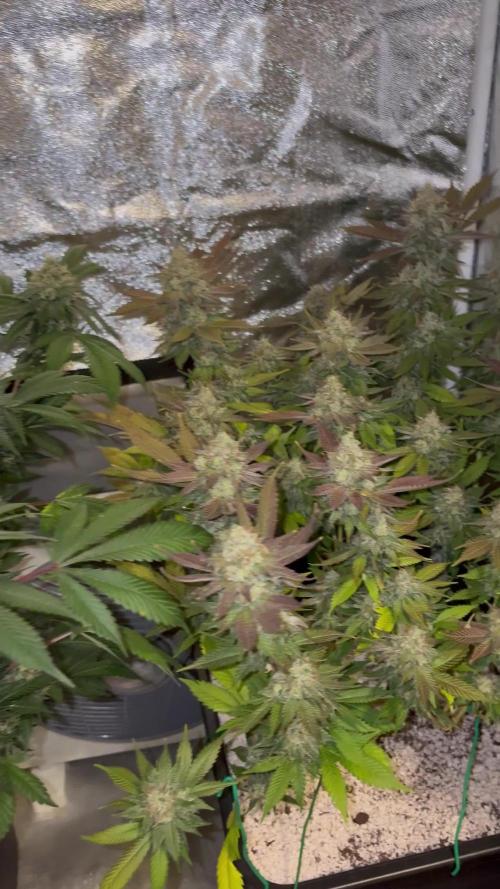
Wir nähern uns dem Ende für die erste von zwei Pineapple Chunks. Trichome sind momentan bei 100% milchig und ganz leicht sieht man hier und da auch ein paar Bernstein Farben.

Likes
46
Share


@Biggy2k20
Follow
Slowly slowly catchy monkey 😂 looking good for its final week, pistils are now starting to change colour. Fox tail is still present but not too bad. This week will be the time for the snip following magnesium deficiency and a flush of 0 ppm water via 7 stage filter.

Likes
4
Share


@RobinHoodGrows
Follow
First Time Grower Here - Jenny sprouted six days after I planted her. I used 3-gallon fabric buckets and FOX Farm ocean floor soil. Six days later her little sister sprouted. So this grow dairy will follow two young Dreamberry's on their way to get rolled up and smoked up.
At the end of week 1, both Jenny and Jasmin are doing great.
7/5/20 Jenny = 7 days
Jasmine = 1 day
Jasmine sprouted on the 4th of July... beautiful.
Sorry, no pics yet.
-RH

Processing
Likes
19
Share


@GrowGuy97
Follow
Day 7 - This little lady is doing great, will probably be transplanting her in about a week! The other bean still never popped! Thanks for following & make sure to check In for daily updates! Happy growing friends!✌️🏼🌱
Day 8 - Still going strong💪🏻

Likes
16
Share


@Kayotic
Follow
*Day 107
*Week 8 of flower
* Smells great, like citrus
* Buds are fattening up

Likes
10
Share


@CHILLING_RACOONS
Follow
Hi Dear Friends, 👨🌾 👩🌾
Plants showed some deficiencies, but we are recovering it. I prefer to have deficiencies instead excesses..
Maybe It was better if I started a week ago to give Top Veg.
It is the biggest of the cycle and it is really fast.
I notice a HUGE difference compared to other plants growed under the 480w quantum board.
The Kush mintz Fast is under the the XS2000 by ViparSpectra and it is bigger and stronger compared to other plants. Small distance between internodes and stems hard like rocks.
This lamp is really a beast, can't wait to try the new models!!
✅ VEGETATIVE week #7 (LAST WEEK)
30/12 SWITCH 12/12H
📅this week goes from 26/12 to 01/01.📅
💡💡💡Viparspectra XS2000 is working at 50% power.
💉🔍Fertilization schedule:🔍💉
26/12 3ml/lt TOP VEG
30/12 TOP MASS 0.2ml/L + 2.2 ml/L TOP VEG
31/12 SENSI CAL MAG EXTRA 2ml/L foliar spray
WE ARE BACK!!!
We are back after a little pause.
We take a break because we were too busy to post high quality diaries. In the last diaries we tried to post as good as possible and we have to publish about 6 or 8 diaries (in addition to these that we will publish shortly). We opened also an educational Instagram page, we growed a lot in a short amount of time BUT, Instagram suspended our account and we lost all our posts, I was so sad and disappointed... a lot of work lost in a night....
In this diary you will see our journey with Kush Mintz Fast by Original Sensible 🤩, sit down and enjoy the show!
We are growing in a 15L Smart Pot with Light Mix soil by BioBizz under the AWESOME XS2000 by Viparspectra 🤩
DATA SHEET:
Bubba Kush , Animal Mints, Secret Hybrid
Genetics: mostly Indica
Yield: 650g/m² indoor
flowering time: 50/55 days
THC: 25%
Aroma: cookie mint
Effect: happy relaxed
💸💸💸💸💸 Here you can buy seeds of this top shelf strain: https://originalsensible.com/original-sensible-seeds-kush-mintz-fast~21711
_______________________________________________________________________
🔧💡OUR SET UP💡🔧
✔️ 💲💲💲VIPARSPECTRA 🚀🚀🚀🌕🌕
ViparSpectra®️ XS2000 240W Infrared Full Spectrum LED Grow Light:
Excellent ratio between wattage and ppfd, excellent light penetraton, perfect light spectrum (it also has IR 🤩) and it has the best build quality on the market. Until now, built quality is really awesome. You can touch that quality. Materials are really strong, excellent driver and the best leds on the market. Heat dissipation is perfect, the lamp is never too hot and it has a passive dissipator so you will have zero noise. It also has IP65 certification. I like that this lamp is bigger than others, so the 240w of power are well distribuited on the space. Viparspectra has an awesome customer service, and shipping was creazy fast!
This awesome brand also offers 3 years warranty.
This lamp has no rivals.
A special thanks to Emily of Viparspectra ❤️❤️❤️❤️
HERE YOU CAN BUY THIS PROFESSIONAL LIGHT: https://www.viparspectra.com/products/xs-series-xs2000 or https://amzn.to/3dyUoJl
and here you can buy other awesome stuff: https://www.viparspectra.com
✔️ 💲💲💲MARSHYDRO 🚀🚀🚀🌕🌕
📦120X120 GROW TENT: an awesome box, easy and fast to assembly. Made by strong materials, solid zips and it is totally lightproof. The position of holes is optimal and the two lateral windows will make easier the work inside the box. There is also a double end, so you are 100% sure that dirt or liquids will not spill out. You can find it here: https://www.mars-hydro.com/grow-tent/buy-mars-hydro-grow-tent-48x48x80-1680d-4-x-4-size-keeps-all-light-in-top-quality-1680d-canvas-is-tear-proof-and-double-stitched-light-blocking-fast-installation-for-sale
💡TS 600 FULL SPECTRUM 100W LED GROW LIGHT : with this light you will achieve excellent buds, you will not need anything more. This lamp replace a 150w HPS lamp, but, with this Led Light you will smoke bigger, harder and tastier buds because Led have a complete spectrum and a powerful light penetration, so your plants will work as much as possible to make you happy. Psssssss it it extremely cheap and it is only 100w, your bills will never be too high, YOU HAVE NO EXCUSES!! Here if you want this little beast: https://www.mars-hydro.com/led-grow-light/mars-ts-series-led-grow-light/mars-tsw-600-led-full-spectrum-hydroponic-led-grow-light
Thank you Eleen of Marshydro❤️❤️❤️❤️
💣Quantum board - 480w - 4x120w Boards by Zhoangshan Koray Opto-Electronic Ltd.
Samsung LM301B 288 led/board 3000K 0dB noise
+24led/board led Osram 660nm
Efficiency 2.6 umol/J 220 lm/w
Driver: Meanwell HLG-480H-36B
💣Quantum board - 240w - 2x120w Boards by Shenzen Yuanhui Led Ltd.
Samsung LM301H 504 led 3500K 0dB noise
+24led/board led Osram 660nm
Efficiency 2.7 umol/J 220 lm/w
Driver: Meanwell HLG-240H-48B
-ESTRACTION FAN:
Blauberg 125 Turbo Pro Series
Maximum air flow: 430-560 m³ / h 50W 32-44 dBA
-FANS:
A)OSCILLATING FAN D.15cm 2 speeds 20w
B) COMPUTER FAN Sunon DP200A – 230V 20w (Strong, reliable and quiet)
C)Cornawall Electronics Multifan Turbo, three speeds, can be used both on support surfaces and mounted on the wall. High capacity, about 740 m3 / h. High silence and reliability.
💊💉💊FEEDINGS:
We used BioBizz light Mix
TOP CROP:
-DEEPER UNDERGROUND: to stimulate roots system
-TOP VEG: for a excellent growth in the vegetative phase
-GREEN EXPLOSION: to promote creation of bud sites and to allow a faster growth
-MICRO VITA: bacterias for equilibrate the soil and to make the plant healty
-BIG ONE: to stimulate bud sites and to stimulate resin production
-TOP BLOOM: to achieve excellent big and hard buds
-TOP CANDY: to feed the buds with molasses for a tastier smoke and to gain weight
-TOP BUD: to enlarge buds and to gain weight
PLAGRON: PK 13-14 to have big and hard buds and to feed plants with lower effort
ADVANCED NUTRIENTS: Sensi Cal-Mag Extra-> for cal mag deficiency
GROTEK: CAL MAG for cal mag deficiency
HESI: PowerZyme to clean and balance the soil. It feeds the plant cleaning the soil.
GHE: - Final Part (ex Ripen) accelerate the final flowering phase, dissolves minerals in excess
- Flash Clean to flush the plant and to be sure that all excesses are out from plant and pot
These two products improve A LOT the smoke of our babies
-PURPINATOR to stimulate flavonoids and to have a better taste and smell.
____________________________________________________________________________________________
🙏❤️ THANK YOU FOR BEING HERE ❤️🙏
Please leave a comment with your opinions, it is very important to us to have a comparison.
If you like our job, tap the weed button and follow us. It will be really appreciated.🙏
We want to thank again everyone that help us in our project. You support us to support our dream. ❤️
SPREAD THE LOVE OF THIS PLANT ALL AROUND THE WORLD
🌿Thank you again🌿
❤️Sweet hugs❤️
👨🌾CHILLING_RACOONS👩🌾
