



@IberianRootcraft
Follow
Final Week of Veg - Transition to 12/12
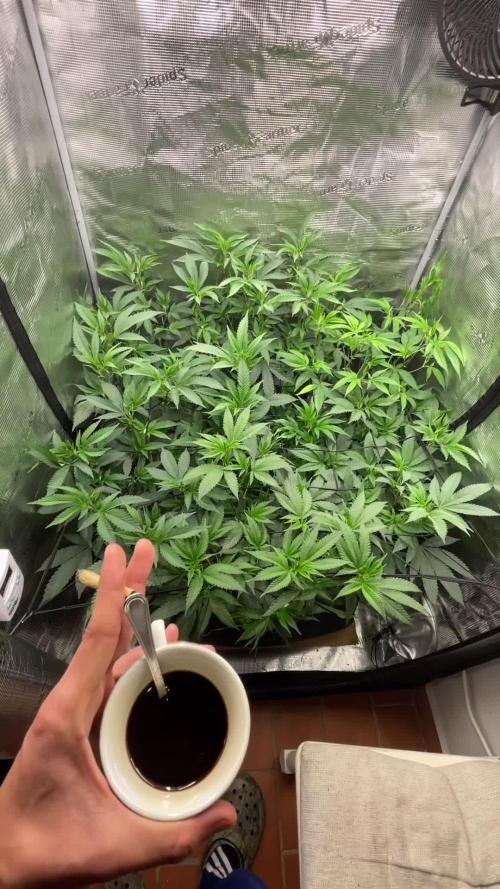
This is the last week before flipping the HiHolyHigh cuts to the 12/12 cycle.
Pre-flower Top Dress:
I have applied a pre-flower top dress using Almicanna Kick Flip and Malted Barley.
• Kick Flip: Provides all the necessary inputs for the upcoming flowering stage.
• Malted Barley: Helps decompose the remaining organic matter in the soil, converting it into readily available nutrients while also strengthening the plants' natural defenses against potential attacks.
Plant Status:
• RS11: Unfortunately, it didn't keep up. It remains locked out and is now 20cm shorter than the rest of the canopy. I’ll keep the top to sample the quality and will try to clone it again for the next cycle.
• Colorado Nightshifter & Runtz: Slightly shorter than the rest as they took longer to adapt, but they are well-developed and ready for a proper test.
• The rest: Looking perfect and ready for the flip.





@DogDoctorOfficial
Follow
Week 3: TrolMaster Chronicles – Transplanting, Growing Strong, and Thriving in PRO-MIX HP 🌱✨
Hey Grow Fam! Another exciting week has flown by in the grow room, and I’m thrilled with the progress! We kicked off Week 3 with our first set of transplants. The Gorilla Melon was transplanted at the end of the week, while the Papaya Zoap is still patiently waiting for its turn to shine. Each plant that’s been transplanted is now comfortably settled in 15-liter Autopots, filled with PRO-MIX HP BIOFUNGICIDE + MYCORRHIZAE, and wow, I’m loving this mix!
🌱 Why PRO-MIX HP is a Game-Changer
For those of you unfamiliar with PRO-MIX HP, let’s take a closer look. This soil provides superior drainage and aeration, thanks to its high porosity. The addition of fibrous peat moss and coarse perlite creates an ideal environment for water flexibility. It’s been perfect for the girls as they transition into their final homes. Plus, the biofungicide and mycorrhizae are doing wonders for root development, giving them all the support they need for vigorous growth. The plants are showing off a beautiful, vibrant green, each with its own unique characteristics—no two plants are the same, and I love that!
🌡️ Environment Update: Temps, RH, and More
Let’s talk about the conditions the girls are thriving in! We’re sitting at:
• Temperature: 26.7°C
• Relative Humidity: 62.9%
• VPD: 1.30 (I know it’s a bit high, but they’re handling it like champs)
• CO2: 800 ppm
• pH: 6.18
• TDS: 215 ppm
• Solution Temperature: 23.2°C
To make things even more efficient, I’ve adjusted the light height, keeping the PPFD around 360 to 400 to save on energy. These beauties are still soaking in the light perfectly, and I couldn’t be happier with how they’re responding.
💧 Watering and Feeding
At this stage, the plants are thriving with just enough nutrients to keep them happy. I’ve kept things simple with a balanced solution, ensuring everything stays within the perfect range. The PRO-MIX HP, with its mycorrhizal fungi, is really helping with nutrient uptake and boosting overall health. It’s amazing to see how quickly they’ve adapted!
🌟 Transplants Complete – Progress Feels Incredible!
I’m super excited with how everything is shaping up! Most of the transplants went smoothly, and the growth we’re seeing is just amazing. The Papaya Zoap is still waiting for its final move, but it’s growing strong, getting ready for the next step. It’s an honor to work with these genetics—they’re each unique, yet all thriving in their own way. 🌱💚
🌍 Shoutouts and What’s Coming Next
I couldn’t do this without the support of my amazing sponsors and all of you, Grow Fam! A huge shoutout to TrolMaster and Aptus Holland for their top-notch gear and nutrients, and of course, to all my followers—whether you’ve been here from the start or are new to the journey, thank you for the love and support! 💚🙏
Don’t forget to check out my Instagram and YouTube, where the Seed to Harvest Series just kicked off! I’m going deep into all the gear, techniques, and day-to-day grow updates you see here. Exclusive content and more are waiting for you on those platforms, so come by and join the fun!
Growers Love to everyone, and here’s to another epic week of growth! 💚🌱 Let’s keep pushing the limits and making magic happen.
• Nutrition: @aptusholland @aptus_world @aptus_es @aptusbrasil @aptus_thailand @aptus_portugal @aptususa_official @aptusplanttechnz @aptusplanttechaus
• Controls: @trolmaster.eu @trolmaster.eu.support @trolmaster.support @trolmaster.agro
• Soil: @promix_growers_eur @promix_cannabis @promixmitch
P.S. Let’s talk about these new Model One LED bars I’m running. 🌿💡 They’re not just any lights—these are full-spectrum beasts designed to give my plants exactly what they need at every stage of growth. The real magic, though? The dimming feature. With just a quick adjustment, I can dial down the intensity without sacrificing the quality of the light. This means I’m saving on energy costs while still delivering top-tier PAR and maintaining a balanced spectrum. It’s not just about blasting plants with light; it’s about giving them the right light at the right time. By fine-tuning the PPFD (Photosynthetic Photon Flux Density), I’m hitting that sweet spot where the plants thrive, and I don’t have to run the LEDs at full power. So, while I save a bit on electricity, my plants still get the perfect environment to reach their full potential. 🌱✨
This level of control lets me optimize the growth, and trust me, my plants are loving it—just another reason I’m thrilled with the Model One setup.
💚💚💚 Growers Love everyone 💚💚💚


shorts_status_processing


@Bluntblazer66
Follow
Oct 25th
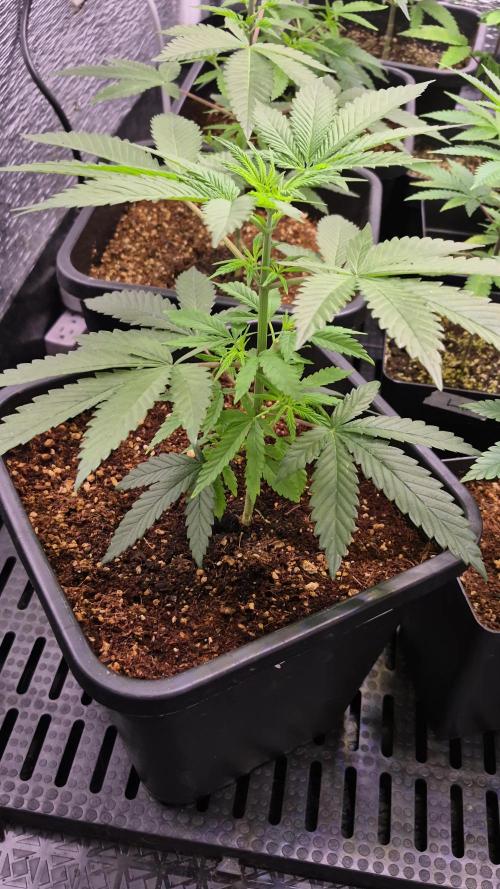
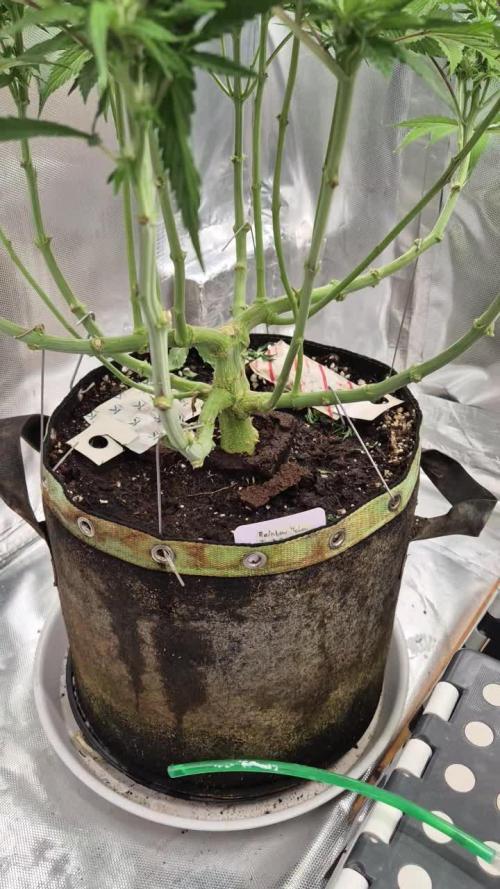
Plant is now sharing the 30 l res with only one other plant Cement Shoes
Both plants are doing very well but they remain stunted
Oct 30th
Moved plants around
Intalled new 1000W iluminar DE (HPS) set at 600W
Now I can use the full grow room
Green Crack should love it






@TragicTerps
Follow
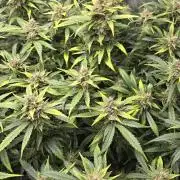
Finally past the halfway point and now we're going to hopefully see these ladies continue to swell.
The whole tent is awesome i moved the mango cream out, harvested and then put a new lady in the tent to flower.
The forbidden fruit is doing okay I'm just not a fan yet lol, the zkittlez is great and the liberty haze is a color changing frost factory.
Halfway there!




@Prilyfe13
Follow
12/02/2025
Week 10! And we have some revelations. I think I figured out a problem. No idea if it's related to the pH fluctuations, but I'm almost 100% certain that these ladies have been experiencing light stress. At least Lemon Cherry Cookies is. But she's taller, so she got the brunt of the light. I turned it down to 50% from 70% to see if that fixes things.
Of course the pH was off. But now the swing for both plants is going down. It seems Papaya Cookies is leveling off her nutrient intake finally. Lemon Cherry Cookies isn't far behind. But today is water change day. We'll be dropping the nutrients down a bit to hopefully clear out the nutrient lockout. Or whatever is happening.
I'm definitely slowing them down. And not in a good way. Buds are kinda on the small side right now. But I'm hoping with the next 2 weeks to go, and everything fixed, we'll get some glorious buds. Next run will be different. Next run, I'll know what to look for. In my defense, the light is topped out and the DLI is pretty bouncy. So I can't get a solid reading anywhere on either plant.
Speaking of either plant, each one is showing completely different stresses. While Lemon Cherry Cookies is getting really yellow leaves close to the buds, Papaya Cookies has brown spots. Indicative of a nutrient lockout. But the lockout is clearing up. I'm afraid the damage is already done though. Plants stunted, or slowed in growth. Maybe they'll both recover quickly.
As for potency, hands down Papaya Cookies is the most potent. She smells so strong, I have to ease the tent open or get blown away by weed smell. She has a super thick layer of frost all over each bud. Some have more. But it's pretty crazy.
Lemon Cherry Cookies doesn't have as much, but she is certainly sticky and smelly. Maybe I can't see as much because the buds are darker and not as developed as her compadre.
The base readings for this week.
Papaya Cookies:
pH: 5.8
EC: 1.639
TDS: 792 ppm
Lemon Cherry Cookies:
pH: 5.8
EC: 1.502
TDS: 749 ppm
I know they aren't the same, but close enough. Let's hope they start to take in the nutrients and not reject them. I also made sure to use a clean fresh reserve bucket for each plant. I think it helped to clear out some of the loose root fibers. We shall see.
So from here on out, it's just water and observe. Well, keep the pH in check too, but that's part of the observation. I know the damage is done on the yellow leaves, so I think I'm just looking for the leaves to stop turning yellow. Ultimately it's the water I have to keep a very close eye on. Fluctuations with these ladies is definitely causing more havoc than the light stress.
So it's about 4 hours after I made the new mix. Both are at the exact same pH. 6.6 and I honestly have no idea what to do. Take the plants back out and pH it again? Or let them sit in it and see if it swings back down. I think it has to do with the water temp. It's gone up 6° f. Not much but enough to mess with the pH. Any suggestions? Comment down below if you have an idea.
12/03/2025
Some changes today. Both ladies had a 6 6 pH this morning. Each also drank just about a half gallon. So I added about 3 ml of pH Down and mixed it up. Added to the reservoirs.
Morning:
Papaya Cookies:
pH: 6.59?! Wtf
EC: 1.718
TDS: 847 ppm
Lemon Cherry Cookies:
pH: 6.8?!!!!!!!!! What in the actual fuck is happening?!
EC: 1.510
TDS: 751 ppm
I put in 3ml of pH down in my top off. Why did it go up?! How?!
Evening: lights on:
Lemon Cherry Cookies: Got a fresh mix. I took out the silica.
pH: 5.8
EC: 1398
TDS: 699
Papaya Cookies:
pH: 5.8
EC: 1776
TDS: 863
I want to see what happens when I take the silica out. I read that it's not really necessary in late flower. Maybe it'll help with the pH swings, not having it in there. I also dropped the mix. Just a little bit. If Papaya Cookies has any issues tomorrow, I'll give her a new mix as well. It could also be the water. I don't have anymore water money, so I had to go to filtered tap water. It's not terrible, but it's hard. Well, kinda hard. I think. Lol. It's like a pH of 7.9
Anyway, both plants have swelling buds. The timing for most charts couldn't be too perfect with these two. I still have to figure out how to keep the EC and TDS from spiking. No clue how to do that. Hopefully the 2 days in a row where I use plain water as the backup reservoir. For when I'm changing the water out. Just pHed to 5.8. it seems to also be slowing down on the "shedding". Lol. I probably made it worse. For Lemon Cherry Cookies that is.
But yah, getting big and plump. I can't wait for the end result. I'm kinda skeptical of my original estimate of 6 oz. per plant or something like that. But now I'm thinking 3 to 4 per plant. Not terrible, but not great. A plant this size should put out 8 oz if the buds bulk up enough. So there still could be hope for the 6 oz. We shall see.
On a different note, I dropped the temp to 73° f. I'd like a nice purple plant. And Lemon Cherry Cookies is the perfect purple plant for it. Papaya Cookies is an all green sativa. Lime green. Very nice. The humidity stays the same. Now, I'm having trouble getting a legitimate explanation as to why the VPD should be 1.2 to 1.6 kPa when the recommended temp is like 73 and the RH between 40 and 50%? It's too high according to VPD charts. Am I looking at the right charts? Is there a difference between the VPD from veg to flower? I wonder.
12/04/2025
So I attempted to pH the water today for both plants. It was pretty much a fail. However I did get one of them within range. Not that'll last very long.
Papaya Cookies:
pH: 5.6
EC: 1728
TDS: 846
Lemon Cherry Cookies:
pH: 5.70
EC: 1492
TDS: 760
So while I managed to get Papaya Cookies in range, it's still not where she needs to be.
Lemon Cherry Cookies was over 7. I don't know how. And I am trying to keep from disturbing the roots, but I needed to pH that plant immediately. I was gonna wait for after lights out, but I really couldn't. The pH was way too high. Even topping off with water pHed at 5.5 only moved it to 6.9. So I did the thing. And now it's done.
I also think I figured out the source of the high pH. It's the roots. Definitely something in the roots. The holdover bucket was lHed to 5.8 exactly. Less than 15 minutes late and I have her back in her normal bucket. The holdover was already at 5.95. How do I clean the roots without hydrogaurd or whatever. I have sensizyme, but not much and it calls for a whole lot of it for a single gallon. It calls for 8 ml for a single gallon of water. Slightly more. I will never use that much. That's insane. Anyway, I'm not 100% sure what it does, and the description is pretty vague. I don't even know if it's the same stuff.
Anyway, the yellowing seems to be getting worse. It's almost on every sugar leaf on the top buds. Like there's still light burn, but I checked. The DLI is below 40 mol. So it has to be this lockout I can't get rid of. I'll be honest, I think if the tent were bigger, it would be easier to handle everything and I might be able to lift the roots without touching them. Alas. I'm in a 3x3 and there is no clearance folfeom the light. And just not enough space in general. One of these plants with a trellis would have filled the whole tent. Both of them take up a ton of space. Flat against the side walls and flat against each other. Nearly touching the front and back. Both plants did this. Plenty of back and front space. Just no room for a trellis that low.
So let's talk plant health. Because these ladies are not doing all that fantastic. I honestly have no idea what's wrong. I've been doing everything you're supposed to do. Keep the pH in check, drop the EC and TDS to keep that in check. Which it's not in check at all. It keeps going up. And I know it's the roots. And the water level. Because they aren't taking in any nutrients, they drink away the water and leave a high concentration of nutes.
The problem I'm having is that I can't get whatever is in the roots to come out completely. How do I do that? I know they spike the pH, but what is holding them back from eating the nutrients? It's obviously not the size of the roots preventing them from absorbing, but like what is it? Should I just tough it out, do what I can and in a week or so start flushing? I don't think they'll be ready in a week. Well, maybe. It all depends on the lowers and mids. I don't base doneness on top buds. Those will always look done first. But the middle buds, at least for me, are a good sign the plant is done. Lowers should be ready as well, but always end up being larf. I should really try to clean up the bottom of my plants before the stretch. Or is it after? I don't know. I can't remember and I should know this for next run. Lol.
Back to the issue at hand. On a plus side, both ladies are starting to really fatten up their buds. Papaya Cookies is covered in trichomes. Lemon Cherry Cookies is kind of lacking to be honest. But maybe that's because of the color. Purple. Maybe it hides it, but I don't think so. Just lacking. Disappointing. We'll see how she turns out in the end. There's still time.
12/05/2025
Morning numbers:
Lemon Cherry Cookies:
pH: 6.59
EC: 1686
TDS: 839
Papaya Cookies:
pH: 4.65
EC: 1819
TDS: 911
After adding pHed water. High or low. Based on the plant.
Lemon Cherry Cookies:
pH: 6.6
EC: 1535
TDS: 766
Papaya Cookies:
pH: 5.6
EC: 1650
TDS: 818
It looks like things are leveling out with EC and TDS. A little bit. But the pH is still way off. Maybe that'll adjust naturally when the plants start to feed again... For like the last week and a half before flush hahaha.
I'll be checking trichomes tonight. I figure it's time we take a look. I'm pretty sure Papaya Cookies is nearly done. Maybe the next week. Lemon Cherry Cookies on the other hand does not look done at all. Maybe she's closer than I realize. But there's still quite a bit of white pistils all over the plant. I like to wait for the lowers to start getting orange pistils. As I said before, I like to judge by the middle of the plant. With the middle, I like to see nearly all cloudy. Maybe a few amber and next to no clear. From my experience, it seems to work best for me. But that could also be plant height based as well. Still middle of the plant makes sense to me. You know the mids will be done and smokable. Where as the lowers, because I'm stupid and never cut them off, will end up being popcorn or larf. Good for pressing though. I also check the uppers, of course.
Anyway, I have been observing the yellowing on the plant from what I think is light burn. It was still going for a few days, but I think it's done now. Now all I need to worry about is the other deficiencies and lockouts and all that.
Mid-day:
I was just thinking about defoliation and how much I just didn't do it this run. I mean, I did, but it was just a little bit here and there. Anyway, I was thinking about the leaves and how the older ones pop off verses the younger ones that obviously don't. Wouldn't it make sense to just take the leaves that pop off when defoliating and then the new growth that may be in the way? Like old growth while still pulling in light, is now starting to use more energy than producing. Just a thought.
12/06/2025
Morning numbers AFTER Adjustments. I was half awake and forgot to record the readings.
Papaya Cookies:
pH: 6.05
EC: 1556
TDS: 774
Lemon Cherry Cookies:
pH: 6.35
EC: 1484
TDS: 741
It looks like we are finally getting back to normal. Lemon Cherry Cookies got about 3/4 gallon of water with 2.5 ml of pH down in it. It only dropped about 0.1 point on the pH scale. But the EC and the TDS are lower than yesterday and the pH was in range. High but in range. Point being, I think she is finally coming out of the woods. I think I'm gonna pull her out this afternoon and pH the water back down to 5.8. I wonder if she'll start taking nutrients in when she gets back to a 5.8 pH. The EC should also adjust a bit more, as well as the TDS. Hopefully it comes out low and in a better range.
Papaya Cookies still has super wonky pH, but not as low as it was yesterday. The EC and TDS both dropped a little bit as well. After adjusting the pH up to "5.8" which ended up at 6.05. No Clue how that happened. Roots maybe. I doubt it. Maybe it hadn't settled quite enough. I wait a few minutes between testing. Maybe I was a little hasty. Oh well. At least it's over. Maybe it'll drop to 5.8 and stop. Lol. Anyway, she definitely has signs of deficiency now. Not craziness everywhere. I think we're in the clear now. It was rost spots all over a bunch of the leaves. No crazy yellowing like Lemon Cherry Cookies.
So it would seem we are close to out of the woods as I said. Looking good. Both plants are drinking and starting to get even more frosty. Lemon Cherry Cookies is a bit behind, almost a week I think.
My concern is drying space. I have my 2x2, but no space for it. At least none that will let me hook it up to the 3x3 and plug in a fan for air circulation. Unless I run a huge power strip. I could do that. I could also plug in the exhaust fan, but I think the filter is all done. Gonna need a new filter. But I was thinking of putting the exhaust fan in and hooking it up to the 3x3 and putting it on low. To help extract the air.
Anyway, I don't want to let Papaya Cookies get too over ripe. And a week would definitely do that. I'm still trying to figure something out. I might have an idea. Definitely only temporary. Just until Lemon Cherry Cookies is done. Then I can dry both plants and pull the 2x2 down when I'm done. I really don't have space for it. Small apartment and all.
I also added some trichome videos that I took yesterday. I can't do pics. My hands aren't steady enough. But these should suffice. About a week left on both of them. Maybe a week and a half. Papaya Cookies looks to be a little bit closer to done. But Lemon Cherry Cookies isn't too far behind. It's the lowers that concern me. Very underdeveloped on Lemon Cherry Cookies. Papaya Cookies has a bit more going for it. Some decently solid buds in the lowers. Nothing big mind you. I'd say they will be smalls. And not larf. I'm definitely getting larf on Lemon Cherry Cookies though. Unless I want to wait another 2 to 3 weeks. That's about how long some of them have left to go. I think. Maybe I'm wrong and they will finish up by end of next week. Ultimately my goal is to have dried cured bud by the end of December. It doesn't look very promising. But maybe. If I harvest next week, that gives a week of drying and a week of curing. I like about 10 days drying and a good 2 to 3 weeks of curing. Middle of January if I let it go as I want it to. And I think I'll do that. No sense in ruining a good batch for impatient thoughts. Sorry for the terrible video quality. Best I can do.
12/07/2025
Morning numbers:
Surprisingly Lemon Cherry Cookies was almost on point. Her pH was 6.1 EC was 1705 and TDS was 735.
Lemon Cherry Cookies:
pH: 6.05 mix didn't do anything
EC: 1440
TDS: 722
Papaya Cookies:
pH: 5.73
EC: 1489
TDS: 736
Everything is looking alright today. Not good by any stretch, but alright. We aren't spiking and the crash with Papaya Cookies was manageable this time.
Lemon Cherry Cookies actually kept within range and even dropped a little. Her TDS is just a bit lower and the EC is roughly the same. To me, this is a win. Doesn't it mean she's no longer in lockout? Or finally recovering? This is great! Just in time for the last week and a half of the run. SMH. Wonder if that means she'll bulk up a bit more. Her buds are decent size but not big, and from what I can tell, not fully developed. She's still behind. But I'm hoping with the recovery, she'll bulk up and harden off. Currently the buds are fairly soft. Good purple color though.
Papaya Cookies. Well, we aren't doing too bad. The numbers look good. Only had to add plain water and got her right in range. Even super close to 5.8. The best part about this is what I'm observing with the plant. The buds are starting to weigh down the back branches. Some of the fronts are falling over as well. The middle is still standing straight up and that's great! What this all means is these buds while not massive, are rock hard and heavy. And I mean rock hard. I wouldn't be surprised if she only lost 60% of her weight after curing. It's possible.
Everything else looks good. The environment, the water temp is fine as well for both plants. 69° not great, but within range.
Update:
Lemon Cherry Cookies pH has not budged an inch and her EC and TDS are about the same as well. A little drop since this morning
Papaya Cookies also seems pretty good. Her pH is still dropping. This time it took 3 ml of pH up to fix it. I haven't seen anymore spotting on the leaves, but there are so many leaves afflicted with the spots it's hard to tell. Either way, a couple branches are leaning hard. Rear. Decent sized buds on them, but rock hard. I'm expecting a bit more bulking over the coming week.
So I think I have figured out the actual root of the problem for both plants. Overfeeding. It has to be. All the problems started in early flower. Both of them doing the same thing except for the pH swings. That's weird to me. Regardless, I think had I fed like half the suggested dose, we would have been very happy. Well, live and learn. Next run will be better.
12/08/2025
Morning Readings:
Papaya Cookies:
pH: 6.2
EC: 1393
TDS: 698
Lemon Cherry Cookies:
pH: 5.85
EC: 1385
TDS: 694
Well then, that looks much better. Had to adjust and Lemon Cherry Cookies was low today. Weird. But a little plain water brought her right up to 5.85. Nearly perfect. Papaya Cookies with a good amount of pH up landed at 6.2. Not on purpose. I miscalculated, but still better than the 4.5 it was at when I opened the tent.
Both plants are really starting to swell their buds. Not much weight on Lemon Cherry Cookies, but Papaya Cookies on the other hand. Heavy. More branches are starting to lean. I kinda wish the whole plant would do it so it can open up space for light to the bottom of the canopy.
I have a feeling that when Lemon Cherry Cookies starts actually putting on weight, the branches will also most definitely lean.
I never talk about this, but the two plants together makes for an extremely potent smell. They are distinctively different, but it's really hard to tell them apart in the tent. I can smell the difference on my hands, but then I touch the other plant and back to no clue. Lol. I can't really figure out a smell. Can't pin it down. Gassy, heady, sweet and sour. I think... Lol.
So this is the last full week for these ladies. Next week we will be starting the flush. It should only be for a few days. Anyway, today is the last day of normal nutes. Starting tomorrow we are taking out the Boost and dropping the bloom down to a quarter dose. I'll keep the cal/mag in but only a tiny bit. Let's hope everything goes as planned. Lol. So far it hasn't. Hahahahahaha. But we learn from our mistakes don't we? Of course. So everything should go smoothly. Tomorrow starts the new week. So I'll post a couple trichome videos for that. And the last time lapse video at the end of the week. That'll cover a month of growing.
Anyway, not much else for today. Oh wait. So the trichomes on Papaya Cookies are extremely prominent. The buds are thickly covered top to bottom. Lemon Cherry Cookies on the other hand don't look to be covering the buds. Not like her besty. BUT I did notice in the video that there's a whole lot more than you can actually see. I wonder if the purple is hiding them from the naked eye. Plus there's still a lot of clear on her and she definitely has time to build more. I might do a dark period for the three days of flushing as well. I'll have to look into it.
Bye for now.


@BigBlu3
Follow
Week 7 Guys!!!!
Welcome Back, And Thanks For Checking In on us!!!!
To Begin: We Moved The Mimosa To Tent 1 to start Flowering *All Autos Are Together*
We Set The Timer And Started The 12/12 for the Tropicana in Tent 2
We Ended Week 6 With Defoliation to Tent 1 (GC,Mimosa,SB) to make way for light to the bud sites
We Have Done Some Research And Will Be Feeding A Compost Tea Roughly Tomorrow evening consisting of (1 cup Worm castings, 2 tbsps. Alfalfa Meal, 2 tbsps. Organic Molasses, 2 tbsps. Bat Guano, 2 tbsps. kelp meal) As Per *Canucks Grow*
24 hours water aerated & 24 hours for the Tea to Cook!
Water is still Ph'd 6.5-6.7 is the highest ive seen so far
Tent 1- Is In Flower roughly 2 weeks in- 20/4 light schedule
Distance from light to plant tops- 19in
Gorilla Cookies from Soil 16in
Mimosa from Soil 14in
Strawberry Banana from Soil 15.5in
As For Tent 2- Just Started Flower
We've Added a Humidifier to raise and keep the RM to 50-60%
The Tropicana has Been Set and Flipped To 12/12 At 100% Lighting
We will do some select Defoliation In a Few Days To get Light to the Plant
Tropicana Cookies Photo From Soil 13in
Light to Plant 18in
This was a quick rundown this Week As Always Drop A Like, Leave a Comment And Just Show Some Love!!!!
See You Guys Next Week!!!!


@Doofy
Follow
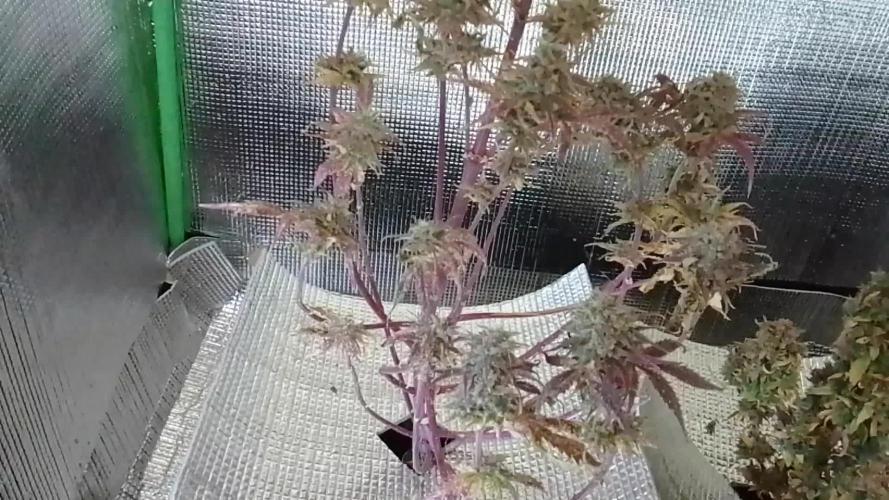
She is not gaining anymore... Guess she will ripen, bigger plant, but still not a bigger harvest...
The sap eaters r still present, but only focus on this Diesel... And they are not explodin, I'm guessing it's near a good balance, with enough natural predators. Also, I pick random beetles from the street and release it in the tent, found a lady but once....


@DieselKush
Follow
Oct.29 - We transplanted the girls into soil since they are moving into vegetation phase
Nov.4 - Watered each plant 250mL, 0.25mL of each nutrient for each girl


@3lementa1
Follow
I realized there may have been a bit of a light leak in the late morning. I taped everything up more. In the future I want to maintain better reflective integrity on the inside of the tent.
Everything looks good. The buds are still growing a little taller and filling out. The CBD Blue Shark is super frosty. It's actually absurd. Orange hairs are coming out in all plants.
I was hoping to be able to keep the exhaust window open overnight to let the overnight temps drop 10 degrees to encourage the purples in the WC genetics, but it's too humid now to have the window open without the grow light on. Otherwise the rh goes up to 70% overnight and it's not worth the risk. Next year I'll flip earlier when it's still colder and drier out for the harvest window.
This flowering period has been really cool. I've really been noticing the process of flowering. The calyxes open up and turn into pistils and sugar leaves, and more keep appearing and popping every day. It's awesome.
March 04 watered again with straight water. They're finally drinking more than once a week! The pistils seem more red today than yesterday. I got a $30 micro camera to check trichromes, they all seem clear for now (there is some glare in the pics). No amber for now at least.
March 05 found some amber trichromes
March 06 lots of leaves are going yellow. We're definitely in the home stretch.
March 06 I've been a little worried about the size of the colas. There's not much sticking out past the canopy. I've also noticed a bunch of new leaves that have started popping out and I was a little worried that the buds were foxtailing or herming. I've had temps go up to 30 a couple times in the morning before I open the window. But it seems that the buds are filling out more and getting fatter, not just foxtailing, and I think they're getting ready for one last push, not just getting full of leaves for no reason.
It changes a lot every day. Tomorrow is the 23rd week of the grow. I switched the lights on a Thursday so this Thursday will mark 8 weeks of flowering time and the beginning of my harvest window (8-9 weeks for both strains).


@2Stones1Bird
Follow
Checkout my Instagram @smallbudz to see the Small budget grow setup for indoor use, low watt, low heat, low noise, step by step.
04/01/2020 - Did the last defoliation, removed about 1/4 of plant material.
06/01/2020 - Fed her 1.5l of 6.5PH water with 0,3ml Cal Mag (Atami) 0,25ml of Grow, 0,6ml of Bloom and 0,5ml Max, and 1ml of each: Heaven, Alga-mic and Vera, noticed some run off, I use about 1/3 of the nutrient dosage on the chart, to achieve about 200/300PPM (500 scale).


@Gram_Solo
Follow
Last week for these 3 remaining Runtzz
I flushed them 4 days ago with flawless finish they had 2 feeds of flawless so far 1 more and then we chop them on Tuesday. Will be doing 10-15 days drying in a 3x3.
Looking very frosty all 3 of these now orange hairs all curled and looks like they have packed out really well!
The smell when you open the tent is heaven!! Old school bud smells!
The journey is nearly fully complete!
😎😎😎😎
Will post harvest pics of these 3 on the next update!
12/05/25
Last 3 have been chopped and are now drying
21/05/25
10 days later and still small popcorns not snapping off which is great, I reckon 2-3 more days and we can get these 3 trimmed and displayed! Not long now will be just in time for contest end



@Ultraviolet
Follow
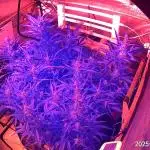
Yellow butterfly came to see me the other day; that was nice.
Starting to show signs of stress on the odd leaf, localized isolated blips, blemishes, who said growing up was going to be easy!
Smaller leaves have less surface area for stomata to occupy, so the stomata are packed more densely to maintain adequate gas exchange. Smaller leaves might have higher stomatal density to compensate for their smaller size, potentially maximizing carbon uptake and minimizing water loss. Environmental conditions like light intensity and water availability can influence stomatal density, and these factors can affect leaf size as well. Leaf development involves cell division and expansion, and stomatal differentiation is sensitive to these processes. In essence, the smaller leaf size can lead to a higher stomatal density due to the constraints of available space and the need to optimize gas exchange for photosynthesis and transpiration. In the long term, UV-B radiation can lead to more complex changes in stomatal morphology, including effects on both stomatal density and size, potentially impacting carbon sequestration and water use. In essence, UV-B can be a double-edged sword for stomata: It can induce stomatal closure and potentially reduce stomatal size, but it may also trigger an increase in stomatal density as a compensatory mechanism. It is generally more efficient for gas exchange to have smaller leaves with a higher stomatal density, rather than large leaves with lower stomatal density. This is because smaller stomata can facilitate faster gas exchange due to shorter diffusion pathways, even though they may have the same total pore area as fewer, larger stomata. Leaf size tends to decrease in colder climates to reduce heat loss, while larger leaves are more common in warmer, humid environments. Plants in arid regions often develop smaller leaves with a thicker cuticle and/or hairs to minimize water loss through transpiration. Conversely, plants in wet environments may have larger leaves and drip tips to facilitate water runoff. Leaf size and shape can vary based on light availability. For example, leaves in shaded areas may be larger and thinner to maximize light absorption. Leaf mass per area (LMA) can be higher in stressful environments with limited nutrients, indicating a greater investment in structural components for protection and critical resource conservation. Wind speed, humidity, and soil conditions can also influence leaf morphology, leading to variations in leaf shape, size, and surface characteristics. Small leaves: Reduce water loss in arid or cold climates.
Environmental conditions significantly affect gene expression in plants. Plants are sessile organisms, meaning they cannot move to escape unfavorable conditions, so they rely on gene expression to adapt to their surroundings. Environmental factors like light, temperature, water, and nutrient availability can trigger changes in gene expression, allowing plants to respond to and survive in diverse environments.
Depending on the environment a young seedling encounters, the developmental program following seed germination could be skotomorphogenesis in the dark or photomorphogenesis in the light. Light signals are interpreted by a repertoire of photoreceptors followed by sophisticated gene expression networks, eventually resulting in developmental changes. The expression and functions of photoreceptors and key signaling molecules are highly coordinated and regulated at multiple levels of the central dogma in molecular biology. Light activates gene expression through the actions of positive transcriptional regulators and the relaxation of chromatin by histone acetylation. Small regulatory RNAs help attenuate the expression of light-responsive genes. Alternative splicing, protein phosphorylation/dephosphorylation, the formation of diverse transcriptional complexes, and selective protein degradation all contribute to proteome diversity and change the functions of individual proteins.
Photomorphogenesis, the light-driven developmental changes in plants, significantly impacts gene expression. It involves a cascade of events where light signals, perceived by photoreceptors, trigger changes in gene expression patterns, ultimately leading to the development of a plant in response to its light environment.
Genes are expressed, not dictated! While having the potential to encode proteins, genes are not automatically and constantly active. Instead, their expression (the process of turning them into proteins) is carefully regulated by the cell, responding to internal and external signals. This means that genes can be "turned on" or "turned off," and the level of expression can be adjusted, depending on the cell's needs and the surrounding environment. In plants, genes are not simply "on" or "off" but rather their expression is carefully regulated based on various factors, including the cell type, developmental stage, and environmental conditions. This means that while all cells in a plant contain the same genetic information (the same genes), different cells will express different subsets of those genes at different times. This regulation is crucial for the proper functioning and development of the plant.
When a green plant is exposed to red light, much of the red light is absorbed, but some is also reflected back. The reflected red light, along with any blue light reflected from other parts of the plant, can be perceived by our eyes as purple.
Carotenoids absorb light in blue-green region of the visible spectrum, complementing chlorophyll's absorption in the red region. They safeguard the photosynthetic machinery from excessive light by activating singlet oxygen, an oxidant formed during photosynthesis. Carotenoids also quench triplet chlorophyll, which can negatively affect photosynthesis, and scavenge reactive oxygen species (ROS) that can damage cellular proteins. Additionally, carotenoid derivatives signal plant development and responses to environmental cues. They serve as precursors for the biosynthesis of phytohormones such as abscisic acid () and strigolactones (SLs). These pigments are responsible for the orange, red, and yellow hues of fruits and vegetables, while acting as free scavengers to protect plants during photosynthesis.
Singlet oxygen (¹O₂) is an electronically excited state of molecular oxygen (O₂). Singlet oxygen is produced as a byproduct during photosynthesis, primarily within the photosystem II (PSII) reaction center and light-harvesting antenna complex. This occurs when excess energy from excited chlorophyll molecules is transferred to molecular oxygen. While singlet oxygen can cause oxidative damage, plants have mechanisms to manage its production and mitigate its harmful effects.
Singlet oxygen (¹O₂) is considered a reactive oxygen species (ROS). It's a form of oxygen with higher energy and reactivity compared to the more common triplet oxygen found in its ground state. Singlet oxygen is generated both in biological systems, such as during photosynthesis in plants, and in cellular processes, and through chemical and photochemical reactions. While singlet oxygen is a ROS, it's important to note that it differs from other ROS like superoxide (O₂⁻), hydrogen peroxide (H₂O₂), and hydroxyl radicals (OH) in its formation, reactivity, and specific biological roles. Non-photochemical quenching (NPQ) protects plants from damage caused by reactive oxygen species (ROS) by dissipating excess light energy as heat. This process reduces the overexcitation of photosynthetic pigments, which can lead to the production of ROS, thus mitigating the potential for photodamage. Zeaxanthin, a carotenoid pigment, plays a crucial role in photoprotection in plants by both enhancing non-photochemical quenching (NPQ) and scavenging reactive oxygen species (ROS). In high-light conditions, zeaxanthin is synthesized from violaxanthin through the xanthophyll cycle, and this zeaxanthin then facilitates heat dissipation of excess light energy (NPQ) and quenches harmful ROS.
The Issue of Singlet Oxygen!!
ROS Formation: Blue light, with its higher energy photons, can promote the formation of reactive oxygen species (ROS), including singlet oxygen, within the plant.
Potential Damage: High levels of ROS can damage cellular components, including proteins, lipids, and DNA, potentially impacting plant health and productivity.
Balancing Act: A balanced spectrum of light, including both blue and red light, is crucial for mitigating the harmful effects of excessive blue light and promoting optimal plant growth and stress tolerance.
The Importance of Red Light:
Red light (especially far-red) can help to mitigate the negative effects of excessive blue light by:
Balancing the Photoreceptor Response: Red light can influence the activity of photoreceptors like phytochrome, which are involved in regulating plant responses to different light wavelengths.
Enhancing Antioxidant Production: Red and blue light can stimulate the production of antioxidants, which help to neutralize ROS and protect the plant from oxidative damage.
Optimizing Photosynthesis: Red light is efficiently used in photosynthesis, and its combination with blue light can lead to increased photosynthetic efficiency and biomass production.
In controlled environments like greenhouses and vertical farms, optimizing the ratio of blue and red light is a key strategy for promoting healthy plant growth and yield.
Understanding the interplay between blue light signaling, ROS production, and antioxidant defense mechanisms can inform breeding programs and biotechnological interventions aimed at improving plant stress resistance. In summary, while blue light is essential for plant development and photosynthesis, it's crucial to balance it with other light wavelengths, particularly red light, to prevent excessive ROS formation and promote overall plant health. Oxidative damage in plants occurs when there's an imbalance between the production of reactive oxygen species (ROS) and the plant's ability to neutralize them, leading to cellular damage. This imbalance, known as oxidative stress, can result from various environmental stressors, affecting plant growth, development, and overall productivity.
Causes of Oxidative Damage: Abiotic stresses: These include extreme temperatures (heat and cold), drought, salinity, heavy metal toxicity, and excessive light. Biotic stresses: Pathogen attacks and insect infestations can also trigger oxidative stress. Metabolic processes: Normal cellular activities, particularly in chloroplasts, mitochondria, and peroxisomes, can generate ROS as byproducts. Certain chlorophyll biosynthesis intermediates can produce singlet oxygen (1O2), a potent ROS, leading to oxidative damage. ROS can damage lipids (lipid peroxidation), proteins, carbohydrates, and nucleic acids (DNA). Oxidative stress can compromise the integrity of cell membranes, affecting their function and permeability. Oxidative damage can interfere with essential cellular functions, including photosynthesis, respiration, and signal transduction. In severe cases, oxidative stress can trigger programmed cell death (apoptosis). Oxidative damage can lead to stunted growth, reduced biomass, and lower crop yields.
Plants have evolved intricate antioxidant defense systems to counteract oxidative stress. These include: Enzymes like superoxide dismutase (SOD), catalase (CAT), and various peroxidases scavenge ROS and neutralize their damaging effects. Antioxidant molecules like glutathione, ascorbic acid (vitamin C), C60 fullerene, and carotenoids directly neutralize ROS. Developing plant varieties with gene expression focused on enhanced antioxidant capacity and stress tolerance is crucial. Optimizing irrigation, fertilization, and other management practices can help minimize stress and oxidative damage. Applying antioxidant compounds or elicitors can help plants cope with oxidative stress. Introducing genes for enhanced antioxidant enzymes or stress-related proteins over generations.
Phytohormones, also known as plant hormones, are a group of naturally occurring organic compounds that regulate plant growth, development, and various physiological processes. The five major classes of phytohormones are: auxins, gibberellins, cytokinins, ethylene, and abscisic acid. In addition to these, other phytohormones like brassinosteroids, jasmonates, and salicylates also play significant roles.
Here's a breakdown of the key phytohormones:
Auxins: Primarily involved in cell elongation, root initiation, and apical dominance.
Gibberellins: Promote stem elongation, seed germination, and flowering.
Cytokinins: Stimulate cell division and differentiation, and delay leaf senescence.
Ethylene: Regulates fruit ripening, leaf abscission, and senescence.
Abscisic acid (ABA): Plays a role in seed dormancy, stomatal closure, and stress responses.
Brassinosteroids: Involved in cell elongation, division, and stress responses.
Jasmonates: Regulate plant defense against pathogens and herbivores, as well as other processes.
Salicylic acid: Plays a role in plant defense against pathogens.
1. Red and Far-Red Light (Phytochromes):
Red light:
Primarily activates the phytochrome system, converting it to its active form (Pfr), which promotes processes like stem elongation and flowering.
Far-red light:
Inhibits the phytochrome system by converting the active Pfr form back to the inactive Pr form. This can trigger shade avoidance responses and inhibit germination.
Phytohormones:
Red and far-red light regulate phytohormones like auxin and gibberellins, which are involved in stem elongation and other growth processes.
2. Blue Light (Cryptochromes and Phototropins):
Blue light:
Activates cryptochromes and phototropins, which are involved in various processes like stomatal opening, seedling de-etiolation, and phototropism (growth towards light).
Phytohormones:
Blue light affects auxin levels, influencing stem growth, and also impacts other phytohormones involved in these processes.
Example:
Blue light can promote vegetative growth and can interact with red light to promote flowering.
3. UV-B Light (UV-B Receptors):
UV-B light:
Perceived by UVR8 receptors, it can affect plant growth and development and has roles in stress responses, like UV protection.
Phytohormones:
UV-B light can influence phytohormones involved in stress responses, potentially affecting growth and development.
4. Other Colors:
Green light:
Plants are generally less sensitive to green light, as chlorophyll reflects it.
Other wavelengths:
While less studied, other wavelengths can also influence plant growth and development through interactions with different photoreceptors and phytohormones.
Key Points:
Cross-Signaling:
Plants often experience a mix of light wavelengths, leading to complex interactions between different photoreceptors and phytohormones.
Species Variability:
The precise effects of light color on phytohormones can vary between different plant species.
Hormonal Interactions:
Phytohormones don't act in isolation; their interactions and interplay with other phytohormones and environmental signals are critical for plant responses.
The spectral ratio of light (the composition of different colors of light) significantly influences a plant's hormonal balance. Different wavelengths of light are perceived by specific photoreceptors in plants, which in turn regulate the production and activity of various plant hormones (phytohormones). These hormones then control a wide range of developmental processes.


@SativaSteve88
Follow
All plants are nice and healthy and all have now been topped, i switched to flower end of week 7 as dont really want them getting much bigger i would of liked to of switched them over a week or so ago but had to give the 5 plants i stunted time to recover and catch up a bit in size with the final stretch now over the next couple of weeks they should all be at a decent size hopefully and fingers crossed they give me some nice smoke in the end, dont you just wish you could fast forward a few weeks sometimes, im dying to see these ladies late in flower getting fat haha roll on mid may ✌️

@3lementa1
Follow
This is the 8th week. Thursday will be 9 weeks of 12/12. Some trichs are amber. They just added a good bunch of girth over the past few days, but most of the pistils are red now. The rest of them have been dropping leaves consistenly but the canopy remains full so they must be putting out more leaves.
I just flushed to 80% runoff and found out that I had 1200ppm. I just got an ec meter but my last reading said closer to 600 so idk what happened there.
I flushed until I had runoff ppm of about 150. Now they're back in the grow tent. I don't want to keep assaulting them with my microscope. I think they're ready. Just gonna let them settle another day or two to dry out a bit.
I took one small branch off the small Wedding Cake plant on Thursday and I've just been watching it dry on my counter. It's been 5 days and the stem snaps but still leaves a fiber connecting. I put it into a small jar with a 64RH thing. I just want to try it. It already smells amazing.
The leaves on the big CBD Blue Shark plant are going really yellow and some other colours are starting to come out as well.
The buds all fattened up and got more frosty again. I was worried they were foxtailing but they got more calyxes underneath the peaks and have been making more of a pyramid shape. They're really close to peak. Harvest day will be March 17 or 18.
March 17 1023pm chopped and hung after lights off all day. RH was 65% before I chopped and 50% after I closed the window and cut the plants off the saturated pots. I did a wet trim to prevent mold. The buds are sticky af. Gonna hang them to dry for 7-9 days before curing in jars :)
March 18 : checked the RH when I woke up and it's chilling at 45% 😎
March 19 : just checked to see how they were drying. There are seeds in every plant. RIP
I'll update when I put them in jars and again a few weeks later for final review. Overall it was a good grow despite the rocky start and a good introduction to the mainline technique and my new grow space. Next grow I should have everything pretty well dialed in.
March 23
They were hanging for 3 days. Rh was around 45, then spiked to 65 overnight when I forgot to turn the fans back on. Temp was high at around 26.they felt wet after 2 days, and bone dry after 4 days. The stems still didn't snap but I put them in jars anyway. A day later, jar RH was 50%. I burped all the jars and there was a smell from the new jars. I took all the weed out, washed out the jars, and did a dry trim on the weed.
One of the Wedding Cake plants must have gone hermie. I didn't see any bananas and didn't even realize there were seeds until the very end. The seed pods looked just like calyxes while the plants were growing. Many of the nugs are unusable. Under the sugar leaves are just layers and layers of seeds. Some weren't hit that badly. The CBD Blue Shark is much better off but still has some seeds.
I'm trying to stay positive. It's a bit of a shock though. I'm anxious to try the finished product. If the flowers at least taste good and have a good effect, all is not lost.


@Mackinnon
Follow
UPDATE :
Very aggressive defoliation was needed,
(Week 4 day 27 ) room is only 3x5and was very full
My goal is having a grow that is easy to maintain with Nice big passages
UPDATE:
They are showing no damage from the defoliation. The Canopy is growing back quite fast , alot easier to deal with but next grow probably only go with 4 plants , 2 white widows , 2 blueberrys. I haven’t decided lst or top , SUGGESTIONS????
Update:
Day 34 -removed aprox 30 sun leafs