





@Momentum
Follow
eine schnelle Nummer 😜
Nachtrag: Glaubt mir, ihr merkt den Unterschied zu Zamnesia und Co..


@GrowerGaz
Follow
Slowly slowly catch monkey. Slow going as topped this week and they are now recovering well and the lower nodes are starting to catch up with the main tops.


@StoneyMelony
Follow
Overview of my grow:
Tent: Secret Jardin DS120 4 x 4 (120 cm by 120 cm)
Lights: 2 x 120 Watt CTlite c4 clusterled
Climat: Trotec Dehumidifyer 240 watt- 10L/24h
Filter: Prima Klima carbon filter PK2600
fan: 2 x Secret Jardin 20watt osc. fan
Pots: Gronest 4 x 11 liter airpots
Water : automated water system
PH: bluelab
Nutrients: Plagron cocos A + B
Plagron PK 13/14
ATA cal/mag
Epsom salt
no rights to music in the videos
Week 9 Very nice week where buds where fattening up. The smell of this plant is very special, it is very hard to explain what i'm smelling other then i can say it is complex and very delicious. Also she is very sticky at this stage and that is what the glue is about offcourse. The stems are not that stable so buds are a little bit collapsing and i had to take care to bring her out. After putting her back in the tent again, i had to support her a bit with a jojo. Next week i give her a final push and she will soon be ready. Thanks for checking 😋


@Ultraviolet
Follow
Its time to prepare for war. *Blows bagpipe*
FISH SH!T THE ORGANIC SOIL CONDITIONER (used twice before and always noticed instantly)
Fish Shit is a living product! It provides a complex Microbial profile that includes thousands of different species of bacteria, fungi, and protozoa. This profile is closer to a natural ecosystem than anything you will find on the market. Fish Shit helps release essential oils and terpenes which contribute to the building of a myriad of flavonoids. Flavanoids play a key role in the development of the most potent aromas and tasteful flavors of a plant and its fruit. Fish Shit contains beneficial microorganisms that help plants maximize nutrient uptake. It does this by transforming nutrients into more usable forms and keeping these nutrients in the soil longer. During photosynthesis plants naturally produce exudates (chemicals that are secreted through their roots). Through these exudates, plants can attract the types of good bacteria that are beneficial to them at different points in their growing cycle. These good bacteria cover the roots and act as a barrier to the invasion of disease-causing organisms that may harm the plant.
What Are Enzymes?
Before we dive headfirst into how, exactly, enzymes can benefit cannabis plants, it helps to understand a little about what these microscopic proteins do. Essentially, enzymes facilitate chemical reactions. They do so by binding with a substrate and forming or breaking molecular bonds. In this context, the substrate is the molecule upon which an enzyme acts to boost the efficiency of a reaction.
•substrate /sŭb′strāt″/
•noun
•The material or substance on which an enzyme acts. A surface on which an organism grows or is attached. An underlying layer; a substratum.
Enzymes are proteins with complex 3D shapes that feature regions called active sites. When the substrate binds to these active sites, it forms an enzyme-substrate complex that causes a chemical reaction to take place, temporarily changing the structure of the enzyme and ultimately causing molecules to either come together or break apart. As a result, molecular products are released, and the enzyme returns to its original shape.
Specific enzymes are capable of binding with certain substrates, as the substrate fits into the active site more or less via a lock-and-key principle. Although, new research suggests a more accurate theory of "induced fit", in which enzymes and substrates undergo structural changes to facilitate the reaction.
If you take the human body as an example, we have an abundance of enzymes in our saliva and digestive system. These molecules bind with substrates in these regions (food particles), working to break down the food we eat into usable parts before converting them to energy.
Enzymes in cannabis work in a similar way to the example highlighted above. Typically, enzymes occur in soil naturally, but if your soil mix is lacking organic material, or you're growing hydroponically, then adding enzymes directly to the substrate is crucial.
By using them in cannabis growing, enzymes not only help break down essential nutrients into smaller, more readily available pieces, but they also support the digestion of dead root cells, clearing a direct path for nutrients.
Overall, enzymes make it easier for your cannabis plants to absorb all the elements they need to reach their full potential. For growers, a plant that reaches its full potential means a bucketload of juicy buds come harvest. This is essential if you want to reuse a pot with old systems left over like mine.
Common plant enzymes include:
•Cellulase
•Xylanase
•Beta-glucosidase
•Hemicellulase
•Amidase
Amino acids are a crucial, yet basic unit of protein, and they contain an amino group and a carboxylic group. They play an extensive role in the gene expression process, which includes an adjustment of protein functions that facilitate messenger RNA
Nitrogen, phosphorus, and potassium are the three main pillars of nutrient solutions and fertilizers, but there are countless other nutrients that your cannabis plants need to produce the best possible harvest. Amino acids are one of them.
You may have noticed that amino acids get a lot of attention from bodybuilders and other athletes. That’s because they play a key role in the synthesis of protein, which, as you probably know, is super important for sports recovery and muscle growth. Amino acids are the building blocks of protein and the foundation of both plant and animal life.
But what do amino acids do for cannabis?
WHY IS PROTEIN IMPORTANT FOR CANNABIS?
Just like proteins are important for the human body, they are equally important for the growth and development of plants.
For example, proteins help plants:
•Facilitate the growth of intracellular plant structures
•Promote energy generation
•Stimulate metabolic processes
•Facilitate the absorption and transportation of nutrients
So, where do plants get these vital proteins from? Well, unlike humans, plants can’t source proteins or amino acids from other organisms. Instead, they need to create their own amino acids, and then use these to build protein. That's why gardeners, much like athletes, go wild for amino acid supplements.
Amino acids help plants by…
• Increasing their production of chlorophyll, which ultimately improves their ability to photosynthesize
• Serving as an easily absorbable form of nitrogen
• Stimulating the synthesis of key vitamins
• Improving their resistance to pests and diseases
• Boosting the strength of their cells
Amino acids also serve as the precursors to auxins, a group of plant hormones produced in the meristems—the apex of the stems where new leaves and stems are born.
Auxins play a key role in the plant, activating genes for plant growth and development by triggering a multitude of vital plant functions. In other words, they determine what its size and architecture will look like. Auxins influence the development of branches, flowers, and roots, and even help to regulate the photoperiod response of the plant.
Some amino acids, like cysteine, also work together with antioxidants like glutathione to help cannabis plants deal with oxidative stress, which can be caused by high-intensity lighting, some nutrient solutions, and high levels of CO₂.
Unlike humans, plants can synthesize all the amino acids they need to survive and develop properly. Unfortunately, however, amino acid synthesis is a really high-energy process, and plants may struggle to produce enough amino acids when exposed to stress.
WHAT FACTORS AFFECT A PLANT’S ABILITY TO SYNTHESISE AMINO ACIDS?
Any kind of stress can affect a plant’s ability to produce enough amino acids.
This includes:
• Drought
• Temperature extremes
• Poor soil health
• Pests
• Diseases
• Poor lighting
• Lack of space
• Poor root health
WHAT DOES ALL OF THIS MEAN FOR WEED PLANTS?
If you want to push your plants to their extreme in terms of floral growth and resin production, you should look into amino acid fertilizers. By making amino acids readily available to your plants, they’ll be able to use crucial energy to grow and bloom, rather than focusing on synthesizing amino acids themselves. Game of Inches, this is another Plants can absorb amino acids via their roots and leaves. They can also benefit from amino acids during both their vegetative and flowering phases. The fastest way for plants to absorb amino acids is via their leaves. The foliar application of amino acids is believed to improve the transportation of nutrients, increase transpiration, and boost photosynthesis. Hence, I recommend feeding your plants with foliar amino acid fertilizers. When doing so, however, carefully measure the amount of fertilizer you use, as—like with any nutrient—overfeeding can damage your plants.
FOLIAR FEED AND SOIL SOAK
• 1 crushed queen anne carrot
• Add 2 tbsp of NPK Raw powdered water-soluble cane molasses
• 20ml h2o2
• 1 crushed radish
• 0.25 tsp NPK Enzymes
• 0.25 tsp NPK Amino Acids
• 50ml coconut water ( nature's own amniotic fluid packed with amino, enzymes )
+ The sound of songbirds.
Onto the predators
1250 -Green Lacewings
Lacewings are extremely voracious predatory insects that feed on several pests. In adulthood, it feeds on pollen and nectar. In the larval stage, it feeds on aphids, thrips, and mealybugs at all stages of growth. It can also attack spider mites in moderate quantities. It is initially an aphid predator, but very effectively controls thrips and mealybugs infestations. It is so voracious that in the absence of prey, it will feed on its congeners. Lacewings are cannibalistic if there is no food available for them. It is therefore important to introduce them into an infestation situation, and not just preventively.
•congener /kŏn′jə-nər/
•noun
•A member of the same kind, class, or group.
•An organism belonging to the same taxonomic genus as another organism.
•A thing of the same kind as. or nearly allied to, another; specifically, in botany and zoology, a plant or an animal belonging to the same genus as another or to one nearly allied.
Ideal temperature 20°C – 26°C
Ideal humidity 60% – 70%
Predatory stage life cycle 21 days
Introduction rate 4 weeks
Storage Refrigerator
Use Immediately
Are there any specific instructions on how to use this predator?
Lacewings are available on small paper cards that you can hang to plant stems. On the cards are dozens of eggs ready to hatch. There are also sterile eggs they can feed on once they have hatched before they are ready to disperse in the foliage. It is important to use them quickly upon receipt to avoid cannibalism. If you don't use them right away, you can store the cards in the refrigerator for 24 to 48 hours to prevent the eggs from hatching too quickly. Avoid storing them for longer than this or you risk losing eggs. 1250 eggs are divided into 7.5 cards, 2500 eggs on 15 cards, and 5000 on 30 cards. The application rate is one card per square meter of growing surface.
Is this predator best used for preventive or curative treatments?
Lacewings are used as a curative solution.
Anything else I should know?
Lacewing eggs hatch approximately 24-72 hours after the cards are exposed to room temperature. When they emerge, the lacewings are just 1.5-2 mm long. They are very small so they are difficult to see. Once hatched, they will stay on the cards for a few hours and then disperse in the foliage. You quickly lose sight of them if you have not witnessed the hatching.
They then live in the foliage for about 3 weeks. Often, you will see them towards the end of their larval cycle. After feeding for 3 weeks, they will triple and even quadruple in size. At that point, they are easier to see. But they remain very discreet insects, it is not abnormal not to see them.
Egg carcasses left behind on the cards do not disappear after the hatching has happened. It's normal to see eggs still on the cards. Visually it is very similar before and after hatching.
Also, on the boxes, there are sterile ephestia eggs which are used to feed the lacewings once hatched. Not all lacewing eggs are viable either. Only a certain percentage of lacewing eggs will hatch. Once hatched, the eggs are white. You can observe this using a magnifying glass.
With,
5000 Stratiolaelaps Scimitus
It is used to prevent or control thrips pupae, fungus gnats larvae, and root mealybugs in the soil. It can also be used for red mites in bird farms or hen houses. The adult is about 1 mm long and is medium brown with a beige triangle on its back. Another fun fact about them is they can survive without prey. They can eat algae and plant debris. This is why they can reproduce and stay in plants for long periods.
Ideal temperature 15°C – 23°C
Predatory stage life cycle 18 days
Introduction rate 2 weeks
Storage Room temperature
Use Within one week
Are there any specific instructions on how to use this predator?
Sprinkle directly on the growing media. They can live in all types of substrates like potting soil, coconut fiber, rock wool, cedar mulch, etc. Stratiolaelaps establish easily so they are permanently fighting pests. One introduction is generally enough unless you have an infestation. In this case, introduce them at least twice at a 2-week interval for best results. If you grow your plants in a 100% mineral substrate, it will have to be released more often since there is less organic matter than in traditional soil.
Do I need to take any specific precautions?
Stratiolaelaps breed in the top layer of the soil. So it is important not to disturb them in the first days following their introduction. They don't like temperatures below 8 ° C. So be sure not to introduce them in a water-saturated or cold environment. Release them 24-48 hours after your last watering. They are very sensitive to chemical acaricides and diatomaceous earth. These methods are incompatible with their use.


@TheBudWhisperer
Follow
Week 6 of flower - again, I prefer to call it the end of week 7 because this chick is mere days from done. She's a straight fuck'n enigma to be honest. Earlier in the week I was sure she was gett'n the knife on the weekend. Now I'm almost positive I can push a little more outta her. She's fading out beautifully now but the trichs are sooooo close to our harvest wheelhouse. General uniformity in cloudiness throughout, little amber on the tops and some racy mirrored trichs on the underbelly👌. Swapped the res. and we'll top off on plain water moving forward to the full finish I think. I expect this to be the last update before the chop. We were hoping for a well-rounded basketball and ended up with a warped beachball monster👌. She's squat and the buds start from literally the base of the plant. Gonna go out on a limb and guess min. 4oz. at this point. Dense resinous beast💪. Not long now ya'll.
Tip 'O The Week
This weeks bullshit is about pick'n ur spot when it comes time to harvest. Some folks like their weed racy and heart palpatation inducing, others like it sedative and ..... ahhh fuck it. I’m way too high to be soapboxing right now. Summary: Wait until she’s done and then get the scissors out!👍.
Background
From Exotic Seeds, Herz OG is a 4th gen. Cross of GG4 and black lemon autos, crossed again with a photo Herz OG mother. Supposedly piney, honey and woody tones with a calm relaxing effect. Just what the lady of the house ordered. She’ll be straight DWC like the rest. 2 weeks on the drip line and depending on how they all do, this may be the girl that stays under the Spider Farmers for the duration. My first go with Exotic so no idea what we’re in for. Let’s hope she’s a beast🤞.
I’ve included a weekly tip forum for those new to the game that have an interest in trying out water based hydroponics. It’s vetted, reliable info that will hopefully help you avoid weeks of lost time and failed attempts. Comments, questions and discussion are always welcome👍.


@Colorado_cookies
Follow
Everything good. Cutting down in 5 to 6 days. Did get any colors yet. But tempatures dropping in this last week so if that helps we’ll see. But over all, plants smell amazing. A lot like cake to me. Other people smell a real heavy lemon. I disagree but maybe curated it’ll be more obvious to me.
Update* had last flush today. Next two days no lights before I chop.
Updated some pictures. Lots of trichomes on these. Out of the three red hot cookie plants all three are pretty different in appearance and pheno.
Any guesses on dried and cured weight? 4 plants.


@Dunk_Junk
Follow
Day 70 - She grew 5cm / 2" this week! The amount of trichomes she has on her is frankly ridiculous 😍 totally white over. The smell upon touching them is intense Grapefruit 😍
PhenoFinders have done a great job breeding this. I'd like to try more of their range.


@TheCannaProphet
Follow
~ FASTBUDS TESTER #2203 ~
Well friends, here we go on another 'canna-venture' together!
The grow room has had a complete remodel and some upgrades done to it including brand spanking new 4x8 and 4x4 tents and a Trolmaster Hydro X controller along with a new Control Panel.
This tester strain is one of six tester strains that FastBuds has graciously provided me with and I'm looking forward to seeing what this girl has to offer when she's grown to her full potential!
One drawback of 'testers' is I have little to no information on it other than its number and that it's an autoflower... 🤪 But, it's ALWAYS a blast growing them for me because not knowing a lot allows me to just concentrate on the essentials: Light, Environment, Water, Nutrients and possibly a bit of LST... not complicated, just basics like keeping a constant temperature and RH in the tent at a level that gives a good VPD, watering when almost dry and maintaining proper light levels according to their stage of growth.
____________________________________________________________________________________________________________________________________________________________________________________________________________________________________________________________________________________________________________________________________________________________________________________________
~THE SETUP~
~Initially seeds were lightly scuffed, then soaked for 3 hours in 78℉ distilled water after which they were transferred to moist paper towels laid out in a Jiffy Pellet plastic starter tray with lid. Underneath the tray was placed a Mars Hydro Heat Mat with Controller that was set to 78℉ where they stayed until their tap roots emerged.
~Planted into Jiffy Peat Pellets that were hydrated with distilled water warmed to 78℉ with a 7.0 ph.
~Once roots emerge from the Jiffy Pellet they're transferred to their fabric pots.
~Grown 100% organic in a 4g Gronest fabric pot and a 3g fabric pot by Wraxly filled with Mother Earth 70/30 Coco/Perlite medium and initially amended with Dr. Earth 4-4-4 / Earthworm Castings / Dr. Earth Flower Girl 3-9-4 and Coast of Maine Stonington Blend Organic Plant Food 5-2-4.
~19/5 light cycle for the entire run with supplemental UVA added during flower. Lights are controlled by a Trolmaster Hydro X controller set for a 15min Sunrise/Sunset simulation.
~Top dressing every 3-4 weeks with slow release dry amendments and Earthworm castings.
~Straight water ph'd @ 6.2-6.8 when needed and bi-weekly Compost Tea's.
____________________________________________________________________________________________________________________________________________________________________________________________________________________________________________________________________________________________________________________________________________________________________________________________
Weekly Updates:
1/19- Here we go into Week Four of flower and these testers are ON FIRE!🔥🔥🔥
Both testers are in a flower frenzy and are ready to eat! Today I gave both girls their last top dressing with Down To Earth 4-8-4 Flower Mix at a ratio of 2tbsp/g and Coast of Maine's Stonington Blend 5-2-4 Organic Plant Food at a ratio of 1tbsp/g which I simplified by using 1/3 cup of the 4-8-4 and 1/4 cup of the 5-2-4 in the 4g pot and 3/8 cup of 4-8-4 and 1/8 cup of the 5-2-4 in the 3g pot. After working the amendments into the medium, I watered it in with 1g of straight de-chlorinated water ph'd to 6.6 @ 74℉. It will take a week for the microbes to begin breaking it down and will last for 3-4 weeks after that which should coincide with them finishing up, or close to it, enabling them to naturally 'flush' themselves out.
I've also increased the power to the HLG 650R's the the Trolmaster Hydro X Controller to 75% which has them pulling 990w at the wall and have them hung 32" above canopy. I also starting adding in 4 hours of UVA during the middle of the light cycle for the remainder of flower. I've been monitoring their leaf temperatures and they're running 71-73℉ which is perfect! I have the AutoPilot APC8200 co2 Controller set to 1100ppm with a 100ppm window and the AC Infinity Cloudline T6 controller set to maintain a 74℉ temperature in the tent while the lights are on.
1/21- I'm watering these thirsty girls daily with straight de-chlorinated water ph'd it to 6.6 @ 74℉ and they're both thriving! The #1 pheno stays in a perpetual state of 'praying' and remains the 'Frost Queen' in the run she is a VERY happy girl! The #2 pheno, while different from her sister, is looking gorgeous and starting to really ramp up her trichome production!
1/23- I watered/fed both testers today with 0.75g of de-chlorinated water each with GreenGro's Natures Brix, Granular Myco and Flower Finisher mixed in, after which I added 1 tsp/g of unsulfured molasses and then ph'd it to 6.6 @ 74℉. They'll be getting straight water from here moving forward as the medium has enough food in it to support them until they finish.
1/25- Daily watering continued today with both girls receiving 0.75g of straight de-chlorinated water ph'd to 6.6 @ 74℉.
OMG they're both looking fantastic with both looking amazing with a generous coating of trichomes covering their flowers, especially on the #1 phenotype and both have developed a funky sweet, creamy aroma! I'm really looking forward to Week Five of flower where these ladies should start to look epic! 😍💚
😎💚 Thank you for checking out my passion in life! Please visit as often as you wish and I hope you enjoy this journey as much as I know I will! Much love 💚 and Grow Strong! 💪😎🤙


@Roberts
Follow
I am harvesting Ztrawberriez autoflower. She grew in a 1 gallon perlite Ice cream bucket. She did excellent under the Spider Farmer SE3000. The worst issues I had was keeping her moist. She did really well. I am eager to try her out. Thank you Spider Farmer, and Fast Buds. 🤜🏻🤛🏻🌱❄️🌱
Thank you grow diaries community for the 👇likes👇, follows, comments, and subscriptions on my YouTube channel👇. ❄️🌱🍻
Happy Growing 🌱🌱🌱
https://youtube.com/channel/UCAhN7yRzWLpcaRHhMIQ7X4g
If anyone needs to purchase fastbuds here is a link for my affiliate program
https://myfastbuds.com/?a_aid=60910eaff2419


@IQuSX
Follow
Ohh
Hello, topman…
The neighbors are much higher and because of this it still does not reach the grid ...
Plus, i included Aptos regulator - silicone@@


shorts_status_processing


@Turbuhaler
Follow
This beautiful plant keep growing very well and it started to produce a small amount of smell.
This week i done the first topping on the main stem (as you can see in the video). I put a little bit of melted candle on the cut, that is why you can see some white things. I have done this to dont let in any bacterias or fungus.
I transplanted it in the biggest pot that i had (16l)😍


@Natrona
Follow
Divine Seeds Auto Contest Candy Outside Grow
👉Sponsored Grow👈
W12F8 8/17-23
This past week has been rainy and overcast from a tropical storm with temperatures mostly in the upper 80s. We have Hurricane Erin approaching and are under a tropical storm warning with wind gusts of 30-40 MPH. While we won’t be directly hit by the storm, we will get the outer bands of heavy winds and rain. To protect my plants, I brought all the girls inside on Tuesday in preps for the storm. I inspected each one for bugs, rot or anything unusual. I found bud rot in a few spots on my Auto Candy and cut them off.
8/19 Auto Candy is 63 days from germination. Divine Seeds says give it 1-2 weeks more.
With the hurricane approaching, we are expecting rain for most of the week. Given the bud rot I found and the pending weather conditions for the next couple of weeks, the remainder of the grow will be In the tent where I can control the environment. I also will be using the air conditioner to drop nighttime temperature.
Thank you all for your continued support and encouragement. Your likes and comments motivate me to keep sharing my journey. Let’s continue to learn to grow together!
Stay green, growers love 💚🌿,
💫Natrona💫



@Highsenberg82
Follow
03/28/2026
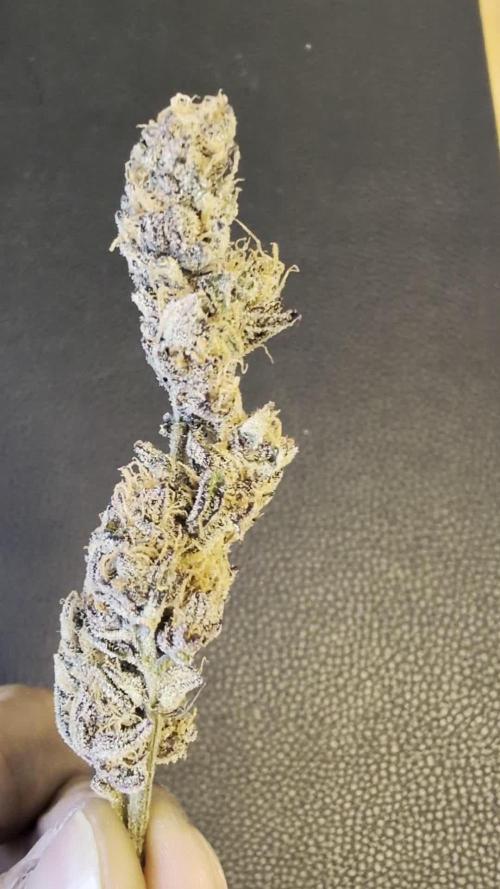
Sour Fraise is drying now. Temperature fits, humidity not. A little too dry 48% RH). Hope upcoming rain will raise humidity soon.
04/02/2026
Added the AC infinity Cloudforge T3 humidifier to the drying tent to keep RH around 60% (60/60 Method). So far so good. Still too humid for curing. Drying nice and slow.


@Gruschel_Muschel
Follow
CASH EXPRESS 03.01.2025
Tag 44 / 19.02.2025
Die 6 Woche ist erfolgreich erreicht! Das Umtopfen war erfolgreich es gab keine großen Schäden an den Wurzeln. Zwischenzeitlich habe ich noch mal gedüngt und einen Wurzelaktivator in das Wasser hinein gegeben.
Gerne nehme ich Ratschläge von der Community an.


