Likes
Comments
Share
@3lementa1
Follow
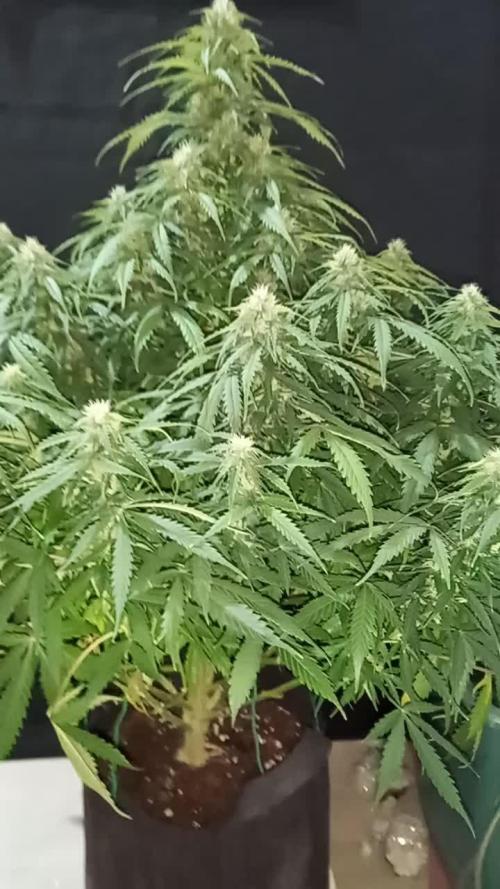
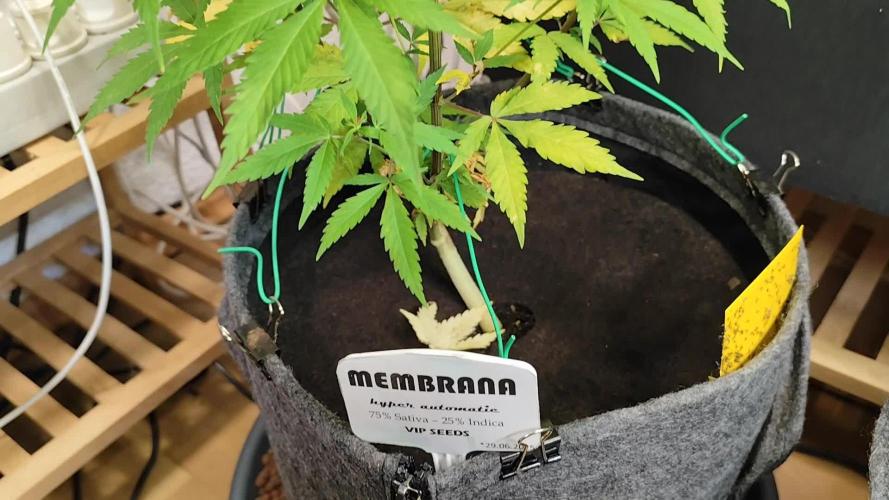
This is the 8th week. Thursday will be 9 weeks of 12/12. Some trichs are amber. They just added a good bunch of girth over the past few days, but most of the pistils are red now. The rest of them have been dropping leaves consistenly but the canopy remains full so they must be putting out more leaves. I just flushed to 80% runoff and found out that I had 1200ppm. I just got an ec meter but my last reading said closer to 600 so idk what happened there. I flushed until I had runoff ppm of about 150. Now they're back in the grow tent. I don't want to keep assaulting them with my microscope. I think they're ready. Just gonna let them settle another day or two to dry out a bit. I took one small branch off the small Wedding Cake plant on Thursday and I've just been watching it dry on my counter. It's been 5 days and the stem snaps but still leaves a fiber connecting. I put it into a small jar with a 64RH thing. I just want to try it. It already smells amazing. The leaves on the big CBD Blue Shark plant are going really yellow and some other colours are starting to come out as well. The buds all fattened up and got more frosty again. I was worried they were foxtailing but they got more calyxes underneath the peaks and have been making more of a pyramid shape. They're really close to peak. Harvest day will be March 17 or 18. March 17 1023pm chopped and hung after lights off all day. RH was 65% before I chopped and 50% after I closed the window and cut the plants off the saturated pots. I did a wet trim to prevent mold. The buds are sticky af. Gonna hang them to dry for 7-9 days before curing in jars :) March 18 : checked the RH when I woke up and it's chilling at 45% 😎 March 19 : just checked to see how they were drying. There are seeds in every plant. RIP I'll update when I put them in jars and again a few weeks later for final review. Overall it was a good grow despite the rocky start and a good introduction to the mainline technique and my new grow space. Next grow I should have everything pretty well dialed in. March 23 They were hanging for 3 days. Rh was around 45, then spiked to 65 overnight when I forgot to turn the fans back on. Temp was high at around 26.they felt wet after 2 days, and bone dry after 4 days. The stems still didn't snap but I put them in jars anyway. A day later, jar RH was 50%. I burped all the jars and there was a smell from the new jars. I took all the weed out, washed out the jars, and did a dry trim on the weed. One of the Wedding Cake plants must have gone hermie. I didn't see any bananas and didn't even realize there were seeds until the very end. The seed pods looked just like calyxes while the plants were growing. Many of the nugs are unusable. Under the sugar leaves are just layers and layers of seeds. Some weren't hit that badly. The CBD Blue Shark is much better off but still has some seeds. I'm trying to stay positive. It's a bit of a shock though. I'm anxious to try the finished product. If the flowers at least taste good and have a good effect, all is not lost.
Likes
25
Share
ANTHOCYANIN production is primarily controlled by the Cryptochrome (CR1) Photoreceptor ( !! UV and Blue Spectrums are primary drivers in the production of the pigment that replaces chlorophyll, isn't that awesome! 1. Diverse photoreceptors in plants Many civilizations, including the sun god of ancient Egypt, thought that the blessings of sunlight were the source of life. In fact, the survival of all life, including humans, is supported by the photosynthesis of plants that capture solar energy. Plants that perform photosynthesis have no means of transportation except for some algae. Therefore, it is necessary to monitor various changes in the external environment and respond appropriately to the place to survive. Among various environmental information, light is especially important information for plants that perform photosynthesis. In the process of evolution, plants acquired phytochrome, which mainly receives light in the red light region, and multiple blue light receptors, including his hytropin and phototropin, in order to sense the light environment. .. In addition to these, an ultraviolet light receptor named UVR8 was recently discovered. The latest image of the molecular structure and function of these various plant photoreceptors (Fig. 1), focusing on phytochrome and phototropin. Figure 1 Ultraviolet-visible absorption spectra of phytochrome, cryptochrome, phototropin, and UVR8. The dashed line represents each bioactive absorption spectrum. 2. Phytochrome; red-far red photoreversible molecular switch What is phytochrome? Phytochrome is a photochromic photoreceptor, and has two absorption types, a red light absorption type Pr (absorption maximum wavelength of about 665 nm) and a far-red light absorption type Pfr (730 nm). Reversible light conversion between the two by red light and far-red light, respectively(Fig. 1A, solid line and broken line). In general, Pfr is the active form that causes a physiological response. With some exceptions, phytochrome can be said to function as a photoreversible molecular switch. The background of the discovery is as follows. There are some types of plants that require light for germination (light seed germination). From that study, it was found that germination was induced by red light, the effect was inhibited by subsequent far-red light irradiation, and this could be repeated, and the existence of photoreceptors that reversibly photoconvert was predicted. In 1959, its existence was confirmed by the absorption spectrum measurement of the yellow sprout tissue, and it was named phytochrome. Why does the plant have a sensor to distinguish between such red light and far-red light? There is no big difference between the red and far-red light regions in the open-field spectrum of sunlight, but the proportion of red light is greatly reduced due to the absorption of chloroplasts in the shade of plants. Similar changes in light quality occur in the evening sunlight. Plants perceive this difference in light quality as the ratio of Pr and Pfr, recognize the light environment, and respond to it. Subsequent studies have revealed that it is responsible for various photomorphogenic reactions such as photoperiodic flowering induction, shade repellent, and deyellowing (greening). Furthermore, with the introduction of the model plant Arabidopsis thaliana (At) and the development of molecular biological analysis methods, research has progressed dramatically, and his five types of phytochromes (phyA-E) are present in Arabidopsis thaliana. all right. With the progress of the genome project, Fi’s tochrome-like photoreceptors were found in cyanobacteria, a photosynthetic prokaryotes other than plants. Furthermore, in non-photosynthetic bacteria, a homologue molecule called bacteriophytochrome photoreceptor (BphP) was found in Pseudomonas aeruginosa (Pa) and radiation-resistant bacteria (Deinococcus radiodurans, Dr). Domain structure of phytochrome molecule Phytochrome molecule can be roughly divided into N-terminal side and C-terminal side region. PAS (Per / Arndt / Sim: blue), GAF (cGMP phosphodiesterase / adenylyl cyclase / FhlA: green), PHY (phyto-chrome: purple) 3 in the N-terminal region of plant phytochrome (Fig. 2A) There are two domains and an N-terminal extension region (NTE: dark blue), and phytochromobilin (PΦB), which is one of the ring-opening tetrapyrroles, is thioether-bonded to the system stored in GAF as a chromophore. ing. PAS is a domain involved in the interaction between signal transduction-related proteins, and PHY is a phytochrome-specific domain. There are two PASs and her histidine kinase-related (HKR) domain (red) in the C-terminal region, but the histidine essential for kinase activity is not conserved. 3. Phototropin; photosynthetic efficiency optimized blue light receptor What is phototropin? Charles Darwin, who is famous for his theory of evolution, wrote in his book “The power of move-ment in plants” published in 1882 that plants bend toward blue light. Approximately 100 years later, the protein nph1 (nonphoto-tropic hypocotyl 1) encoded by one of the causative genes of Arabidopsis mutants causing phototropic abnormalities was identified as a blue photoreceptor. Later, another isotype npl1 was found and renamed phototropin 1 (phot1) and 2 (phot2), respectively. In addition to phototropism, phototropin is damaged by chloroplast photolocalization (chloroplasts move through the epidermal cells of the leaves and gather on the cell surface under appropriate light intensity for photosynthesis. As a photoreceptor for reactions such as escaping to the side of cells under dangerous strong light) and stomata (reactions that open stomata to optimize the uptake of carbon dioxide, which is the rate-determining process of photosynthetic reactions). It became clear that it worked. In this way, phototropin can be said to be a blue light receptor responsible for optimizing photosynthetic efficiency. Domain structure and LOV photoreaction of phototropin molecule Phototropin molecule has two photoreceptive domains (LOV1 and LOV2) called LOV (Light-Oxygen-Voltage sensing) on the N-terminal side, and serine / on the C-terminal side. It is a protein kinase that forms threonine kinase (STK) (Fig. 4Aa) and whose activity is regulated by light. LOV is one molecule as a chromophore, he binds FMN (flavin mononucleotide) non-covalently. The LOV forms an α/βfold, and the FMN is located on a β-sheet consisting of five antiparallel β-strands (Fig. 4B). The FMN in the ground state LOV shows the absorption spectrum of a typical oxidized flavin protein with a triplet oscillation structure and an absorption maximum wavelength of 450 nm, and is called D450 (Fig. 1C and Fig. 4E). After being excited to the singlet excited state by blue light, the FMN shifts to the triplet excited state (L660t *) due to intersystem crossing, and then the C4 (Fig. 4C) of the isoaroxazine ring of the FMN is conserved in the vicinity. It forms a transient accretionary prism with the tain (red part in Fig. 4B Eα) (S390I). When this cysteine is replaced with alanine (C / A substitution), the addition reaction does not occur. The effect of adduct formation propagates to the protein moiety, causing kinase activation (S390II). After that, the formed cysteine-flavin adduct spontaneously dissociates and returns to the original D450 (Fig. 4E, dark regression reaction). Phototropin kinase activity control mechanism by LOV2 Why does phototropin have two LOVs? Atphot1 was found as a protein that is rapidly autophosphorylated when irradiated with blue light. The effect of the above C / A substitution on this self-phosphorylation reaction and phototropism was investigated, and LOV2 is the main photomolecular switch in both self-phosphorylation and phototropism. It turns out that it functions as. After that, from experiments using artificial substrates, STK has a constitutive activity, LOV2 functions as an inhibitory domain of this activity, and the inhibition is eliminated by photoreaction, while LOV1 is kinase light. It was shown to modify the photosensitivity of the activation reaction. In addition to this, LOV1 was found to act as a dimerization site from the crystal structure and his SAXS. What kind of molecular mechanism does LOV2 use to photoregulate kinase activity? The following two modules play important roles in this intramolecular signal transduction. Figure 4 (A) Domain structure of LOV photoreceptors. a: Phototropin b: Neochrome c: FKF1 family protein d: Aureochrome (B) Crystal structure of auto barley phot1 LOV2. (C) Structure of FMN isoaroxazine ring. (D) Schematic diagram of the functional domain and module of Arabidopsis thaliana phot1. L, A’α, and Jα represent linker, A’α helix, and Jα helix, respectively. (E) LOV photoreaction. (F) Molecular structure model (mesh) of the LOV2-STK sample (black line) containing A’α of phot2 obtained based on SAXS under dark (top) and under bright (bottom). The yellow, red, and green space-filled models represent the crystal structures of LOV2-Jα, protein kinase A N-lobe, and C-robe, respectively, and black represents FMN. See the text for details. 1) Jα. LOV2 C of oat phot1-to α immediately after the terminus Rix (Jα) is present (Fig. 4D), which interacts with the β-sheet (Fig. 4B) that forms the FMN-bound scaffold of LOV2 in the dark, but unfolds and dissociates from the β-sheet with photoreaction. It was shown by NMR that it does. According to the crystal structure of LOV2-Jα, this Jα is located on the back surface of the β sheet and mainly has a hydrophobic interaction. The formation of S390II causes twisting of the isoaroxazine ring and protonation of N5 (Fig. 4C). As a result, the glutamine side chain present on his Iβ strand (Fig. 4B) in the β-sheet rotates to form a hydrogen bond with this protonated N5. Jα interacts with this his Iβ strand, and these changes are thought to cause the unfold-ing of Jα and dissociation from the β-sheet described above. Experiments such as amino acid substitution of Iβ strands revealed that kinases exhibit constitutive activity when this interaction is eliminated, and that Jα plays an important role in photoactivation of kinases. 2) A’α / Aβ gap. Recently, several results have been reported showing the involvement of amino acids near the A’α helix (Fig. 4D) located upstream of the N-terminal of LOV2 in kinase photoactivation. Therefore, he investigated the role of this A’α and its neighboring amino acids in kinase photoactivation, photoreaction, and Jα structural change for Atphot1. The LOV2-STK polypeptide (Fig. 4D, underlined in black) was used as a photocontrollable kinase for kinase activity analysis. As a result, it was found that the photoactivation of the kinase was abolished when amino acid substitution was introduced into the A’α / Aβ gap between A’α and Aβ of the LOV2 core. Interestingly, he had no effect on the structural changes in Jα examined on the peptide map due to the photoreaction of LOV2 or trypsin degradation. Therefore, the A’α / Aβ gap is considered to play an important role in intramolecular signal transduction after Jα. Structural changes detected by SAXS Structural changes of Jα have been detected by various biophysical methods other than NMR, but structural information on samples including up to STK is reported only by his results to his SAXS. Not. The SAXS measurement of the Atphot2 LOV2-STK polypeptide showed that the radius of inertia increased from 32.4 Å to 34.8 Å, and the molecular model (Fig. 4F) obtained by the ab initio modeling software GASBOR is that of LOV2 and STK. It was shown that the N lobes and C lobes lined up in tandem, and the relative position of LOV2 with respect to STK shifted by about 13 Å under light irradiation. The difference in the molecular model between the two is considered to reflect the structural changes that occur in the Jα and A’α / Aβ gaps mentioned above. Two phototropins with different photosensitivity In the phototropic reaction of Arabidopsis Arabidopsis, Arabidopsis responds to a very wide range of light intensities from 10–4 to 102 μmol photon / sec / m2. At that time, phot1 functions as an optical sensor in a wide range from low light to strong light, while phot2 reacts with light stronger than 1 μmol photon / sec / m2. What is the origin of these differences? As is well known, animal photoreceptors have a high photosensitivity due to the abundance of rhodopsin and the presence of biochemical amplification mechanisms. The exact abundance of phot1 and phot2 in vivo is unknown, but interesting results have been obtained in terms of amplification. The light intensity dependence of the photoactivation of the LOV2-STK polypeptide used in the above kinase analysis was investigated. It was found that phot1 was about 10 times more photosensitive than phot2. On the other hand, when the photochemical reactions of both were examined, it was found that the rate of the dark return reaction of phot1 was about 10 times slower than that of phot2. This result indicates that the longer the lifetime of S390II, which is in the kinase-activated state, the higher the photosensitivity of kinase activation. This correlation was further confirmed by extending the lifespan of her S390II with amino acid substitutions. This alone cannot explain the widespread differences in photosensitivity between phot1 and phot2, but it may explain some of them. Furthermore, it is necessary to investigate in detail protein modifications such as phosphorylation and the effects of phot interacting factors on photosensitivity. Other LOV photoreceptors Among fern plants and green algae, phytochrome ɾphotosensory module (PSM) on the N-terminal side and chimera photoreceptor with full-length phototropin on the C-terminal side, neochrome (Fig. There are types with 4Ab). It has been reported that some neochromes play a role in chloroplast photolocalization as a red light receiver. It is considered that fern plants have such a chimera photoreceptor in order to survive in a habitat such as undergrowth in a jungle where only red light reaches. In addition to this, plants have only one LOV domain, and three proteins involved in the degradation of photomorphogenesis-related proteins, FKF1 (Flavin-binding, Kelch repeat, F-box 1, ZTL (ZEITLUPE)), LKP2 ( There are LOV Kelch Protein2) (Fig. 4Ac) and aureochrome (Fig. 4Ad), which has a bZip domain on the N-terminal side of LOV and functions as a gene transcription factor. 4. Cryptochrome and UVR8 Cryptochrome is one of the blue photoreceptors and forms a superfamily with the DNA photoreceptor photolyase. It has FAD (flavin adenine dinucle-otide) as a chromophore and tetrahydrofolic acid, which is a condensing pigment. The ground state of FAD is considered to be the oxidized type, and the radical type (broken line in Fig. 1B) generated by blue light irradiation is considered to be the signaling state. The radical type also absorbs in the green to orange light region, and may widen the wavelength region of the plant morphogenesis reaction spectrum. Cryptochrome uses blue light to control physiological functions similar to phytochrome. It was identified as a photoreceptor from one of the causative genes of UVR8 Arabidopsis thaliana, and the chromophore is absorbed in the UVB region by a Trp triad consisting of three tryptophans (Fig. 1D). It is involved in the biosynthesis of flavonoids and anthocyanins that function as UV scavengers in plants. Conclusion It is thought that plants have acquired various photoreceptors necessary for their survival during a long evolutionary process. The photoreceptors that cover the existing far-red light to UVB mentioned here are considered to be some of them. More and more diverse photoreceptor genes are conserved in cyanobacteria and marine plankton. By examining these, it is thought that the understanding of plant photoreceptors will be further deepened.
Likes
10
Share
Heatwave gone, sun still around. Rocky (Purple#1) is a killer! Growing 16 new tops and adopted a nice symmetry after just 2 rounds of topping. So much stretch after the first couple days of diffused light outdoors! Nodes are at least 5cm apart. Most new tops are coming from one node further below the cut. I’ll probably leave it at that and focus on getting them all equally tall and spread outwards. Excuse my enthusiasm - first time growing photos outdoors. This hits different! Prince (Purple#1) was super slow to redistribute auxin after LST but it’s finally getting to the right places. Lamin J (Casamance Sativa) is stretching so hard, main stem is LTD’d halfway around the pot. By the time I can flip them this one gonna be a basket! Lamin HC (Casamance Sativa) stretched a whole lot too and grew huge leaves. Little less busy pushing new tops compared to Rocky. Gonna have to top this one again soon to get to at least 8. Jimi (Purple#1) about tripled in size after going outdoors but hardly developed any new nodes. Got too lanky and I chopped it in half. Little clone now trying to make it on the window sill.
Likes
75
Share
@Theia
Follow
Started week 7 with another topping. She looks a bit of a mess ATM as I have had to bend some of her arms a full 90degrees and do some funky leaf tieing to keep everything in shape.. Nothing snapped and she seems okay. I will see how she recovers in the next day or two. Re introduced grow to her feed. I shall check back in after a few days of recovery and try to get a better pic then the blurple ones I managed earlier. Day 48 She is so strong. The topping did not bother her showing 3 cm of growth the night I topped her.. I have cleaned all old fan leaves and defoliated the mainlines. Just have 8 colas atm. I attached a ring from a plant holder to try and hold the shape. 7 of the 8 colas have grown exactly where I wanted but 1 has taken a funny turn and as a result it's grown a bit short of where I need it. I shall try to bring them all to a uniformed height then I think I'm going to let 2 more nodes grow out and if that looks like it's given me enough space I will do the final topping for 16 colas. If she looks like it will be to busy I shall stick to 8.. Thanks for looking stay safe and happy growing.😁👍🤘
Likes
2
Share
had crazy smell when I opened the glass it smelled like two rooms away Very good high more indica
Likes
2
Share
Die Rs11 wurde erfolgreich nach nur 48 Stunden im Papiertuch vorgekeimt, bis die Pfahlwurzel eine Länge von ca 1-2cm erreicht hatte. Danach hab ich sie direkt in den Coco Plug gesetzt, so dass sie die Keimblätter schön entwickeln kann.
Likes
170
Share
Week 9 is here. Massive shout to RQS & James for supporting me in this grow. Once again the genetics that RQS have is unbelievable. ✌️ Day 58, buds are fattening up real nice with a very nice smell. I hope to carry on feeding for another 2 weeks then start the flush. I plan to remove some more leafs of the topped plant she is so bushy but full off bud! Water feed repeat for this lady’s for now. Thank you for all the support and love shown during this grow. Have a great week ✌️👊🏻💚🙌
Likes
4
Share
@Growtopus
Follow
In knapp einer Woche haben sich die beiden verdoppelt. Die Seifuku hat sich super vom Topping erholt, hat aber einen etwas großen Abstand zwischen den Nodien. Die Lampe wurde von 80 cm auf 60 cm Abstand gesenkt, um so die Intensität zu erhöhen. Beide haben es gut vertragen, und nächste Woche wird sie weitere 10–15 cm gesenkt, da ich wegen des Magnetdimmers nur in 20-%-Stufen dimmen kann. Bei der Sour Zoda wurde das erste Blattpaar entfernt, sodass die Seitentriebe nicht mehr verdeckt werden. Ich habe aber wohl das falsche gewählt, weil das nächste Paar so schnell gewachsen ist, dass sie sofort wieder verdeckt waren. Die Sour Zoda wächst eher gedrungen im Vergleich zur Seifuku. Nach den Fotos wurden beide mit Wizzy's Pflanzengeflüster (0,5 g auf 50 ml pro Pflanze) eingesprüht. ---- In just under a week, both have doubled in size. The Seifuku has recovered really well from the topping but shows a somewhat large spacing between the nodes. The light was lowered from 80 cm to 60 cm to increase intensity. Both handled it well, and next week it will be lowered another 10–15 cm, since with the magnetic dimmer I can only adjust in 20% steps. On the Sour Zoda, the first pair of leaves was removed so the side shoots wouldn’t be shaded. But I probably chose the wrong pair, because the next set grew so quickly that they were shaded again right away. The Sour Zoda grows more compact compared to the Seifuku. After the photos both plants have been treated with Wizzy's Pflanzengeflüster (0,5 g in 50 ml per plant) Nachtrag: Wir haben einen Schädlingsbefall, daher wurde die Erde bedeckt mit einer dicken Schicht Sand und darauf Splitt. Dadurch wird der Sand nicht weggespült beim Gießen und es wird noch unattraktiver für die Wurzelfliegen. Bei der Seifuku wurden die Haupttriebe mit Clips heruntergebogen. Bei beiden wurde das unterste Blattwerk entfernt, damit die ich die Barriere gut auf die Erde bekomme.
Likes
33
Share
This girl is finally starting to put on a little stretch, but she is still by far the shortest plant of the bunch. I lifted her up about 3 inches so she doesnt get completely smothered out over the next week. I will lift her another 3 inches if she doesnt make more upward progress soon. I moved her to the front of the room for easy access since she need daily defoliation being as bushy as she it. She is definitely different than any in house strain I have seen. Besides that she is a happy girl. Starting to see a few pistils and she is transitioning. The scrog setup is working great for the plants that have grown through it. It is really going to help me put each top where I want it and keep them spread out so more of those lower branches can make their way up. So far everything is running nice and smooth just the way we like it.
Likes
Comments
Share
🌹 Pink Rozay Auto B - Week 4 | Early Flowers, Big Dreams 🌹 Some plants quietly follow the rhythm of the room. Others decide to write their own timeline. Pink Rozay Auto B is proving to be one of those special girls. While the entire 8×8 Adventure is progressing beautifully under our 12/12 From Seed experiment, she and her sister have clearly decided they aren’t waiting for anyone. Both have entered flowering noticeably earlier than many of their neighbors, already stacking fresh white pistils and showing that unmistakable transition from vegetative growth into reproductive mode. Whether they’ll ultimately finish well ahead of the others or simply settle back into the group’s pace remains to be seen—but that’s exactly what makes phenotype hunting so fascinating. Every day brings another lesson. This diary is another chapter in documenting that unique journey. ⸻ 🌱 Life Inside the 8×8 Adventure The room continues to evolve into exactly what I hoped this experiment would become. Multiple cultivars… Multiple phenotypes… One environment… …all responding in their own completely unique ways despite receiving identical treatment. Watching these differences emerge is one of the greatest rewards of this project. Pink Rozay Auto B isn’t the tallest plant in the room, nor the widest, but she carries herself with incredible confidence. Every day the structure becomes a little more refined, with new flower sites appearing throughout the canopy while maintaining a compact and manageable shape. She may not demand attention… …but she certainly earns it. ⸻ 🌿 Gentle Training, Better Light Training continues to be extremely light and intentional. Rather than forcing the plant into unnatural shapes, I’m simply guiding her architecture little by little. Low Stress Training continues to spread the branches outward while preserving the natural growth momentum. Combined with regular leaf tucking, more light now reaches the lower developing shoots without removing healthy foliage unnecessarily. It’s amazing how much difference simply moving a few leaves can make. Every exposed node becomes another opportunity for a future flower site, helping create a more balanced canopy while allowing airflow to penetrate deeper into the plant. Sometimes the smallest adjustments deliver the biggest results. ⸻ 🌸 Racing Into Flower One thing is becoming increasingly obvious. Pink Rozay Auto B is moving. Fast. The top flowers are already producing beautiful clusters of bright white pistils, and several lower branches have joined the race as well. Compared with many of the surrounding plants, she’s clearly a step ahead in flower initiation. Whether this means she’ll ultimately finish earlier or simply started blooming sooner is impossible to know at this stage—but that’s part of the excitement of documenting every single week. Nature always has the final word. ⸻ 🌡️ Summer Challenges Continue Summer growing always keeps us humble. Even with the air conditioning working around the clock, keeping temperatures under complete control during the hottest days remains one of the biggest daily challenges. This week the environment averaged: • 🌡️ Day Temperature: 33°C • 🌙 Night Temperature: 25°C • 💧 Relative Humidity: 63% • 🌱 Root Zone Temperature: 21°C • 💦 Nutrient Solution: 26°C • ⚡ EC: 1.35 mS/cm • pH: 6.1 • 🌿 CO₂: 639 ppm Considering the outside temperatures, I’m genuinely pleased with how stable the room has remained. The plants certainly don’t seem to mind. Healthy color, vigorous growth and strong turgor continue to suggest they’re adapting very well. ⸻ Feeding Program This week the feeding schedule remained simple and consistent using the Plagron Terra line: • Terra Grow — 1.8 ml/L • Power Roots — 1 ml/L • Pure Zym — 1 ml/L • Sugar Royal — 1 ml/L The combination continues to promote vigorous vegetative growth while providing plenty of support as flowering begins. No need to complicate things. Healthy roots continue to build healthy flowers. ⸻ 🔬 Looking Forward Over the coming week I’ll continue monitoring her carefully. If she keeps flowering at this pace, she could become one of the earliest finishers inside the entire 8×8 Adventure. Or… She might simply be an early bloomer before settling into the same finishing window as everyone else. Either outcome is exciting. That’s exactly why I love running multiple genetics together—every phenotype tells its own story. Pink Rozay Auto B has definitely captured my attention. Now it’s her turn to show us what she’s truly capable of. ⸻ 💚 Thank You As always, thank you to everyone following this adventure. Every like, every comment, every question and every bit of encouragement makes these journals even more enjoyable to create. A huge thank you to GrowDiaries for providing a place where growers from all over the world can share knowledge and learn together. Massive appreciation as well to Plagron for supplying the nutrition driving this entire run, and to Zamnesia for providing the genetics that make this project possible. Finally… Thank you to everyone following the entire 8×8 Adventure from seed to harvest. Every week brings us one step closer, and I can’t wait to see where Pink Rozay Auto B decides to take us next. Growers Love and happy growing! 🌱💚
Processing
Likes
16
Share
@Jazzvet
Follow
4th week of vegetation. The girl has grown healthy and entered in the blooming phase, and the first pistils are starting to appear. I've increased the dose of bio grow to 0.7 ml per 3 L and I'll continue for 2 more weeks. See you next week happy growing
Likes
91
Share
@MrCOCO
Follow
The girls grew up again and are already 110 cm tall. I don't see any problems ... I did supercroping and they are fine too ... We keep going ...🍃🍃🍃
Likes
25
Share
@Kakui
Follow
Veg44, defoliación grande, y ajuste de amarras. Siempre digo que será la última defoliación y termino defoliando más, ahora a qué crezcan un poco más antes del cambio 12/12 Veg46, las plantas están ya recuperadas y creciendo a buen ritmo. Veg48, riego con solo Sensizym y Sensi CalMag, con pH 6.3 y EC 0.8, drenaje de EC 1.9 y pH 6.1(ok). Debido al crecimiento de debe ajustar amarras y quitar una que otra hoja.
Likes
18
Share
@valiotoro
Follow
Hello everyone 😎 Week 6 of flower for the Amnesia Zkittlez🍭 Only 1 plant left then finito✔️ Very nice smell super sweet🤤 The buds are super sticky🔥
Likes
24
Share
Very saddened by the turn of events, 3 herms, 2 different grow environments, but each tent had another strain growing along with it. No seeds or problems with the Cookies strain… I had no power outages, no light leaks, no schedule changes, and performed relatively little defoliation during flower. To me, this cannot be attributed to stress, as they showed no sign of stress or deficiency’s throughout the grow. Long story short, booooooo.
Likes
27
Share
At the 5 week point we are still a way off what they should be due to their waiting for me to get them settled but today they look good and better than they have all week. The megacrop is working the magic now and I am getting them into their NFT later today so I expect them to fly.
Likes
36
Share
Day 29 Flowering: Hi all. As another week passes these exotic ladies are impressing the hell out of me. They have all really put some energy into forming long colas with really bulky little budlets along their whole stems. Herz o.g is by far the chunkier of the three but not by a big margin at all. her crown is forming nicely from above and I can clearly see her future potential colas. She looks a very nice colour of green on her leaves whichnis down to the Megacrop and its amazing chlorophyll building properties. This will help to really power those fan leaves to pump the nutrients and essentials to the forming buds I am now trying to stress her as little as possible to allow her to keep her focus on that alone and not dealing with uneeded stresses. Strawberry Cola is beginning to build some nice stacks too. Her stretch helped to keep her in the canopy but she is at present overshadowed by a huge mimosa Lemon due harvesting. it has stolen some of her light over the past week or so but this will be corrected as I begin harvesting the other strains running shortly. Monster mash isnrhe biggest surprise... she came up out of nowhere over the last few days. She now towers the whole grow rooms strains. Her cola lengths are looking very positive with the nodes reaching to low in the canopy too. She will also benefit from a move around as I harvest the other strains. She will get a prime position to keep those colas stacking up long. They have all had a defol at day 21 and the air can get around their frames really easily to keep the chance of mould right down. So far so good and very happy days ahead . Be safe and well growmies.
Likes
28
Share
@J_diaz420
Follow
Comienza la floración de estas pequeñas!! Cambiamos línea de fertilizantes gracias a b.a.c 👍👨‍🌾🏻🍀
Likes
32
Share
@AsNoriu
Follow
Day 30. Girls got water and bacterial feed yesterday. Grow well. Some stretching too much, lights should be lower ... But I alway can use SuperCroping ;))) Hope in two weeks all old plants will be gone and girls will occupy space correctly. Water , then Heavy feed in plans this week, I updated my approx feed plant, just bacterial feed I give once in a week, or in reality approx every 10-11 days .. Constantly spray them with one ml/L of BioHeaven. They get it at least in the morning and most days straight before lights go out. My older plants are almost done, so I have to play with humidity,but never forget BUD ROT !!!! Loads of leaf tucking and small training involved too. Btw, look at plastic pot, all same feed, spray, care, but without humidity dome ... Plant was out, when all other were just dropped into soil ... Mars SP 150 helps me so much in such overcrowded space .... Happy Growing !!!