


Puis-je faire confiance en mon smartphone pour mesurer de PPFD ?

Angus_MacGrowerstarted grow question 3y ago
TL;DR: oui.
Il y a une polémique qui enfle ici depuis quelques jours à propos de la capacité d'un appareil photo de smartphone à mesurer efficacement le PPFD, certaines personnes discréditant totalement la capacité d'un capteur photo à capter des photons (sic).


Open
Setup. Lighting
likes
Answer

Hashyanswered grow question 3y ago
I don't think mine is that far out, maybe says the light is a little stronger then it actually is.
likes
Complain
Angus_MacGroweranswered grow question 3y ago
That's why calibration is important.
Even Apogee's quantum meters need regular recalibration.
In a video, Bugbee talk about a tool you can use to get sunlight metrics for where you live, so you can calibrate your equipment on a clear day.
I'm currently trying to find this video. 😋
likes
Complain
Hashyanswered grow question 3y ago
I use the photone app and have used it for quite a while. I have not Calibrated it so its been a bit trial and error over the last few years but I have found the readings my plants like throughout there life span. Just hope when I change my phone the readings will be the same.
likes
Complain

HerbalEduanswered grow question 3y ago
i have had different results with different phones depending the quality of the photo sensor it can be accurate enough or totally funky.
likes
Complain
Angus_MacGroweranswered grow question 3y ago
Pour ceux qui débarquent après la bataille (littéralement), l'exposé original est dans le premier commentaire tout en bas de la page (GD ne laisse pas la possiblité de mettre beaucoup de texte dans l'intitulé des questions). ^^
likes
Complain
Angus_MacGroweranswered grow question 3y ago
> The emitted luminous flux (in lumens) of an LED lamp is a transmission quantity. The illuminance (in lux) describes the luminous flux received and is therefore a reception quantity.
Fun fact: dans cette phrase, vous pouvez remplacer "emitted luminous flux (in lumens)" par "PPF", "The illuminance (in lux)" par "PPFD" et "luminous flux" par "irradiance" et ça marche toujours.
Et je remercie Polyphemus ici de s'être débunké tout seul pour une fois. ^^
likes
Complain
Angus_MacGroweranswered grow question 3y ago
> Questions is like a separate part of the site for whatever reason.
My guess is one dev (or one team) make GD in the first place, and later someone else added the Grow Questions sections. :3
likes
Complain
Angus_MacGroweranswered grow question 3y ago
> and i'm going to ensure that by blocking you
It don't work: i've blocked you days ago.
likes
Complain
Angus_MacGroweranswered grow question 3y ago
Polyphemus, vous vous répétez.
Lux est un mesure exprimée en lumen par mètre carré par seconde. C'est exactement la même chose qu'entre le PPF et le PPFD… Faut vraiment être débile pour se planter une fourchette dans le pied à ce point.
J'ai présenté des arguments étayés, vous continuer juste à brailler sans citer une seule source viable. Fin de l'histoire.
likes
Complain

Polyphemusanswered grow question 3y ago
angus, i wont' reply to you ever again.. and i'm going to ensure that by blocking you
1 like
Complain
Polyphemusanswered grow question 3y ago
due to inverse sqare law in effect with lights... a matter of 6 inches can greatly impacat resulting DLI... light spreads out quickly.
you can take a lazy approach.. or you can fine-tune it. each to their own on that. you want to waste money (electricity) .. that's your choice.
1 like
Complain
Polyphemusanswered grow question 3y ago
lux and lumen are 1:1 so it doesn't fucking matter except to nit-pick.
"Difference between lux and lumens
The emitted luminous flux (in lumens) of an LED lamp is a transmission quantity. The illuminance (in lux) describes the luminous flux received and is therefore a reception quantity."
it's measuring the same exact thing the difference is transmission vs reception. irrelevant. light meters measure klux.. not lumens.
you jsut made up a useless argument again.. go re-read. never said anything about only in 1 m^2... i but it is relative to 1m^2 .. that way you can compare DLI in a 4x4 to a 3x4 and it means the same thing.. and in this case PPFD too.
your cmos censor explanation is narrow-sighted and missing sevearla important other foactors at play. A phone is still shit at measuring umol/s any which way you slice it. the apps even say so if you read the fine print.
DLI and PPFD are not the same thing and part of what you obvisouly do not get... lol.. ppfd is a factor in cacluting DLI..
ppfd can be comapred accros different sized areas but not different hours of operations. DLI can be compared apples to apples across both contexts.. inherently different things even if one is a factor of another. One is a rate of photons per m^2 the other is the total moles of photons applied per day.. FFS it's in the equation. just fucking read it...
are you trying to be obtuse? i'm not replying to you anymore.. you either are fuckign ignorant beyond help or you are purposefully spewing nonsense for a response.
also, your perception of how much your respect means to be is very over-bloated, lol.. your repsect is nothing. you are one person that clearly is missing more than half of the needed knowledge to udnerstand this stuff, lol. your superficial understanding and narrow-sighted focus is laughable.
you are objectively and verifiably wrong. no respect from an obstinate person that refuse to do a little reading is no loss.
1 like
Complain
Angus_MacGroweranswered grow question 3y ago
@Organoman non non non, c'est pas une question : je suis en train de présenter des études qui expliquent qu'un capteur photo peut parfaitement être utilisé pour mesurer une intensité lumineuse. J'essaie juste de rassurer les débutants en rappelant que c'est un outils viable, malgré le comportement Petit Bourgeois de Polyphemus qui visiblement a les moyens de payer un outils hors de prix qu'on ne va utiliser que peu de fois.
Il faut aller lire le premier commentaire tout en bas. ^^
likes
Complain

Cartman420answered grow question 3y ago
There is no controversy on this site. Just a bunch of morons that know fuck all. Oh that's all of you.
likes
Complain

Organomananswered grow question 3y ago
Keep your light at the recommended height the manufacturer gives........your planrs will be fine and will not notice or complain.
Tiny, tiny details make microscopic differences that you will never, ever notice!
1 like
Complain
Angus_MacGroweranswered grow question 3y ago
OMFG! Le traducteur automatique de GD est tellement mauvais. ><'q
likes
Complain
Angus_MacGroweranswered grow question 3y ago
> You still don't distunguish between PPFD and umol/s correctly.
Venant de quelqu'un qui visiblement ne sait pas faire la différence entre Lux et Lumen et qui a prouvé à plusieurs reprises qu'il n'est pas capable de calculer des surfaces correctement, je trouve ça d'un comique sans fin.
> To accurately convert from Lumens to umol/s requires […]
Lux.
L'application prend la valeur reçue en Lux et la converti en PPFD en utilisant le type d'éclairage précisé par l'utilisateur pour appliquer le coefficient de conversion associé dans la base du logiciel.
Bien que j'ai déjà dit plusieurs fois que j'appréciais qu'on me reprenne quand je dis des conneries, faut-il encore apprendre à lire.
> ppfd is not a single point measurement. it is the total rate of umol/s PER meter-squared. You'd need many, many measurements from the entire area, then average them together to get an idea of PPFD
Comme je l'ai dit plus haut, vous avez clairement des problèmes avec les notions de surface. Bien que le PPFD soit une mesure exprimée en mol par mètre carré par seconde, ça ne veut certainement pas dire que c'est une valeur qu'on ne peut mesurer qu'uniquement sur une surface d'un mètre carré.
Si on suit votre raisonnement, alors on ne peut mesurer une vitesse en Km/h qu'uniquement en se déplaçant pendant une heure.
Or, il est parfaitement possible de mesurer une valeur sur une surface (ou distance) plus petite et d'ensuite extrapoler les résultats. C'est le principe d'une unité de mesure.
Franchement, j'aimerai pas être dans votre tête quand vous faites face à la carte de couverture d'un luminaire. Ça doit être l'enfer en 2D.
> The "PPFD" (wrong terminology if a single point) it reports is suspsect for several reasons you simply cannot avoid. the wide angle of light entering the lense is a big problem too. It causes wildly inflated lux readings, for example.
Justement, je parle ici d'un capteur CMOS, et si je prend le temps d'expliquer que c'est une surface couverte de capteurs photosensibles, c'est pour mettre en avant le fait que c'est une surface et donc qu'elle va mesure des valeurs sur l'intégralité de la surface. De plus, comme la taille du capteur et l'angle de vue de l'optique sont des valeurs connues, le fabricant (Sony dans la grande majorité des cas) prends ces valeurs en compte pour retourner une mesure en Lux à travers l'API. Maintenant, si vous ne voulez pas faire confiance aux compétences des ingénieurs de chez Sony…
Par ailleurs, les optiques photos reçoivent un traitement anti-reflet justement pour éviter que la lumière rebondisse dans tous les sens et fausse les mesures des capteurs.
> Also, DLI is what matters.. not PPFD.
C'est absolument la même chose, mais à une échelle temporelle différente. Et les deux sont importants.
Et puisque vous vous contentez ensuite uniquement d'essayer de discréditer les recherches validés sur lesquels je base ce qui est censé être un petit article à l'attention de débutants et non pas de pseudos-nerds qui se touchent la nouille, je vais juste rappeler que dans le débat sur le rinçage j'ai vigoureusement critiqué AutoflowersMachin car il a refusé de prendre en considération l'étude non vérifié que vous avez présenté en guise de fait absolu pour appuyer vos propos. Je vais donc vous faire la même remarque :
Votre égo démesuré vous rend idiot et aveugle au point où vous citez des noms savants mais refusez de prendre en considération des études sérieuses quand elles se vont pas dans votre sens. C'est un comportement minable mais au moins il nous permet de comprendre que votre stratégie consiste à disperser des informations dans vos trop longues explications, tellement ennuyeuses, mal écrites, insultantes et peu sourcées, afin de faire croire à tout le monde que vous maîtriséez un sujet qu'au mieux vous avez du mal à expliquer, qu'au pire ne comprenez pas et sur lequel vous broder.
Je vais être franc avec vous : non seulement vous avez totalement perdu mon respect et je refuse de continuer à jouer à votre jeu stupide tant que vous n'avez rien d'autres que des jérémiades comme arguments.
likes
Complain
Polyphemusanswered grow question 3y ago
heck, "max" dli changes every day in every garden that doesn't have precise controls over it's environment. you potentially need something a little differenet each day..
1 like
Complain
Polyphemusanswered grow question 3y ago
You still don't distunguish between PPFD and umol/s correctly. you seem to use them interchangeably and you don't understand the difference between measuring Lumens and photons. this is part of the problem.. you incomplete understanding.
To accurately convert from Lumens to umol/s requires the SFD, or spectral flux density, of the light in question. A camera lense definitely does not have this capability. Therefore, all they can do is use a one-sized-fits-all conversion factor that could have enormous error for some people and less for others.. but some error for all except for the lucky few whose light directly matches whatever conversion factor they whimsically choose to use. This is incontrovertibly true... it is fact. Cannot deny it. mathematical certainty.
ppfd is not a single point measurement. it is the total rate of umol/s PER meter-squared. You'd need many, many measurements from the entire area, then average them together to get an idea of PPFD.. the more points of measurement, the more accurate the guesstimate will be. It is a time-intensive and focus-intensive operation. if not measuring from same exact distance at each point and perfectly level each time you do measure, it's going to contain human error as well as rounding errors due to possible low resolution of measurments (how many across canopy and evenly distributed poitns on top of that).
Lumen meters and phone apps are effective at giving you proportional intensity. That is useful. The "PPFD" (wrong terminology if a single point) it reports is suspsect for several reasons you simply cannot avoid. the wide angle of light entering the lense is a big problem too. It causes wildly inflated lux readings, for example.
Also, DLI is what matters.. not PPFD. PPFD is an incomplete picture when assessing how much energy you are providing per day (DLI). A single measrument will be of umol/s of PAR.
you need trial and error based on observation of plant growth to fine-tune power, distance of light etc, regardless. A more accurate guesstimation of DLI provided will definitely shorten this learning curve, but totally uneccessary to achieve the same goal. It is helpful in comparing relative intensity of various locations in canopy in order to more evenly distribute light. That's it.
Calculating DLI from hours of use and light's specs is a faster and more accurate process given basic common sense. Can you dream a context in which it is not? sure, but it would be a context that wouldn't match any rational garden space.
reading lux does not mean it can read umol/s in an accurate way or else there'd be apps available that don't convert from lumens. That method is inherently inaccurate given the context. The apps that come with a meter and can effectively convert lumens to umol/s do exist, but you need a bluetooth/wifi probe to do so. those apps aren't the free ones, either.
Yeah, you can accurately measuer lux, but that isn't what matters. I'd still argue a 10 dollar light meter is a better way to go because it is far more directional than a wide angle lense. you'll see those meters measure lux much lower than a phone app. My diy lights burn the shit out of plants at 32-35klux over 12 hours of operation, for example, and i see people with readings of 65klux from their phone apps with lights that pale in comparison in quality/power. That's with a real light meter.. not a phone app with inherent issues beyond the physical chip you mention.
no one said don't use a smartphone app.. they merely put it in proper perspective of what its real capabilities are. you just made up soem weak argument that was never used (scarecrow logical fallacy). proportional intensity is useful.. but don't lie to yourself that your phone accurate can give you a PPFD measurement or umol/s LOL... it cannot beyond some wide ranaging +/- 10% or more error.
the consitency of it's measurement is what is useful. they number may not be right, but if you find your corners or edges are 50% of readings in center, you know your umol/s is also 50% at corners and edges compared to center... even if you don't know exactly what that umol/s is in either spot. it can help you even out canopy.. choose a more effective hanging distance etc.
regardless, you need trial and error observing plant over long periods of time to know if oyu have your light that is providing max DLI -- i.e. you amp up until you have damage, then you back off to the point where no damage occurs over long-term. sometimes light damage takes 2-3 weeks to see the symptoms if only a small bit off vs off by a large amount.
local enviornmental variables make any DLI suggstion a ballpark concept, regardless. There is no 'single" DLI recommendation because what is optimal will vary quite a bit from 1 garden to the next.
1 like
Complain
Angus_MacGroweranswered grow question 3y ago
"That migro guy from youtube" the name is Shane Torpey. ^^
And if I refer to the studies I've taken the trouble to link to, in fact even uncalibrated the results are fairly accurate. But yes, it's better to calibrate the application and it's really not complicated if you have access to precise measurements for your lamp model.
likes
Complain
Angus_MacGroweranswered grow question 3y ago
Un capteur CMOS, qui équipe la majorité des appareils photos numériques depuis 2000 est une surface composés de milliers de cellules photosensibles qui convertissent des photons en électrons. Chaque pixel d'une photo est généré à partir de 4 cellules photosensibles, recouvertes de filtres rouges, verts et bleus (le vert étant doublé) formant une matrice qui permet ensuite d'interpoler la valeur RGB du pixel. Si la caméra frontale de votre smartphone est annoncée à 3Mpx ça veut dire que le capteur est composé d'au moins 12 000 000 de ces cellules photosensibles.
Le tout est protégé par un filtre passe-bas, chargé de filtrer les fréquences IR, ce qui fait du CMOS un outils parfaitement capable de mesurer la quantité de photons strictement dans le PAR, perçus sur toute sa surface.
En fait, deux études de 2013 et de 2017, confirment qu'il est parfaitement possible d'utiliser une webcam ou le capteur photo d'un smartphone à condition de convertir la valeur du pixel en noir et blanc, les calibrer et obtenir des résultats suffisamment précis pour être utilisé par un hobbyiste ou même un pro.
https://www.researchgate.net/publication/261031459_Development_of_a_webcam_based_lux_meter
https://www.researchgate.net/publication/317596937_Smartphones_as_a_Light_Measurement_Tool_Case_of_Study
Sur les appareils Android, la valeur du capteur de luminosité est calculé par le module photo ou le driver et est récupéré directement en Lux via l'API : https://developer.android.com/reference/android/hardware/SensorEvent#values (voir Sensor.TYPE_LIGHT)
L'application mobile, que ce soit PPFD Meter que Photone, se contente alors de convertir cette valeur du Lux au PPFD et propose pour ça différents preset afin d'utiliser le coefficient le plus adapté au type de lumière que vous utilisez. Il est aussi possible de corriger la dérive en calibrant le capteur en utilisant les valeurs que des testeurs ou que le fabricant ont relevés à pleine puissance à une position et une distance donnée du luminaire.
En passant, j'aimerai aussi mettre en avant cette étude de 1993 réalisé par le Department of Plants, Soils, and Biometeorology, Utah State University, co-signé par le très estimé Bruce Bugbee, qui démontre que les Quantum Sensors mesurant PPF et YPF tendent à retourner des résultats erronés en présence de LED rouges. Étant donné que la grande majorité des luminaires horticoles de nos jours sont équipés de LED rouges, c'est un point non négligeable.
https://journals.ashs.org/hortsci/view/journals/hortsci/28/12/article-p1197.xml
Pour conclure, en tant que cultivateur amateur, il est donc parfaitement possible, et même recommandé, d'utiliser son smartphone pour avoir une estimation assez réaliste du PPFD, sans avoir besoin de débourser de quoi passer sur un appareil professionnel, qui sera plus utile et plus robuste afin d'être installé en extérieur.
likes
Complain
Similar Grow Questions
Solved

paulsgrows
Nanners?Can someone verify my latest 2 photos look like nanners? If so, I’d love some insight on why my plants seem to be so light sensitive. Most growers seem to blast their plants with upwards of 200w with little issue. Mine is sitting at 80w 22inches and it seems to be struggling!6y ago
3
2
Solved

420pete
light bleachingWhy are my leaf tips getting bleached still? I have the light 18 inches from the canopy which is what is recommended for veg, and that's only around 400umol/m2s but the leaf tips keep burning. Temps are low if anything, consistently between 65 and 75 farenheight.6y ago
1
3
Solved

WakeUpAndSmellTheGarden
LIGHT SCHEDULE? (Auto)What is the best schedule for a lumatek ats 200w pro in a 80X80x180cm growbox pls? (Autoflowers only) My plants actually growing not more than 35cm high with 18/6 light schedule and 100% light from grow to harvest.. need some hints. Sure there is a problem. Giving less nutri nowSetup. Strain - Autoflowering
Setup. Lighting
Feeding. Other
3y ago
5
Solved

Scipio
Best Light Schedule for Autoflowers?I'm wondering what light schedules my fellow growers like to use with their Autoflowers? I'm debating weather the additional cost of a 20/4 is worth it in terms of growth and increased Bud Quality/Size over a 18/6 schedule. I would love to hear your experiences.Setup. Lighting
3y ago
4
8

Solved

jihun
Luma or marshydro fcHi Guys,What do you think that of 2 different lights?1. Lumatek Zeus series2. MarsHydrio FC seriesWhich is the better? ( or other hq led)I know the Mars is better price,but i would like to know which is the better in real life ? (No price to value to ratio,real experience.Setup. Lighting
3y ago
1
4
Solved

Captain_marijuana
LightWhat would you say about my lighting based off the leaves of this auto? Too bright, too weak, or just fine?
Leaves. Other
Setup. Lighting
3y ago
1
5


Solved

WulfBlud
Bloom light on heat goes too high?When turning on the bloom setting the temps seem to be getting up to 84 on the very top of my tent and around 80-82 by the bud sites.
Is this too high? Is there any problem turning the bloom high power switch off to let it cool down for a half hour once or 2 a day if too hot?Setup. Lighting
5y ago
1
Solved

Dudders
Would this be an upgrade or downgrade?Currently using a 400w HPS on a 18/6 schedule for my autoflower.
I've just seen this being sold on FB and wondered whether this might be as efficient/better/worse than what I already have
Appreciate that it's a 'budget' light, but still looks pretty good 🤷♂️🏼
Setup. Lighting
5y ago
1
7


Solved

Cod_Fish_Joe
Currently my lights are on a 18/6 schedule, from 6am, until 12am.
I want to change their light cycle to start at 4pm and turn off at 10am, so the heat of the light balances the chill of the night.
Whats the best way to do this, without triggering flowering, or stressing them.
Week 1
Setup. Lighting
6y ago
3
3
Solved

GrowerMario
Medic Grow LED: Your experience vs. top-tier brands?Hey growers, I’m currently running Medic Grow LED fixtures in my setup. Would love to hear your experiences with them – especially regarding flower density, terpene profiles, and overall efficiency. Has anyone noticed any significant differences compared to other top-tier brands?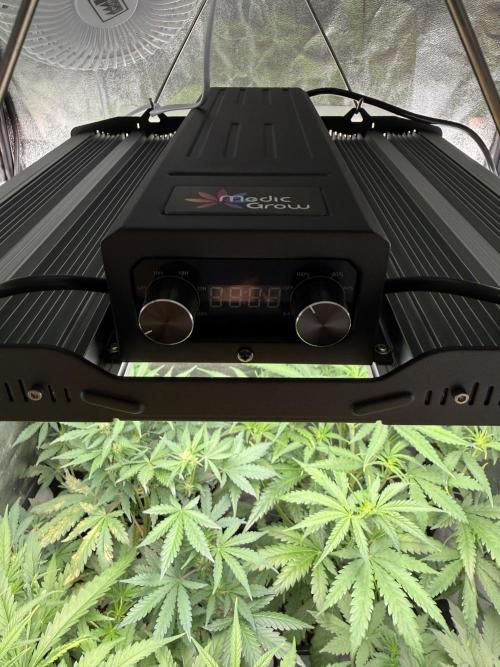
Setup. Lighting
15d ago
1
Solved

GlockAbuser
Is this a sign of too much light?I’m noticing the leaves grow extremely close to each other, should I be concerned at this stage, should I pull the light higher back? This is day 3 of week 2, I’m feeding it full advanced nutrients line up for veg. And drying out for a day and a half between waterings
Week 2
Setup. Lighting
3y ago
2
3
Solved

ngenius
hey guys , a have a question regarding light.
So, I have 2 autoflowers under a 130w led right now both age 14days exactly.
In a couple days a will also have the mars hydro ts600.
I am working with a 1meter squared tent.
how high sould i hang my lights during veg and flower ?Setup. Lighting
5y ago
2
4


Solved

MomoCookie
Heyho
So apparently my plant got bigger than I thought.
After stretching its only 30 cm from the Mars TS 1000 (Its already on the highest possible position)
And I'm running it at ~80%
Do you think I can turn it up to 100%?
It's always nice to go here
Thanks for helping
H. G.
Setup. Lighting
5y ago
6


Solved

Growladyeastmidlands
Led lights and autos floweringI need help in my veg area I have 6 flowering autos also I'm using a king.plus 1600w led light I also have 2 600w led lights and I not sure what is best for the veg area I want to use the 600w lights cos cheaper but will the flowering plants cope with the lower watt lights or not
Setup. Lighting
5y ago
3
3