Likes
Comments
Share


@sanibelisl
Follow
Major changes here at Night Owl summer camp. Have had a rodent problem! Something has figured out a way to get into the dormitory (greenhouse)and had a feast on my plants. Five branches off the Harvey Wallbanger, and two each off the Vanilla Fizz and the 91Grapes. Oh my gosh! I needed to do something else. My wife gave me a spare bedroom for a grow nursery! What a girl I have! So spent the day yesterday moving tents and hanging lights and got the girls all situated in the new dormitory away from some vampire in the night.
Will give an individual plant update shortly.
***ok, back. Let’s start with the Harvey Wallbanger. Miss Harvey was on her way to becoming my most interesting grow to date before she was devoured by some creature of the night. She’s a cross of Orange Diesel and Cookie Smasher and even at this early stage of flowering she’s producing a nice glossy sheen and sweet aroma to match. She is a towering 48 inches making her the tallest autoflower that I have ever grown. She is slender and resembles the structure of a clone but I believe her flowers themselves will be massive in size and trichomes production. To date she has yet to make a single leaf with more than five points on it. She is truly interesting.
Next let’s explore the Vanilla Fizz. Ms. Fizz didn’t get it as bad as Miss Harvey but suffered significant injuries as well. Loosing two full branches and enough bottom bud sites that the bottom 30 percent is now already cleaned up. She is the bushiest of the three with plenty of growing bud sites. Standing a proud forty three inches tall she comes in last in height but may be stacked up the nicest.
Last but certainly not least comes the 91Grapes. Since she received the least amount damage from nightly feastings we are going to feature her until harvest. Only loosing two branches and not much else she was spared from destruction. She is massive!!! Not a massive amount of vegetation just in size over all. She’s 44 inches tall and big enough around for a bear hug. She takes up the entire 40 inch by 40 inch tent all by herself. She was probably spared damage due to her size. Pom poms are everywhere as is evidence of cheerleading practices and she is captain of the squad. Going to have to get a little more creative with the way watering will be conducted in the future. The formula 707 soil is for retaining moisture in outdoor conditions so I am afraid that it will retain moisture indoors and be a pest problem.

Processing
Likes
26
Share


@GrowGuy97
Follow
Day 7 & 2 of the NHLs still havnt popped, transplanting the one NHL that did pop today!
Day 12 think 1 of the orange sherbet have nute burn so flushing it out and dropping the dose a little hopefully that helps!


Likes
23
Share


@Piorkeed
Follow
Week 11 started
I think that the plant is near to the end, maybe a couple of weeks or less. During this week I will start to check trichomes, my objective is to have 50-50 milky and amber. This will be the last week with nutrients.
D71: changed the water to the pot, added 30ml bloom, 15ml micro, 10ml pH-.
D73: first trichomes check today: 40 crystal, 50 milky, 10 amber. Added four liters of tap water.
D74: added 3 liters of tap water with 5ml of pH-
D75: added 3 liters of tap water.

Likes
18
Share


@DogDoctorOfficial
Follow
🌱✨ Super Sativa Seed Club Germination Report! ✨🌱
Hey fellow green thumbs! 🌿 Today, we're diving into the exciting world of germination with our latest run from Super Sativa Seed Club. Buckle up, because it's going to be a fun and informative ride!
We started our germination journey with the trusty Cannakan method. This approach is a game-changer for seed enthusiasts looking for robust and quick germination. Here’s how it went down:
Initial Soak: Our seeds (Auto Fast Pete and Auto Northern Dragon Fuel) took a luxurious bath in water for about 30 hours. This soaking period is crucial as it wakes up the seeds and starts the germination process. 🌊🌱
Once our seeds had a good soak, we moved them to soil. This transition is where the magic really begins! The seeds were carefully placed into a rich, well-draining soil mix to ensure they had the best start possible.
🌟 Genetic Breakdown:
1. Auto Fast Pete:
Lineage: This auto-flowering marvel comes from a lineage of speed demons, known for their rapid growth and resilience.
Characteristics: Expect a robust plant with a quick life cycle, perfect for those looking to get results fast. Auto Fast Pete is renowned for its sturdy structure and abundant yields.
Flavor & Effects: With a sweet and spicy profile, it’s a treat for the senses. The effects are balanced, offering a pleasant, uplifting high that's perfect for any time of the day.
2. Auto Northern Dragon Fuel:
Lineage: A powerhouse combination of Northern Lights and Dragon Fuel genetics, this strain is all about strength and vigor.
Characteristics: Known for its impressive growth and high resin production, Auto Northern Dragon Fuel is a cultivator's dream. It has a slightly longer life cycle compared to Auto Fast Pete but rewards with larger yields.
Flavor & Effects: A complex blend of earthy, pine, and fuel notes, it’s both intriguing and satisfying. The high is potent and relaxing, making it great for unwinding after a long day.
🌱🌿 What to Expect:
Fast Growth: With Auto Fast Pete, you’ll see rapid development. It's like watching nature's express train!
Resilient Plants: Both strains are known for their toughness. They handle stress well and are forgiving to minor cultivation errors.
Impressive Yields: Expect a bountiful harvest from both strains. Auto Northern Dragon Fuel might take a bit longer, but the wait is worth it.
Aromatic & Flavorful Buds: Get ready for a sensory delight with rich, complex aromas and flavors.
🌍🌟 Conclusion:
Germination is just the beginning of our exciting journey with Super Sativa Seed Club's Auto Fast Pete and Auto Northern Dragon Fuel. These genetics promise not only a rewarding cultivation experience but also top-notch end products. Whether you’re a seasoned grower or a curious newbie, these strains offer something special for everyone.
Stay tuned for more updates as our plants grow and flourish! Happy growing, and may your gardens always be green and bountiful. 🌿💚✨
Germination method 🌱 @thecannakan
Genetics @supersativaseedclub_official
Nutrition
@aptusholland 🌿
@aptus_world 🌎
@aptus_es 🌍
@aptusbrasil 🌱
@aptus_thailand 🌿
@aptus_portugal 🌳
@aptususa_official 🍀
@aptusplanttechnz 🌺
@aptusplanttechaus 🍃
Ambient controls🎮
@trolmaster.eu @trolmaster.eu.support @trolmaster.support @trolmaster.agro
Soil @promix_growers_eur @promix_cannabis
LED - @lumatekeu
Watering- @autopot_usa @autopot_global
Love and attention- @dogdoctorofficial
As always thank you all for stopping by, for the love and for it all , this journey of mine wold just not be the same without you guys, the love and support is very much appreciated and i fell honored and so joyful with you all in my life 🙏
With true love comes happiness 💚🙏 Always believe in your self and always do things expecting nothing and with an open heart , be a giver and the universe will give back to you in ways you could not even imagine so 💚
More info and complete updates from all my adventures can be found ⬆️link in the profile description ⬆️
Friendly reminder all you see here is pure research and for educational purposes only
💚Growers Love To you All 💚
#SuperSativaSeedClub #GerminationReport #FastPete #NorthernDragonFuel #PlantMagic #GardeningJoy #NatureLovers #PlantPower #Inspire #GrowYourOwn #aptus #aptusplanttech #aptusgang #aptusfamily #aptustrueplantscience #inbalancewithnature #trolmaster #trolmastereurope #trolmastersecrets #Autopots #sssc

Likes
3
Share


@Saltlife420
Follow
Week 4: Girls have responded well to nutes.
Defoliation started this week. White spots started showing, After research we believe this to be because of our hard water and getting water on the leaves.
We also started LST using fishing line, however this did not work so we removed it.

Likes
13
Share


@masterofsmeagol
Follow
7/20 Went over this morning to plants soaking wet and heavy rain. Went back around 4pm and plants actually look really good. The rain has stopped for a bit and the girls looked great. Apart from some septoria leaves I needed to defoliate on the first plant I treated. I also noticed a few others on other plants so it's spreading albeit slowly. I treated the three in the middle with their second dose of Plant Doctor at 3tsp/1gal. One gallon administered to each plant via root drench. I think I may treat the other plant showing signs with a diy Dr. Zymes using citric acid as the active ingredient. That way I Gould start treatment right away without having to rely fully on plant doctor. Plus it would kill any pests. Ive seen damage but the birds do a number on them. I dont want to spray my plants with a bunch of chemicals if I don't have too. I shouldve replaced the pallets and cleaned the cage better. I think I did a good job sanitizing as I have no wpm. Just this septoria I probably got when the lady mowing the lawn cut all tjis fucking grass and blew it in my pen, throwing bird seed and I'm sure tons of disease into my grow bags. I literally had to harvest a bunch if fucking sunflowers. It looked like my plants had been mulched. Just with small disease carrying shrubs. At some point some of this stuff has to be on purpose. You CAN'T be that stupid. A couple kushes in the back look hungry. I think I may need to up my feed. I've written to much. I'll keep this updated. Thanks if you made it this far.


Processing
Likes
52
Share


@CBD_Sweden
Follow
@MephistoGenetics,
Hi all the happy people here in GrowDiaries.
This is my second cultivation ever and it will be fun to try a bigger space than my closet grow.
First, I'm just going to say I'm done with the construction of my new growroom.
The room is 2.14 meters by 1.7 meters and has a ceiling height of 2 meters.
It provides a floor area of 3.6 square meters.
I use a 54 Watt Lightwawe T5 for germination and 2 Pcs 400 Watt HPS lamps.
I have a channel fan that replaces the room air about 40 times an hour to get a comfortable environment in the room, the air enters a fresh air intake from the outside.
The air is purified through a carbon filter to then leave the room to the rest of the basement.
Then I use that heat to heat the rest of the basement.
I will use 10 pcs 15 liter Autopots to grow with and a 100 liter water tank that supplies the pots of water and nutrition.
I will grow completely organically in soil and will watercure my buds to get the best possible medicine for me.
But there are no cultivation rooms to be displayed here, so I continue with what is most important.
I am very excited to see how the new growroom will work and how this Stilton Special will turn out.
Strain Name: Stilton Special F1
Genetic heritage - Sour Livers F3 x Northern Cheese Haze F3
Strain behaviour - Stilton grows well from the off, and develops into a stout but branchy specimine that leads to a fine yield of awesome flowers. She's not too stretchy but also is sizeable enough with good growth, to train and shape to your liking. Flowers develop pretty fast and grow to a good size, it may to advised to clear out some undergrowth and if needs be a very gentle defoliation mid-way through the grow, although leaf tucking may suffice well enough.The end product is of top shelf quality and she doesn't lack in yield either.Give your garden, nose, and body a treat and be sure to indulge in a slice of Stilton this year, You won't regret it.
Size - 50 - 70 cm
Structure - Medium height but bushy
Flower Density - 9/10
Indica/Sativa - 65/35
Cycle Time - 65 to 70 days from sprout
Yield - 90 to 140 grams as a single plant
Best Method for overall high yield - 9-12 per 1,2m x 1,2m sq in 10-15 Liter pots (Soil)
Aroma - Very strong, Cheesey/fruity/sour/spicey/ with a dash of coffee.
Taste - Dank berries
Effect - Good hybrid powerful but balanced effect
Medicinal Benefits - TBA
Best Grown - Indoor/Greenhouse
Cannabinoids - TBA
Extract information - Ideal extract candidate - High in resin, oil and terps.
--------------------------------------------------------------------------------------------------
2017-09-18. Start of week 4. I have defoliated her and she got water and nutes. She is 17 cm high and have not start to stretch yet.
---------------------------------------------------------------------------------------------------------------------------------------------------------
2017-09-19. 2 new fan is installed in the grow room. Added pic and video.
-----------------------------------------------------------------------------------------
2017-09-20. Kl 23.00. Did some massive defoliation, added video and pics
------------------------------------------------------------------------------------------------
2017-09-22. The girl has recovered well after my massive defoliation. She is now 22 cm high. I accidentally lowered the lamp a bit too far down and burned some leaves on one girl. They have got water and nutrition today.

Likes
6
Share

@DE_BW
Follow
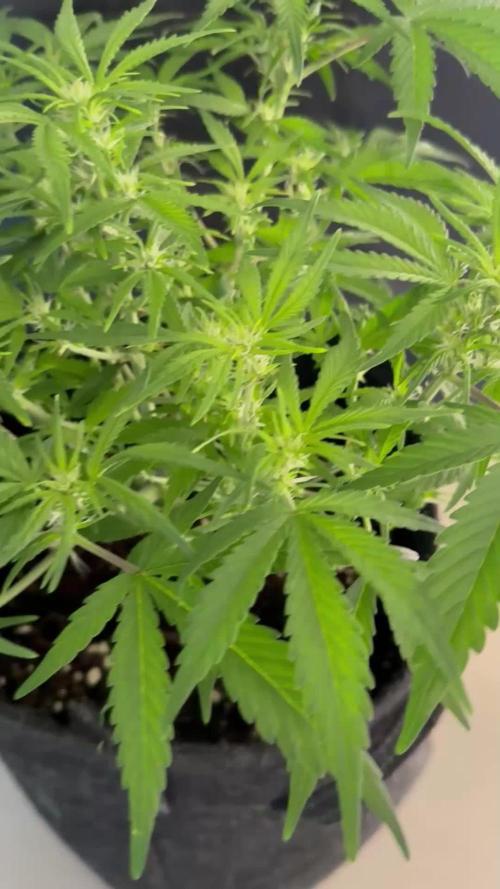
Day 37 marks the official start of flowering, with strong stretch, healthy pistil formation, and a fully stabilized canopy after completing all LST work. Feeding is set at 2-2-2.5 (Micro/Grow/Bloom), no additives yet, and root pressure looks excellent with visible post-watering guttation and vigorous growth. Environment is stable at 23.5°C and 50% RH, main light runs at 100% from 80 cm to allow stretch before lowering both lamps for full flowering intensity next week.
Likes
10
Share


@Rko41
Follow
Super phénotype la couleur violet s’invite vu que c’est une fast elle avance rapidement j’ai griffer un peu de guano de chez top crop avec un peu de sel d’epsom

Processing
Likes
35
Share


@BarrieGrower
Follow
Week seven of flower, temp is coming down and is good.
Buds really just started to fatten up. They are getting really frosty too. Getting faded leaves and some burnt and or dead ones too. One looks like it will finish in a couple of weeks, the others look like they might need more time.
Cheers!

Likes
3
Share

@Krautis_IndoorFarm
Follow
Tag 70 Blütetag 30
Fokus & Freiheit im Zelt! 🏔️💨
Halbzeit in der Blüte und der Dschungel atmet auf! 🚀 30 Tage nach der Umstellung am 19. Dezember haben wir die Zügel im 90x90 Zelt wieder fest in der Hand.
Das Update vom Feld:
• Der große Kahlschlag: Letzten Dienstag haben wir alle Damen noch mal ordentlich entlaubt. Das sorgt für maximale Lichtausbeute an den unteren Bud Sites und eine perfekte Luftzirkulation im „Forest-Floor“ Klima.
• Zapplez 2.0 (The Centerpiece):
Sie steht jetzt völlig frei im Rampenlicht. Die dunkle, fast mystische Färbung kommt nach dem Entlauben noch krasser zur Geltung ein echter Kontrast Killer! 🍇❄️.
• Z-Vally Power:
Die beiden Z-Vallys (hinten links & vorne rechts) nutzen den neuen Platz sofort aus und pumpen ordentlich Masse in die Blüten.
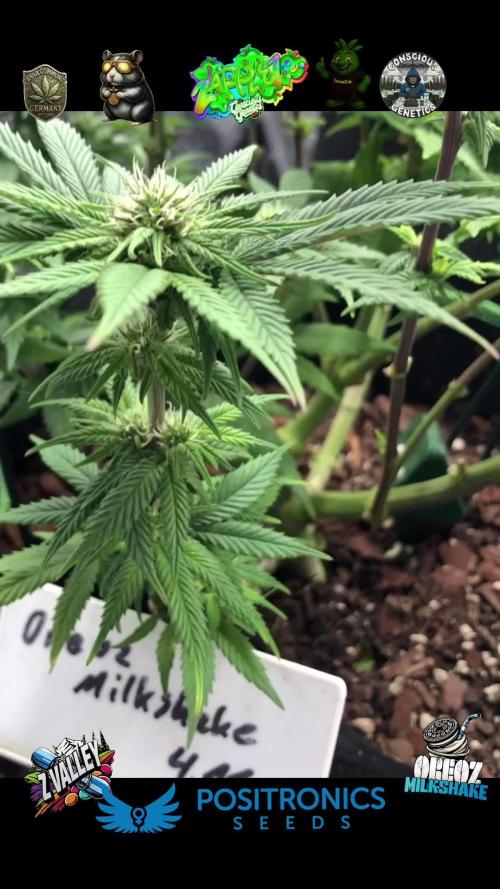
• OreoZ Milkshake:
Kein Verstecken mehr! Die beiden Damen (vorne links & hinten rechts) haben den Turbo gezündet und die Blütenbildung ist jetzt absolut on point. 🥛🍪
Präzision & Living Soil Power 🎯
Wir sind wieder voll messfähig! Gegossen wird präzise mit pH 6,0, um in dieser entscheidenden Phase das Maximum aus den Terpenen zu kitzeln. Ein riesiges Lob an @panova25.de die Pufferwirkung des @living_roots_pro hat uns perfekt durch die Zeit ohne Messgerät getragen, aber mit der Feinjustierung holen wir jetzt das Gold nach Hause!.
Die Vitalität in den 30L Stofftöpfen ist nach dem Entlauben unschlagbar. Wir steuern mit Vollgas auf das finale Drittel zu!
Die Crew & Partner:
🌿 Genetik: @conscious__genetics & @positronicsseedsgermany
🤝 Support: @panova25.de & @living_roots_pro
📍 @cannacommunity.deutschland @cannacommunity.germany @cannacommunitygermanyx
#Zapplez20 #LivingSoil #Blütetag30 #Defoliation #OreoZMilkshake ZVally OrganicGrow 90x90Tent CannabisCommunity HomegrowGermany


Likes
2
Share


@CannabisCultivate
Follow
Big Momma has finally been transplanted, this is the mother plant of our East Coast Punchers and you can safely assume that she is a house favourite! I (TOH) have claimed her as my own, I was more than happy when I found a pile of boards that could be made into a single plant bed. I love repurposing and reusing, as you can see C.C. put together a small square bed that is tall enough to keep the dog from watering her himself…
The bottom of the bed started with a piece of cardboard (brings the worms) followed by a good amount of soil from previous fabric pots (gotta reuse), the worm castings along with the fish shit was added and the top half of the bed was Stepwell Super Soil. A good dusting of myco4 was added to inoculate the roots, the bottom of the infinity pot was removed and she was placed on top.
We had quite a good rain last night with a bit of a gust so she was braced by bamboo before bed, she has dropped about 3 inches so more soil will be added to top her up.
Now the fun can begin, I look forward to grooming her into shape and the therapy she is sure to provide will be priceless for me because a busy mind is best kept busy! 💚✌️


Likes
11
Share


@merchandise91
Follow
It is day 27 and Most plants starting to flower so they are getting a mix of grow nutes and bloom nutes
All looking really healthy and seem to be thriving and certainly drinking a lot more . Some side branches have been strategically trained to try and make most of space and improve yield
Day 28 given water will continue with grow and bloom nutes as still getting vertical growth which I am glad to see 👌

Likes
69
Share


@Grow4Releaf
Follow
Jan17th added videos.
Just given them all a easy week.
Gonna be starting to keep an eye on these , but still in cruise control for the most part.
Still working on the space but have the in fan and out delt with now and dehumidifier and ac sorted so 👍🏻👍🏻🤞🏻🤞🏻 we shall see how the environment here acts now .
Tested the ec and ph after a watering and they both were OK with what was going in.
But im really not in any rush ,still getting situated with everything.
Atleast weve got that stuff sorted
Smells insane tho can't wait to see how it's finished taste turns out.
As always appreciate anyone that took time to check out any of my grows, and appreciate any feedback or suggestions!!
Best of luck!!

Likes
84
Share


@Doc_Homegrow
Follow
My plant is growing pretty well. She has developed many new nodes, since I used fertilizer last wednesday. I want to top her next wednesday or so, becuase of my limited tent-height. I also put the light from 14 DLI to 20 DLI. I want to increase the intensity every day a bit more to let her slowly adapt.
Edit: I rotated her so that she can absorb light evenly and therefore grow evenly.
Update 08.04.24:
Some roots have reached the surface, so I decided to cover them with some new soil. I also decided to top her today and bend some of her leafes down.
Update 09.04.24:
I actually didn't want to start LST until next week. The topping is actually intended to strengthen the growth of the secondary branches, but a few of these branches received little light. That's why I decided to start with LST now and continue to enable the growth of the secondary branches.

Processing
Likes
11
Share


@Hawkbo
Follow
Couple got a little burn I think maybe a little too much soil in there with the coco on top of the light feed? I got all the final pots filled up today they will go in 3 gal bags either today or tmm. It's a Greentree pro ultra coco/perlite mixed with some roots organic soil about 70/30.
This ones in the other humidity dome I gotta get back up and take a pic


Likes
21
Share


@TheStrainAlchemist
Follow
Impressive guys, is outstanding the root growth, this little pot of 1,5L only lasted 3 days, was already root bound and I had to moved them to the final pot, as you can see I left quite a lot of space for the future top dressing.
She looks slightly smaller then the wedding cake even if she started bigger and stronger but the early topping slow down her a lot. She’ll recovery I am sure.
Enjoy fellow growers. ♥️☮️

Likes
4
Share

@BobbersDown
Follow
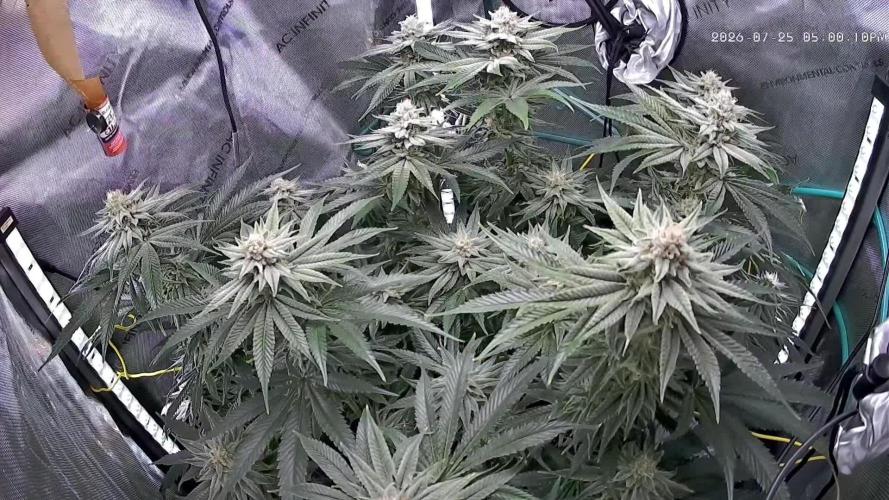
Fighting high ambient humidity..... Hopefully winning. Still super frosty and bulking like crazy! Keeping airflow going and hoping for the best with 2 to 3 weeks left.