


Likes
4
Share


@Bagseedsteve
Follow
Made little bases for them to keep them off the floor and this will most likely be the last time I change or move them around. Hoping to get a trellis net soon it'll be my first time. If anybody is actually looking at this id appreciate tips.

Likes
128
Share


@PapaNugs
Follow
These girls are super sticky! Resin is building up all over the place, including the leaves. I've been defoliating like crazy but they just keep coming back.

Likes
11
Share


@GodZilla_Owner
Follow
Week 3 – Day 22 (VT22)
RedPure#4 was transplanted into a 15L fabric pot this week and received 💧 2.5L of water.
She’s showing the first signs of preflower 🌸 and is staying nice and compact – just as expected.
Looks like she’s going to turn a beautiful purple 💜 soon!
She reacted well to the transplant and shows no signs of stress.
The overall light intensity (DLI) was reduced to 27 to keep stress low, but RedPure handled it like a champ 💪.
📅 Looking ahead:
🔹 Watering volume will increase to 4–5L depending on demand.
🔹 Root growth looks promising – they’ve started exploring the new pot.
🔹 Light LST will continue, and I might remove a few bigger leaves 🍃 if needed.

Likes
13
Share


@Brickleberry
Follow
In this first cycle published on the site, I did the ScrOG technique for the first time, and honestly I am quite happy with the final result😊 The plants performed very well both in vegetation and in the flowering phase.👌
The only "anomaly" was a beautiful flower affected by fasciation (called "Stewie" by me😄)
I hope you enjoyed this diary and that it will be useful for you in the future!😎

Likes
16
Share


@Sethstover
Follow
This plant is exactly what you would expect from it gets orange and yellow all around when fading smells just crazy of 🍊 got some good sized buds all around it this plant just reeeeks it’s so gassy but straight orange super strong can smell the orange before even getting close very sticky but not to frosty on sugar leafs at all had some nice calyx development was always a happy plant even when under fed fully organic 444 and 284 Gaia green
Had tons of calaxs when I trimmed it up it was kinda crazy thick buds all dense and smell sooo good very sticky plant would definitely recommend this as a orange smelling bud always needed more calmag on this one

Likes
34
Share


@AshBrand
Follow
Welcome!
In this grow we have:
2x Platinum Wedding Crasher
2x Gelato 41
1x Sour OG
2x Lemon Kush
Germination/Rooting - 14 Days
9/17/21 - The clones look good in solo cups of soil. We will transplant into 5 gallon pots in the grow tent after they fully root in the cups.
9/18/21 - Looks like the clones are doing well in soil! We are so excited to grow these out. The clones came from a very highly respected grower.
9/19/21 - No ugly growth. All clones look amazing! We upgraded the light to a Mars TSW 2000.
9/20/21 - They are looking good and most likely rooting throughout the cups. I’ll give them a little bit of water today. I want the roots to go looking for the water so I’ve kept them slightly dry.
9/21/21 - They look happy. I will let them just do their thing… We are waiting on our Mars TSW 2000 light to show up anyways. No roots visible from the drainage holes in the cups.
9/22/21 - Looking really healthy and growing nicely. I’m excited for them to fully root in the cups so we can transplant them into the tent. The Mars TSW 2000 should be here in the next few days.
9/23/21 - Looking so good! We can’t wait to get these under the Mars TSW 2000 in the tent. They smell and look great.
9/24/21 - The clones look really good except for one Sour OG. It wilted and died, roots did not take unfortunately. I have a Lemon Kush started from seed we will grow in place of the dead Sour OG. Today we got our Mars Hydro TSW 2000 light. We will be hanging it and updating with pics/videos.
9/25/21 - They look amazing. Lots of growth while rooting.
9/26/21 - So far so good. Watering when the cups get light in weight. In just a few days we will be transplanting. See the video for today, we hung the Mars Hydro TSW 2000!
9/27/21 - Watered them yesterday, they look healthy. The Lemon Kush isn’t a clone, it is from seed. It’s the smallest girl but it’ll perk up quickly.
9/28/21 - Transplant day!! The clones are looking really good and it’s time to transplant into the 4x4 under that Mars Hydro TSW 2000 at 50% intensity. Check out the pictures and videos from today!
Likes
8
Share


@JohnWeed
Follow
The girls is grow well, the bud look biggest this weed.
Some leaves especialy the bottom leaves have started to become yellow surely because of the light penetration.
However everything look good for me

Likes
4
Share


@buzbun
Follow
smoke is really good.strong taste and effect that you feel imideately.some times i catch a good paranoia with this strain.good psy effect. maybe it cause 11/13 light cycle. few hours after smoke good to sleep or eat smth good.not for day smoking.somy buds i stored in vacuum bags they very dense after this


Likes
105
Share


@BioBuds
Follow
And another week has passed and the ladies are going towards en of flowering. What I noticed the last couple of weeks is trouble keeping it stable and unstunted. The two Forbiddens and one XL all went slower. The one XL Runt in the 5 liters bigger grow bag is going full throttle and is almost done, the others are still filling out.
My theories: The bigger grow bag held on to more water, the bigger grow bag kept the roots cooler, the bigger grow bag had in theory the same amount of nutes as the smaller, so the ratios could be more optimal. The bigger grow bag was nearer to the intake of cooler air and not so hot by the heat. Final theory: the bigger grow bag has better super soil regulation and is less affected by the fluctuating PH of my nute mix.
For now, it is all speculation. Im considering all possibilities but I think I need to tweak my recipe for autos and always use 20 liter bags instead of 15.
Still Im not complaining, they all get to a nice size and we still have some weeks of flowering to go.
But the XL Rut on the left is creating fat heavy buds I wish all plants had. Nice how the smell is definately geloto on the both, the XL runtz a little more pungeant, the Forbiddens a little more fresh.
This SP 3000 still delivering the goods, with the ventilation still great output, no noticeable loss of output or overheating.
Look at the spring deals at www.mars-hydro.com. When is the last time you treated yourself to something nice? Come on, you've earned one!
We shall see how they develop, trying to balance my way to the end of flowering hoping they won't stunt again. Final weeks.
Thanks again for visiting!!
Hug
Bud


Likes
5
Share


@Ganjagrandaddy
Follow
Day 42:Well its halfway though the flowering cycle at least now and I thought with the genetic mix of her parents that she would be a full 11 week sativa cycle. Seems I may be wrong!!!!. She is beginning to colour up nicely now as though she is headin for the finish line. By far the the most ripe of the 9 strains which is surprising as she was younger and had 2 weeks catching up to do before the flip. She is even looking more advanced than the fast flowering Tester run in here now. The Gz mother was completely done by week 9 so maybe they will follow her rather than the longer Gelato41 time. She smells very fruit sweet with a slight hint of a diesel/gas. She is really oily to touch now and even low down where the larf would normally be a little pointless , she has put out medium sized buds too. . I am very happy with her whole cycle so far and she has not been slouch at all. Seeing her overtake the race and showing off is a win for me and the Birth of GanjaGrandaddyGenetics ,GGG seeds. lol Have 2 strains of my own at harvest nearly now and the Hulklato I featured in the last update has given out a very good 6 oz with around 1oz of that being larf and small buds. Not too bad for a first seed popped. let's see if this little lady can come close to her cousin. The NFT system has made the grow the easiest "hands off " growing i have done. Only needing to top up the res and leave it till it needed it again has been a lazy affair but to see an old school system like this work so well compared to the many others I have since used , has been a surprise. I dont know why NFT dropped off the radar but for anyone who is new to growing , it is a perfect , easy to set up and use medium.
Good luck on all your grows. catch you at the next update.


Likes
23
Share

@MyLittleGarden
Follow
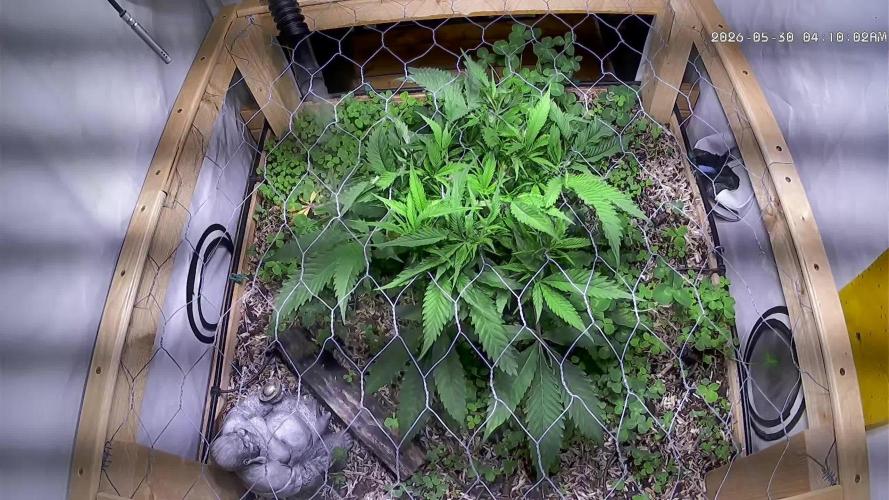
Vegetationswoche 8 - 30.05. – 05.06.2026
Diese Woche lief alles ziemlich entspannt. Einmal leicht entlaubt und die Triebe weiter unters Netz gespannt, damit sich die Utopia Haze langsam über die Fläche verteilt.
Die Pflanze wächst aktuell richtig gut, sieht gesund aus und hat schöne satte grüne Blätter. Der SCROG füllt sich langsam und das Cover Crop verwandelt das Beet mittlerweile in einen kleinen Dschungel.
Ansonsten habe ich nicht viel gemacht und der Pflanze einfach ihren Raum gegeben.
Blumat-System läuft stabil, Klima passt ebenfalls.
Likes
9
Share


@Mr_nugs_lover_David
Follow
Gorgeous looking plant, you can tell she's definitely an indica strain by those beautiful fat leaves that she has, I'm very excited to try this strain for the 1st time, and also it's the first time I grow a strain from this Spanish Bank from the canary islands! I'm pumped to be able to grow her this year, let's see how she performs!!

Likes
26
Share


@Gardengobblin
Follow
Récolte total de 222g séché .
Une merveille cet plante . Vraiment je la recommande . Belle tête bien givré , bien compact , très odorante et collante comme jamais . J'ai vraiment hâte que la cure soit terminé pour déguster ca

Likes
2
Share


@Ultraviolet_
Follow
Remember that, however you are played, or by whom, your soul is in your keeping alone. Even though those who presume to play you be kings or men of power, when you stand before God, you cannot say, 'But I was told by others to do thus,' or that virtue was not convenient at the time. This will not suffice. Remember that.
Day:18
84°F and 65% RH (VPD) for the vegetative stage. Approximately 1.15kPa(assuming leaf temperature is about 2°F cooler than the air), which falls right into the ideal vegetative sweet spot (0.8kPa to 1.2kPa). At 1.15kPa, plants can draw water and nutrients efficiently without risking stress or wilting. It keeps the leaf pores (stomata) open, allowing for ideal carbon dioxide intake and maximizing vegetative growth. VPD is determined by the leaf's temperature, not just the ambient air. Because leaves usually run 1° to 3°F cooler than room air under bright grow lights, my actual VPD will be slightly lower, closer to the 1.0kPa mark. As she transitions from vegetative growth to flowering, one can gradually lower the humidity (to around 45–60%) and drop temperatures slightly to prevent disease from settling inside dense buds when they appear.
Night:6
At 70°F and 60% relative humidity, Vapor Pressure Deficit (VPD) is 0.86 kPa. This is right on the cusp of whats optimal for the vegetative stage. During the nighttime, plants generally close their stomata and undergo cellular respiration rather than photosynthesis. Transpiration slows to a near stop, making VPD less critical at night than during the day. However, maintaining a nighttime VPD between 0.8 and 1.0 kPa is highly beneficial in that it ensures the air is dry enough to prevent powdery mildew or bud rot, but moist enough to keep the plant from undergoing unnecessary stress. This range keeps the environment comfortable for cellular processes and prevents large atmospheric swings. Keeping it all flowing.
(Not pushing them yet, these are photoperiods)
The optimal soil (root zone) temperature for cellular root respiration and nutrient uptake in cannabis is between 68F & 72F This narrow range balances biological energy production (cellular respiration) with the dissolved oxygen levels in the soil, maximizing plant growth and health. Warmer soils hold significantly less dissolved oxygen. When soil temperature exceeds 74F oxygen depletion occurs, inhibiting cellular respiration almost entirely, At 68-72F root cells generate optimal adenosine triphosphate (ATP) via respiration to power root-tip elongation and the active transport of water and nutrients.
Too Hot (Above 78F) Root respiration increases, demanding more oxygen, while the water's oxygen-carrying capacity drops. This creates a prime environment for anaerobic pathogens and Pythium (root rot).
Too Cold (Below 60F) Root metabolism and cellular respiration slow to a crawl. This severely impairs nutrient and water absorption, leading to yellowing, wilting, and phosphorus deficiencies.
A lot depends on whether it's automatic or photoperiod; with photoperiod, there is not as much of a need to push "hard" as the real countdown only begins once the flower is initiated. Automatics, on the other hand, the chronological "clock" begins ticking the moment the seed germinates. It is of critical importance that the seedling growth gets off to the races, understanding that early growth is like compound interest, which will pay off come harvest. This reality is why getting autoflowers "off to the races" early on yields such exponential benefits. The "compound interest" is directly related to the surface area of the leaves. Larger, faster-growing seedlings process more light and build bigger root networks early on, which translates into an explosion of vertical and lateral growth during their short vegetative window.
The margins for error are so thin with autoflowers; this early-stage momentum depends on several critical practices. Seedlings exposed to increased atmospheric CO2 levels early in life will develop at an increased rate. To effectively "extend" or optimize the capacity of Photosystem II (PSII) for increased photosynthetic efficiency. In standard oxygenic photosynthesis, Photosystem II (PSII) is naturally limited to the red-light spectrum, peaking at 680nm. Extending its light-harvesting capacity past 700nm into the far-red region requires bypassing the natural limits of standard chlorophyll a. Adding 730 nm (far-red) LEDs alongside standard red/blue lights has been shown to increase canopy photosynthesis by 20–30% in several crops by acting synergistically with shorter wavelengths. However, the limitation is that excessive, pure IR/Far-red light (without accompanying red light) can trigger the "shade avoidance response," causing plants to grow tall, weak, and spindly rather than robust. Utilizing infrared light (specifically the 700-750 nm far-red range) is a viable method to boost photosynthetic efficiency. It acts as a bridge to allow PSII to utilize a broader spectrum of light, breaking the traditional 700 nm barrier. UVR8-mediated signaling (often in conjunction with CRY proteins) triggers protective mechanisms that maintain the stability of the photosynthetic apparatus (including LHCII and reaction center proteins), thus ensuring that the efficiency of Photosystem II remains higher in UV-B-exposed plants compared to plants lacking this receptor. ΦPSII indictates the rate of electron transfer from water to plastoquinone, which drives the production of ATP and NADPH. There is a close link between ΦPSII and the true rate of CO2 fixation (Φ*co2).
ETR stands for Electron Transport Rate. It measures the speed at which electrons are moved through the thylakoid membranes in a plant's chloroplasts during the light-dependent reactions of photosynthesis. Infrared light (particularly Near-Infrared or NIR) improves cellular energy by interacting directly with the electron transport chain (ETC) in mitochondria. This process boosts adenosine triphosphate production, which acts as a metabolic coefficient multiplier by accelerating enzyme activity dramatically.
Extend then multiply.
Far-Red photons interact with plant photoreceptors to accelerate the plant’s biological "clock" or trigger a shade-avoidance response. Autoflowers don't use the plant's biological clock, although the IR will initiate a shade avoidance and make them stretchy. You can just add equal measures of 660nm-680nm to negate the shade avoidance effect. Replacing nights' "darkness" with a combination of IR+ and 660nm. Because autoflowers don't require a dark period to flower, many growers just blast them with light. 18/6 24/0. However, this ignores the plant's metabolic rhythms, where daytime photosynthesis (light reactions) must be perfectly balanced with nighttime carbon fixation and assimilation (Calvin cycle) to avoid bottlenecking plant development. Cellular respiration is a 24/7 process, but it can only function while the plant has the free oxidative capacity to do so. A 100% photosynthetically active leaf cannot perform cellular respiration. The viral trend of defoliation of every leaf that isn't "getting enough light" is of great detriment overall, putting 100% of the cellular respiratory "workload" and responsibility on the 0/4/6 hours of darkness in sub-optimal conditions for enzymatic activity. Photosynthesis captures nearly 100% of the initial energy as carbon, while cellular respiration is the process that unlocks 90% of that captured energy into usable ATP so the plant can use it. Respiration is considered only roughly 30% to 40% efficient. It captures enough of the potential energy in glucose to synthesize around 30 to 38 ATP molecules per glucose molecule. The remaining 60% to 70% of the energy in the sugar is not captured in ATP; instead, it naturally escapes into the environment as heat, which helps regulate plant temperature. In plants, the primary enzymes of the Electron Transport Chain (ETC) and the ATP synthase complexes are typically adapted to function optimally in warmer temperatures (roughly 77°F to 95°F, depending on the specific plant strain). As temperatures rise within this physiological range, molecular collisions increase, speeding up respiration and ATP production. The cannabis plant has a branched respiratory pathway. During heat or cold stress, plants activate Alternative Oxidase (AOX). AOX burns sugars to dissipate energy as heat rather than coupling it to ATP production. This pathway actually functions optimally at elevated temperatures to help protect the cell from the damaging build-up of Reactive Oxygen Species (ROS) during heat stress. Enzyme activity generally scales with heat; there is a strict biological limit. If canopy temperatures in a grow room exceed 104°F, the enzymes and their supporting lipid membranes lose stability. Not saying you need to go crazy, just optimize nights the same as we optimize days.
Phosphorus is the driving force behind early seedling development. It acts as the "energy hub" of the plant, directly driving cell division, robust root growth, and the creation of DNA. Without an adequate, easily accessible supply early on, the plant's overall growth potential and final yield can suffer permanently.
Likes
28
Share


@MrGrowthSpurt
Follow
This strain was easy to grow, she started flowering on the 5th week and reached maturity on the 13th week (8th week of flowering). I had 2 of these plants growing at the same time. White LSD#2 took on a reddish/burgundy tone which made it look completely different from#1 All in all it was really a easy grow.

Likes
24
Share


@TerpTurtle
Follow
Flipped tent to flower
Strawberry truffle is so sticky, just defoliating veg growth and your hands are extremely tacky,
Healthy plants, All leaves are fat and genetics proving themselves to be strong+vigorous
Likes
3
Share

@Mr_nugs_lover_David
Follow
She has become a beautiful little bush full of fat dense nuggets completely covered in fruity and sweet resin glands with some purple no tones in the buds. Love It!
