


Kein Wachstum nach 5 Tagen

xhibostarted grow question 5mo ago
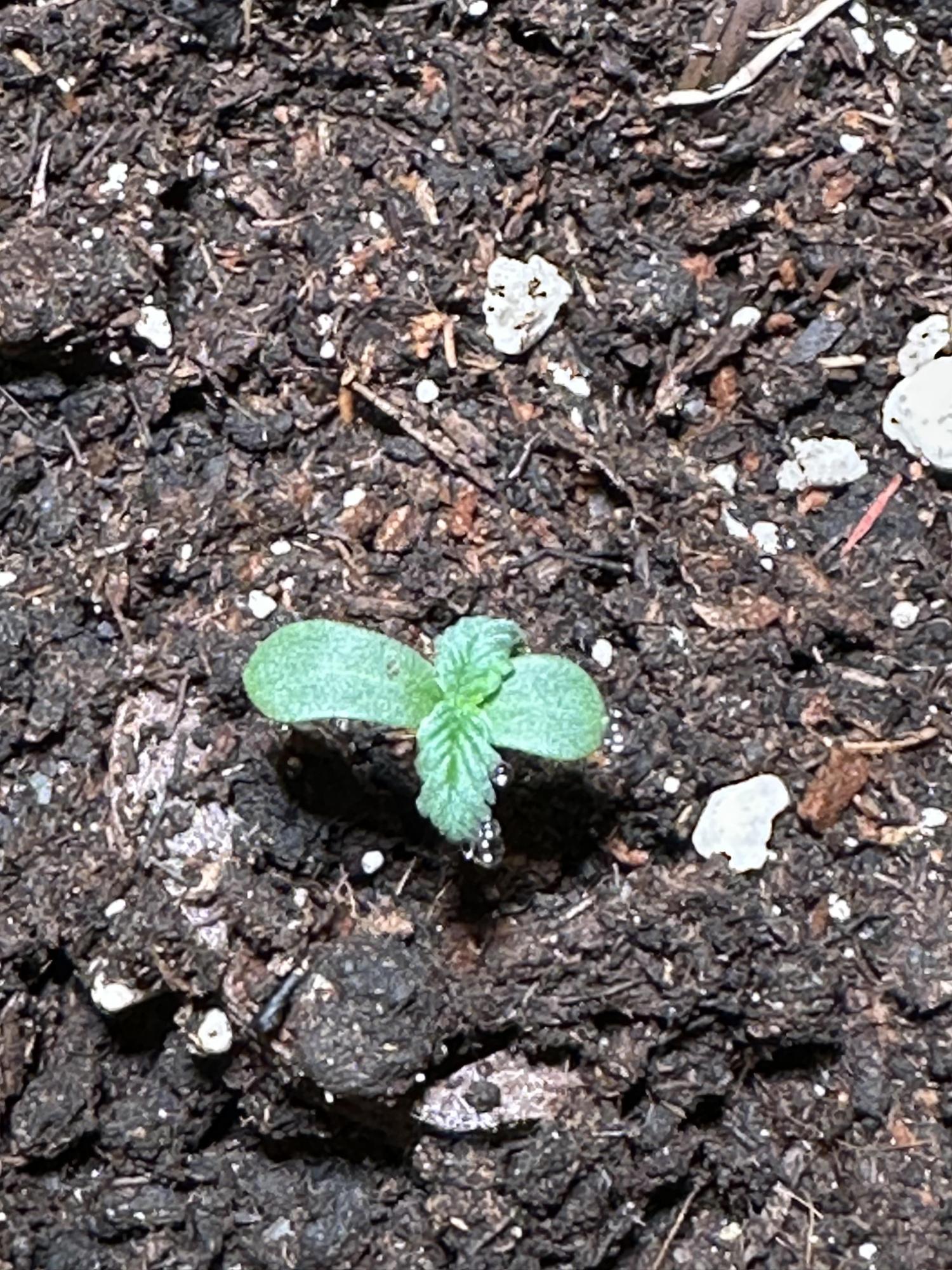
The cotyledons haven't visibly grown for 5 days. I've watered a little, and for the last 2 days not at all, and the light is shining at ~200 PPFD on the seedling. From my previous grows, I know that there should be some slight visible growth. Can I optimize anything?
Solved
Plant. Too short
1 like

cangrowzanswered grow question 5mo ago
Meal time xhibo!
I can absolutely reassure you: This looks like the classic "root focus." Even though it's annoying when nothing seems to be happening up top for days, the most important stuff is happening underground right now. The little one is currently putting all its energy into the foundation. Once the roots have a grip on the pot, the leaves will start growing again up top.
It's great that you're being careful with watering – a wet seedling is a dead seedling. Your 200 PPFD is also perfect, so you don't need to change anything.
Two little tips that often help:
• Keep the humidity high: Since the roots aren't doing much yet, high humidity helps a lot. If you don't have a tent with 70% humidity, just put a glass over it.
• Check the temperature: See if it's warm enough (around 23–25°C). If the room is rather cool, the plant will switch to energy-saving mode.
As long as it looks as healthy green as in the photo, everything is in the green zone. Give it a few more days, it will be fine!
Happy Growing, Growmie!

JaramnieJazzanswered grow question 5mo ago
Yeah, 1-2 weeks without a drop of water and no nutrients, they don't need anything in the first weeks.
2 likes
Complain

00110001001001111Oanswered grow question 5mo ago
use appropriately sized pots. Then you can water properly. That too needs some rethinking and stick to orthodox methods.
if the light is the cause, those nodes won't space out over time... in that case, you know to give a little less light next time...
If giving too much light is ignored, it will stall the plant.. a seedling starts to look funky when given too much light.. the nodes stay tight and the leaves start physically pushing on leaves above and they start to be forced upward... not a good version of 'praying' leaves, lol.
So, no matter what the light intensity should be, how the plant grows is the basis for everything... the math gets you in a decent spot to start, but then you must adjust based on how the plant behaves. Use deductive reasoning, not inductive. Temp and RH will play a role in exactly what a plant can handle at any stage of life, too. Seasonal differences are possible and may require different targets - whether using PPF measumrents or lux doesn't really matter. "PPFD" is not a single-point measurement. read up on DLI for proper terminology use. it'll avoid simple misunderstandings when discussing light with someone that actually understands the math. The nitty-gritty isn't necessary to memorize. Like is said, no matter what the plant growth pattern is what dictates how much light to give. That growth is the culmination of all the factors that matter... The growth pattern is accounting for the impact of climate and atmopsheric co2 available...
max DLI is not a consistent value for all settings... only if every relative variable is the exact same would you have the same 'max' DLI. If climate changes or atmospheric co2 levels change, you'll have to re-measure for seasonal light intensity targets, too. And, per stage of life... LOL. Take notes.. it helps. Especially if workign with several lights and 3-4-months between doing working with seedlings... and other various points of life cycle.
1 like
Complain

TruTraTrianswered grow question 5mo ago
If you really want them... more patience if necessary. Otherwise, I would have said it doesn't look like a nice, easy coconut + perlite mix or something similar, it could be that they need a bit more air or had a few too many drops of water. The beginning can... but doesn't have to mean anything bad, but at some point, it's too late to throw them away, so I always try to push myself with autos when something goes wrong... the sooner you get rid of them, the better... or not at all 😅
I've had great stuff from Linda before, but that doesn't mean anything 👻
1 like
Complain
Similar Grow Questions
Solved

Cremo
Very small plant in 9th weekHi guys. What can be the cause of the very small size of my Straw'Nana in the 9th week? Leaves are looking healthy, the whole plant looks very healthy but super small. It grows in a 5 gallon fabric pot which should be more than enough to make it grow big as fu.... please help :)Week 8
Plant. Too short
5y ago
9
6


Solved

Dingle_Dangle
Autos behavior in case of slowed growthCold temperatures slowed significantly their growth. Given the situation, are they going to have more time then the 4 usual weeks for the vegetation stage? I mean, will the flowering stage be delayed of 1/2 weeks?
Thanks
- DDWeek 4
Plant. Too short
5y ago
1


Solved

purgen
Need tips/help with very very bushy plantPotted for almost 6 weeks, grows super super bushy (already has 12 branches (6 nodes?), branches are so short that I can't even LST them. I guess she grows like that because of her genetics but maybe there's a way how to 'fix' her? Topped once, strain RQS Triple G
Plant. Too short
Techniques. LST
4y ago
4


Solved

SiReNaX
What do you guys think?It's my first grow (automatic, 6 weeks old) and compared to other plants, my plant looks a bit small/ridiculous. I give her 24/7 light (I read that on guides) is that maybe too much? What's your impression of her? I use two growlights (one from above and one from the side).
Other. General questions
Plant. Too short
Plant. Other
2y ago
1
1
Solved

MyFlowers
Please help. Is it normal?Please help. My autoflowering flowers are they ok??? Ppm850 , ph 6.0-6.8 , i use foxfarm oceanforest soil start feeding them when first signs of flowering but only 1/3of what label say. I have 2x600w in 4x4 tent in 20hours circle light , day temp 25c night 21c
Leaves. Tips · Burnt
Leaves. Curl down
Plant. Too short
6y ago
5
4


Solved

Kenough
Getting better yields from small plantsShe's well into flower but in my opinion, she's too short for it. What can I do to make the flowering process go as well as possible considering her short 15cm stature?
The side nodes are barely 5cm tall and are already flowering. With no new leaves growing it might get rough.
3y ago
2
5

Solved

TeesTrees
My plant wont grow in height!She had a hard first 2 weeks, it was not the optimal condition for anything. Is there anything i can do now to help the plant grow. I know it is going to flower soon and with current hight it is highly disappointing 😕 ,Ill be lucky if i get a bud.
4y ago
7
7
Solved

Nitapita21
Plant not growingI’m in week 4 of growing and my plant seems to have stopped growing. Is there anything I can do? It has great drainage in the grow bag and I’ve fertilized it and it gets plenty of light. What am I doing wrong?
Other. General questions
Plant. Too short
Setup. Outdoor
5y ago
1
1
Solved

CreamOfTheCrop
Uneven Canopy ManagementI've been trying to even out the canopy, Strawberry Cough (smaller/bushier) is a completely different pheno to Blueberry (tall/stretchy). How should I manage it? I've tried heavy defol/topping for Blueberry and prefer to stay away from LST - I want both to have a similar diameter
Other. Other
Plant. Too short
Plant. Too tall
6y ago
2
1

Solved

craudiaoDaMassa
Slow-Growing Plants with Pale Leaves Turning Yellow - Need Advice!Hey friends, I need your help. My two plants, over a month old, are only 5 cm tall, with very pale green leaves. The temperature has been normal for three weeks, but the lower leaves are turning yellow. Any ideas? Check my profile for photos!
Leaves. Color · Yellow
Plant. Too short
2y ago
1
6
