


Likes
Comments
Share

@SwabianMadness
Follow
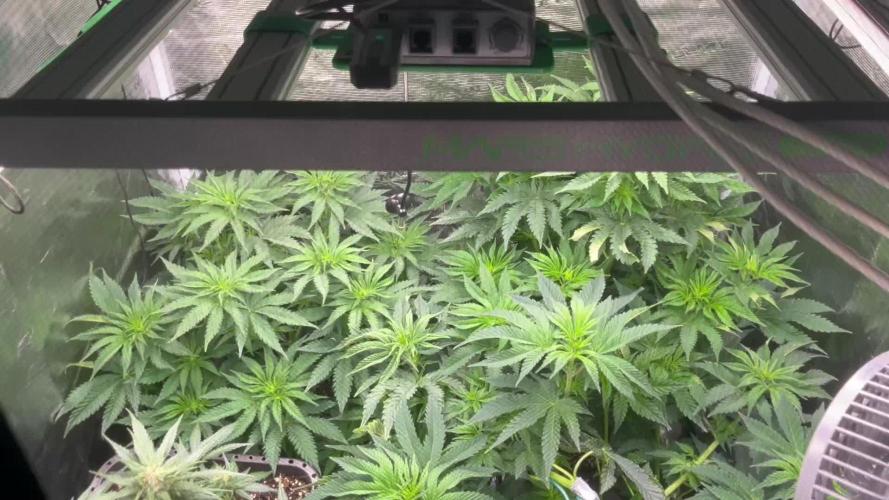
Was little bit nervous when i see them after the 5 Days. The Tent looks so empty because the Leafs hang down. I gave them 1,5 Liter of Water with Calmag. And next morning everything looks fine again 😊
The Stems where i cropped them are healed almost. Just two needs some Days more
It’s done with the vegetative Stage. They get to big if i wait longer. Gave them yesterday a Top Dressing with Mega Worm. And 15ml of Orgatrex in 6 Litre of Water. After one Litre the Pots are full. The other one i give them today
One thing i learned this Time is that you better don’t run IR Light on Vegi because the Nodes stretch to much. But the Photosynthesis Rate had a big Push..
Hope i can get the Ladies under Control

Likes
33
Share


@FreshCoastOrganics
Follow
These girls are getting bigger and bigger every day. I’d say week five is the beginning of pre-flower. I started with a very low dosage of nutrients to see how they will respond.
I’ve had to tie them down quite a bit but it has helped branch out new nodes and Bud sites that are comparable in size to the main cola. With the small environment I’m growing in I’ve also had to do a large amount of leaf tucking.
The EC and PH of the runoff was pretty spot on, I was around 800ppm, 1.6ec, and the ph was around 6.0. Overall I’d say that these plants are a hell of a lot happier than my other plants in the different medium. This is the Miller soils organic ammended soil, which is pretty decent but I prefer to control most of my grows so next time around I will be using either bio bizz light mix or light mix with 40%-50% coco and added perlite or pumice. I want to really see the full potential of these advanced nutrients products and see how they compare to other brands/amending with basic dry organics. I have so many seeds to play with so I will have a lot of diaries coming soon after these are harvested 😉

Likes
8
Share


@Leafy420
Follow
I was high and somehow meshed up the weeks i just continue counting even do the days dont add to the weeks
Day 25
They are looking wunderbar
I removed the humidifier cause they seem to hold there own
Soil is getting bit drier so tomorrow i will prepare the water and day 26 the get there second feed
Day 26
The soil was completely dry So gave them 700ml each 2ml/L
Day 27
they look nice and bushie so did some more LST, soil is dry again!?
Day 28
Soil bone dry So gave them 1L, 2ml/L of each nutrients
800ppm 6.05 ph
Had a lil bit off run off, just enough to do a test
Ppm bit high on 2 im the 1200-1300ppm
And on the other 2 around 1000
I think in 3 Day's i give the 2 just ph water and the other just a lil bit

Likes
9
Share


@Xabii
Follow
Values are average of the day.
DATE - °C - RH% (Tent Temp/RH)
20240704 21.2 59.1
20240705 22.9 56.2
20240706 23.6 54.4
20240707 22.4 46.0
20240708 23.3 49.1
20240709 25.1 52.2
20240710 26.4 59.0
DATE - PH
20240704 6.23
20240705 6.26
20240706 6.28
20240707 6.28
20240708 6.29
20240709 6.30
20240710 6.32
DATE - EC(us/cm)
20240704 939
20240705 957
20240706 986
20240707 974
20240708 988
20240709 1023
20240710 1067
DATE - °C (Reservoir)
20240704 19.4
20240705 20.0
20240706 21.1
20240707 20.2
20240708 20.6
20240709 22.0
20240710 23.9
Likes
20
Share


@The_Bearded_Grower
Follow
welcome to 📅 Day 36 flower 4/19/2021 she is growing just as I have come to expect she looks very healthy and full. she has many tops and they are developing fast. That's all for this week happy growing and keep your stick on the ice 🏒

Likes
25
Share


@BudHaks
Follow
Hey, there peeps!
Apologies for not updating my diary as I have been quite busy balancing non-plant responsibilities -.-!
Anyway, we are now on day 75 since I ordered my equipment and started germinating my seed and day 71 since I placed my seedling in her first Coco pot! She is now a staggering 4 foot 2 - which was overwhelming considering this is my first grow and orginally only cleared out 2/3 of my cuboard but now it uses the whole space but she's coming along so well! I have also added a LED Grow Light Full Spectrum 50W Red COB as I wanted some extra light for the bottom half nuggests.
She is very healthy (I assume from the strong healthy roots) and hasnt shown any major defects other then the initial defects i encountered in week 2-3 and slight light burn on the top cola in week 7 which was from the plant growing so quickly and touching the light, but I did then adjust the light within 2-3 hours.
What do you guys think and how did she get so tall consdiering she is an auto-flower and the strain is meant to be indica domiant?

Likes
290
Share


@Ferenc
Follow
Wao.... weather is shit but she grew a lot. Not flowering yet it was because of the rainy days. It is just wind and rain now. Very bad....
Well, she is okay 💪

Likes
17
Share


@laxx
Follow
WE ARE SO BACK PEOPLE!! 🎉🎉
Welcome welcome back to my weekly update, we got some good and some bad news this week.
Bad news first: I will postpone harvesting due to the trichomes remaining clear which I am pretty frustrated about.
BUT good news: we got some new light! I updated to a FC-1500 EVO from MarsHydro which got some insane efficiency compared to my last light. I can hang it 10 cm higher with a better light spread and a PPFD increase of 200 (now staying at around 900 PPFD throughout the tent) and all this while taking 10w less! Truly a technologie of all time! 😂
However I will harvest on Wednesday in the upcoming week, because it allows me to have my desired 10 days of dry-time while also maintaining my schedule with starting the Cup-grow February 1st.
I also included some Bud Porn this time around because I felt like messing with DavinciResolve again, nothing too fancy though :)
14.01.:
- watered all plants with 1L/plant
- increased max. temperature to 26 Celsius
- decreased the light to 20 cm height ➡️ all of this to boost the metabolism of the plants for them to produce cannabinoids faster and making my trichomes milkier
16.01.:
- changed the lamp to MarsHydro FC-1500 EVO
- height at around 30 cm while maintaining the temperature levels
17.01.:
- watered all plants with 1L/plant
- this is the last watering they will receive
Likes
Comments
Share

@deseed_uy
Follow
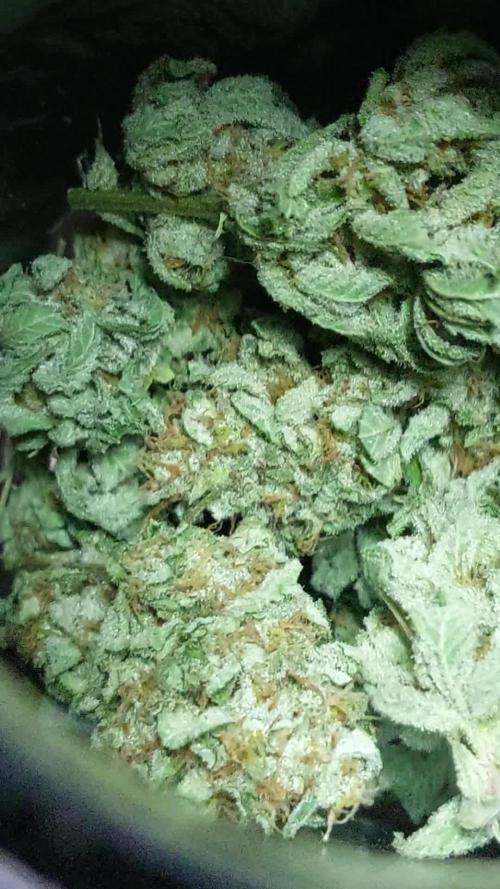
Llegó la cosecha, salió poco por factores climaticos pero muy buena calidad y exquisito a pesar del poco lavado. Muy contenta con el resultado iremos mejorando
Likes
7
Share


@Naujas
Follow
I'm happy :) I couldn't do it as it should have been, my ph meters broke and ruined everything :( well, but I'm very, very satisfied with the result :) a big thank you to my teacher :)@AsNoriu you are super :) without you it wouldn't have been possible :) I learned a lot of useful information from you :) the house is full of lemon aroma :)

Likes
16
Share


@eldruida_lamota
Follow
Que hay familia, recta final de estas xupet y haribo de Rkiem seeds, la verdad que los esquejes de mi colega e flipado, Los 8 ejemplares han salido muy bien, tienes unos tonos y aunque no sean muy grandes se ven flores muy prietas y repletas de tricomas, espero se puedan apreciar bien en las fotos y el vídeo.
Ya e practicado un lavado de raíces que era necesario para proceder a seguir regando sólo con agua unos días más.
Sin más dilación , me despido hasta el año que viene 🤣 buenos humos y feliz año 💨💨💨🎉🎊.

Likes
7
Share


@BonesJones123
Follow
Germ Week1 (Day 1 Feb24)
Stilton and Tropical Berry done directly into a riot cube sat in a bed of biobizz light mix in a solo cup
2 fruity widow seeds sat into a wet paper towel in a ziploc bag
Feb 27 - no real move from the widow's in the bag, so i moved one of them into a riot cube
Mar 1 - action from stilton, but the others not really doing much.
Mar 2 -widow 2 is dead. went to the shop and got myself a barney's farm critical kush, into a paper towel
What's the plan here?
Hoping for 4 different strains to give me 4 different reactions to the same conditions and maybe I'll find something that likes the space i've set up
I've never done direct to substrate before, but seems to work fine. Doing the kush in a bowl just because it feels more comfortable to me, but likely not a big deal
What are we doing different this time?
Try to watch and maintain temp and humidity as well as possible.
In seedling I'll look to mist the riot cube once per day, in the morning, with a tiny bit of water
As soon as the first set of leaves touches the edge of the cup i'll transfer to final pot and hopefully have some micro-r to help the transition
Looking to maintain as little LED headroom as possible, to try and get the nodes really close
Aiming to top at node 3 once I see node 6 just start to pop out
Feed once per week and water once per week.


Likes
228
Share


@StarLorr
Follow
Welcome to my Pablø Ęscøbar diary.
In this diary:
Seeds: sponsored by Ðivine Șeeds
Media: Promix HP
Nutrients: Advanced Nutrients, Diablo Nutrients.
Light and Weather: Şun☀️and Mother Earth.🌎
___________________________
Feeding:
Tue 09Jul: 6L nutrients pH'd 6.5
Sat 13Jul: 10L water not pH'd
Sun 14Jul: 8L water not pH'd
Mon 15Jul: 10L water not pH'd
*please note that most water only feedings are 2L at the time throughout the day in bottom saucer*
___________________________
Another beautiful week, besides Wednesday's flood😅 it poured so much rain that my Tuesday morning feeding got flushed out and was in the bottom saucer Thursday morning😳😂that was a first for me.
All is good with my Ðivine Ladies, just me anxious to see them buds coming out.
______________________________
Thanks for stopping by, likes and comments are appreciated!👊🏻😎
Keep on growin!
Keep on tokin!!!
😙💨💨💨💨💨


Likes
24
Share


@Easygrower
Follow
Hello growers day 65 in the garden starting to get some purple in her now she is starting to swell up so happy days she’s looking pretty good considering I’ve only give her water from my tap from the start happy growing be safe until next week peace ✌️
Likes
7
Share


@Waisgrower
Follow
Llegando a la 3ra semana de floración de nuestras plantas🌺. Buena producción de Regina, rico aroma frutal🍇🍉🍊. Se realizo un pequeña desfoliacion, quietando las hojas mas grandes para asi tener una meyor penetracion de luz.💡
La fase vegetativa se fertiliza con Top veg y ahora con top Bloom, próximo riego le toca a top candy 💥.
Royal gorilla🦍 @royalqueenseedsrqs 🦁
Likes
32
Share


@EBPbyEVD
Follow
I only use a stimulant and cal mag. There will be no training for the entire period; this is not necessary in this grove. Growth is going quite well, they are even outpacing my babies who were planted earlier. The plant in the middle is a little behind. The lamp operates at 25%. Further more, success is inevitable.

Likes
30
Share


@Mosquito_Haarlem
Follow
Oogsttijd 🌲
Werkelijk waar boven verwachting, dikke vette keiharde wiettoppen.
Zamnesia strains blijven me verbazen.
Dit is zijn harde toppen zoals een indica, maar met de lange lengte van een sativa, heerlijk.
Ze vertoont paars, roze en oranje tinten en ruikt zoet.
Ik heb de plant in zijn geheel opgehangen en zal de resultaten delen wanneer de wiettoppen droog zijn.
Wordt vervolgd

Likes
8
Share


@HmGrwnFlowers
Follow
Girlscout Cookies x UK Cheese by HomegrownCannabis Co.
Produced lots of chunky flowers. Nice calming smoke. Would definitely grow it again.

Likes
13
Share

@Patres
Follow
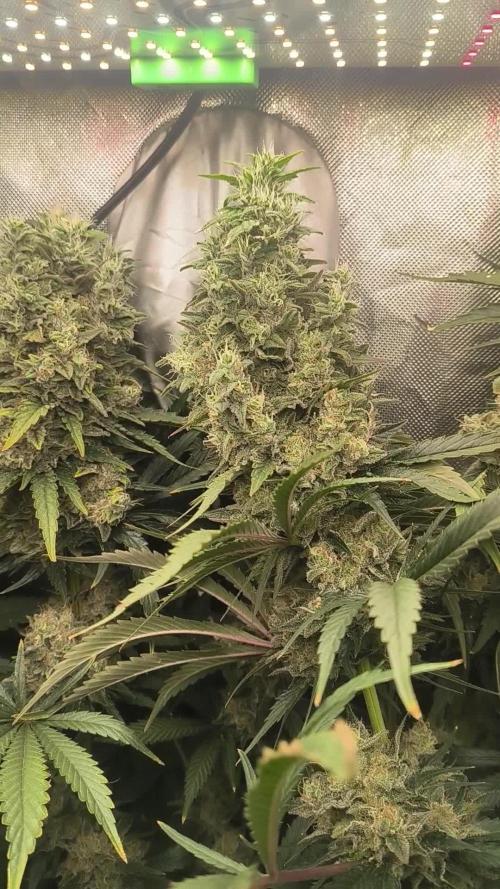
K.onec 9 týdne a na listech se objevují různé deficity živin v dosledku snižování ec kdy sem se během tohoto týdne dostal na ec 1 následující týden už budu zalévat pouze čistou vodou ec0.3 rostlina během posledního týdne dozrává do krásné podoby nicméně trichomy jsou tak 50/50 průsvitné/mléčné takže to vidím na ještě týden do sklizně. Stonky rostliny se pod masivní vahou pupenů ohýbají a bortí do všech stran a samotné pupeny jsou obrovské musím říct že takto veliké pupeny jsem ještě nikdy nevypěstoval. A děkuji plagron a zamnesia za tuto zkusenost
Likes
13
Share


@SwabianMadness
Follow
The Canopy was so full and i decide today to make another Defoliation for better Light Penetration. I have just 11-16 Days left for the original Harvest Date. Just hope that i don’t get some Bananas now somewhere in the Buds 😌😃 better to make it right the last two times. But i don’t want to take to much
In Future Runs i know now how to do it
Only give Water with PH 6.8 until harvest. No Nutrients anymore
Maybe wait one or two Weeks longer to get bigger Buds and more Couchlock Effect from it
